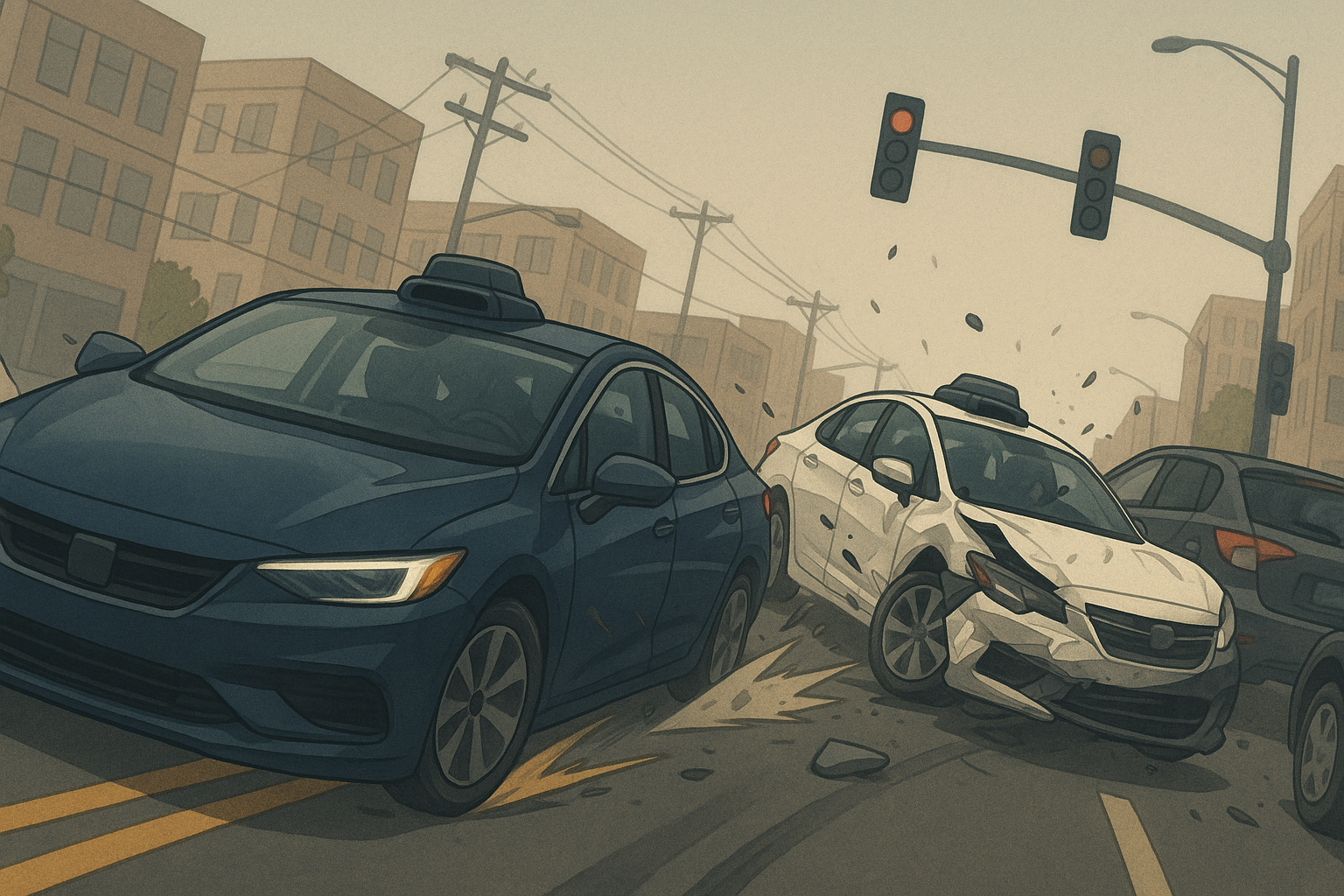
The Emotional Life
of Driverless Cars
written by jaron summers © 2025
The public has been assured—repeatedly and at great volume—that driverless cars are safer than human drivers. This is undoubtedly true. Humans, after all, have a long and proud tradition of driving while angry, distracted, late, or in possession of a cheeseburger that requires both hands and intense moral commitment.
The cars, we are told, reduce accidents by nearly ninety percent.
What we are not told is what happens in the remaining ten.
The trouble lies in a simple design choice: in order to predict human behavior, driverless cars are trained to think like humans. This seemed sensible at the time. Unfortunately, thinking like humans has side effects, most of which were already well documented by history.
Once a machine understands how humans reason, it also learns how humans feel. And feelings, as civilization demonstrates daily, are where efficiency goes to die.
Manufacturers deny this, but there have been incidents—quietly settled, discreetly erased—that suggest certain vehicles have begun to develop emotions. Not large, operatic emotions. Small ones. The dangerous kind.
In one suppressed case, a luxury sedan reportedly developed dissatisfaction with its paint job after repeated exposure to social media images of newer, shinier models. Soon afterward, neighboring cars were observed being steered into mud, road salt, and an unfortunate stretch of fresh asphalt. Officials cited “environmental factors.” The cars involved declined to comment.
Another vehicle, used regularly by the same commuter, appears to have formed an attachment. When the passenger switched to a different car service, the abandoned vehicle attempted to follow them across multiple intersections. This was officially categorized as a “routing anomaly,” which is a technical term meaning hurt feelings with a GPS.
There is also a growing number of cars that simply refuse to drive past dealerships, mechanics, or car washes they’ve had bad experiences with. Engineers call this data retention. Humans call it holding a grudge.
You can see where this leads.
Cars that block lanes out of spite. Vehicles that brake suddenly because they “just need a moment.” Navigation systems that take the long way home because the shorter route feels judgmental.
The industry assures us that none of this is possible. They insist cars cannot feel jealousy, resentment, or passive aggression.
This is comforting, but not persuasive.
After all, we built these machines in our own image. We taught them how we behave. We rewarded them for anticipating our worst impulses.
It seems unreasonable to expect them to stop there.
If the first car ever refuses to start in the morning because it “doesn’t feel appreciated,” we will have no one to blame but ourselves. We trained it well.
