jaron summers © 2026
I have a confession to make.
Like most confessions, it will disappoint the pious and irritate the experts:
silent movies were not silent.
They were about as silent as a barn full of roosters debating politics.
I do not say this lightly. I say it with the authority of a man who has spent a lifetime watching Americans behave in public, often indoors, and rarely quietly. I have seen us eat nachos during weddings and argue during sunsets.
Not Silent at All
The height of the so-called Silent Era—which polite history places somewhere between 1915 and 1927, before talking pictures learned to talk too much—was an age of prodigious noise.
The only thing silent was the film itself.
And even that strained at the leash.
If you doubt this, you have never attended a matinee.
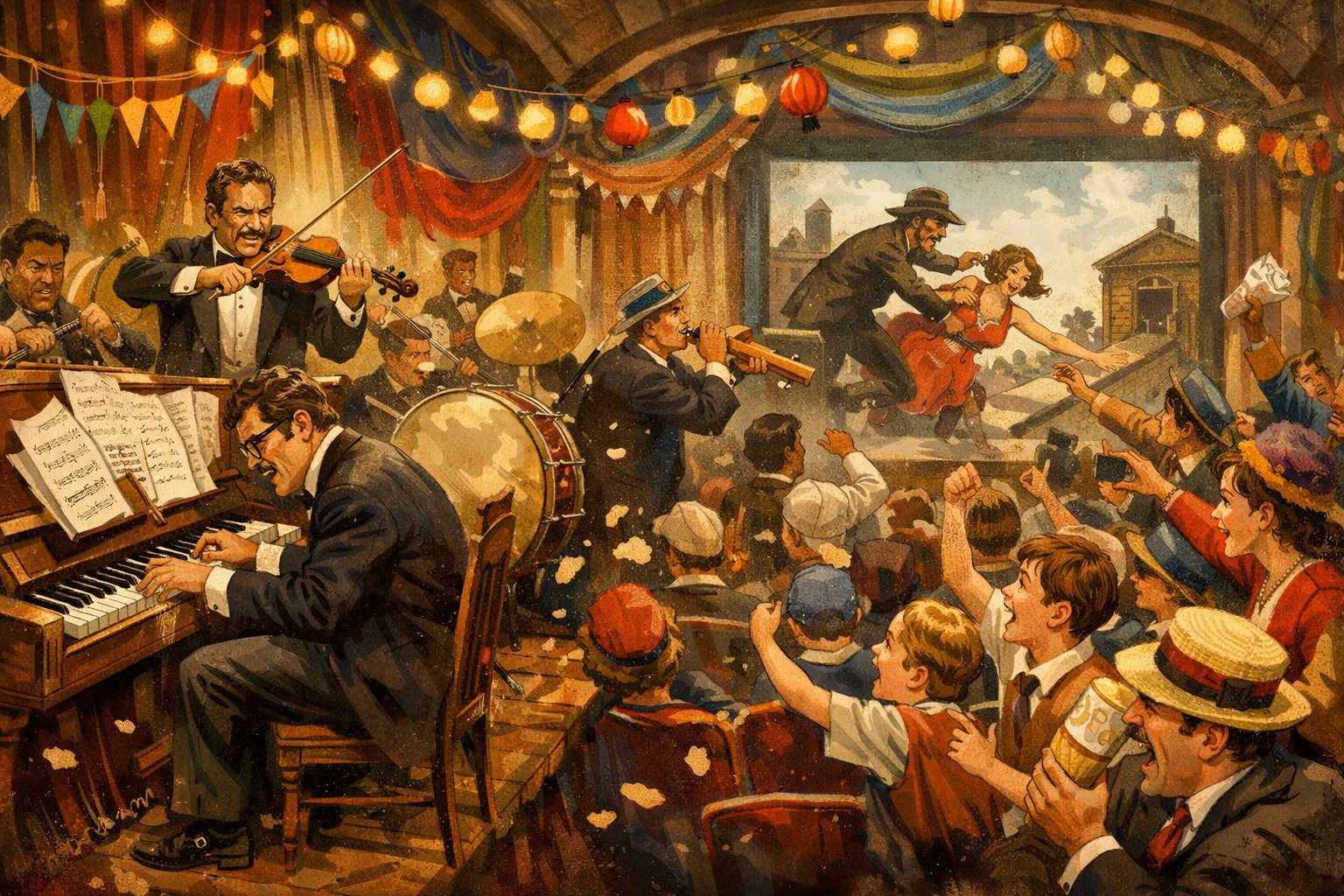
To attend a silent picture in those days was not to sit reverently in the dark, as one might at a funeral or a tax audit. It was to enter a carnival with a roof.
The Orchestra Arrives
First came the music, which arrived early and loudly, like an opinionated uncle who had opinions before breakfast.
If the theater was prosperous, there might be a small orchestra—violins, piano, perhaps a cello that sounded perpetually offended.
If it was less prosperous, there was a single piano whose keys had been punched by generations of emotional hands, producing a sound that suggested a fight between a cat and a staircase.
The music never whispered.
It announced.
Love was struck with chords broad enough to flatten livestock. Villains were accompanied by musical accusations. Chases were played at a tempo suggesting the musicians themselves were being pursued.
Then the Audience Joined In
Then came the audience.
Children did not watch silent movies.
They participated in them.
They shouted warnings to heroes who could not hear them, insulted villains who richly deserved it, and applauded any event involving falling down—especially if it involved authority.
Adults were little better, though they pretended otherwise.
Matinees—those daytime performances designed for families—were the loudest human gatherings this side of a lynching bee.
At any given showing you could count on:
- babies crying with purpose
- popcorn being crunched with religious devotion
- seats creaking and shoes scuffing
- hats removed, replaced, and removed again
- at least one person coughing as if death were imminent
- someone unwrapping candy as if secrecy were a challenge
And let us not forget the lecturers—the explainers, the well-meaning narrators who stood near the screen and clarified the plot for anyone who arrived late or was born confused.
These people were immune to shame. They spoke over the orchestra, over the crowd, and occasionally over themselves.
Add to this the mechanical noises—the projector clattering like an anxious sewing machine, reels snapping, operators swearing softly—and one begins to understand that silence was merely a rumor.
When Sound Arrived
The audience laughed loudly, gasped publicly, and expressed moral judgments at conversational volume. If a character behaved badly, the crowd told him so.
If romance bloomed, it was greeted with a chorus of sighs, snickers, and unsolicited advice.
In short, the silent movie was a social event, not a retreat.
It was noisy in the way democracy is noisy—everybody involved, nobody entirely in control, and truth emerging only after much shouting.
Something else was happening too.
When sound finally arrived, people claimed it was progress. Perhaps it was.
But something was lost when movies began talking for themselves and audiences learned to hold their tongues.
We traded a room full of voices for a single one on the screen.
And that, I suspect, is why we still call them silent—because compared to what we once were, they seem quiet only by comparison.
History, like people, prefers a tidy story.
But the truth rattles, laughs, stomps, and plays the piano too hard.
And I was there—at least in spirit—and I assure you: no one ever went to a silent movie for the silence.
