The Flotation Device
W…ritten by
jaron summers © 2026
It starts, as these things often do, with a word that should have stayed in a barn.
“Do you know what a fluffer is?”
If you’re older than twelve, your brain probably supplies the wrong answer first. That’s understandable. English is a language that loves ambush. But in its original, innocent, agricultural setting, a fluffer is simply someone involved in horse breeding—a handler whose job is to keep a valuable stallion calm, focused, and properly positioned during live cover. It is a matter of safety, efficiency, and money. There are clipboards. There are protocols. No one giggles for long.
In other words, a fluffer is a perfectly respectable job—as long as you’re a horse.
The trouble begins when the word escapes its fencing.
Somewhere between adult-film folklore, locker-room humor, and the sentence “I heard once…,” the term wandered into human territory, where it does not belong. There is no legitimate, regulated, real-world profession involving human fluffers for private couples. No licensing board. No Yelp reviews. Any job that exists only in anecdotes is not a job. It’s a warning.
And yet, the idea lingers. Not because people are perverse, but because people are tired—and because modern life has trained us to believe that everything can be outsourced if we just find the right service tier.
We outsource food, memory, navigation, conversation, taste, even grief. Why not intimacy? Why not efficiency-optimize marriage the way we optimize cloud storage? This is not villainy. It’s the quiet arrogance of productivity culture colliding with human limits.
Which is where the yacht comes in.
The fantasy usually unfolds offshore, just beyond the horizon, where cell reception weakens and logic follows. A luxury yacht. Champagne. Teak decks. Flags of convenience fluttering meaningfully. Someone says the words “international waters,” and suddenly a large number of adults become convinced they’ve discovered a legal invisibility cloak.
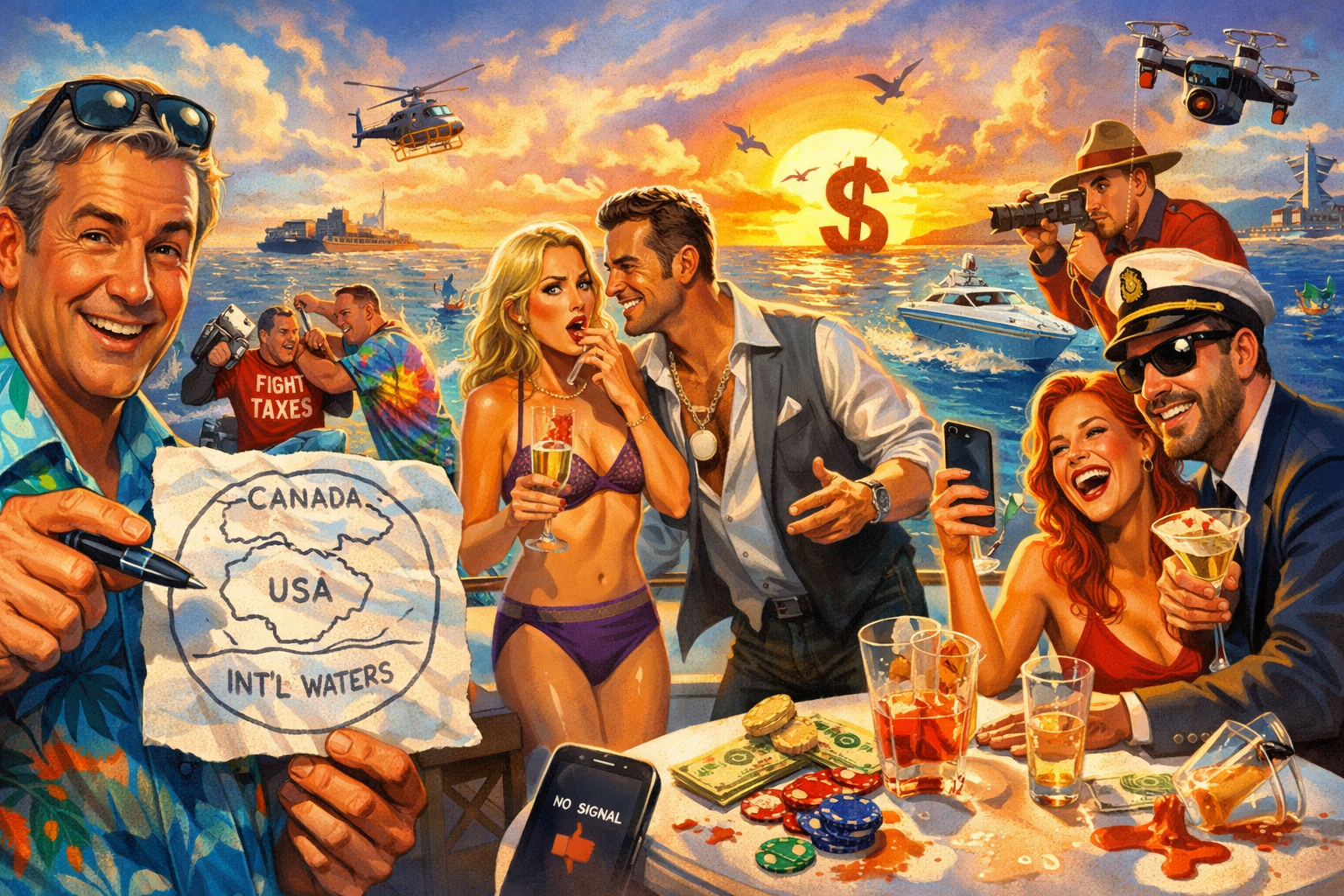
This belief is almost always explained with a cocktail napkin.
The napkin diagram is a classic of the genre. A confident man—let’s call him Greg—draws a lumpy shape and announces, “This is America.” Someone says it looks like a potato. Greg says it’s stylized. He then adds a larger blob on top. “This is Canada.” Someone asks why Canada is on top of America. Greg says, “Historically.” A line is drawn through both shapes. “That’s the border. Very arbitrary.”
The napkin grows ambitious. A circle is drawn around both countries. “Once we’re out here,” Greg explains, tapping the ocean part, “we’re in international waters.” Someone asks about U.S. law. Greg waves it away. Someone asks about Canadian law. Greg smiles. “Canada’s very polite.”
This is where politics often enters, uninvited and badly dressed. Someone objects that laws don’t stop working just because you cross a line. Greg counters that regulations loosen. Someone says regulations are laws. Greg says that’s a mindset problem. A drink spills. Voices rise. The napkin slides off the table. Someone steps on it.
Borders, it turns out, do not appreciate being drawn by people who have had two martinis and read half an article.
The yacht fantasy persists because it promises consequences without responsibility. It suggests that embarrassment, jealousy, regret, and litigation are all jurisdiction-dependent, like roaming charges. But what would actually go wrong in such a scenario has very little to do with sex and everything to do with being human.
Emotionally, things unravel quickly. Jealousy has a way of ignoring mission statements. Humiliation does not respond to wellness jargon. The phrase “this was your idea” arrives early and stays late. People discover that what they thought was openness was actually denial with better lighting.
Legally, international waters are far less international than advertised. Jurisdiction does not evaporate at sea; it layers. Consent becomes complicated. Liability travels well. Lawyers, especially, are excellent sailors.
Socially, nothing sinks faster than discretion. Phones exist. Screenshots are immortal. Group chats remember everything and forgive nothing. The ocean may be vast, but the internet is patient.
None of this makes for titillation. It makes for comedy.
That’s why the idea works best not as provocation but as farce. Nothing explicit needs to be shown. In fact, nothing explicit should be. The humor lives in implication, reaction shots, and bureaucratic panic. In schedules that go wrong. In euphemisms that collapse under their own weight. In the realization that you cannot anchor a marriage in technicalities.
This is not a story about what happens on the yacht. It’s about what people think will happen—and what that belief says about them.
At heart, it’s a story about borders. Legal borders. Emotional borders. The invisible lines people draw to convince themselves they’re exempt from ordinary rules. The napkin is the perfect symbol: confident ink, porous paper, no staying power. Drop it in water and it dissolves instantly.
Water doesn’t erase borders. It reveals which ones were imaginary.
In the end, the yacht drifts back. The bar tab arrives. Someone quietly pays it. Some couples separate. Some stay together, chastened. One or two even improve—not because of optimization, but because they finally stop trying to dodge adulthood.
The napkin floats away, unreadable, its grand theories reduced to pulp.
And if you ever hear someone explain international waters using a cocktail napkin, order one more drink. You’re about to witness a very expensive misunderstanding.
