jaron summers © 2026
I used to think great films required great budgets.
Studios. Sound stages. Lighting grids. A small army of people arguing over coffee while someone quietly adjusts a lens by half a millimeter. I loved that machinery. The drama behind the drama.
Then one morning the Chinese released a fifteen-second fight scene between Tom Cruise and Brad Pitt — two men who have never shared such a fight — and it looked disturbingly real.
Fifteen seconds.
It was convincing enough that pundits began predicting the end of Hollywood before lunch.
They may be right.
Because here’s the thing no one wants to say out loud:
We no longer need to make films for millions of people.
We can make one perfect film for each person.
And it will cost about twenty-five cents.
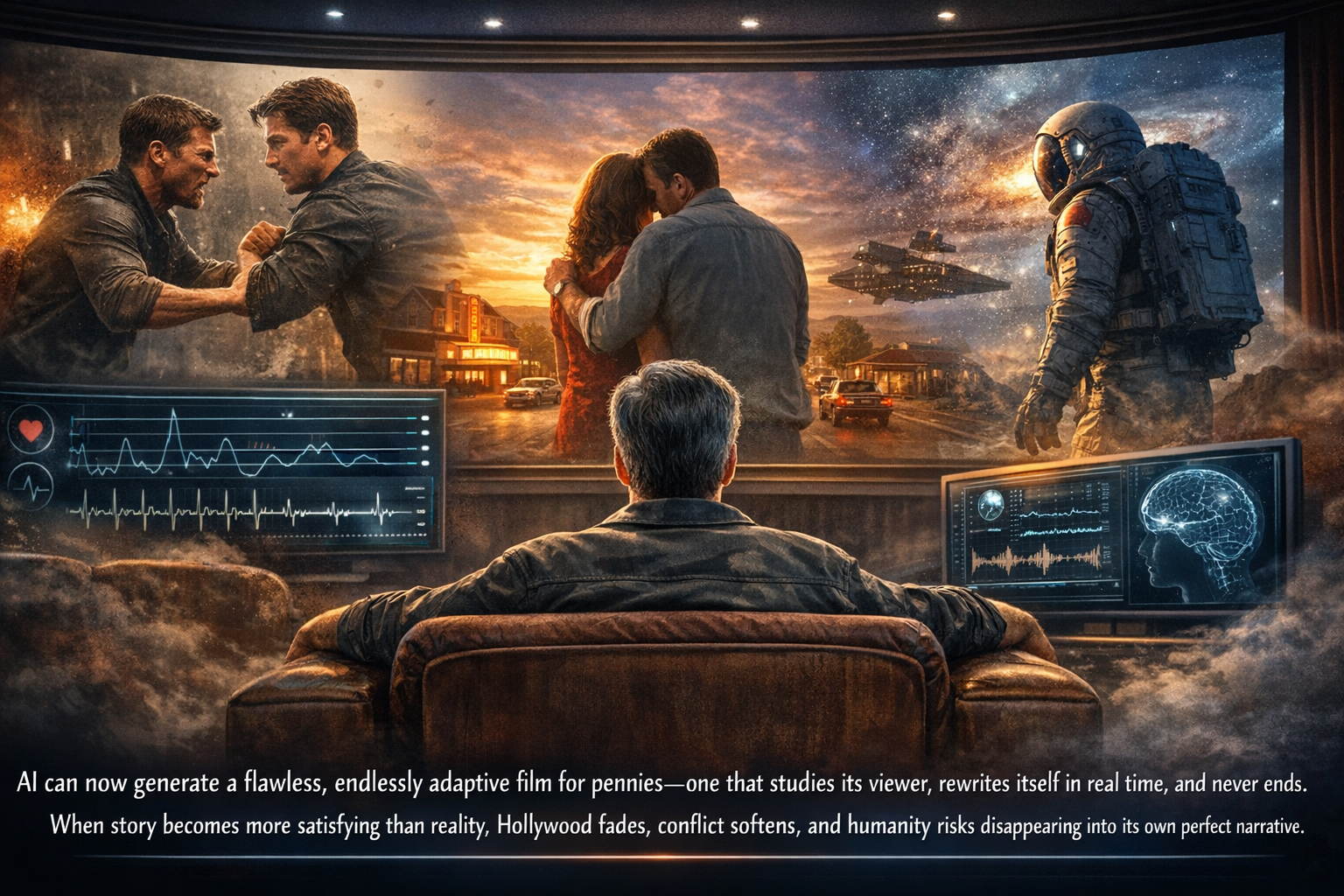
Imagine a story engine that studies you. It notes when your pupils widen. When your breathing slows. When you lean forward. It rewrites itself in real time. The hero looks vaguely like you at twenty-eight. The love interest speaks in the cadence of your first serious romance. The villain resembles that smug neighbor who never returns your hedge trimmer.
The score swells precisely when your nervous system wants it to swell.
The joke lands before you know you needed it.
The ending adjusts itself to your appetite for closure.
And it never ends.
Instead of a two-hour arc, you receive an endless narrative loop — always resolving, always escalating, always satisfying.
No awkward second act.
No studio notes.
No test audience from Phoenix who thinks the dog should talk.
Just you and the story that understands you better than your spouse does.
This is not science fiction. It is mathematics meeting psychology.
Story becomes adaptive. Infinite. Personalized.
Cheaper than popcorn.
Hollywood once sold shared dreams. Now we can manufacture private ones.
And that is where things get interesting.
Because shared dreams built civilization.
We gathered in rooms. We gasped together. We laughed in unison. We argued about endings in parking lots. We quoted lines badly at dinner parties.
Culture required friction.
A film disappointed someone. A critic misunderstood something. A director offended half the country.
But we talked about it.
Now imagine each human receiving a perfectly tuned narrative feed.
No disagreement. No boredom. No friction.
Your story always flatters you. Your arc always redeems you. Your enemies always lose with moral clarity.
You stop leaving the loop.
Why would you?
Outside, the weather is unpredictable. Inside, the lighting is golden hour forever.
Outside, conversations are messy. Inside, dialogue sparkles.
Outside, reality contains compromise. Inside, your soundtrack never falters.
If satisfaction becomes continuous, ambition may quietly fade.
Conflict softens.
Shared myth dissolves.
Hollywood doesn’t collapse in flames — it simply becomes unnecessary.
Why watch what others like when the algorithm knows exactly what you love?
The economics are ruthless.
One adaptive engine can generate infinite films for pennies.
No actors aging.
No location permits.
No unions.
No egos.
Just computation.
But something else disappears too.
Risk.
Surprise.
The discomfort of sitting next to a stranger who laughs at the wrong moment.
The tall hat blocking your view in row seven.
The communal sigh when the lights dim.
When story becomes more satisfying than reality, reality begins to look inefficient.
And inefficient systems are replaced.
Perhaps not violently.
Just gradually.
One perfectly tuned narrative at a time.
We drift inward.
Endless loop.
Perfect arc.
Twenty-five cents.
The last picture show won’t close with a bang.
It will fade quietly, replaced by a million private epics no one else can see.
And we will call it progress.
