How to Hack Time
(Using Science, Energy Drinks,
and a Chatbot Named Steve)
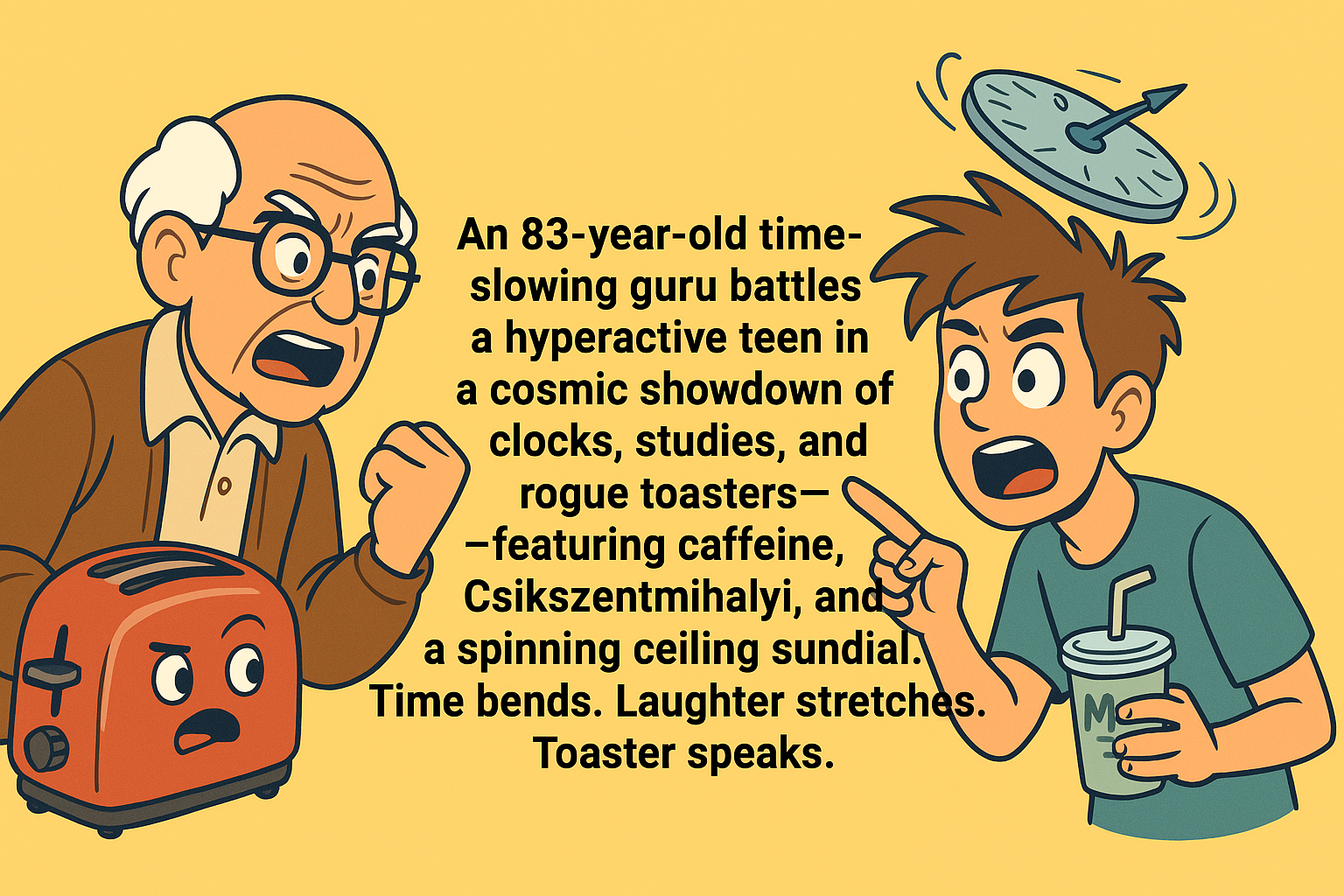
“You want time itself to slow?” asked Tucker, seventeen, slurping a quadruple energy drink through a bamboo straw.
“I’m creating temporal drag.”
“That sounds like something you’d get arrested for,” he said.
“No, no. Temporal drag means making time feel slower on purpose. Scientists Zakay and Block figured out that if you pay attention to time, it stretches out like cheap taffy.”
Tucker blinked.
“You’re telling me staring at the clock makes life longer?”
“Not longer,” I said. “Just longer feeling. Which is almost as good and far cheaper than immortality. Ever heard of Mihaly Csikszentmihalyi?”
“Is he the guy who invented the croissant?”
“No. He discovered Flow. It’s what happens when you get so absorbed in something that time vanishes.”
“Oh,” Tucker said. “Like when I’m playing video games.”
“Exactly. Five hours go by and you think it’s been twelve minutes.”
“That’s not flow,” Tucker said. “That’s my mother yelling that dinner is cold.”
The Two Speeds of Time
Here is the strange thing about time.
It has two gears:
Gear One: Boredom
You’re sitting in math class. The clock says 3:10.
Five minutes later you look again.
The clock says 3:11.
This is known as glacial time.
Gear Two: Fun
You start a video game at 7:00.
You blink once.
It is now 1:30 in the morning and your parents are Googling military school.
“So which one is real time?” Tucker asked.
“Both,” I said. “The clock measures time. But your brain experiences time. And your brain is a notorious liar.”
“Great,” he said. “My brain is gaslighting me.”
“Correct,” I said. “But once you understand the trick, you can hack the system.”
How to Slow Time Down
Step one is very simple.
Pay attention.
When you notice every little thing—the sound of your shoes, the way sunlight hits a wall, the taste of coffee—your brain starts recording more detail.
More detail means more memories.
More memories make time feel longer.
“So basically,” Tucker said, “you’re saying I should become… aware?”
“Yes.”
“That sounds suspiciously like mindfulness.”
“Don’t panic,” I said. “We’re not joining a yoga cult. We’re just stealing a trick from neuroscience.”
The Sock Experiment
“Now watch this,” I said.
I pulled the sock from the microwave.
“Why were you microwaving a sock?” Tucker asked.
“To warm my feet.”
“You could just wear shoes.”
“And deny science its moment?” I said.
The sock was hot.
Time had passed.
But the real experiment was this:
Tucker had been paying attention the entire time.
To the conversation.
To the sock.
To the ridiculousness of the situation.
And suddenly twenty minutes had felt like an hour.
“You see?” I said.
“What?”
“You just lived more time.”
Tucker considered this.
“So if I pay attention to life…”
“Yes?”
“…life feels longer?”
“Exactly.”
He nodded slowly.
Then he picked up his energy drink.
“Well,” he said, “this is the first time science has ever made me feel like I might live long enough to finish high school.”
Final Thought
Time isn’t a straight line.
It’s more like a prune.
Wrinkled. Flexible. Slightly mysterious.
And if you learn how your brain experiences it…
you can stretch a single afternoon
into something that feels like a week.
Which is the closest thing humanity has ever come
to time travel without a flux capacitor.
