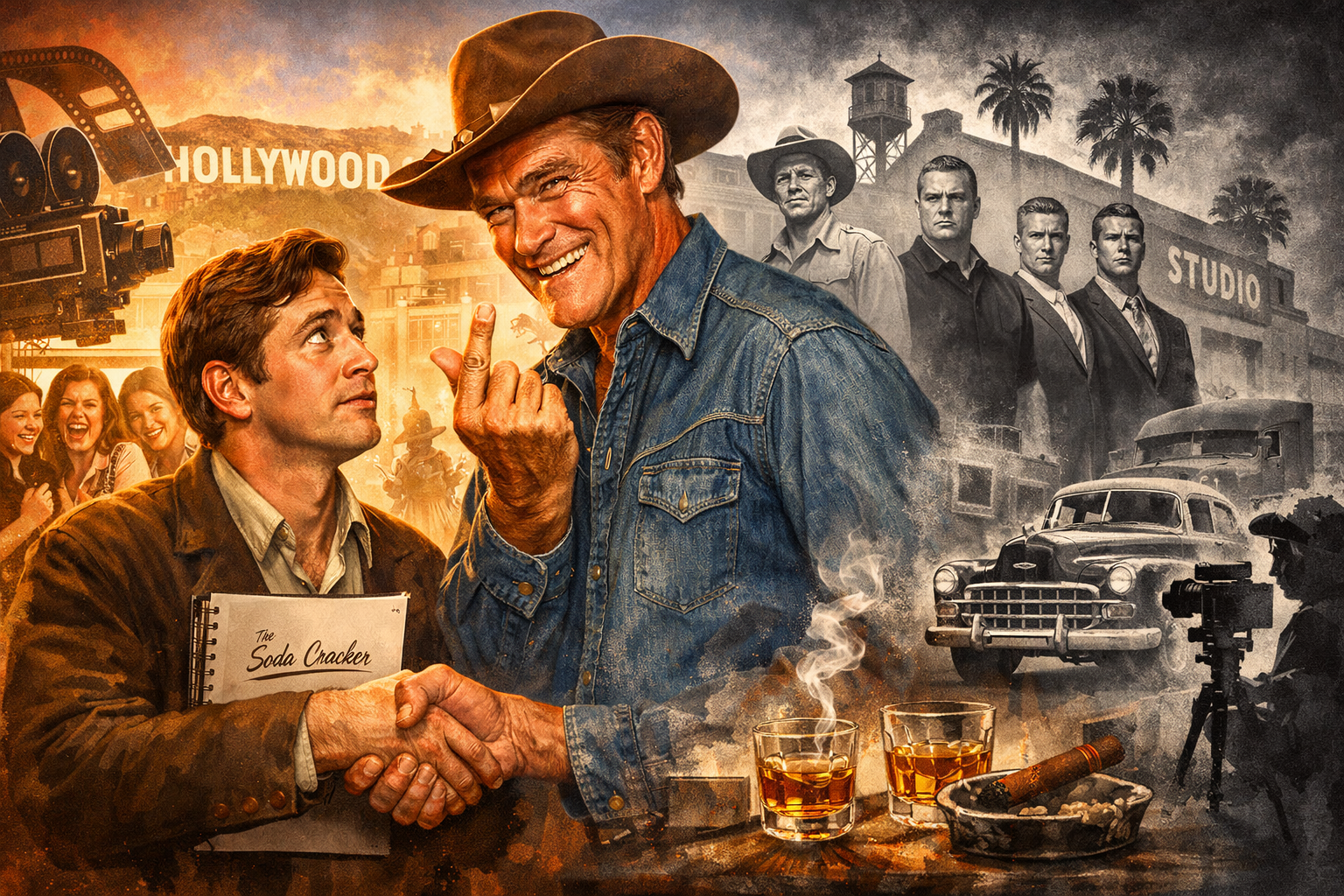

You remember The Rifleman on TV.
If you were a kid in North America at the right time, you didn’t just watch it—you longed to have Chuck Connors adopt you, teach you to shoot straight, and perhaps escort you through adolescence with moral authority and a Winchester he could spin like a Dallas cheerleader.
All the kids knew about Chuck’s rifle: a modified Winchester Model 1892 carbine with a loop lever. The series used a set screw in the trigger guard so Connors could fire rapidly when he worked the lever, which is what made that opening sequence unforgettable.
Connors was big, brave, decent, and infallible. Or so I believed.
Then, when I was in my late twenties, I wrote a script called The Soda Cracker, and somehow this giant of my childhood read it and asked my agent to set up a meeting in the Valley on a Saturday.
I was so excited I could barely sleep. Before sun up I changed clothes several times, which is not something a man likes to admit, but hero worship does weird things to the wardrobe.
I must have looked in the mirror five times and thought: Don’t blow this. This is Chuck Connors. The man didn’t just save the day. He practically invented it.
I got to the meeting half an hour early, even with heavy traffic, and sat hiding in my car like a nervous jewel thief waiting for the bank to open.
Then he arrived.
He didn’t so much park as glide into the lot and head into a ritzy little café as if the laws of gravity and parking were merely advisory. I waited a decent interval, then followed him in and discovered that all my prepared lines had fled the scene.
A couple of waitresses were teasing him when I walked over and introduced myself.
“Hi, I’m Jaron.”
He turned, smiled, and said, “Great to meet you. You’ve got a hell of a script here. Where’d you learn to write like that?” Then with a wink, he said to one of the waitresses, “This guy is what Hollywood needs.”
I had no idea what to say. I had very few heroes, and none of them had ever looked at me as if I might be the real thing.
And I could feel something else happening too. When one of the waitresses—I had just met—looked at me, there was the faint suggestion she might be thinking of getting to know me, simply because a giant had validated me. If Chuck had asked me for a free rewrite I would have nodded agreement, afraid to even look him in the eyes.
Then he shook my hand.
It wasn’t a handshake so much as a weather event. His fist swallowed my arm nearly to the elbow. He seemed about nine feet tall, with the kind of presence that made nearby furniture consider its options.
He asked how my drive had been. The warmth in his voice only deepened my conviction that he was one of the greatest actors in the world and an even greater man. He had played Luke McCain, after all. I more or less assumed he had higher morals than the Pope and would probably help old women across freeways.
He stood there smiling at me, so I asked how his drive had been.
“Great,” he said.
“How far did you have to come?”
“About twenty miles. I was in Westlake.”
“Oh,” I said, innocent as fresh snow. “What were you doing there?”
Without hesitation, he made a small but unmistakable gesture: one finger poking through the circle formed by his other hand, in and out, in and out — deliciously slow — while he grinned like a seven-year-old who had just liberated a cherry pie and blamed it on the dog.
And just like that, the great upright hero of my childhood stepped off his marble pedestal, lit a cigar, and turned out to be gloriously, magnificently human.
I was stunned.
Not offended. Just stunned.
The Rifleman, whom I had mentally appointed Assistant God of the West, had apparently spent the night in Westlake engaged in activities not specifically endorsed by my Sunday School teachers.
But the shock passed quickly, for Chuck was impossible not to like.
He had the relaxed mischief of a man who knew exactly how large he was, how famous he was, and how funny life became once you stopped pretending to be a monument.
Later he told me something that made me admire him even more.
He said that when he had a difficult meeting at a studio—especially with some executive trying to push him around—he would bring along several of his sons. Or perhaps four large young men he had sprung from a nearby prison farm. In any case, they were all enormous. They’d sit there quietly, saying nothing, just looking at the executive while Chuck made his points.
According to Chuck, the executive usually agreed to everything he wanted.
That is not negotiating. That is frontier diplomacy.
I loved the image: some poor studio functionary (who would never return my calls) now in a knit tie and expensive fear, looking up to find Chuck Connors and his giant offspring—or parolees—arranged before him like a delegation from the Viking branch of the Screen Actors Guild.
By then I understood that Chuck’s greatness had little to do with sainthood.
He wasn’t Luke McCain. He was better than that.
He was charming, outrageous, funny, worldly, and completely at ease inside his own legend. He didn’t protect my illusions. He flattened them with a smile and then invited me to lunch.
It was one of the happiest disappointments of my life.
