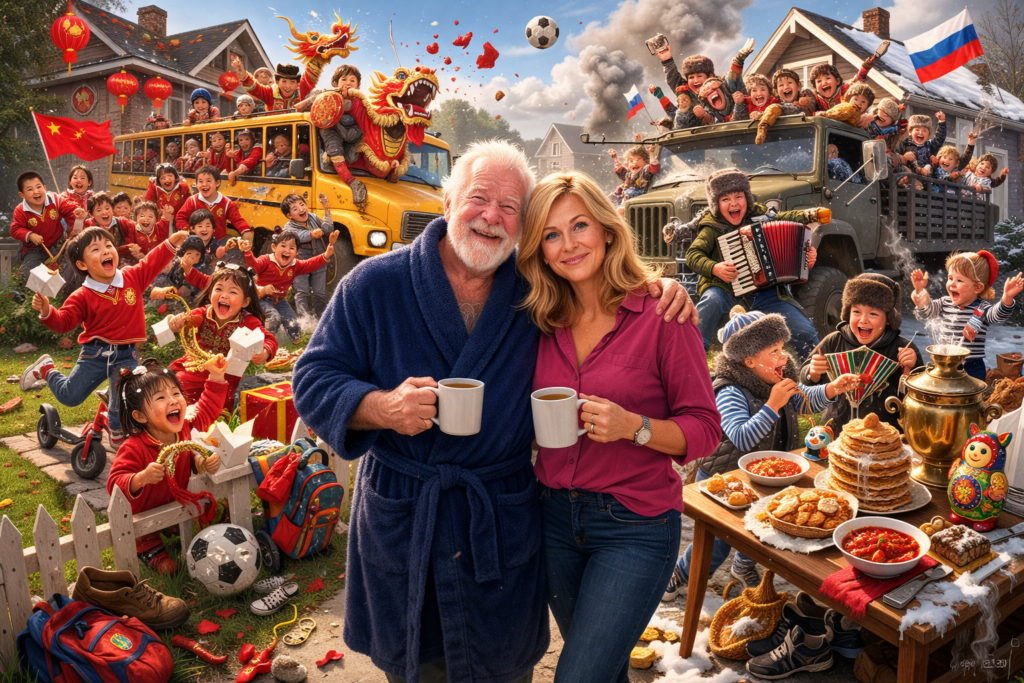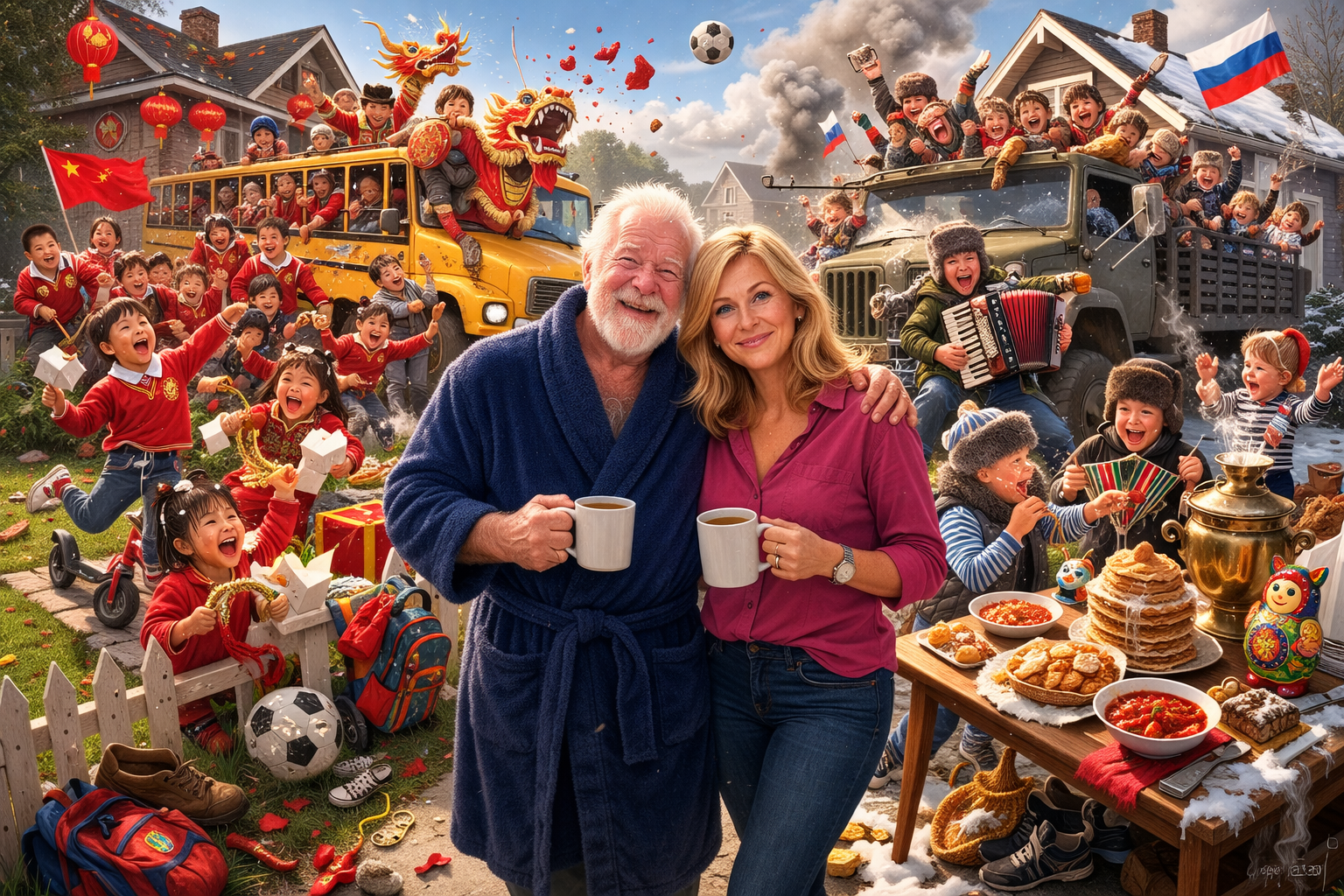

Kate and I once lived between two families who each had 243 children.
One family was Chinese. The other was Russian. We were the neutral zone.
Now, before anybody gets the wrong idea, Kate and I love children.
We married late, found each other at just the right time, and decided there were already plenty of kids on the planet—along with a few too many adults doing unimpressive things with it.
So we had no children of our own. We did not dislike children. We simply felt the species had a comfortable lead.
Then we moved between these two families and realized the species was not merely surviving. It was staging a comeback.
At first the number of children seemed impossible. Then exaggerated. Then, after a week or two, oddly conservative.
Every morning our street filled with so many children that dawn itself seemed to arrive in installments. They came out of both houses in waves, streams, and tactical units.
Some were toddlers, some were lanky adolescents, and some were at that age where they looked old enough to drive but still had jelly on their sleeve.
There were scooters, backpacks, lunch boxes, violins, soccer balls, one accordion, and enough stray footwear to open a branch outlet of civilization.
Kate and I, who could leave the house in under three minutes, began to feel less like a married couple than a clerical error.
The Chinese family on our left moved with quiet efficiency.
The Russian family on our right radiated stoic endurance. The fathers on both sides had the calm look of men who had crossed over into a realm beyond fatigue, surprise, and arithmetic.
“Big family,” I said once to the Chinese father.
He inclined his head as if I had complimented a hydroelectric project.
The Russian father stood in his yard with his hands behind his back while children streaked past him in every direction, looking like a man who had seen winter, war, and plumbing fail, and found all three survivable.
The mothers were the true geniuses.
They moved through those human tides with the serene competence of air-traffic controllers.
They could identify a cry at two hundred yards, detect guilt without evidence, and know which child had misplaced a mitten, swallowed a marble, or hidden a spoon in the bathroom before the spoon itself knew it was missing.
Kate and I, meanwhile, could be thrown off balance by one long grocery list and a plumbing invoice.
Not long ago I read about certain billionaires and mega-wealthy men using surrogacy to produce children almost as if they were building inventory, with one child reportedly costing around $200,000 by the time you add clinics, surrogates, donors, lawyers, and assorted specialists.
That means each of our neighboring families represented nearly fifty million dollars in child-production value. Together, the two households came to roughly $97.2 million, not counting cereal, braces, clarinet reeds, or emotional wear and tear.
These days Elon Musk keeps warning that civilization may crumble if people do not have more children.
He may have a point in some broad, statistical, end-of-empire sense.
But if he had visited our street, I think he would have gone home reassured.
Whatever demographic winter he fears had clearly melted in our neighborhood.
The practical details of those two households were staggering.
Birthdays were not parties. They were fiscal quarters.
Christmas had to be managed like a wartime supply chain.
Laundry was no longer a domestic chore but a major textile operation.
And breakfast—breakfast alone—must have required planning, raw materials, and the moral stamina of a moon launch.
I prefer not to speculate too deeply about the bathroom schedule, because I am trying to keep this piece cheerful and not drift into apocalyptic fiction.
Yet the astonishing thing was this: both families seemed genuinely happy.
Not forced happy. Not brochure happy. Real happy.
The children tumbled, shouted, laughed, accused one another, forgave one another, misplaced shoes, found the wrong shoes, and lived in a state of glorious democratic uproar.
The Chinese side sounded like a thriving economy.
The Russian side sounded like a heroic campaign. Together they produced the kind of noise that made silence feel unnatural, maybe even dangerous.
Once, both houses went quiet for almost fifteen minutes.
I looked at Kate.
“Something’s wrong,” I said.
She listened. “What kind of wrong?”
“Biblical wrong.”
Then came the blessed return of pounding feet, shrieks, laughter, a slammed screen door, a whistle, and what may have been a small argument involving a cello.
We relaxed. Life, in all its crowded enthusiasm, had resumed.
There were advantages to living there.
Crime was unlikely.
No thief wants to operate under the watchful eyes of 486 children.
If I sneezed on our porch, I received “Bless you” in three accents, and one child asked if I needed soup.
At Halloween, those families did not trick-or-treat. They mobilized.
At Christmas, I suspect entire sectors of the toy market waited nervously for their orders.
At dinnertime, both houses glowed with the warm confidence of civilizations refusing to go quietly.
Would I have wanted that life? Of course not.
Two errands and a weak cup of coffee can bring me near collapse. But I admired it. I admired the scale, the humor, the resilience, and the outrageous faith in tomorrow.
Kate and I made our choice and have never regretted it.
We loved our freedom, our quiet mornings, and our ability to locate our own shoes.
Still, living between those families was oddly heartening.
It reminded us that whatever else may be going wrong in the world, human beings have not entirely lost their appetite for hope, noise, love, and astonishment.
Looking back, I do not think we lived between two families.
I think we lived between two arguments against extinction.
On one side, China. On the other, Russia.
And in the middle sat Kate and me—childless by choice, fond of children, slightly outnumbered, and reassured at last that the future, if it ever arrived, would not be short of people.