In Coronation, Alberta, there were two kinds of gasoline.
One kind was legal for ordinary sinners. The other was purple.
Purple gas was meant for farmers and farm equipment, which made sense because farmers had machinery the size of apartment blocks and fuel bills that could make a grown man stare at the horizon and mutter about Ottawa.
The gas was cheaper because it carried less tax. It was also dyed purple so even the dimmest bureaucrat could tell if somebody had grown too fond of agricultural privilege.
This led to an obvious problem.
In Coronation, population 950, almost everyone knew a farmer, was a farmer, or was related to someone who drank like one. So the existence of cheaper purple gas posed the sort of moral challenge our prairie town was not fully equipped to resist.
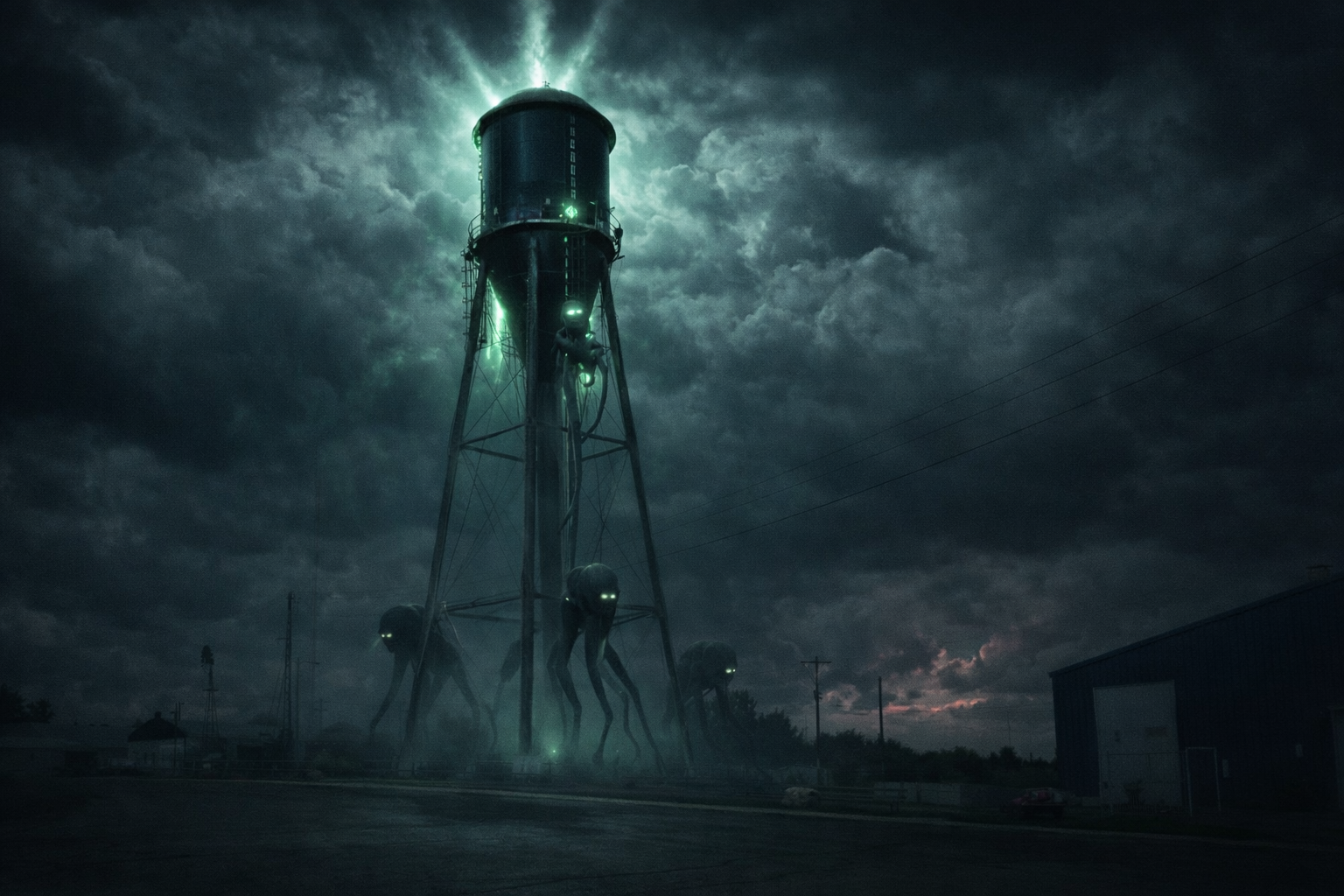
Coronation also had a water tower—a great silver bullet on four spindly legs rising over the town like a threat from God or a signal to passing aliens. As a boy, I was certain it was one or the other. I once tried to climb it.
That’s when I met Jesse James.
His last name was James. I called him Jesse, which seemed accurate and also guaranteed I would be boxed about the ears.
He helped the police and believed civilization depended on keeping boys off water towers and purple gas out of private vehicles.
On the matter of water towers, he was right.
He caught me halfway up and delivered a firm correction to my ears—less a beating than a public service announcement.
“If you’re going to kill yourself,” the gesture implied, “do it lower down.”
I took the lesson to heart. From that day forward, I confined my more ambitious thinking to ground level.
Which is where the purple gas problem lived.
I was about twelve when I began to understand that adults, for all their height and neckties, often lacked imagination.
They obeyed rules, complained about rules, drank because of rules, and once in a while got themselves elected mayor while barely able to stand upright.
But very few of them looked at a system and thought: There must be a side door.
That was where I came in.
I won’t go into the mechanics of anything—partly because I’m older now, and partly because governments, unlike writers, have no sense of humor. Let’s just say I developed an early interest in the difference between appearance and reality.
From time to time, the RCMP would set up roadblocks outside town.
This gave the whole affair a festive air, like a church picnic run by suspicious men with badges.
Drivers approached with faces carefully arranged somewhere between innocence and mild indigestion. The Mounties would inspect tanks, peer into vehicles, and generally behave as if they expected to find purple gas, stolen livestock, and possibly a Communist under a tarp.
Most people feared these roadblocks.
I regarded them as a design challenge.
And somehow, despite all the inspections, Jesse James—who could keep a boy off a water tower—never seemed to find very much purple gas.
I admired that.
Not because I had anything against the police, although I did have a philosophical objection to ear-boxing. No, I admired it because it confirmed something I had already begun to suspect:
Authority is often theatrical.
It wears a hat, sets up a barrier, asks stern questions, and examines what it knows how to examine. But life, especially in a place like Coronation, tends to seep around the edges.
That was Coronation all over.
A town where almost nothing happened—except the parts that did.
Take Mr. Price.
Saturday morning, 1957. I’m fifteen. Late spring. The prairie air, touched with clover, wakes me like a gentle accusation: get up, you’re alive.
It’s a dandy day to be alive.
The front of our home is my father’s dental office. The back is where we live. We have two bathrooms, one faintly perfumed with ether—a luxury in Coronation.
My father drinks every evening.
Mother says he drinks to excess. He says he drinks to capacity.
Our house is wrapped in tar paper, waiting for stucco.
Every spring, Mother suggests finishing it.
Every spring, my father explains that the foundation must settle.
He fears earthquakes.
The last seismic event in our part of Alberta was sometime before the dinosaurs.
My father designed the house using a shoebox filled with tiny balsa wood walls and miniature doors, rearranging them endlessly until perfection was achieved.
Mother did not share his enthusiasm.
This may have had something to do with how he represented us inside the model.
I was a clown.
He was a king, complete with crown and sceptre.
Mother was a witch—repurposed from a Halloween cake, dressed in a violet wedding gown. Using his dental tools, my father had fashioned her face into a remarkably accurate likeness.
“You turned me into a witch,” she said.
“On the contrary,” he replied, “I made a witch into a loving wife.”
I dress quickly and ride my bike to Price’s Food Market, where I work as a delivery boy. Saturdays are long—eight to six.
Mr. Price does not care for me. He thinks I talk too much. Several times he has threatened to shoot me—but always in a friendly way. As far as I know, he does not own a gun.
I park behind the store and head to the flour shed.
I hear a sound.
A low growl.
A man sits on the floor, swallowed by shadow. Thick boots. I recognize them.
Mr. Price.
A rifle lies beside him.
Blood pools across the splintered wood.
This is not a good sign.
“Don’t m-murder me, Mr. Price,” I whisper. “I’ll stop talking so much. My mother will really m-miss me.”
He looks at me. A faint smile. Then away.
I understand.
I run.
Inside, Terrasa is on the phone taking a grocery order. I tell her to hang up. She stares at me. I explain that Mr. Price has shot himself.
She drops the phone, crosses herself. “The unpardonable sin.”
I catch the receiver midair and call the operator. We need a doctor.
Terrasa staggers into the back room, pours coffee, her hands shaking. She takes a cinnamon bun. They are the best in Canada—gooey, perfect, irresistible. Mr. Price makes them every morning before anyone arrives.
He must have done that today, too.
I wonder if he had one before he pulled the trigger.
I would have.
The doctor’s office answers. She’s covering for Dr. O’Brien. She doesn’t know where the market is. I tell her to wait—I’ll guide her.
I race home. My bike crashes into the stairs. My mother asks what’s wrong.
“Price shot himself between his peepers,” I say. “He almost got me.”
I sprint across the street, flag down the doctor, and lead her back.
She sees the blood, the rifle.
“Get two or three large men,” she says. “Don’t tell them more.”
“You can count on me,” I say. “This is usually such a peaceful place.”
“It doesn’t seem peaceful to me.”
I run to the Royal Crown café.
“I need three large men,” I say.
No one looks up.
“A fellow citizen has been shot!”
That gets their attention.
“Price shot hisself clean through his skull,” I say, drawing on my extensive Western film education. “The doctor needs help.”
Chairs scrape. Men rise.
Then everyone rises.
They follow me in a wave through the store and out to the shed.
I feel like the Pied Piper.
By ten o’clock, Mr. Price is at the hospital.
He will not survive the day.
A Mountie locks the store.
I go home.
My father is in his lab, crafting a dental bridge, smoking British Council cigarettes, sipping Scotch every few minutes. Not drunk—just orbiting it.
We look out across the lot at the dealership and the garage where he sometimes drinks after work.
“Anything unusual happen this morning?” he asks.
“Price plugged himself,” I say.
“Did you see him do it?”
“Right after.”
“Could be foul play,” my father says. “Considering what he charges for coffee.”
“You think so?”
“Hard to shoot yourself twice.”
“Twice?”
“That’s what I heard, pardner.”
“Maybe you did it,” I say.
“No motive,” he replies. “And I have an alibi. You, on the other hand…”
My mother appears in the doorway.
“Can you two bushwhackers stop long enough to eat?”
Over soup, my father says, “It’s remarkable how often people die by their own hand in Coronation.”
“Is that why we moved here?” I ask.
“Let’s talk about something happy,” says my mother.
My father looks at me. “You’ll probably get paid for the full day.”
“That’ll be dandy,” I say.
But I’m thinking about Mr. Price.
About how quiet the store will be.
About the cinnamon buns.
And I wonder if, before he checked out, he had one last perfect bun.
I would have.
