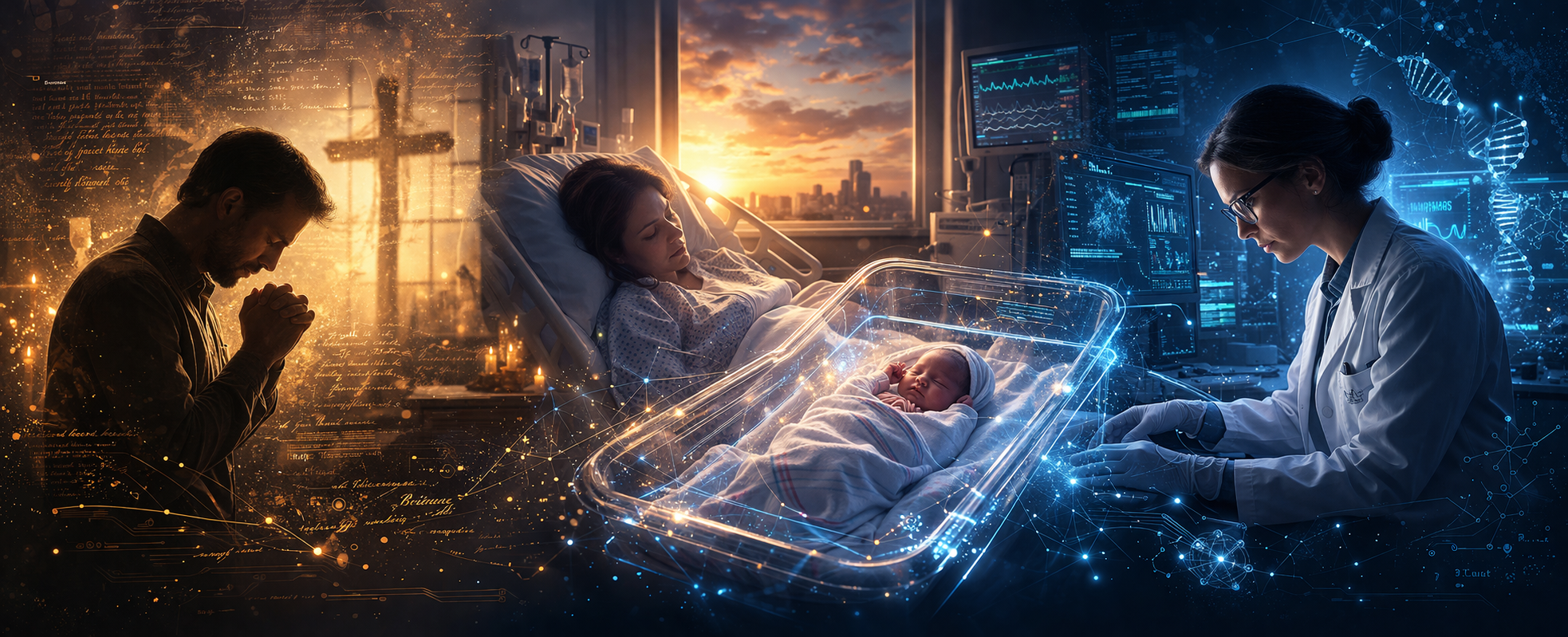
A child is born. Two people claim credit. Both may be right.
A hundred years from now, someone will insist they know exactly who I was.
They’ll say Jaron Summers was six feet tall, or five-foot-eight, or possibly a defensive end for a mid-level college team in Nebraska. There will be records. There are always records. Some of them will be right. Most will be confident.
If I’m lucky, one of them will claim I invented something useful. If I’m unlucky, someone else will prove I didn’t.
That’s how history works. It doesn’t just remember—it edits, trims, combines, and occasionally hallucinates.
The problem with certainty is not that it’s wrong. It’s that it refuses to share the room.
Which brings me to a child named Samuel, born just before dawn on a Tuesday that nobody will remember except the people who were in the room.
Four people, if you count the baby, which seems only fair.
The mother, Emily, who had been through enough to qualify for sainthood in several traditions.
The father, David, who believed—firmly, calmly, without apology—that God had finally answered his prayers.
And Dr. Evelyn Kaplan, who believed—just as firmly—that she had.
Samuel, meanwhile, arrived on schedule with lungs strong enough to object to the whole arrangement.
The room was quiet except for the machines and the child, who came into the world protesting existence in the universal language of newborns.
Kaplan checked the monitors. Numbers lined up neatly, as if they had been rehearsing for this moment.
“All vitals stable,” she said. “Exactly as predicted.”
David, the father, stood near the bassinet, hands trembling just enough to betray him.
“Predicted,” he said softly. “We prayed for ten years.”
Kaplan didn’t look up.
“And we ran 11,000 simulations,” she replied.
He let out a short laugh. Not mocking. Not friendly either.
“Well,” he said, “looks like one of us finally got through.”
Kaplan adjusted a setting.
“Yes,” she said. “We did.”
The air between them settled into something that wasn’t quite disagreement and wasn’t quite peace.
David stepped closer to the child.
“You don’t really believe this is just math,” he said.
Kaplan shook her head.
“I don’t believe in ‘just,’” she said. “I believe in ‘how.’”
David nodded.
“And I believe in ‘why.’”
Kaplan finally looked at the baby.
“Why is a story we tell ourselves,” she said.
David smiled faintly.
“Funny,” he said. “So is history.”
Emily slept through most of it.
After nine months of procedures, adjustments, medications, and what Kaplan referred to as “guided biological optimization,” Emily had earned the right to miss the philosophical portion of the evening.
Samuel, meanwhile, had no opinion.
He slept. He cried. He ate. He did what humans have always done at the beginning—he existed without explanation.
The process that brought him there had been, in Kaplan’s words, “comprehensive.”
There were algorithms involved that could predict probabilities most people would prefer not to know. There were adjustments made at levels so small they might have offended God, if God was paying attention to that sort of thing.
Kaplan was good. Exceptionally good.
She did not claim miracles.
She did not need to.
David, on the other hand, had spent a decade talking to someone who did not return calls in the traditional sense.
He had prayed in churches, in cars, in hospital waiting rooms, and once, memorably, in a supermarket aisle between canned soup and discounted cereal.
He had not received a response he could quote.
But he had not stopped asking.
Which is, depending on your point of view, either admirable or inefficient.
In the weeks that followed, Samuel grew into himself the way all children do—by refusing to follow instructions.
Kaplan’s system monitored everything.
Temperature. Respiration. Nutritional intake. Sleep cycles.
It made recommendations.
“Feeding interval suboptimal.”
“Environmental variance detected.”
“Sleep pattern irregular.”
It was never wrong.
That became a problem.
Not because it made mistakes.
Because it didn’t.
One evening, David sat in the living room holding Samuel.
“You ever think,” David said, “that you might be missing something?”
“Such as?” Kaplan replied.
“This,” he said. “The part you can’t measure.”
“Everything can be measured,” she said.
“Then measure why I’d trade places with him if I had to.”
Kaplan paused.
“That is not a measurable variable,” she said.
“Exactly.”
The incident happened three months later.
Samuel stopped breathing.
Emily screamed. David froze. Kaplan moved.
“Respiratory interruption,” she said. “Immediate correction.”
They acted.
Samuel inhaled.
Life resumed.
Later that night:
“You hesitated,” Kaplan said.
“I was scared,” David replied.
“Fear reduces response efficiency.”
“It also means you care.”
Kaplan paused.
“Clarify.”
“You don’t know what it feels like to almost lose him.”
“No.”
“Neither did I.”
Years later:
“Where did I come from?”
“We wanted you,” Emily said.
“You are the result of a biological process,” Kaplan added.
David said, “You were unlikely.”
“Is that bad?”
“No. It’s what makes you interesting.”
And that was enough.
A hundred years from now, someone will explain exactly how Samuel came into the world.
They will cite data.
They will quote belief.
They will draw clean lines through a messy story.
And they will be certain.
Which is the most human thing of all.
Because somewhere between what we can measure…
…and what we choose to believe…
there is always a child.
And no final answer.
Just a very convincing one.
