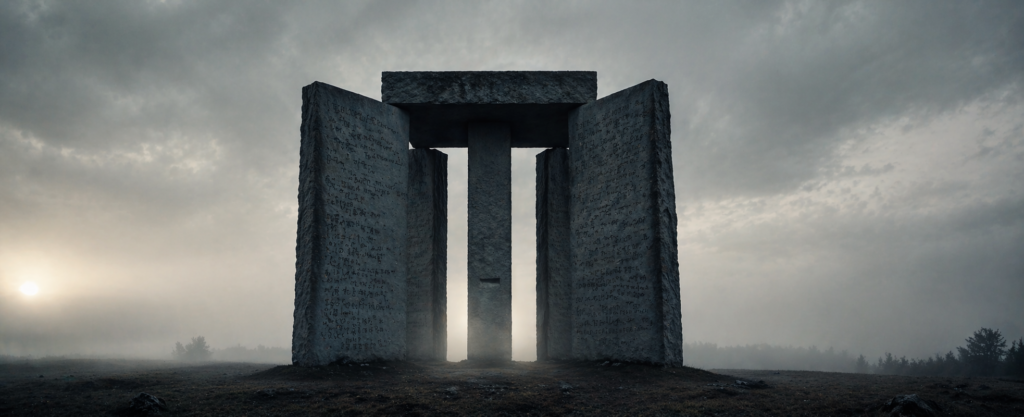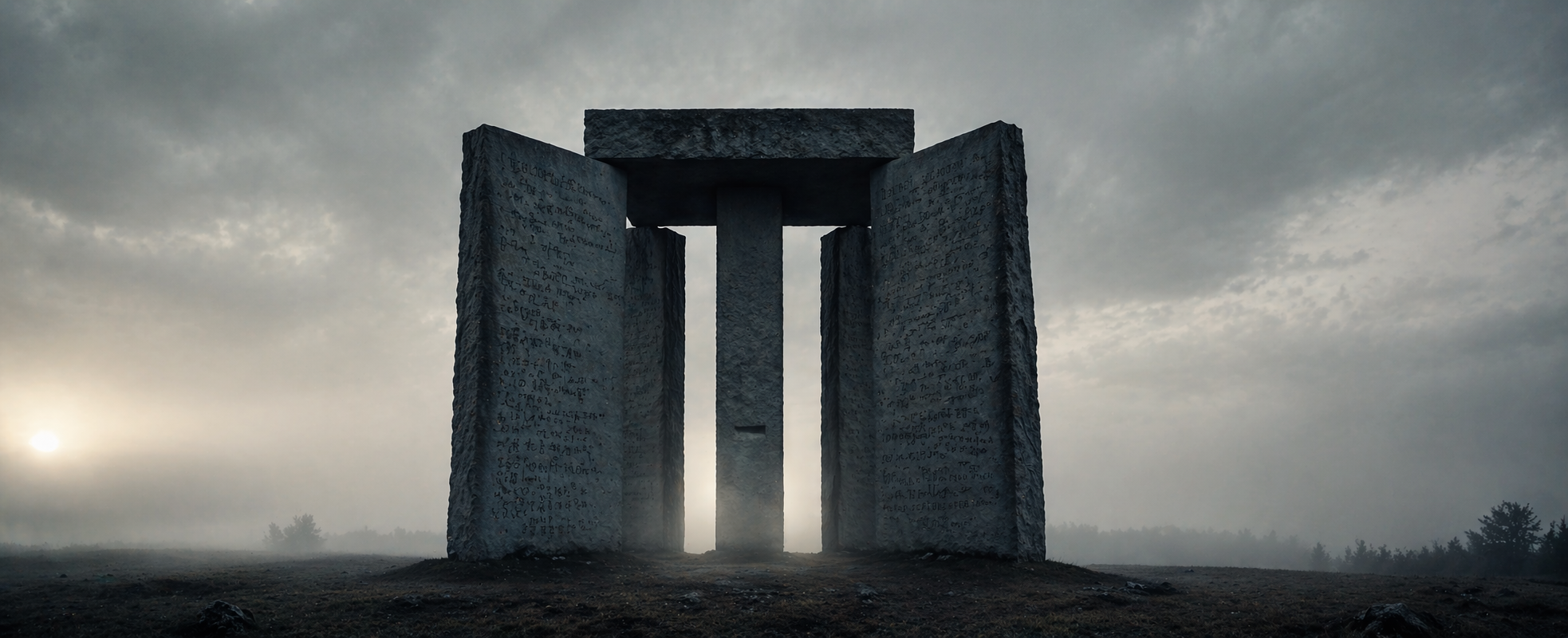

There is a monument in America that seems to be waiting for something.
It does not advertise. It does not explain itself. It simply stands there, patient as a man who knows something the rest of us do not.
In northeastern Georgia, on a low, unremarkable hill, five massive slabs of granite rise out of the earth in a quiet star formation. Each stone is over sixteen feet tall. Each weighs more than twenty tons. Together, they support a capstone that seems less placed than imposed.
It is not a beautiful thing. It is not even particularly welcoming.
It is, however, unforgettable.
They are called the Georgia Guidestones, and no one knows who built them.
That, of course, is not entirely true.
One man knew.
He arrived in Elberton, Georgia, in 1979. Well-dressed. Soft-spoken. Educated. He gave his name as Robert C. Christian, which was not his name.
He said he represented a small group of Americans who had been planning something for twenty years.
He did not say who they were.
He did not say where the money came from.
He did not say why they had chosen that particular hill.
He only described what he wanted built.
It was to be enormous. Precise. Indestructible. Capable of surviving catastrophe.
It would function as a clock, a calendar, and a compass. It would track the sun. It would align with the stars. It would speak to the future in eight languages.
And carved into the stone would be instructions.
Not suggestions. Instructions.
Guidelines for those who might survive whatever was coming.
The banker who handled the transaction was told the truth—or at least a version of it. He was given the man’s real identity on one condition: that he would never reveal it. Not to his wife. Not to his children. Not to anyone.
He agreed.
He is still keeping that promise.
The monument was built. Paid for. Installed.
And then the man who commissioned it disappeared.
He walked out of town without a handshake and was never seen again.
That alone would have been enough to make the stones famous.
But it was what was written on them that made people uneasy.
The first instruction is not subtle.
Maintain humanity under 500,000,000 in perpetual balance with nature.
Even when the monument was unveiled in 1980, that meant most of the world’s population would have to go.
Today, the math is worse.
The remaining instructions speak of guiding reproduction, creating a universal language, balancing rights with responsibilities, and seeking harmony with the infinite.
Some people read those words and see reason.
Others see something else entirely.
Over the years, the stones have been called a warning, a prophecy, a blueprint, a joke, a monument to rational thought, and the Ten Commandments of the Antichrist.
Witches have gathered there. Tourists have photographed it. Vandals have tried to erase it. Conspiracy theorists have adopted it like a stray dog with excellent instincts.
No one agrees on what it means.
Which, of course, may be the point.
The man who paid for the monument understood something that most people, and almost all institutions, fail to grasp.
Clarity is overrated.
Mystery endures.
Give people an answer, and they will argue about it for a while.
Give them a question carved in stone, and they will return to it for generations.
The Georgia Guidestones do not tell us what to think.
They invite us to wonder who would dare to think it.
And why.
Somewhere, at some point, a small group of people spent a great deal of money to leave a message for a future they believed might not include us.
They did not sign their names.
They did not explain themselves.
They did not stick around to take questions.
They simply built something that would outlast curiosity, outlast outrage, and possibly outlast us.
Which is why the monument does not feel like a relic.
It feels like a placeholder.
It is not remembering the past.
It is waiting for the future.
People prize what they don’t understand at least as much as what they do.