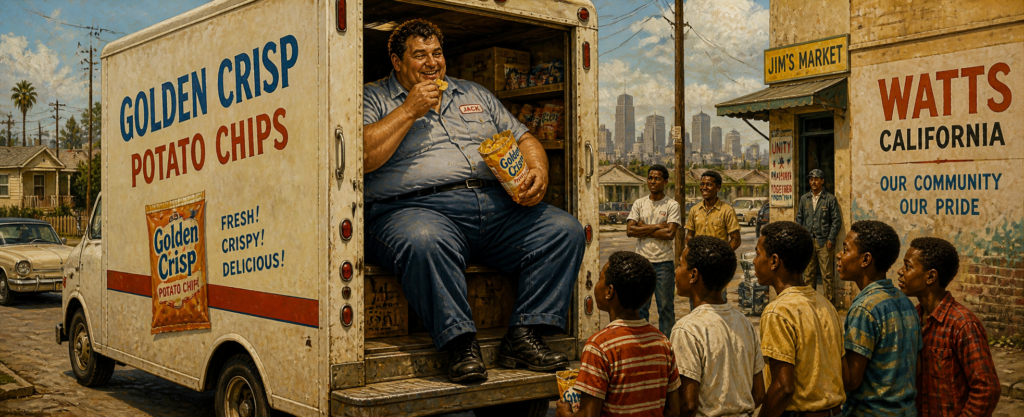
Jack Ford was a good man.
That was the general opinion, and it held up under casual inspection. He was six foot six, built like a refrigerator that had played football, and had the kind of easy kindness that made people forgive him for blocking entire doorways.
His wife adored him.
She called him my friendly giant, which was accurate in two directions: he was friendly, and he was, increasingly, a giant.
Jack came from a family with a peculiar weakness.
They were devoted to Coca-Cola.
Not in the ordinary, recreational sense. This was something closer to religion, except with more burping. Cases became crates. Crates became shipments. One relative befriended a Coke delivery driver, and soon the family was receiving enough Coca-Cola to qualify as a branch office.
They drank it constantly.
Morning, noon, night — liquid sugar, bubbling away the years.
It did not end well.
They grew ill, one by one, and died earlier than anyone thought reasonable. It was sad, though not exactly mysterious. If a coroner had listed the cause of death as “carbonated enthusiasm,” no one in the family would have challenged it.
The family nickname for Jack had once been J.F.
Later, it became Junk Food.
He carried it lightly, which was one of the last things he carried lightly.
Jack married well.
His wife had money, patience, and the dangerous belief that love could outrun appetite. For a time, it appeared she might be right.
But Jack did not like to sit still.
Men of his size and temperament often feel an obligation to be useful, even when usefulness is optional. So he got a job.
He drove a potato chip truck.
This was Southern California, where potato chips were not snacks so much as municipal infrastructure. Jack took a route that other drivers avoided — South Cental LA.
There were stories.
Kids grabbing boxes and running. Men stepping out with knives, sometimes guns. The company had a policy: don’t argue, don’t resist, don’t escalate.
“Give them the chips,” they said. “Everyone likes you, Jack. Let’s keep it that way.”
It was the first corporate policy in history based entirely on surrendering nacho cheese.
Jack agreed.
He was not a man looking for trouble. Trouble, in Jack’s case, usually came salted.
At home, things were managed. Kind of.
His wife noticed the weight.
She mentioned it.
Then she mentioned it again, using the married-person tone that sounds gentle but can loosen wallpaper.
Jack, being both gentle and large, chose not to argue. Instead, he leaned further into his work.
Six hours a day in Souh Central.
A good man, doing a difficult job, helping where he could.
Then something odd happened.
Jack began to gain weight.
Not gradually. Not the way a man eases into it over years with poor decisions and elastic waistbands.
This was acceleration.
Fifty pounds. Then more. Then much more.
His wife was concerned.
Jack was puzzled.
“I don’t understand it,” he said.
He meant it.
Doctors were consulted. Advice was given. Calories were discussed in the way people discuss arson after the building is gone.
Nothing seemed to explain it.
Jack continued to grow.
Eventually, he reached a weight that required engineering solutions.
Four hundred pounds.
Then more.
At one point, he hovered around four hundred and twenty-five pounds, which is less a weight than a weather system.
A special bed was installed. Equipment was brought in. A team came once a day to turn him, carefully, like a valuable antique grand piano with opinions.
If they didn’t turn him, his breathing suffered.
Everything suffered.
Jack had time to think.
He spoke with his wife about karma.
“Maybe it’s real,” he said.
“Maybe it isn’t,” she replied.
It was the sort of conclusion people reach when the evidence is inconclusive and the snack cupboard is empty.
They talked about children.
They decided against it.
Practical considerations prevailed.
Jack’s final months were quiet.
He remained kind.
He remained loved.
He remained, to the end, a good man.
Then one day, he died.
Afterward, there were questions.
There are always questions, especially when the outcome does not match the explanation.
The answer, when it came, was simple.
Jack had not been losing product a the point of a gun.
He had been hyper-snacking.
Not a little.
Not occasionally.
Systematically.
Doritos, potato chips, corn chips, barbecue chips — whatever he was carrying, he was also personally auditing.
In the truck.
On the route.
Between stops.
A handful here. A bag there. Then another. Then another. Six hours is a long time when a man is alone with inventory.
It turned out the danger in South Cental had been real.
Just not the kind anyone expected.
Jack Ford had spent his life avoiding confrontation.
In the end, the only thing that took him down—was himself.