
When I was five years old, I attempted to murder one of our neighbors.
Fortunately, I was not very good at it.
The neighbor was Mr. Baker, the railway station manager in Didsbury, Alberta.
My father was his dentist.
Because Mr. Baker had a large family, Dad gave him reduced rates.
This detail becomes important later, as details often do in failed homicide.
Every year my mother and I took the train from Western Canada to Lake Andes, South Dakota, to visit my grandmother.
Grandmother generally slept all winter.
Not medically.
Voluntarily.
She considered winter an unnecessary interruption between autumn and spring.
Children under five rode free on the train.
Mother went to the railway station to buy her ticket.
Mr. Baker looked at me.
Then he asked the question that altered the course of Canadian criminal history.
“How old is the boy?”
Being an honest child, I answered before Mother could.
“Five.”
Mr. Baker charged her half fare for me.
This seemed unfair.
Not merely unfair.
Actionably unfair.
That evening I overheard my parents discussing the matter.
I do not remember exactly what was said.
I remember the general conclusion.
Mr. Baker had cost us money.
As a child, I possessed a highly developed sense of justice.
I lacked only judgment, proportion, and an attorney.
Earlier that week I had seen a cartoon in which someone dropped an anvil on somebody else.
The principle appeared sound.
Mr. Baker walked to work every morning.
His route took him beneath several large trees near our house.
The plan practically designed itself.
I assembled my gang.
Every successful criminal enterprise requires assistants.
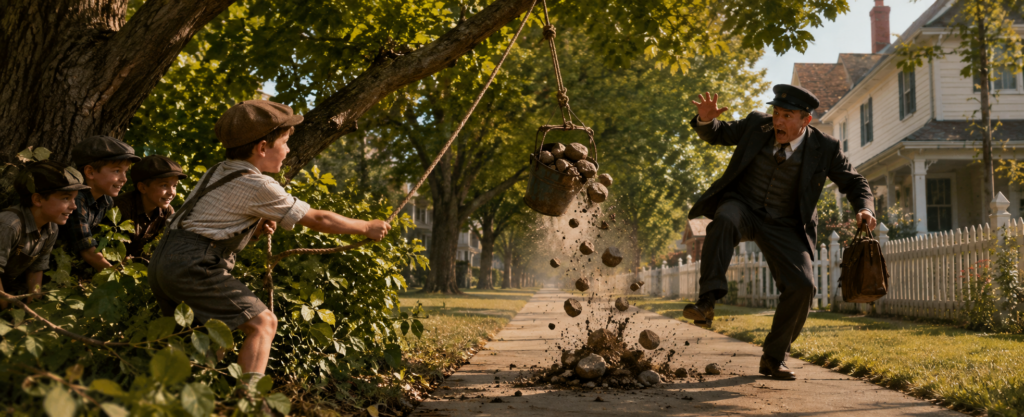
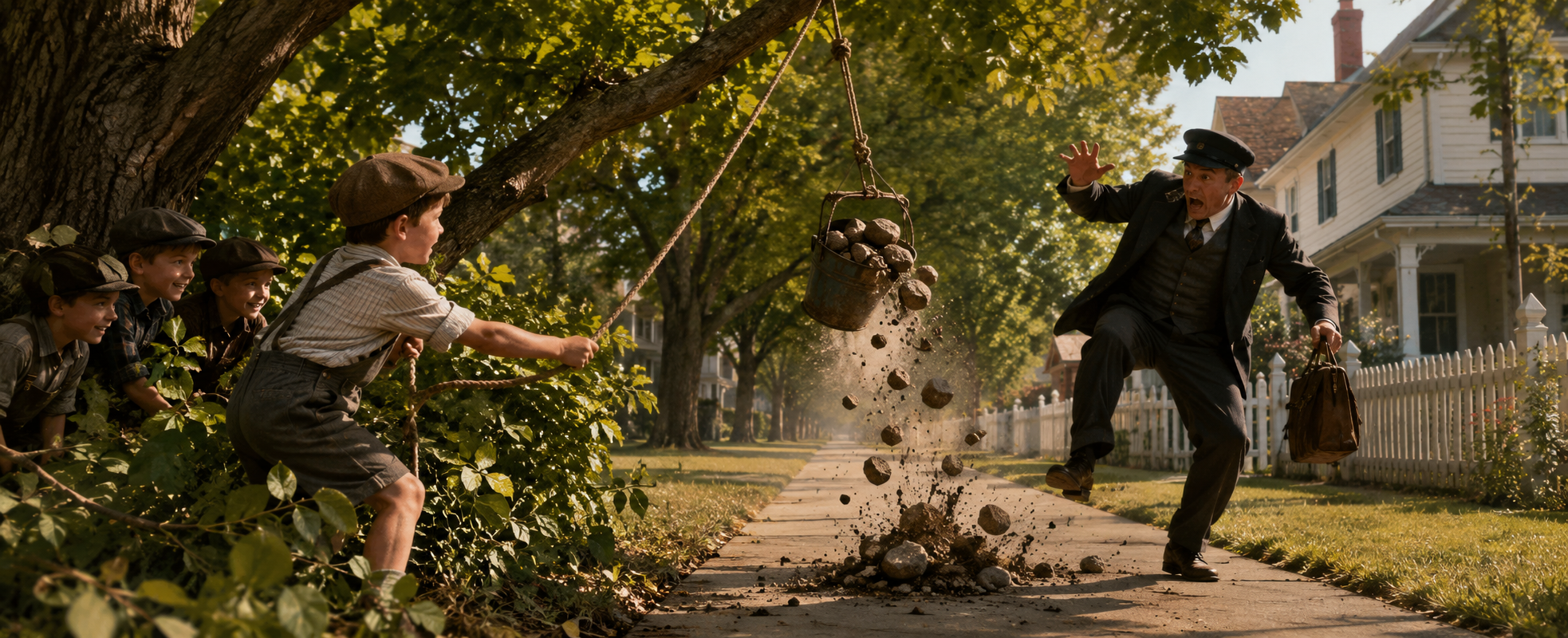
We found a bucket.
We filled it with stones.
We tied a rope to the handle.
Then we threw the other end of the rope over a tree branch and hoisted the bucket above the sidewalk.
It was a surprisingly sophisticated operation for a group whose average age was approximately six.
We concealed ourselves in nearby bushes.
The plan was simple.
When Mr. Baker walked beneath the bucket, I would give the signal.
My associates would release the rope.
Gravity would handle the rest.
Looking back, I now realize there were flaws.
At the time I considered it flawless.
Mr. Baker approached.
I gave the signal.
The rope was released.
The bucket plunged toward Earth.
And I missed.
Not by much.
The bucket struck the sidewalk directly behind him and exploded into a cloud of rocks, splinters, and disappointed justice.
Mr. Baker jumped.
My gang fled.
The assassination attempt was over.
Mr. Baker reported the incident to my father.
He informed Dad that I was a danger to the neighborhood and that perhaps the police should become involved.
Dad took the matter seriously.
Eventually.
First he laughed.
Then he explained that dropping buckets of rocks on people could kill them.
This information had somehow escaped my planning process.
He then gave me one of the most useful pieces of advice I have ever received.
“If you’re going to murder any more of our neighbors,” he said, “talk it over with me first.”
That ended my life of organized crime.
Mostly.
The following year Mother returned to the station to buy train tickets.
Mr. Baker looked at me.
Then he looked at Mother.
“I think he only looks four and a half,” Mr. Baker said.
I rode free.
Justice had been achieved.
No additional construction projects were required.
Unfortunately, I had already begun developing new ideas.
South Dakota had rattlesnakes.
There were warning signs everywhere.
When Dad phoned to see how the trip was going, I asked if I could bring a few rattlesnakes home.
“What for?” he asked.
I explained that I intended to place them in Mr. Baker’s outhouse.
There was a long silence.
Dad finally said I was not to go near any rattlesnakes under any circumstances.
I asked when I could.
“When you’re twenty-five,” he said.
That seemed reasonable.
By the time I reached twenty-five, I had lost interest in rattlesnakes.
I had also stopped trying to murder the neighbors.
This was probably for the best.
The neighbors certainly thought so.
And so did Mr. Baker.