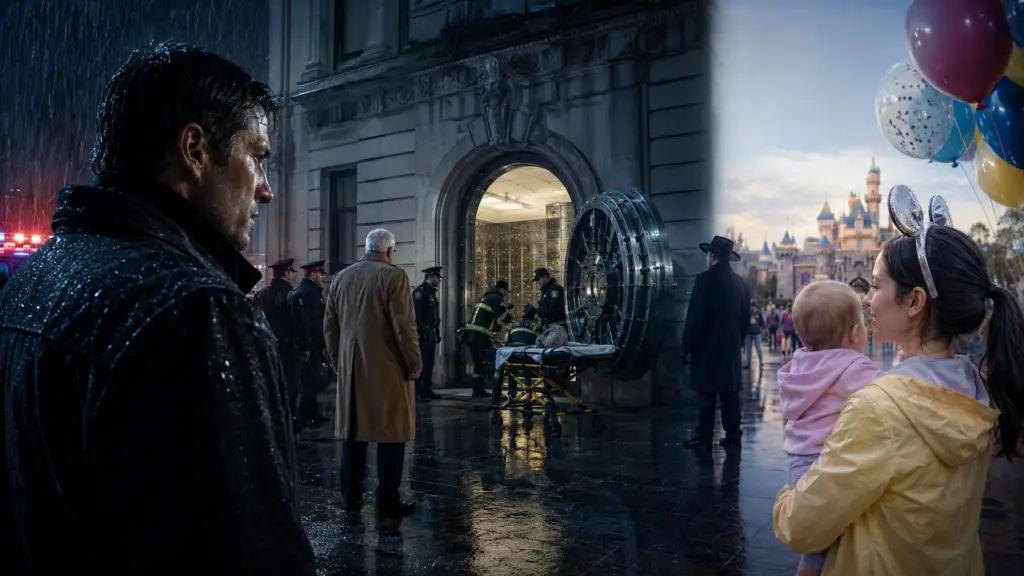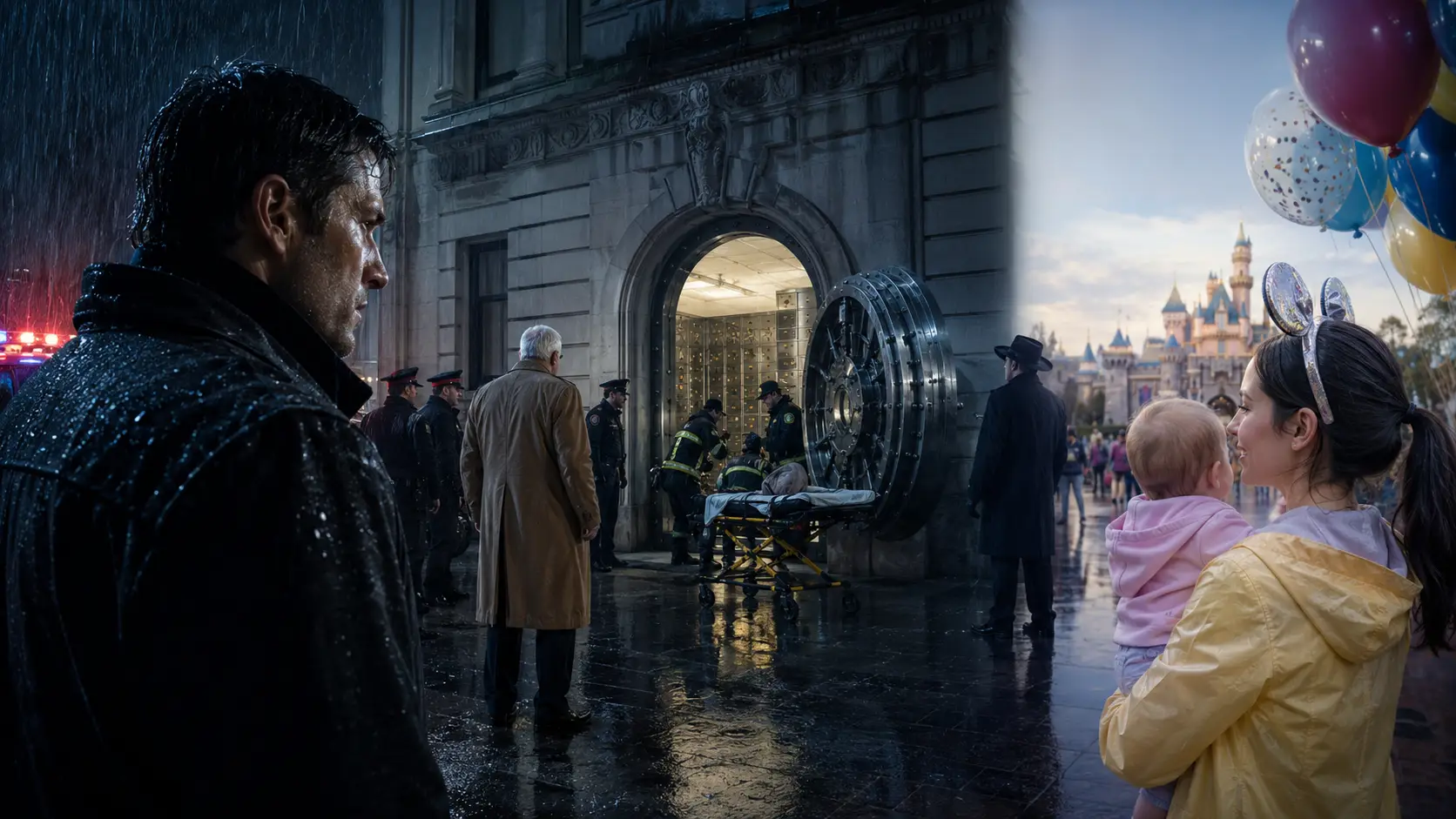

At 2:13 in the morning, the emergency dispatcher heard a baby crying from inside a bank vault.
The sound was faint, irregular, and somehow worse because of the static.
“My name is Gloria Bellows,” the woman whispered. “I’m inside the main vault at North Dominion Bank. I have my daughter with me. She’s eight months old.”
The dispatcher, Denise Carver, straightened in her chair.
She had been drinking coffee and reading an article about household mould. One moment she was wondering whether the black line around her bathroom window was dirt or death. The next she was listening to a terrified woman buried behind forty tonnes of steel.
“How did you get inside?”
“I don’t know.”
“Are you injured?”
“No. I don’t think so.”
“Is anyone else with you?”
A pause.
“No.”
The baby cried again.
“Please hurry,” Gloria said. “There isn’t much air.”
Denise signalled her supervisor.
Within twelve minutes, police cars blocked both ends of Jasper Avenue. Fire crews arrived next, followed by paramedics, rescue technicians, an explosives unit and a sleepy deputy fire chief who had put his uniform trousers on over blue flannel pyjamas.
The rain started at 2:29.
At first it tapped delicately against the pavement.
Then the sky opened.
Water crashed through the streetlights in silver sheets. Gutters overflowed. Manhole covers trembled. Television crews arrived and erected tents that immediately began trying to fly to Saskatchewan.
North Dominion Bank occupied the oldest commercial building on the block, a limestone fortress with brass doors and narrow windows. The bank had expanded over the decades, swallowing a tobacconist, a dress shop and a dentist’s office whose painted sign could still be seen beneath layers of brick in the alley.
The vault remained where it had been installed in 1938.
Nobody had the original plans.
At 2:38, the bank president arrived in a camel-hair coat over striped pyjamas.
Graham Bellows was sixty-three, silver-haired and broad-shouldered, with the exhausted dignity of a man who had spent thirty-eight years remembering customers’ birthdays and pretending to enjoy retirement seminars.
Detective Leo Mercer met him at the police barrier.
“Are you Graham Bellows?”
“Yes.”
“Do you know a Gloria Bellows?”
Bellows stopped walking.
The rain ran down his face.
“She’s my granddaughter.”
Mercer watched him carefully.
“Could she have access to the bank?”
“No.”
“To the vault?”
“Absolutely not.”
“Does she have a daughter?”
Bellows stared toward the dark windows.
“Emily. Eight months old.”
Mercer disliked coincidences, particularly after two in the morning.
“Where is Gloria now?”
“She’s supposed to be in California.”
“Supposed to be?”
“She won a weekend at Disneyland. Some promotional contest. She and the baby flew down yesterday.”
“Have you spoken to her?”
“Yesterday morning.”
“Could the trip have been cancelled?”
“I don’t know.”
A rescue technician hurried toward them.
“We have the caller on a continuous line. The number is masked. Dispatch can’t trace it.”
“Cellular?” Mercer asked.
“Sounds like it. But reception inside that vault should be impossible.”
Bellows seemed to sway.
Mercer caught his arm.
“Can the vault be opened?”
“At six.”
“We can’t wait until six.”
“It’s time-locked.”
“Override?”
“No.”
“Emergency key?”
Bellows looked at the bank.
“There are four keys and a timed combination. All four officers must be present.”
“Can you drill it?”
“You can drill anything.”
“How long?”
Bellows gave him a sad look.
“That depends upon how much of the bank you’re prepared to destroy.”
Mercer took the headset in the command vehicle.
“Gloria?”
“I’m here.”
The voice was soft, breathless and young.
Behind it, the baby made a wet, tired sound.
“My name is Leo Mercer. I’m with Edmonton police.”
“I know.”
“How do you know?”
“I can hear them outside.”
Mercer glanced at the technician.
The man shook his head. No exterior sound was reaching the microphone.
“Gloria, tell me what you see.”
“Nothing.”
“What do you smell?”
“Metal. Dust. Something oily.”
“What are you touching?”
“The floor. It’s cold. There are metal doors along the walls.”
Safe-deposit boxes.
Mercer had been inside the vault once, years earlier, when investigating an elderly customer’s claim that someone had replaced his gold coins with brass washers. The case had gone nowhere.
Gloria’s description was accurate.
“Is there a light switch?”
“I found one. Nothing happened.”
“Look for a telephone.”
“There’s an old one near the inner door. It’s dead.”
Bellows had been permitted into the command vehicle. At this, he whispered, “There is an old telephone.”
Mercer covered the microphone.
“Who knows about it?”
“Any employee who has been inside.”
“Has Gloria?”
“Never.”
Mercer returned to the call.
“What happened before you woke up?”
“I was walking to my car.”
“Where?”
“Near the river.”
“When?”
“I don’t know.”
“Who brought you to the bank?”
“I never saw them.”
“Did they say anything?”
Another pause.
The baby began crying harder.
“They said my grandfather would understand.”
Bellows closed his eyes.
Mercer removed the headset.
“What are you supposed to understand?”
“Nothing.”
“You went pale.”
“My granddaughter and great-granddaughter are locked in my vault.”
“You went pale before that.”
Bellows looked at the rain running down the command vehicle’s windows.
“I don’t know what they want from me.”
“Who are they?”
“I don’t know.”
Mercer believed he was telling the truth.
He also believed Bellows had spent much of his life practising how to tell only the portion of the truth that caused the least damage.
The rescue team began drilling at 3:06.
The sound was monstrous.
It moved through the old bank like an animal trapped inside the walls. Glass shook. Dust drifted from decorative plaster. Firefighters ran electrical cables through rising water while technicians studied diagrams transmitted from the vault manufacturer’s retired engineer in Ohio.
The first drill bit lasted eleven minutes.
The second lasted nineteen.
The third snapped and had to be extracted.
Mercer stayed on the telephone with Gloria.
“Tell me about Disneyland,” he said.
“I’ve never been.”
“You won the trip?”
“A radio contest.”
“What station?”
“CKLX.”
“What was the question?”
“They played three seconds of a song. I had to name it.”
“What song?”
“‘Dancing Queen.’”
Bellows gave a faint, involuntary laugh.
“Her mother played that song every morning for a year,” he said.
Mercer looked at him.
“Ask her about the pancakes,” Bellows said.
“What pancakes?”
“She’ll know.”
Mercer returned to the headset.
“Gloria, your grandfather wants me to ask about pancakes.”
For the first time, her voice changed.
Despite the fear, Mercer heard a smile.
“He burns the first one.”
Bellows lowered his head.
“He always says he does it deliberately,” Gloria continued. “He calls it the cook’s tax. But he burns it because he turns the heat too high.”
“That’s her,” Bellows whispered.
Mercer asked dozens of questions.
Gloria answered all of them.
The yellow house where she had lived as a child.
The grandmother who baked bread on Sundays.
The scar on Bellows’s thumb from opening an oyster with a steak knife.
The name of Gloria’s first dog.
The broken angel ornament they still hung on the Christmas tree because Gloria had cried when Bellows tried to throw it away.
These were not facts from a bank file.
They were the sediment of a family.
By four o’clock, every major Canadian news network carried the rescue live.
A woman and baby trapped inside a sealed bank vault.
The bank president’s granddaughter.
A mysterious abduction.
A vault that could not be opened.
The story needed no improvement, although the television networks attempted several.
One correspondent announced that the vault was running out of oxygen, although nobody knew how much air it contained.
Another reported that Gloria had been kidnapped by an international gang, although nobody had established that a gang existed.
A retired police officer in Toronto spent nine minutes explaining how he would open the vault, despite having never seen it.
At 4:41, three black sport-utility vehicles arrived.
Six people stepped out wearing dark jackets displaying the crest of the Royal Canadian Mounted Police.
Their leader was tall and spare, in his early fifties, with greying hair and the calm expression of a surgeon whose patient was not yet technically dead.
He introduced himself as Superintendent Daniel Price, RCMP Federal Policing.
Mercer examined his identification.
Price waited without impatience.
“This involves the apparent kidnapping of a Canadian citizen, a major financial institution and possible organized crime,” he said. “We’ve been instructed to assume control of the federal aspects.”
“That was fast.”
“The deputy commissioner was awakened.”
“I’m sure he appreciated that.”
“He has teenagers. He says he hasn’t slept since 2009.”
Mercer almost smiled.
Price knew the proper phrases.
He knew the chain of command.
He knew whom to telephone at headquarters and which exhausted superior officer would prefer signing a transfer of authority to accepting responsibility for a dead infant.
More importantly, he arrived at the precise moment everyone desperately wanted someone else to take charge.
The RCMP team established a secure area inside the bank.
One member began photographing the vault corridor.
Another collected employee records.
A woman named Corporal Nash interviewed Graham Bellows about high-risk customers, threats and disputed accounts.
Price listened to several minutes of Gloria’s call.
“Convincing,” he said.
“You think she’s lying?” Mercer asked.
“I think fear is convincing.”
“The baby?”
“Also convincing.”
“You don’t believe she’s in there?”
Price looked through the command vehicle window toward the bank.
“I believe we should open the door.”
At 5:51, the technicians reached the final locking mechanism.
Mercer returned to the telephone.
“We’re nearly through.”
“Please hurry.”
“We’re coming.”
“Promise?”
“I promise.”
The baby had become quiet.
Too quiet.
“Gloria, is Emily breathing?”
“Yes.”
“Keep talking to me.”
“I’m tired.”
“I know. Tell me what you’ll do when we get you out.”
“Hold her.”
“What else?”
“Call my grandfather.”
“He’s standing beside me.”
Bellows leaned toward the microphone.
“Glory?”
She inhaled sharply.
“Grandpa?”
“I’m here.”
“I’m sorry.”
“For what?”
“For ruining your bank.”
Bellows tried to laugh.
The sound broke in the middle.
“Banks can be repaired.”
At 5:58, the locking bar surrendered with a metallic crack.
The vault door moved three inches.
Firefighters pulled.
Steel groaned against steel.
A gap appeared.
Paramedics rushed forward carrying oxygen and blankets.
The first firefighter entered.
Then a second.
Mercer stood close enough to see the beams of their lights moving across the rows of safe-deposit boxes.
One light crossed the floor.
Another climbed the rear wall.
The first firefighter stopped.
“Where is she?”
The paramedics crowded the doorway.
Mercer pushed through behind them.
The vault was empty.
There was no woman.
No baby.
No grey blanket.
No telephone.
No hiding place.
Only polished stone, brass fittings and hundreds of small metal doors.
Mercer turned in a complete circle.
“Gloria?”
His voice echoed.
The telephone line in the command vehicle remained open.
Mercer ran back outside.
The headset lay on the console.
Static whispered through it.
“Gloria?”
Nothing.
“Gloria, can you hear me?”
A baby cried once.
Then the connection ended.
For several seconds, nobody moved.
Bellows stood in the command vehicle doorway.
“Where is she?”
Mercer looked at him.
“She wasn’t there.”
“I heard her.”
“So did I.”
“She was in the vault.”
“The vault is empty.”
Bellows pushed past him and entered the bank.
Mercer followed.
The old man searched behind doors, beneath tables and inside storage rooms. He entered the vault and called his granddaughter’s name until Price placed a hand on his shoulder.
“She isn’t here, Mr. Bellows.”
“She was.”
“We’ll find her.”
“How could she disappear?”
Price looked at the open vault.
“That is what we are going to determine.”
By six-thirty, the bank had become the most famous crime scene in Canada.
The RCMP team ordered all local officers, firefighters and bank employees out of the interior while federal forensic specialists examined the vault.
Mercer resisted.
Price took him aside.
“You’ve been awake all night.”
“So have you.”
“I slept in the vehicle.”
“For twenty minutes.”
“I’m highly trained.”
“You snore.”
“That is not classified information.”
Despite himself, Mercer smiled.
Price lowered his voice.
“Go find Gloria’s house. Find out whether she was taken from there. We’ll secure the vault.”
Mercer looked through the glass doors.
Corporal Nash was photographing safe-deposit boxes. Two other federal officers carried equipment cases down the corridor.
“You’ll call if you find anything?”
“Immediately.”
Mercer left at 6:42.
He would later calculate that this was the moment the real robbery began.
Gloria Bellows lived in a narrow two-storey house in Glenora with a red front door and a wooden stork on the lawn announcing the birth of Emily Rose.
Nobody answered.
A neighbour in a quilted dressing gown watched from her porch as police forced the door.
The house showed no sign of violence.
There was no overturned furniture.
No blood.
No hastily abandoned meal.
The refrigerator contained milk, apples and a bottle of champagne with a note attached:
For when you get home. Love, Grandpa.
The baby’s crib was empty.
So were the suitcase rack and the space where a stroller had stood.
Mercer found a Disneyland itinerary on the kitchen table.
Flight numbers.
Hotel reservation.
Airport shuttle.
Return Sunday night.
“Detective?”
A constable stood in the hallway holding a security tablet.
“The doorbell camera uploaded to the cloud.”
The recording showed Gloria leaving the previous afternoon.
She wore a yellow raincoat and carried Emily against her chest. A taxi driver loaded two suitcases into the trunk.
Gloria turned back, locked the door and waved at the camera.
Then she left.
Mercer watched it three times.
At 8:10, the airline confirmed that Gloria Bellows and her daughter had boarded a flight from Edmonton to Los Angeles.
At 8:23, American customs confirmed they had entered the United States.
At 8:47, Gloria’s credit card was used at the Disneyland Hotel.
At 9:02, a photograph appeared on a theme-park security feed.
Gloria Bellows stood beneath a row of balloons wearing silver mouse ears.
Her baby slept in a stroller.
The time stamp corresponded almost exactly to the moment Mercer had been speaking to her inside the vault.
Mercer called Graham Bellows.
“She’s alive.”
The old man began crying.
“She’s in California. She was never inside the bank.”
“Then who did I hear?”
“I don’t know.”
A second call interrupted them.
The voice identified itself as Assistant Commissioner Helen March of the Royal Canadian Mounted Police.
“Detective Mercer?”
“Yes.”
“We understand North Dominion Bank requested federal assistance.”
“You have people here.”
A pause.
“No, Detective. We do not.”
Mercer felt the room change around him.
“I’ve been working with Superintendent Daniel Price.”
“We have no superintendent by that name in Federal Policing.”
“He showed credentials.”
“Where is he now?”
Mercer looked at his watch.
“Inside the bank.”
“Get everyone away from the building.”
The line clicked as March began issuing orders.
Mercer called the command post.
No answer.
He called Graham Bellows.
No answer.
He ran to his vehicle.
At 9:19, Mercer reached Jasper Avenue.
The black sport-utility vehicles were gone.
The bank’s front doors stood open.
Graham Bellows sat on the pavement beneath the awning, his pyjama trousers soaked to the knees.
Mercer knelt beside him.
“Are you hurt?”
Bellows shook his head.
“They said they needed my keys.”
“Did you give them the keys?”
“They had a federal order.”
“Graham.”
“They knew everything. They had forms. They had identification.”
“What did they take?”
“I don’t know.”
The real RCMP arrived seven minutes later.
The first officer through the door was a woman with rain streaming from the brim of her cap. She looked at the open vault, the equipment cases left in the corridor and the rows of safe-deposit boxes.
“Don’t touch anything.”
Within an hour, the bank was sealed for the second time.
This time by actual federal police.
At first, nothing appeared stolen.
Cash drawers remained untouched.
The overnight currency reserve was intact.
Gold bars stored for commercial clients were exactly where they belonged.
No alarms had been disabled.
No locks had been smashed.
Of the 117 safe-deposit boxes opened by the false RCMP team, only fourteen were empty.
Every one belonged to a customer over seventy.
Every one belonged to someone who had not entered the vault in at least twelve years.
And every customer had once been personally assisted by Graham Bellows.
“What was in them?” Mercer asked.
Bellows sat in his office wrapped in a grey blanket.
“I don’t know.”
“You opened them.”
“Under what I believed was federal authority.”
“What did you see?”
“Files.”
“What kind of files?”
“Old ledgers. Photographs. Envelopes. Keys.”
“No jewellery?”
“Not that I saw.”
“No cash?”
“No.”
“Why would fourteen elderly customers store bank records in their boxes?”
Bellows stared at the rain streaking the window.
“They didn’t.”
The federal investigators left the room.
Mercer closed the door.
“What aren’t you telling me?”
Bellows seemed to shrink inside the blanket.
“Thirty years ago, a customer named Thomas Vale accused the bank of removing property from his safe-deposit box.”
“What property?”
“Silver certificates. Bearer bonds. Gold coins.”
“How much?”
“At the time, perhaps eighty thousand dollars. Today, considerably more.”
“What happened?”
“The access records showed no irregularity.”
“You investigated yourselves?”
“The bank’s security division investigated.”
“And found the bank innocent.”
“Yes.”
Mercer sat across from him.
“What happened to Vale?”
“He lost his business. Then his house. He became obsessed with proving the theft.”
“And?”
“He died.”
“How?”
Bellows looked down.
“He drove his car into the river.”
Mercer waited.
The silence did the work.
“You were involved.”
“I was the assistant manager.”
“Did you steal from him?”
“No.”
“Did you know who did?”
“No.”
“Did you suspect?”
Bellows closed his eyes.
“Yes.”
The scheme had begun before Bellows joined the bank.
A senior officer identified elderly customers who rarely visited their boxes. He befriended them, helped them organize documents, handled their keys and made careful notes about what each box contained.
Nothing disappeared immediately.
That was essential.
Years passed.
Owners died.
Families forgot.
Inventories vanished.
Records were amended under the cover of maintenance, key replacement or unpaid rental fees.
The bank denied everything.
Customers were told that property they clearly remembered depositing had never existed.
“Why didn’t you report it?” Mercer asked.
“I had a wife. Children. A mortgage.”
“So did Thomas Vale.”
“I know.”
“You protected your job.”
“I told myself I was protecting the bank.”
“What’s the difference?”
Bellows looked toward the vault.
“There isn’t one.”
“And the fourteen boxes?”
“They belonged to the banker who created the scheme.”
“Why were they listed under customer names?”
“He used dormant boxes as storage. Evidence. Duplicate keys. Private records. Insurance, in case anyone in the bank tried to remove him.”
“Where is he?”
“Dead for seventeen years.”
“Who knew the evidence was there?”
“I did.”
“Anyone else?”
Bellows hesitated.
“My daughter.”
“Gloria’s mother?”
“Yes.”
“Did Gloria know?”
“I don’t think so.”
Mercer leaned back.
The crying woman.
The family stories.
The scar on Bellows’s thumb.
The burnt pancakes.
Someone had not simply studied Gloria’s public life.
Someone had entered the family.
“Was Thomas Vale related to Gloria?”
Bellows did not answer.
Mercer understood.
“Her other grandfather.”
Bellows nodded.
Gloria’s mother had married Thomas Vale’s son.
The granddaughter of North Dominion’s president was also the granddaughter of the man the bank had destroyed.
That afternoon, Mercer flew to Los Angeles accompanied by an RCMP investigator.
Because Gloria Bellows was in the United States and because parts of the scheme involved American telephone networks, servers and financial accounts, the FBI opened a parallel investigation.
Special Agent Rebecca Sloan met them at the FBI’s Los Angeles Field Office.
She was compact, direct and visibly unimpressed by international mysteries before lunch.
“We have located Ms. Bellows,” she said.
“Is she safe?” Mercer asked.
“She is annoyed.”
“That’s encouraging.”
“She thought the calls were part of the radio contest.”
“What calls?”
“Two hundred and eighty-seven calls, forty-three text messages and one voicemail from a television producer offering her an exclusive interview before she knew she was missing.”
They found Gloria near Sleeping Beauty Castle.
She was wearing silver mouse ears.
Emily slept in a stroller.
Gloria looked exactly like the woman Mercer had imagined in the vault, which disturbed him more than he expected.
“You’re Detective Mercer?”
“Yes.”
“I’ve heard your voice.”
He stopped.
“Where?”
“On the news. They played part of the emergency recording.”
“Did it sound like you?”
Gloria looked at Sloan.
“That’s why I’m frightened.”
In a private room at the hotel, Gloria listened to the entire call.
The baby cried through the speakers.
Gloria covered her mouth.
“That’s Emily.”
“You’re certain?” Sloan asked.
“A mother knows.”
“Could it be from a video?”
“Yes. Maybe. I’ve sent hundreds to my family.”
“And the voice?”
“It’s mine.”
“Did you make that call?”
“No.”
“Did you record those words?”
“Never.”
Mercer placed photographs of the false RCMP team on the table.
Security cameras had captured their arrival but not their departure. Rain, darkness and strategically positioned umbrellas concealed most of their faces.
Gloria studied Superintendent Daniel Price.
“I’ve seen him.”
“Where?”
“I don’t know.”
“Think carefully.”
She closed her eyes.
“A hospital, maybe.”
“Recently?”
“When Emily was born. There were so many people.”
“Was he a doctor?”
“No.”
“A visitor?”
“I don’t remember.”
Sloan asked about the Disneyland contest.
Gloria had entered through a website advertised on social media. The prize included airfare, hotel accommodation, park tickets and a car service.
“Did anyone telephone you?” Mercer asked.
“A woman from the radio station.”
“Did she ask personal questions?”
“She said they were for publicity. Family background. Why the trip mattered. Memories of my grandfather.”
“Did she ask you to provide recordings?”
“A short video. I had to say how excited I was.”
“How many times?”
Gloria thought.
“She kept saying the sound was bad. I recorded it at least twenty times.”
The contest did not exist.
CKLX had never offered a Disneyland weekend.
The website had disappeared.
The airline tickets and hotel had been purchased through a chain of prepaid cards.
The FBI traced the emergency call through three American servers, a telephone exchange in Iceland and a Canadian cellular relay that claimed never to have carried it.
Audio specialists examined the recording.
Their conclusion was both reassuring and impossible.
The voice belonged to Gloria Bellows.
The phrasing, breathing and emotional inflection suggested a live conversation rather than a simple recording.
Yet Gloria had been recorded on airport cameras, hotel cameras and dozens of tourist phones during the entire event.
The baby’s cries were real.
They had been assembled from videos Gloria shared with a private parenting group.
The voice had been built from interviews, family recordings and contest videos, then guided in real time by technology sophisticated enough to imitate hesitation, fear and affection.
But technology alone could not explain the knowledge behind it.
Someone knew which questions Mercer would ask.
Someone understood how Graham Bellows would react.
Someone knew that the first pancake burned.
“Could Gloria have been involved?” an FBI supervisor asked.
Mercer shook his head.
“She was the distraction.”
“So was the bank robbery.”
“No. The bank robbery was another distraction.”
The supervisor frowned.
“From what?”
“That’s what worries me.”
Three days later, anonymous packages began arriving across Canada and the United States.
A widow in Calgary received her mother’s diamond necklace.
A retired teacher in Oregon received gold coins his father had placed in a North Dominion box in 1974.
A family in Edmonton received seventeen silver certificates, along with interest calculated to the penny.
A former machinist in Winnipeg received bearer bonds and a letter apologizing for the delay.
Each package included photocopies of bank records proving how the property had been taken.
The thieves had not emptied fourteen boxes of valuables.
They had taken the evidence needed to locate the valuables.
Some property had been hidden in private collections.
Some had been transferred to shell companies.
Some had remained in the homes of dead bank executives, whose children believed the jewellery and coins were family inheritances.
The false RCMP team spent the next six months returning what the bank had stolen.
They also released records to reporters, regulators and prosecutors.
North Dominion Bank collapsed before Christmas.
Graham Bellows testified before Parliament and later in three criminal trials.
He lost his pension.
He lost his reputation.
He lost most of his friends.
He also helped identify thirty-seven families whose property had vanished.
The public could not decide whether he was a coward, a criminal or an elderly man who had finally discovered courage after it had ceased to benefit him.
Mercer decided he was all three.
No member of the false RCMP team was arrested.
Superintendent Daniel Price did not exist.
Corporal Nash did not exist.
The vehicles were found months later in a warehouse outside Calgary, cleaned so thoroughly that investigators joked the thieves should be awarded a federal janitorial contract.
Gloria returned to Edmonton with Emily.
She refused interviews.
For several weeks, strangers followed her through grocery stores and asked her to say, “Please hurry.”
She stopped answering her telephone.
Mercer visited her once at the yellow house near the wheat field where she had lived as a child.
“Do you believe my family planned it?” she asked.
“No.”
“Do you believe my mother did?”
“I believe someone close to your family supplied information.”
“My mother died four years ago.”
“I know.”
“She hated the bank.”
“She had reason.”
“Could she have planned it before she died?”
Mercer looked toward the field.
The wheat moved in the wind like water.
“I don’t know.”
Gloria held Emily against her shoulder.
“Grandpa says the people who robbed the bank were heroes.”
“What do you say?”
“I say heroes don’t borrow babies.”
Mercer had no answer to that.
A year later, he received a postcard.
On the front was a photograph of Disneyland’s Sleeping Beauty Castle.
On the back, someone had written:
Gloria won the trip fairly.
The contest had only one entrant.
There was no signature.
Mercer placed the postcard in his desk beside the transcript of the emergency call.
Years passed.
He retired.
Graham Bellows died at seventy-one, leaving most of his estate to a legal fund for victims of financial fraud.
Gloria became a teacher.
Emily grew old enough to find the famous recording online.
She listened to herself crying inside a vault she had never entered.
Then, one autumn morning, Mercer received a padded envelope at his retirement home.
Inside was a small brass key.
No note.
No return address.
The number stamped into the metal corresponded to a safe-deposit box at a North Dominion branch that had closed decades earlier.
Mercer contacted the institution that had inherited the branch.
The box still existed.
It had remained unpaid and unopened for forty-two years.
Because of the criminal investigation and the peculiar history of the key, a judge authorized its opening.
Mercer attended with two lawyers, an RCMP inspector and Gloria Bellows.
Inside the box was a single reel of magnetic recording tape.
An audio laboratory restored it.
The voice belonged to Thomas Vale.
Gloria’s grandfather.
The man whose accusations had been dismissed.
He described the theft of his property, the names of the bank officers involved and his failed attempts to force an investigation.
Near the end, his voice became tired.
“If you are hearing this,” he said, “they probably told you that I imagined everything.”
The tape crackled.
“Banks do not merely protect money. They protect belief. Once people stop believing, the locks are only metal.”
There was a pause.
Then Thomas Vale said:
“There are four keys to the vault. The bank holds all four.”
“Truth is the fifth.”
The recording ended.
Nobody spoke for a long time.
Gloria wiped her eyes.
“Did the people who robbed the bank leave this?”
Mercer looked at the brass key.
“I think they wanted us to find it.”
“Why wait so long?”
“Perhaps they wanted the bank gone first.”
“Or perhaps they wanted the story to have a good ending.”
Mercer smiled.
“That sounds dangerously sentimental for professional criminals.”
Outside, rain had begun to fall.
Not violently.
Just enough to darken the pavement and turn the city lights into trembling reflections.
Mercer walked home beneath an umbrella.
He thought about Gloria’s voice coming through the static.
The crying baby.
The empty vault.
The false Mounties arriving at precisely the right moment.
For years, investigators had concentrated on the technology used to create the telephone call.
They asked how a voice could be copied.
How a cellular signal could appear inside a sealed vault.
How a conversation could be manufactured in real time.
Mercer had come to believe those were the wrong questions.
The thieves had not defeated the vault.
They had defeated attention.
They had shown the police a trapped woman.
They had shown the television networks a miracle.
They had shown the bank a threat.
They had shown the RCMP a professional impersonation.
They had shown the FBI an international communications crime.
Every observer saw a different mystery.
Nobody saw six polite people carrying evidence out through the front door.
The greatest trick had not been making Gloria disappear.
It had been convincing an entire country that she had ever been there.
Mercer stopped beneath a streetlight and listened to the rain.
Somewhere in the distance, a siren began to rise.
He thought of Thomas Vale’s final words.
Four keys belonged to the bank.
The fifth belonged to anyone brave enough to use it.
And in vaults across the country, elderly customers began doing something that made bank managers unexpectedly nervous.
They came back.