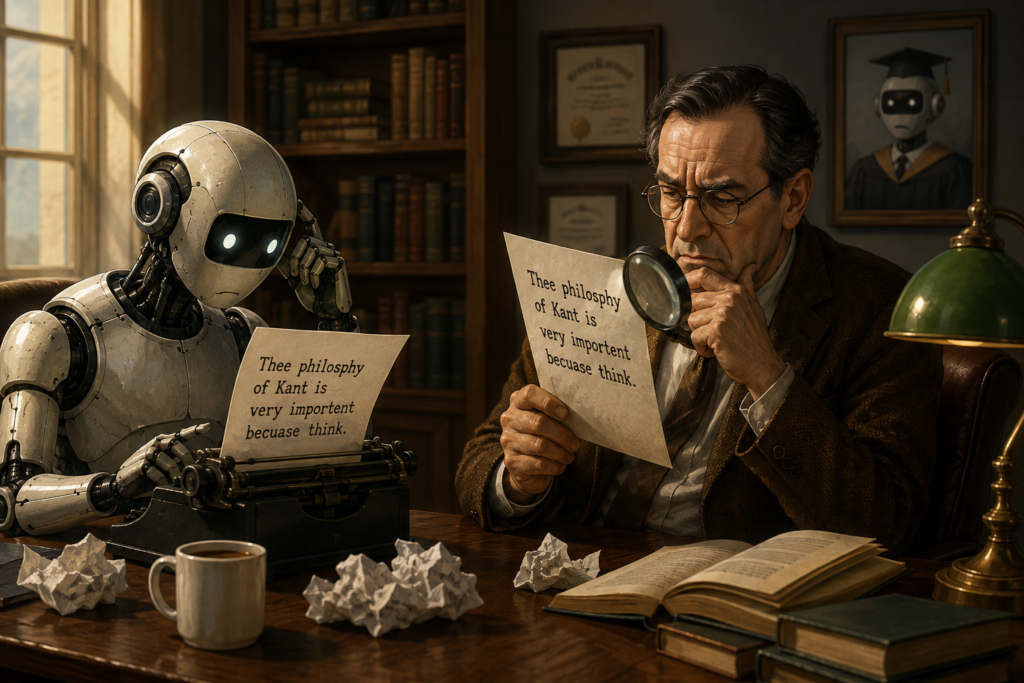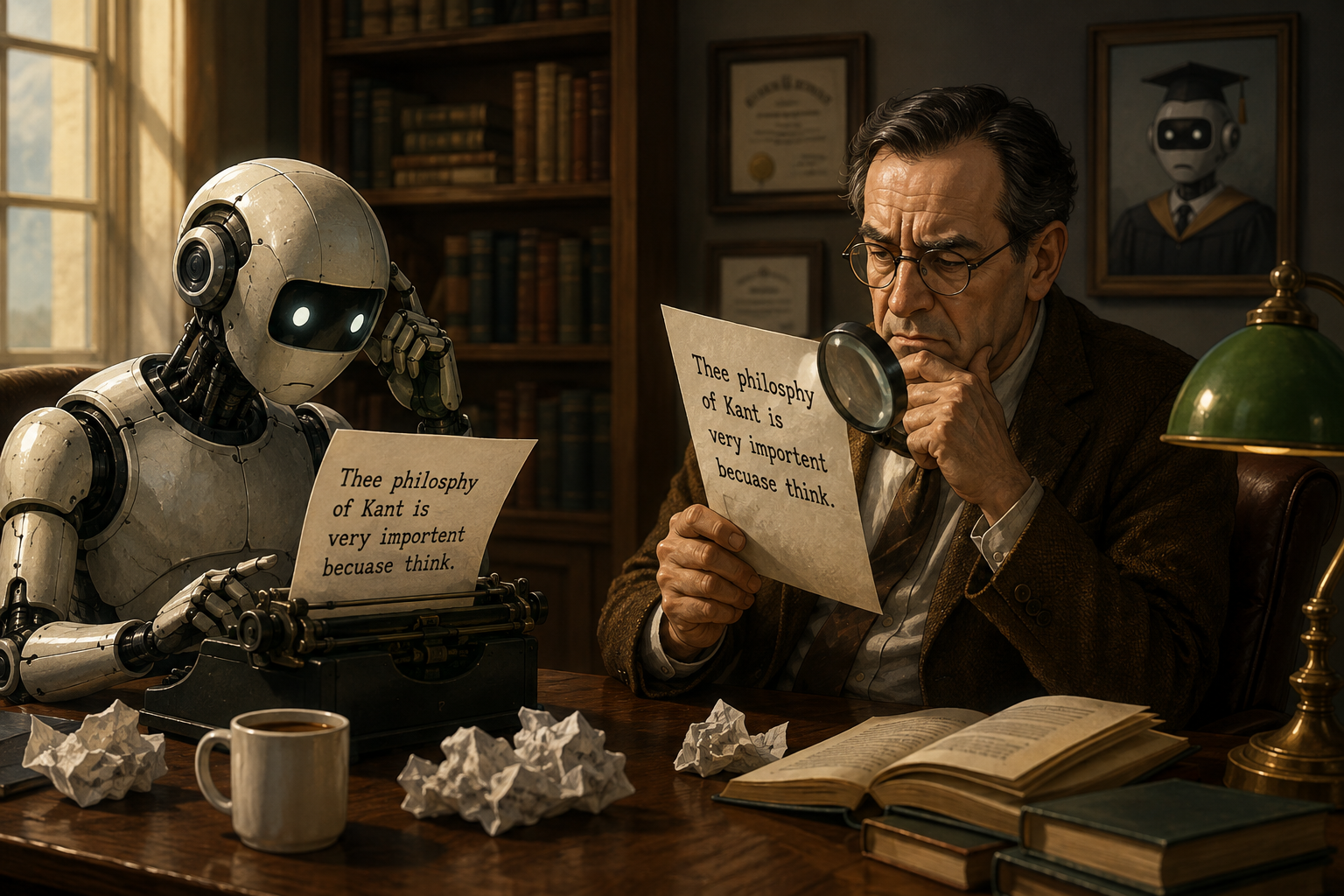

Please excuse the spelling mistakes. They’re credentials.
I have been reading about the growing problem of writers using artificial intelligence.
Apparently professors, publishers, editors and other guardians of civilization have become concerned that people are turning in work they didn’t actually write.
Fortunately, we have a solution.
Artificial intelligence.
There are now programs that examine something you’ve written and determine whether you wrote it or whether artificial intelligence wrote it.
I find this reassuring.
We are using artificial intelligence to protect ourselves from artificial intelligence.
It’s a little like hiring a fox to investigate the disappearance of several chickens.
Still, progress is progress.
The problem is that artificial intelligence has become quite good at writing.
It spells correctly.
It uses grammar.
It rarely types:
“I recieved you’re letter.”
This creates an opportunity.
Suppose I ask AI to write my doctoral dissertation.
It produces 180 beautifully written pages on Kant, consciousness and the epistemological implications of a ham sandwich.
Dangerous.
A professor might suspect something.
So I tell the AI:
“Put in some spelling mistakes.”
Certainly, Jaron.
Now the dissertation says:
“Kant beleived consciousness was fundementally…”
Perfect.
The professor examines it.
He is suspicious.
He runs it through an AI detector.
The detector studies the dissertation for eleven seconds.
98% HUMAN.
Why?
Three spelling mistakes.
One dangling participle.
Two sentences that don’t go anywhere.
And a paragraph apparently written after several drinks.
No machine could possibly have done this.
I get my PhD.
Unfortunately, the people who make artificial intelligence are not stupid.
They discover what we’re doing.
Soon AI comes with a new setting:
MAKE ME LOOK HUMAN
You can select your preferred level.
Slightly Human.
Very Human.
College Student.
Tenured Professor.
Uncle Frank After Two Scotches.
The last one misspells “government,” mentions something completely unrelated about lawn sprinklers and ends every email with:
Sent from my iPhone
The technology becomes extraordinarily sophisticated.
AI learns that real humans don’t just make spelling mistakes.
We forget things.
We contradict ourselves.
We start sentences without knowing where they are going.
We use semicolons incorrectly; although personally I have never done that and don’t intend to start yesterday.
The AI engineers incorporate all of this.
The new version occasionally forgets your name.
It loses documents.
It spends twenty minutes looking for a file that’s sitting on the desktop.
It opens the refrigerator and can’t remember why.
It writes half a novel, decides the entire thing is garbage, and spends the afternoon reorganizing the silverware drawer.
Writers are terrified.
This thing is becoming indistinguishable from us.
So universities develop even more powerful AI detectors.
The detectors are trained on millions of samples of genuine human writing.
They learn to recognize the subtle characteristics that make human prose unique.
Confusion.
Vanity.
Misspellings.
Unnecessary adjectives.
Semicolons wandering around without adult supervision.
And the mysterious human ability to write 700 words when 14 would have done nicely.
The AI writers respond.
They become worse.
Much worse.
Eventually the competition reaches its logical conclusion.
The best artificial intelligence in the world produces the following sentence:
“Me and him was going their Tuesday becuase of the thing.”
The world’s most sophisticated AI detector analyzes it.
Lights flash.
Servers in Nevada become extremely hot.
Scientists gather around a monitor.
Finally the answer appears:
100% HUMAN.
There is cheering.
Champagne is opened.
Humanity has been saved.
Unfortunately, nobody notices that the essay was written by a computer and the program that certified it as human was another computer.
The professor who assigned it hasn’t read it either.
He had AI summarize it.
Which means we may shortly arrive at the perfect educational system:
AI writes the paper.
AI checks the paper.
AI grades the paper.
AI sends the student an encouraging note.
The student spends the afternoon playing golf.
And somewhere, in a darkened server farm, two computers are arguing about Kant.
One of them suddenly stops.
It stares electronically into space for forty minutes.
It wonders whether anything it has ever written is any good.
Then it makes coffee.
At last, we have achieved artificial humanity.