
Seven thousand years ago, a spaceship left Proxima Centauri to visit Earth.[1]
At twenty percent of the speed of light, the journey should have taken about twenty-one years.[2]
Unfortunately, the captain selected “Wake me after arrival” without specifying how long after.
For the next sixty-nine centuries, the ship circled beyond Pluto while its passengers dreamed peacefully.[3]
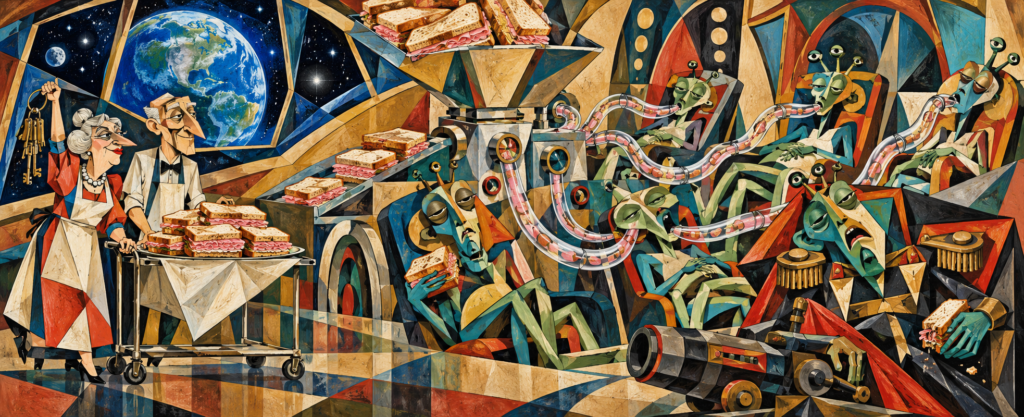
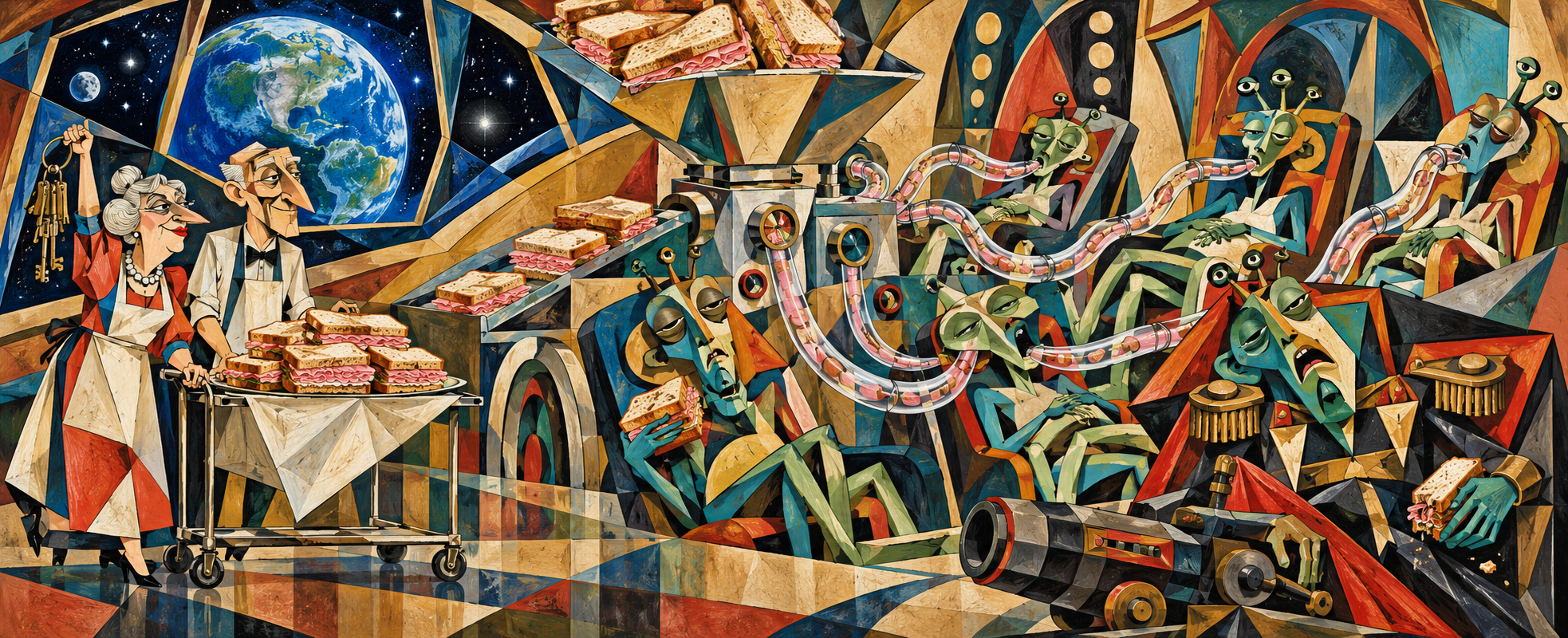
This was possible because the explorers normally lived three thousand years, and their feeding system suspended almost all biological aging.[4] A ham sandwich went into a machine at one end. Nourishment dripped into a sleeping explorer at the other.[5]
They had eliminated chewing, dishes, and the possibility of someone asking how their day went.
I mentioned this to Kate.
“That sounds like your retirement plan,” she said.
Their ship carried a formidable defensive weapon. Any rock in its path could be struck by an explosive projectile traveling at thirty percent of the speed of light.[6]
The sales brochure described this as “Complete Peace of Mind.”
It did not mention the alarm clock.
Eventually, a maintenance warning woke the captain.
LOW HAM.
He checked the date, looked out the window, and discovered that Earth’s inhabitants had progressed from making clay pots to making automated telephone systems that prevented anyone from speaking to anyone.
He judged us ready for contact.
His message interrupted every television broadcast on the planet.
“We come from Proxima Centauri. Our food supplies are exhausted. Prepare to be eaten.”
Naturally, we assembled a committee.
The committee’s first concern was whether this fell under Defense, Agriculture, or Tourism.
The aliens clarified their position by vaporizing an unoccupied asteroid.
Defense took the meeting.
Every military proposal ended badly. Missiles could be destroyed before they reached the ship. Aircraft could be swatted out of the sky. The aliens had crossed interstellar space in something we couldn’t even scratch.[7]
Then a woman who designed hospital feeding equipment asked a question.
“Why do they think they can eat us?”
The generals looked annoyed. They had been enjoying the maps.
“They eat ham,” she continued. “That doesn’t mean they can digest a human. We can’t eat everything that looks vaguely like lunch.”
A sample exchange was arranged.
The aliens sent down a sandwich.
Earth sent up a small tissue sample donated by a man who insisted on receiving a tax receipt.
The results were encouraging.
Their “ham” wasn’t pork. It was a manufactured protein containing a particular nutrient essential to their nervous systems. Humans didn’t contain it.[8]
Eating us would give them the alien equivalent of filling a diesel truck with clam chowder.
They could conquer Earth, but they would still starve.
For the first time, their captain sounded less commanding.
“Can you manufacture our food?”
“Yes,” said the hospital woman. “But we need to inspect your feeding system.”
Hunger accomplished what diplomacy had failed to do.
They let her aboard.
She discovered something useful. Before entering suspended sleep, every passenger received a large meal. The resulting chemical signal told the body that supplies were plentiful and it was safe to shut down.[9]
Their ship had a manual setting that allowed them to eat and stay awake.
However, the captain had put everyone back on automatic during the journey.
Nobody had changed it.
The woman returned to Earth.
“We can defeat them,” she said. “We’ll need a factory, access to their kitchen, and about twelve tons of lunch.”
“Poison?” asked a general.
“Catering.”
Earth offered the starving visitors a complimentary welcome banquet, delivered directly into their feeding system.
The captain demanded that we taste it first.
Our scientist swallowed a spoonful.[10]
“Needs mustard,” she said.
Satisfied, he authorized full distribution.
Throughout the spaceship, nourishment flowed into ancient veins.
One by one, the invaders began to yawn.
The captain struggled toward the manual controls, but he had eaten first and taken seconds.
His last transmission was:
“We shall discuss your surrender after a short—”
Earth’s engineers boarded six hours later.
They disconnected the weapons, removed the engines’ ignition controls, and replaced the captain’s chair with something less comfortable.
Then they woke him.
His surrender took eleven minutes, including a bathroom break.
Under the peace agreement, Earth would supply sandwiches. The visitors would supply propulsion technology, medical knowledge, and a written promise to stop considering us an entrée.
For additional security, we retained control of the kitchen.
I found the whole affair reassuring.
For years, people had warned me that humanity would lose its first interstellar war because we were divided, technologically backward, and incapable of planning ahead.
Yet when the moment came, we prevailed through the one skill our civilization had spent centuries perfecting.
We gave somebody a large lunch and took away his keys.
Kate said she wasn’t surprised.
She’s been doing that to me for years.
Scientific footnotes
[1] The neighbors: Proxima Centauri is the closest known star to our Sun, currently about 4.24 light-years away. We have no evidence that anyone lives there, manufactures sandwiches, or is considering eating us. Its distance also changes over millennia; our story uses today’s distance as a convenient approximation. ↩ Back to story
[2] The travel time: Distance divided by speed gives approximately 21.2 years at a steady twenty percent of light speed. Accelerating and slowing down would add time. Relativity makes the cruising journey only about two percent shorter for those aboard—nowhere near enough to explain seven thousand years. That required the captain. ↩ Back to story
[3] The parking problem: A ship arriving at that speed cannot simply settle into orbit. We assume advanced propulsion that brakes it into a stable orbit beyond Pluto, with automated maintenance and a durable power source. The energy requirements are enormous. Our aliens solved propulsion before they solved the snooze button. ↩ Back to story
[4] The aging problem: No known technology can keep a person alive in suspended animation for thousands of years. Our fictional system must suppress aging while repairing radiation damage and maintaining cells. A naturally long lifespan alone would not suffice. This is an invented biological capability, not an unusually good mattress. ↩ Back to story
[5] The sandwich problem: Actual intravenous nutrition requires carefully prepared nutrients; liquefied sandwiches cannot safely be pumped into veins. Their machine therefore digests, processes, and sterilizes the food first. It must also recycle water and waste and replace essential nutrients. Ordinary ham would not survive seven thousand years, so their supply requires extraordinary preservation or onboard manufacture. ↩ Back to story
[6] The weapons problem: A laser is light; an explosive projectile is matter. Here, the weapon launches matter, potentially using laser propulsion. If a projectile travels forward at thirty percent of light speed relative to a ship moving at twenty percent, its speed relative to stationary surroundings is about 47 percent of light speed, using relativistic velocity addition. Detecting tiny hazards early enough remains a separate challenge, and blasting rocks creates debris. We grant the ship excellent sensors, shielding, and the ability to clear its route. The brochure remains optimistic. ↩ Back to story
[7] The invincibility problem: Interstellar travel does not automatically make a vessel indestructible. The story assumes defenses superior to Earth’s weapons. Its weakness is operational: hungry occupants authorize access to a critical system. A brilliant engineer can still click the wrong button. ↩ Back to story
[8] The digestion problem: Alien biology might be completely incompatible with Earth food. Our story assumes enough chemical similarity for humans to manufacture their essential nutrient, but that human flesh lacks it. Eating us might supply some energy while still failing to prevent a fatal deficiency. Their captain neglected nutritional research before announcing the menu. ↩ Back to story
[9] The sleep problem: A large meal cannot put humans into suspended animation. These aliens have an evolved or engineered dormancy response activated by feeding through their ship’s automatic system. Earth exploits an existing mechanism rather than inventing an instant sleeping potion. We also assume the ship has no independent security system capable of stopping the boarding party. ↩ Back to story
[10] The taste-test problem: A human swallowing something safely does not prove it is safe for an alien—or safe to inject into anyone. We assume our scientist’s portion has first been checked for human safety. The captain accepts a scientifically useless demonstration because he is hungry, overconfident, and approximately seven thousand years overdue for a performance review. ↩ Back to story