Kate and I recently decided to simplify our lives.
This is how elderly people announce the beginning of a disaster.
“We have too much stuff,” I said.
Kate looked around the room.
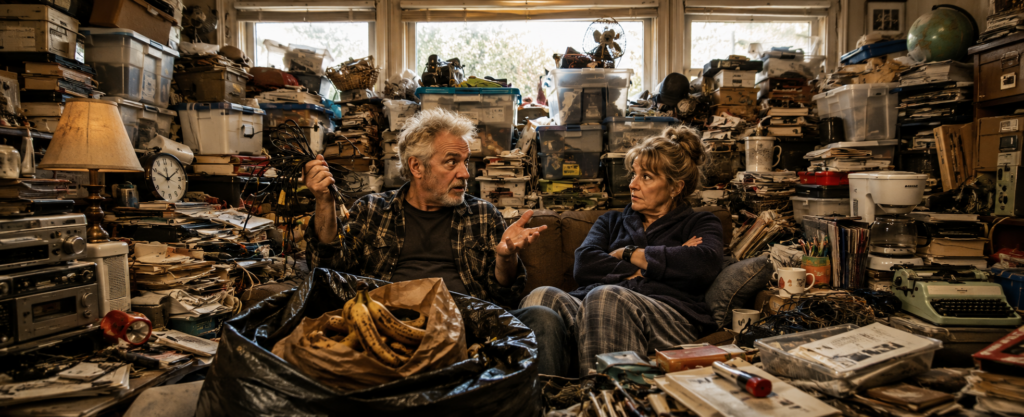
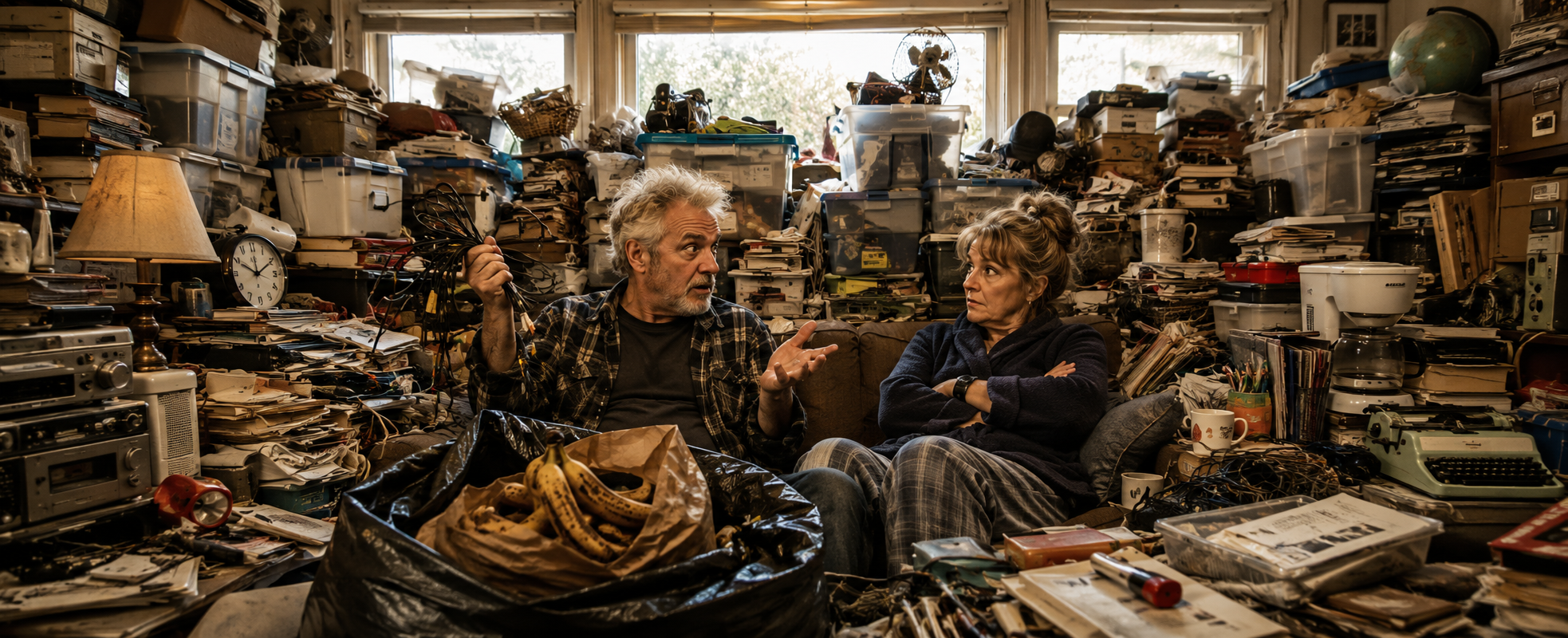
This took several minutes because portions of the room have not been visible since the first Obama administration.
“We do have a lot,” she admitted.
That was all the encouragement I needed.
I immediately entered what experts call the Delusional Phase of Organization.
Within minutes, I was holding up random objects like an archaeologist excavating a doomed civilization.
“Do we really need this?” I asked.
Kate glanced over.
“What is it?”
“I’m not entirely sure.”
“Then yes,” she said. “Probably.”
This is how clutter survives.
Every object, if it remains in a house long enough, develops emotional, historical, financial, medical, legal, or apocalyptic value.
I picked up a tangle of electronic cables.
“These go,” I declared.
Kate narrowed her eyes.
“One of those might belong to the external drive with your television scripts.”
I slowly placed the cables back down.
This is how fear enters the process.
Soon every object begins radiating possible catastrophe.
I found an ancient key.
“What does this open?” I asked.
“We don’t know,” Kate said.
“Then why are we keeping it?”
“What if it opens something important?”
Such as what?
A lost railway vault?
Churchill’s cigar humidor?
The emergency launch system for Canada?
And yet she had a point.
The moment you throw away an unidentified key, the universe immediately reveals the thing it opens.
This is one of the fundamental laws of physics.
I moved to the kitchen, determined to regain momentum.
“Now this,” I said, holding up faded instruction manuals, “can definitely go.”
Kate took one from my hand.
“That’s for the bread maker.”
“We haven’t used that bread maker in ten years.”
“Yes,” she said. “But the moment we throw away the manual, we’ll find the bread maker.”
This was becoming psychologically expensive.
I tried philosophy.
“People think they’re organizing their lives,” I said, “but mostly they’re buying containers for things they were supposed to throw away.”
Kate nodded.
“That’s true.”
I sensed victory.
“The first container is optimism,” I said. “The second container is surrender.”
“That’s good,” Kate admitted.
“The modern world has convinced people that rearranging objects is the same thing as improving themselves.”
Kate looked toward my office.
“What about the six storage bins labeled WRITING NOTES?”
“That’s different.”
“How?”
“Those are creative.”
Inside those bins were dead batteries, Radio Shack receipts, a cassette recorder, fourteen mystery adapters, three unread books on productivity, and enough paper clips to stabilize a suspension bridge.
But in my mind this was not clutter.
This was research.
Clutter, like madness, is something other people have.
Still, I pressed forward.
I began tossing things into a garbage bag.
Old magazines.
Broken headphones.
A flashlight that only worked during emotional emergencies.
Then I made a terrible mistake.
I picked up a small paper bag containing ancient banana skins.
“Finally,” I said. “Something obviously useless.”
Kate’s expression changed.
“Don’t throw those away.”
“You cannot be serious.”
“Banana peels are useful.”
“For what?”
“You can polish shoes with them.”
“We have never polished shoes with banana skins.”
“You can compost them.”
“We don’t compost.”
“You can use them for plants.”
“We don’t have plants.”
“You can dry them.”
I stared at her.
“For what possible reason would we dry banana skins?”
Kate folded her arms.
“You never know.”
And there it was.
The four most dangerous words in the English language.
You never know.
Civilization itself may be built upon those words.
Nobody throws anything away because deep inside every human brain lives the terrifying belief that the discarded object will become urgently necessary eleven minutes after disposal.
This explains garages.
This explains storage lockers.
This explains why people rent buildings to protect plastic Christmas decorations, broken fans, and exercise equipment purchased during medical optimism.
I sat down.
“Maybe people aren’t supposed to simplify.”
Kate nodded.
“Look at history. Writers work in cafés. Monks worked in cells. The Romans built bathhouses full of noise, gossip, politics, exercise, massage, and naked senators.”
“And they built roads that lasted two thousand years,” I said.
“Exactly. Meanwhile we can’t throw away a banana peel.”
We both sat quietly.
Then Kate looked toward the living room window.
“Can you still see outside?”
I turned.
Not really.
Several towers of carefully preserved belongings had migrated upward until the lower half of the windows resembled an archaeological dig.
Sunlight now entered the house only after negotiating with extension cords and unidentified chargers.
“We may have crossed some kind of line,” I said.
Kate nodded.
“Probably around the third container.”
Outside, somewhere beyond the cardboard and memory boxes, civilization continued.
Inside, Kate and I sat in the dim glow of accumulated optimism, surrounded by enough possibly useful objects to survive either a small electrical outage or the collapse of Western society.
Somewhere beneath the extension cords, expired warranties, mystery adapters, and emotionally significant banana skins may be two or three major motion pictures.
Possibly award winners.
As soon as Kate and I locate our address book, dear reader, we plan to send the ideas directly to you before Netflix gets involved.