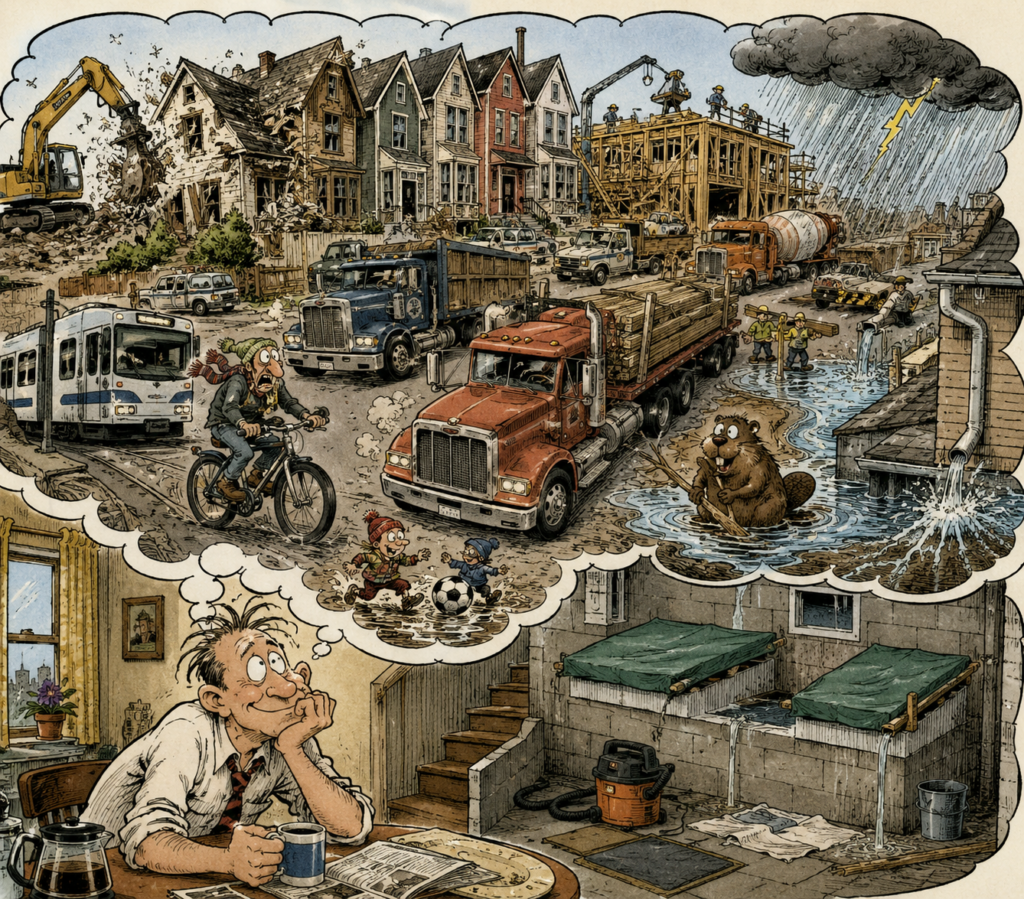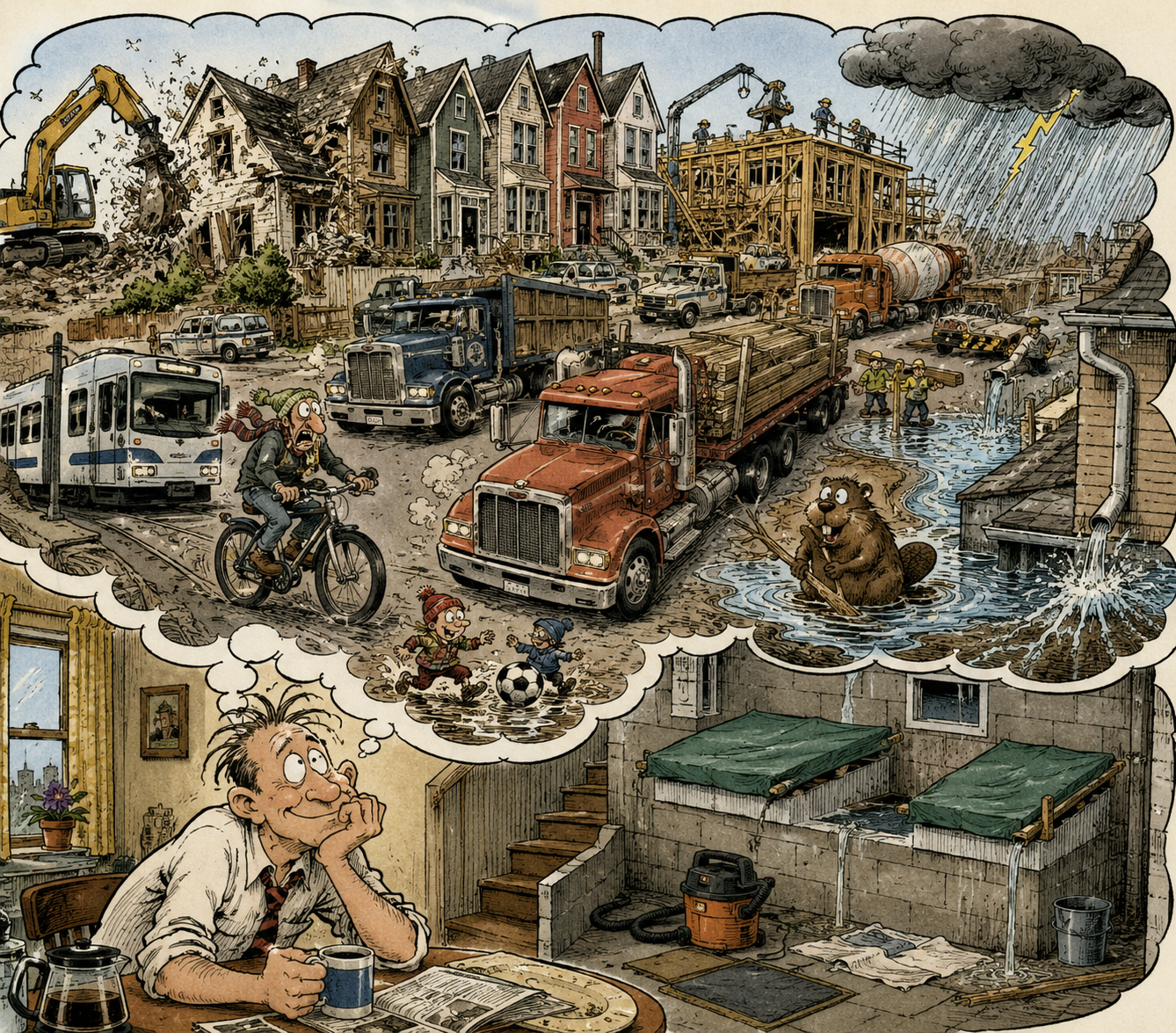

We live in a beautiful old neighborhood in Edmonton. Or at least we did until somebody at City Hall discovered density.
Density is one of those soothing planning words. It sounds much better than, “Let’s knock down one perfectly good house and replace it with enough housing for a minor republic.”
Our house is on the corner of 78 Avenue in Belgravia, one block from the LRT.
The walk to the station takes about 30 seconds.
In my case, 40 seconds.
I limp.
Apparently this extra ten seconds has made us prime targets for urban transformation.
The theory is that if you live close enough to the LRT, you will not need a car.
You will walk.
Or bicycle.
This is an excellent theory.
Especially in January.
At forty below, bicycling is delightful if your destination is a heated ambulance.
Our little section of 78 Avenue is now one-way, and it dead-ends near the LRT.
Massive construction is going on just beyond us.
The city bought several houses near the dead end and is planning access through the back alley.
This is the alley where neighborhood children have traditionally played.
Apparently they were underutilizing valuable transportation infrastructure.
Meanwhile, developers have been buying perfectly good houses, knocking them down, and replacing them with considerably more humanity.
Where there was once a house, a lawn, a lilac bush and perhaps a retired professor muttering about squirrels, there can now be multiple skinny houses, suites, rentals and parking areas.
The planning theory says this is fine because the new residents can use bicycles and the LRT.
Parking is therefore less important.
Cars are yesterday.
Except during construction.
Construction requires vehicles roughly the size of Prince Edward Island.
Eighteen-wheelers arrive carrying lumber, concrete, drywall, machinery and what appears to be the structural framework for Calgary.
They park outside our house.
Sometimes for hours.
They wait for their turn to reach the construction site.
Then, because the street dead-ends, they have to back up.
This has given us excellent entertainment.
There is something wonderfully modern about designing a neighborhood for bicycles while filling it with trucks large enough to transport a small cathedral.
Then the trades arrive.
The plumbers have trucks.
The electricians have trucks.
The carpenters have trucks.
The roofers have trucks.
The excavators have trucks.
The supervisors have trucks.
The only people in the entire development plan who apparently do not own automobiles are the people who have not moved in yet.
Then Edmonton had rain.
A lot of rain.
For a while, our basement was receiving forty or fifty gallons of water during bad storms.
This was inconvenient.
We considered expensive waterproofing.
Then we decided to become beavers.
Beavers are excellent engineers.
They do not have degrees.
They do not hire consultants.
They do not hold public hearings.
They do not commission a twelve-million-dollar study to determine whether water runs downhill.
They look at water and think:
I don’t want it there.
Then they put it somewhere else.
So that’s what we did.
We repaired five roof leaks for about $2,000.
That stopped the roof leaks.
Completely.
Then we cleaned the gutters.
We extended the downspouts.
We dug little trenches several feet long so water would head toward the alley and avenue, both of which are lower than our house.
And we covered the basement window wells with waterproof tarps anchored to the house.
When rain threatens, we can unroll the tarps in about five minutes.
When the storm passes, we roll them back up in about five minutes.
This is our version of municipal infrastructure.
Total cost of the removable waterproofing system: about $700.
Our neighbor had professional waterproofing done for about $27,000.
During one of the worst storms, she had a few quarts of water to vacuum up.
So did we.
Yesterday our rain gauge recorded 10.41 millimetres.
Most of it arrived in short bursts totaling roughly half an hour.
Our roof leaked exactly nothing.
Our basement leaked exactly nothing.
We have towels strategically placed on the basement floor.
Bone dry.
The wet vacuum has not been used for several days.
Neither have the mops.
I am not suggesting our $700 collection of tarps, anchors, gutters and trenches is identical to a $27,000 professional waterproofing job.
That would be silly.
Professional waterproofing comes with excavators, engineers, drainage membranes and impressive invoices.
Ours comes with a ladder and a man who limps.
But we accidentally discovered something beavers have understood for several million years:
Water cannot enter your basement if you persuade it to go somewhere else.
This has caused me to reconsider urban planning.
Perhaps Edmonton does not need more consultants.
Perhaps it needs more beavers.
A beaver would look at our neighborhood and immediately understand several things.
Water runs downhill.
Eight homes contain more people than one home.
More people usually generate more traffic.
An eighteen-wheeler is not a bicycle.
And if you put more and more people onto the same narrow street without increasing the capacity of the street, eventually you discover something urban planners call “transportation pressure.”
The rest of us call it traffic.
None of this requires a master’s degree.
It requires being a moderately observant rodent.
I do not think developers are villains.
Developers do what developers do.
If the city says you may buy one property, replace the house with considerably more housing and sell the result for considerably more money, somebody is going to do it.
I probably would.
Nor do I have evidence that anybody at City Hall is taking bribes.
Suspicion is not evidence, and I would much rather make fun of policies I can actually see than accuse people of crimes I cannot prove.
The interesting question is simpler.
When somebody profits from increasing the density of a neighborhood, who pays for everything that happens outside the property line?
Who provides the extra street capacity?
Who provides parking?
Who deals with construction traffic?
Who maintains the alleys?
Who handles the stormwater?
Who makes sure an eighteen-wheeler backing toward an alley does not encounter a six-year-old coming the other way?
Those are not arguments against new housing.
They are arguments for arithmetic.
You cannot simply multiply the number of people, divide the number of parking spaces, subtract the cars and call the remainder urban planning.
Edmonton may ultimately prove that its new approach works beautifully.
I hope it does.
I love this city.
I love our neighborhood.
And I love being one block from the LRT.
Thirty seconds away.
Forty if you’re me.
But sometimes I look out the window at an eighteen-wheeler sitting outside our supposedly car-optional neighborhood and wonder whether we have confused an aspiration with a fact.
Meanwhile, Kate and I will continue operating our own public works department.
When rain threatens, we deploy the tarps.
The water hits them.
It runs away from the house.
The basement stays dry.
No committees.
No consultants.
No feasibility studies.
No rezoning hearings.
No 147-page report explaining that gravity is still under review.
Just gravity.
So far, gravity has an excellent record.
And if the City of Edmonton ever needs us, our consulting firm is ready.
Jaron, Kate & Associates.
Urban Planning and Beaver Works.
Specialists in water diversion, common sense and extremely short walks to the LRT.
Payment in advance.
We accept cash, lumber or reasonably fresh willow branches.