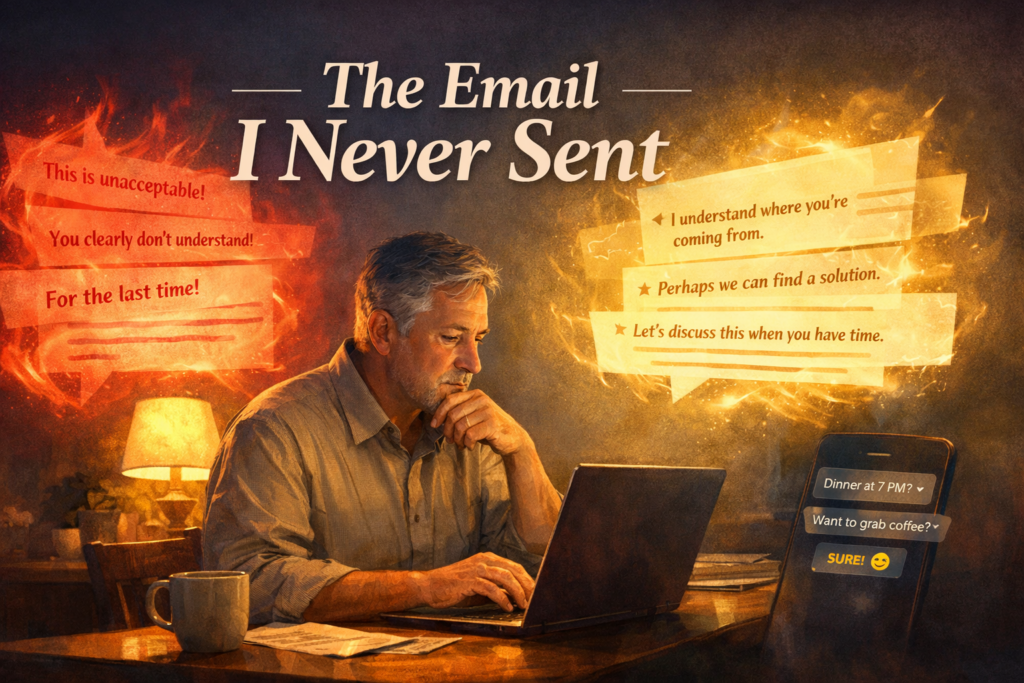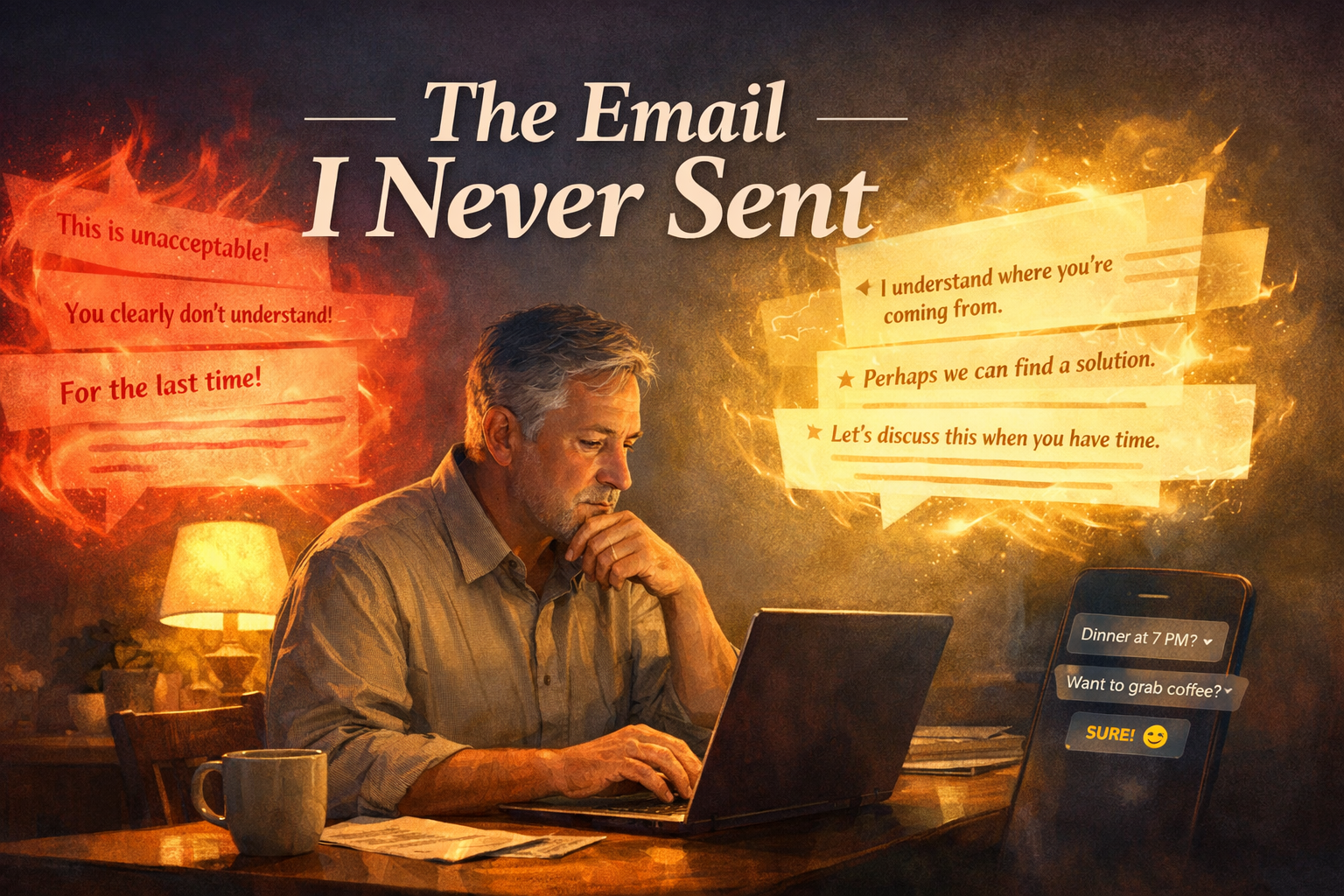
I have ended friendships that took forty years to build in under a minute.
Not with a knife. Not with a fist. Not even face to face.
With an email.
Not just any email, either. A magnificent one. A scorching, beautifully reasoned, morally airtight email written in the white heat of absolute certainty.
You know the kind.
It has clarity. It has force. It has the rhythm of justice. It may also contain phrases like “for the last time,” “you clearly don’t understand,” and that old diplomatic favorite, “let me be perfectly clear,” which has never improved a relationship in the history of civilization.
In the old days, I would write one of these masterpieces, read it once or twice, admire its balance of logic and restrained fury, and then—like a pilot with complete confidence in his instruments—press Send.
Then I would wait.
What came back was rarely what I expected.
First, silence. Then distance. Then, in a few memorable cases, the quiet extinction of relationships that had taken decades to build and roughly forty-seven seconds to dismantle.
I once saw a man I had known for years at a gathering after one of these email episodes. We both examined the food table with tremendous concentration. The guacamole held up better than the friendship.
That was when I began to understand something useful and slightly humiliating:
Anger does not read like clarity.
It reads like you’re loading a weapon.
A Small Adjustment
Recently, I made one small change that may have saved me from becoming a lonely old man with excellent grammar.
Now, instead of sending the dangerous email to the person who inspired it, I send it somewhere else first.
Not to a friend. Not to my wife. Certainly not to the wounded party.
I send it to ChatGPT.
I take my finest, most devastating draft—the one that would end matters cleanly, permanently, and with several phrases I would later deny writing—and I give it a simple instruction:
Make this warm and friendly.
That is when something almost supernatural occurs.
The email comes back recognizable, but transformed. The issue is still there. The concern is still there. The point I wanted to make has not been neutered, blurred, diluted, or sent to finishing school.
But the tone has changed.
The sharp corners are gone. Accusations become observations. Sentences that sounded like indictments now sound like invitations to talk. Final judgments quietly downgrade themselves into possibilities.
It is the difference between saying, “You have behaved like a baboon in slacks,” and, “I may have misunderstood your intention here.”
Oddly enough, people respond better to the second version.
The Results
The results have been, frankly, suspicious.
People who, based on my original draft, should have been assembling legal counsel or hiding the good silver… call me.
They say things like:
“Let’s talk.”
“Maybe we should grab dinner.”
“Come by Starbucks—I’ll get the first round.”
I read these replies with mild astonishment, like a man who showed up for a duel and was handed a muffin.
It appears most people are not opposed to resolving things.
They are simply opposed to being attacked with punctuation.
What I Learned, A Little Late
There are two emails in every conflict:
- The one you want to send.
- The one that might actually work.
The first is written by your ego, your injury, your history, and the part of your mind that would like to deliver a closing argument while the courtroom rises in admiration.
The second is written by the wiser, duller, more effective part of you that would prefer to solve the problem and keep the relationship alive.
For years, I trusted the first one.
It had passion. It had momentum. It had style. It made me feel like a man of principle standing alone against the collapse of civilization.
Unfortunately, the jury was never as impressed as I was.
The Cooling Chamber
What I have now is a kind of cooling chamber.
A place where the heat can burn off before anything irreversible happens.
I still write the angry email. In full. If anything, I write it better than ever. My inner prosecutor remains active, eloquent, and occasionally magnificent.
But he no longer gets final edit.
The draft goes into the machine hot and comes back fit for human consumption.
That is no small thing.
Because the real problem is not that the first draft is false. Quite often it is brutally, exquisitely true.
The problem is that truth delivered without mercy is often heard as contempt. And contempt is one of the fastest ways to turn a solvable problem into a permanent one.
A Final Thought
If an email feels important, wait an hour.
If it still feels important, wait a day.
If it still feels important, rewrite it as if the future matters more than the thrill of being right.
I have not become a calmer man.
I still have opinions. I still occasionally write emails that, in their original form, could clear a banquet hall.
But I no longer trust my first draft with other human beings.
And that simple change has improved my life more than I would have thought possible.
The emails I almost sent might have cost me old friends, good evenings, and the occasional decent table at Starbucks.
The ones I send now sometimes get me invited to dinner.
Same grievance.
Different tone.
Entirely different future.
Your first draft may be honest.
Your second draft is the one that knows how to live among other people.