For years I knew a man named Gordon Keyes. What he didn’t look like was a man who had once had breakfast with Walt Disney.
He ran a Mail Boxes Etc. about 150 feet from our place, and every so often I’d go in to Xerox something, mail something, or perform one of those small adult rituals involving envelopes and false urgency. Gordon was always pleasant. Efficient. Calm.
The kind of man who handed you a receipt as if it mattered.
When I met him in the early 1970s, I was about thirty. Gordon was ten or fifteen years older—old enough to have lived a life, young enough to remember exactly where it turned.
He was Chinese, though I knew more Chinese than he did, thanks to a short and not entirely successful stretch in China. Gordon spoke the language of small business: politeness, accuracy, and just enough warmth to keep you coming back.
Which is to say, he did not look like a man who had once been invited to breakfast by Walt Disney.
Gordon had graduated from West Point and served in the Korean War.
When he came home in the mid-1950s, he stayed with his grandparents, who lived next door to Walt Disney.
Not in the neighborhood. Not down the block. Next door.
The kind of next door where fences are low, drinks are shared, and Saturday night barbecues become a standing reservation.
Walt and his wife were close to Gordon’s grandparents. They grilled, laughed, and enjoyed the easy rhythm of people who had built something and were finally enjoying it.
Gordon’s grandfather said, “Walt would like to meet you.”
In Hollywood, that is the equivalent of a knighthood without paperwork.
Disneyland had just opened and was becoming world famous.
Gordon admired Walt. He wanted to be a producer. In his mind, this was not breakfast—it was a beginning.
And then came the morning.
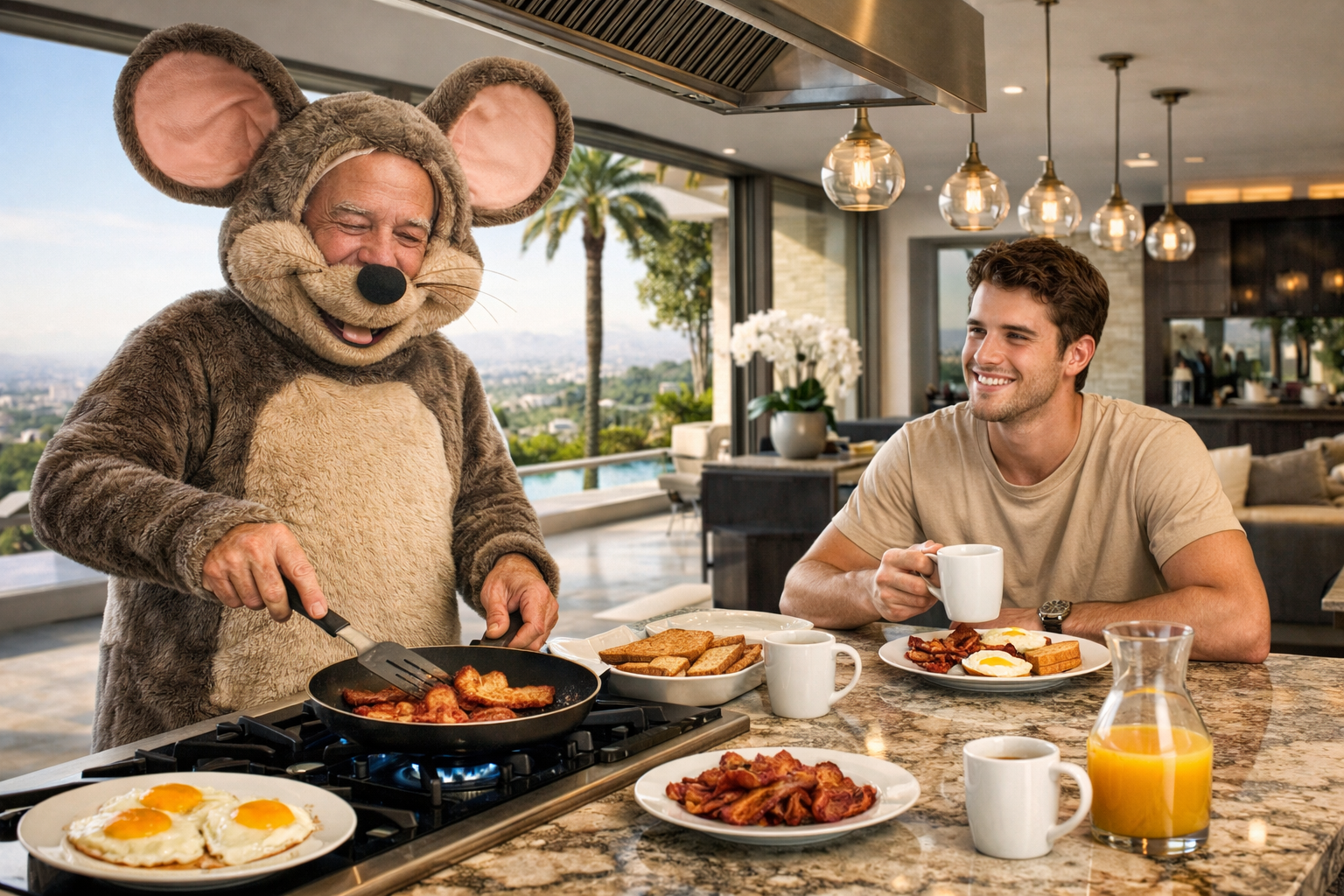
Walt made breakfast.
That matters. Men like Walt Disney don’t make breakfast. They delegate it. They invent it. They franchise it.
But that morning, he cooked.
Eggs. Bacon. Coffee. Opportunity, lightly salted.
Gordon sat across from him, eating a meal prepared by a man turning orange groves into a kingdom.
And Walt liked him.
West Point. Military service. Grandson of a trusted friend. Gordon checked every box that mattered.
Then Walt did something extraordinary.
He handed Gordon a pass.
Not just any pass. A pass for Gordon and seven friends to enter any Disney park—present or future. And inside each park, Walt said, there was a private VIP room where Gordon and his guests could have anything they wanted.
Food. Drink. Privilege.
A preview of membership.
Then Walt asked a question.
“What do you think of theme parks?”
If life had a soundtrack, it would stop here.
Gordon remembered his grandfather’s advice.
Always tell the truth.
So he did.
“I don’t like them,” he said. “I think they destroy entertainment. I don’t think they can succeed.”
There are moments when honesty is noble.
There are moments when honesty is brave.
And then there are moments when honesty is unemployed.
Walt stopped eating.
No anger. No speech. No drama.
He simply stopped.
Then he looked at his watch—the most elegant exit ever invented.
“Gordon,” he said, “I’ve just remembered I have an appointment. You’ll have to excuse me. You’ll have to go now.”
And then—perfectly, devastatingly—he handed him his hat.
That was it.
No second meeting. No studio tour. No slow walk into greatness. No seat at the table where futures are assigned.
Just breakfast, a question, an answer, and a door.
Gordon believed—and I think he was right—that if he had simply said, “Thank you, Walt. It’s extraordinary what you’re building,” his life might have gone differently.
He might have lived inside that kingdom.
Instead, he spent it 150 feet from me, making copies.
There is nothing wrong with making copies. Civilization depends on duplication. But the contrast is hard to miss.
On one side: breakfast with Walt Disney, a VIP pass, and the outline of a remarkable future.
On the other: padded envelopes, toner, and a very decent man behind a counter.
The lesson is not that honesty is a mistake.
The lesson is that honesty, like mustard, should be used carefully—especially at breakfast.
Especially when the man cooking it owns the future.
Some men lose fortunes in the market.
Some lose marriages in court.
Gordon Keyes appears to have lost the Magic Kingdom over eggs.