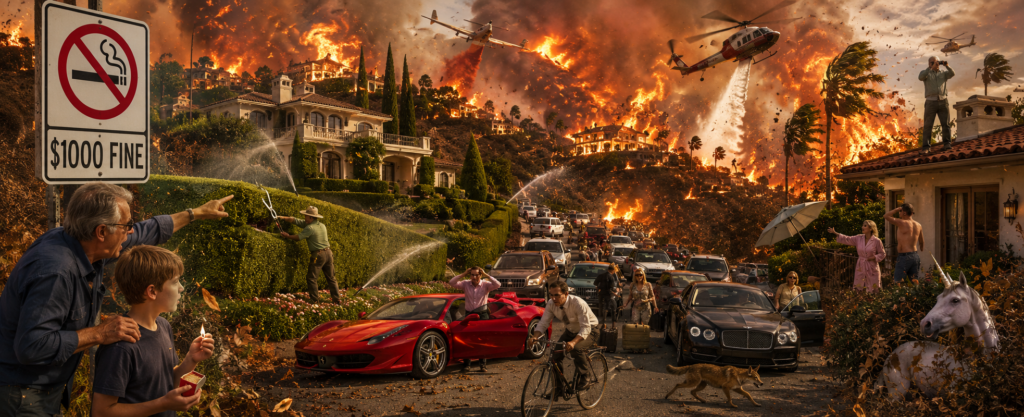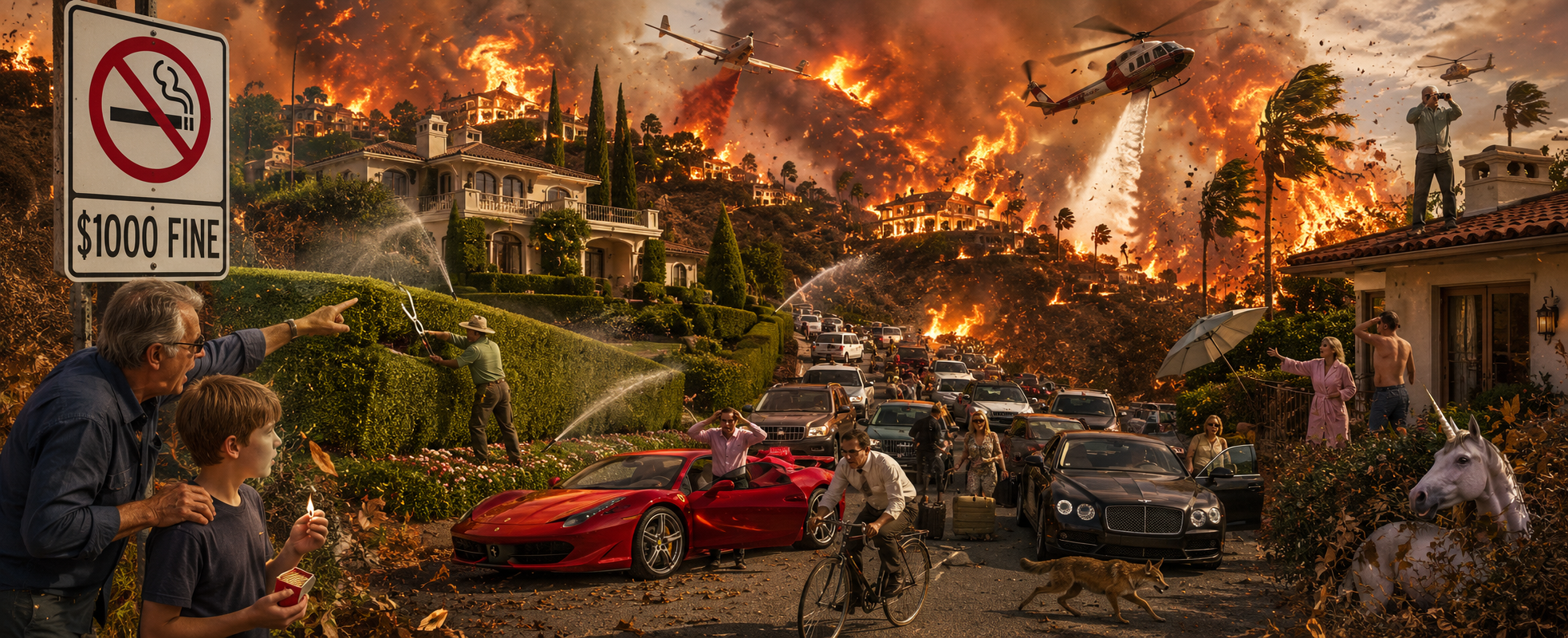

I found my nephew Mandrake standing beneath a large sign in Bel Air that read:
NO SMOKING DURING FIRE SEASON.
$1000 FINE.
Unfortunately, Mandrake was holding matches.
Not one match.
A whole box.
He also appeared to be attempting science.
“Mandrake,” I said carefully, “what exactly are you doing?”
“I was seeing if dry leaves ignite faster than newspaper.”
“Why?”
“I got curious.”
Curiosity is greatly overrated.
Curiosity gave us volcano research, reality television, and six Spider-Man reboots.
I took the matches away from him the way one removes grenades from a raccoon.
“Mandrake,” I explained, “you are standing in one of the most flammable neighborhoods in America.”
He looked around.
Birds chirped.
Sprinklers clicked peacefully.
A gardener trimmed hedges worth more than my first car.
“It seems okay to me,” he said.
That is the danger of Southern California.
Everything always seems okay right before catastrophe.
People jog casually past hillsides capable of exploding into biblical firestorms.
They sip green juice while nature quietly sharpens knives.
I pointed toward the canyons.
“You see all that brush?”
“Yes.”
“That’s basically gasoline wearing leaves.”
Mandrake nodded thoughtfully.
“In 1961,” I continued, “a fire broke out in Bel Air during Santa Ana winds. Entire neighborhoods burned. Embers flew through the air, crossed roads, leaped canyons, and landed on rooftops.”
“How far can embers travel?” he asked.
“Far enough to ruin a movie producer’s week.”
The Santa Ana winds themselves deserve respect.
Those winds arrive from the desert hot, dry, and insane.
Old trees bend sideways.
Outdoor furniture migrates.
Dogs develop trust issues.
One tiny ember catches and suddenly Los Angeles transforms into a giant Weber barbecue.
“Couldn’t helicopters stop it?” asked Mandrake.
“Not always. Years ago firefighters often charged directly into the canyons. Now much of the battle depends on aircraft, defensive lines, and praying the wind develops hobbies elsewhere.
Alas, helicopters cannot safely fly in extreme winds.
Which unfortunately is exactly when the fires become enthusiastic.
That’s when rich people discover that owning six bathrooms does not automatically protect you from physics.
I once watched footage of millionaires abandoning Mercedes vehicles while trying to flee narrow canyon roads clogged with traffic.
One man had a Ferrari.
Another had a Bentley.
Neither moved faster than a frightened accountant on a bicycle.
That’s the irony of disaster.
When civilization collapses, suddenly the guy with hiking boots and bottled water becomes king.
And the fellow with the Italian sports car worth half a million dollars becomes decorative roadside furniture.
“Do you have an emergency plan?” I asked Mandrake.
“Not really.”
“Good. You’re already blending into Los Angeles.”
People here spend a hundred thousand dollars remodeling kitchens but keep approximately one flashlight for the entire household.
Meanwhile half the city parks on canyon roads barely wide enough for two squirrels to pass comfortably.
I lowered my voice.
“And occasionally,” I said, “brush fires are started by transients.”
Mandrake blinked.
“Seriously?”
“Son, this city contains people who attempt surgery on themselves after watching YouTube.”
We stood quietly for a moment.
A warm wind moved through the trees.
Somewhere in the ravine below a branch cracked.
Personally, I would not be shocked if several unicorns were hiding down there.
I simply would not invest heavily in the theory.
Mandrake mused over this and said, “I never really thought about any of this.”
“That,” I said, “is because you are young.”
Young people believe disasters happen to other people.
Older people understand that disasters happen specifically to them.
Preferably while carrying groceries.
There was a time I considered myself highly vigilant during fire season.
I even served briefly as what might be called a rooftop monitor.
If smoke appeared, I climbed onto the roof and scanned the horizon heroically like a weathered frontier scout protecting civilization.
Unfortunately, age has altered this arrangement somewhat.
I am now at the stage where climbing onto a roof sounds less like bravery and more like an insurance claim.
These days I monitor danger from indoors while seated carefully near snacks.
Mandrake looked again at the warning sign.
“So you’re saying I shouldn’t play with matches in Bel Air during fire season?”
And then I noticed the little bastard was holding a lighter.
“A hobo gave it to me,” said Mandrake proudly. “He said, ‘Have fun.’”
This was too much.
I snatched the lighter from his hand and hurled it toward a decorative fountain.
Unfortunately, it struck a tree branch, ricocheted off a rock, and produced the sort of spark normally associated with federal investigations.
For one strange second nothing happened.
The wind arrived exactly then.
Then somewhere deep in the canyon below us, something ignited.
Mandrake stared at me.
I stared at Mandrake.
Far away, a dog began barking.
And that, more or less, is how Glendale got all the screenwriters.