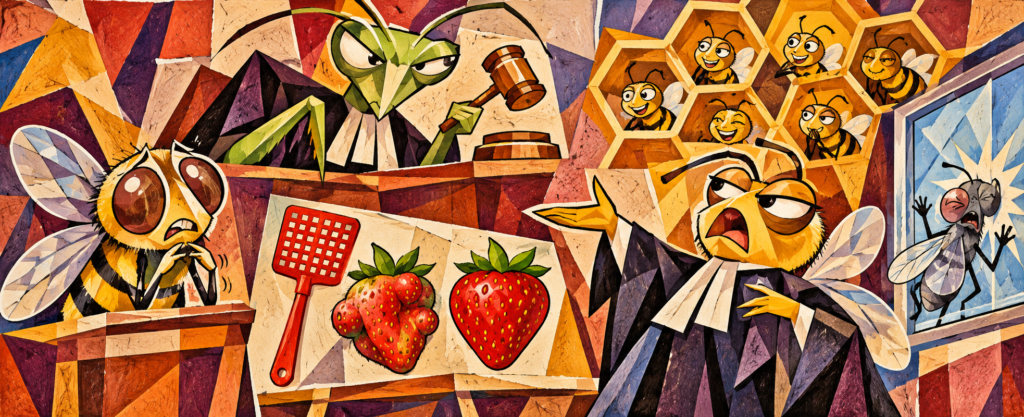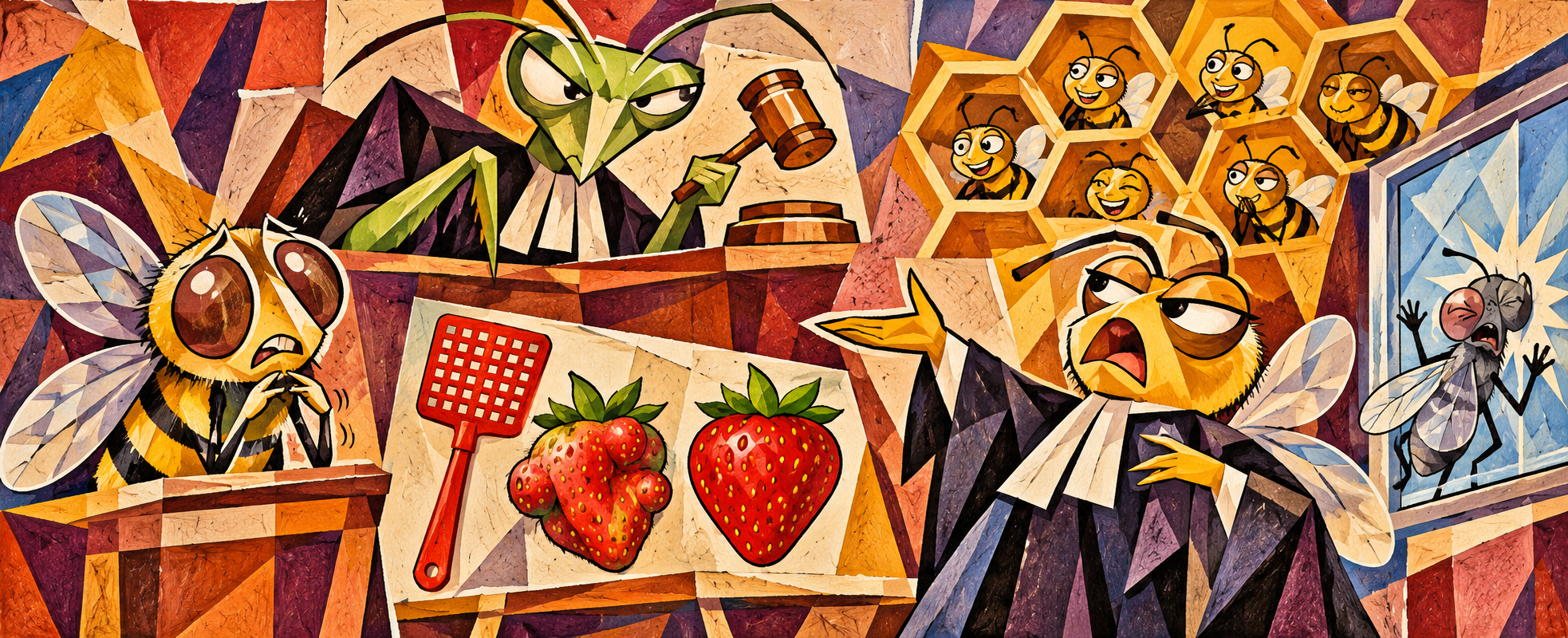
The first-ever hearing of the International Insect Tribunal was delayed twenty minutes while the bailiff tried to shoo the plaintiff out of the courtroom.1
“I’m on the docket,” said the fly.
“So were the last three,” said the bailiff. “Once you open the window, everybody says they’re on the docket.”
The plaintiff, a hoverfly named Leonard, took the stand and rubbed his front legs together.
“Let the record show,” said the honeybee’s lawyer, “that the witness is doing that thing with his hands.”
“I’m nervous,” Leonard said. “Your client brought twelve thousand relatives.”
“Those are character witnesses.”
“They’ve formed a ball around the stenographer.”
Judge Mantis asked the character witnesses to disperse. They did, taking the stenographer’s lunch with them.2
“Your Honour,” said Leonard, “I intend to prove that flies are more lovable than honeybees and that the world needs fewer fly swatters. I also intend to establish why a honeybee can show up at a picnic with a concealed weapon and everybody says, ‘Oh, look, she’s working.’”
The honeybee’s lawyer rose. “My client makes honey.”
“Yes,” said Leonard. “And the moment you put it on toast, we’re all supposed to forget what happened to the strawberries.”
The bailiff wheeled in Exhibit A, a strawberry shaped like a man trying to get out of a sleeping bag.3
Leonard had been reading Ben Crair’s piece in The New Yorker. He told the tribunal that researchers had found that honeybees can help pollinate a flower on their first visits. When they keep coming back, they can damage the flower’s reproductive parts. Studies have linked heavier honeybee traffic to smaller apples and more misshapen strawberries.
“How many visits are we talking about?” asked the judge.
“Your Honour, if I ring your doorbell once, I’m a visitor. If I ring it forty times and leave you unable to have children, I expect a stern letter.”
The court reporter asked him to repeat that last part, having just returned from looking for her sandwich.
Leonard held up a second strawberry. It looked exactly like the strawberry on a carton of strawberry yogurt, which is the highest standard a strawberry can aspire to.
“At an English farm with no stocked hives, hoverflies accounted for more than half the pollinating insects. In the researcher’s experiment, nearly sixty percent of the strawberries pollinated by hoverflies were good enough to sell. When he tried doing it himself with a paintbrush, he got about forty percent.”
“Was he a good painter?” asked the judge.
“He was a scientist, Your Honour. His parents had already come to terms with it.”4
The bee’s lawyer approached the witness.
“Mr. Leonard, you’re yellow and black. You look so much like a bee that half the people who see you in a garden assume you are one. If flies are so lovable, why do you dress like my client?”
“It gets me through the garden alive,” Leonard said. “You try looking like yourself in a world where they sell your murder weapon three to a package.”
The judge examined Exhibit B, a red plastic swatter.
“Three to a package?”
“One for the kitchen, one for the porch, and one for when you can’t remember where you left the other two. They’ve studied the customer.”5
The bee’s lawyer had one last question.
“Were you ever a maggot?”
Leonard took a sip of water.
“I was young.”
“Did you eat aphids?”
“Hundreds.”
A murmur ran through the gallery. The aphids had reserved an entire row and now wished they’d sat farther back.6
“I was doing pest control,” said Leonard. “What was your client doing at the same age?”
The honeybee leaned over to her lawyer. The lawyer leaned over to the microphone.
“Her aunts have advised her to say she had a happy childhood.”
By then, even Judge Mantis could see that Leonard had a case. Pack enough managed hives into one area and they can leave wild pollinators short of nectar and pollen. The judge ruled that honeybees could continue making honey and pollinating flowers, but that gardeners ought to make room for wild insects too. She also ordered the courthouse to get rid of two of its three swatters.
“Which one are you keeping?” asked Leonard.
“The one we can find.”
Outside, a reporter asked Leonard what ordinary people could do for flies.
“Plant a few flowers. Give us a little room. And if you see one of us at the window, open it. He’s been trying to leave for forty-five minutes.”
“How can you tell?”
“He’s hitting the glass with his face. We’re lovable. I never said we were bright.”7
Inspired by Ben Crair’s “In Defense of Flies,” published in The New Yorker on November 19, 2026.
Footnotes
- The tribunal spent six months drafting a policy on open windows. The final draft blew out the window. It was recovered in Belgium, where it is now an enforceable parking regulation. ↩
- The sandwich was later identified in a police lineup. It had been cut into twelve thousand triangles, and every bee claimed she’d just had a corner. ↩
- Exhibit A was released on bail and given a new identity. It now lives in a jar of preserves. The other strawberries have agreed to call it “Apricot.” ↩
- His mother still keeps a photograph of the paintbrush on the mantel. When people ask about her son, she says, “That’s his wife. We’re hoping for strawberries.” ↩
- In a focus group, nine out of ten customers said the swatter was easy to use. The tenth was standing on a chair trying to get a moth off the ceiling with the unopened package. He bought another one on his way home. ↩
- The aphids had booked under the name “Pea Growers’ Association.” All forty-six listed the same pea plant as their home address. The clerk asked for an emergency contact. They gave her a second pea plant. ↩
- The fly at the window turned out to be the tribunal’s chief architect. At the opening ceremony he had demonstrated the same window using a pair of scissors and a ribbon. The ribbon went through beautifully. ↩