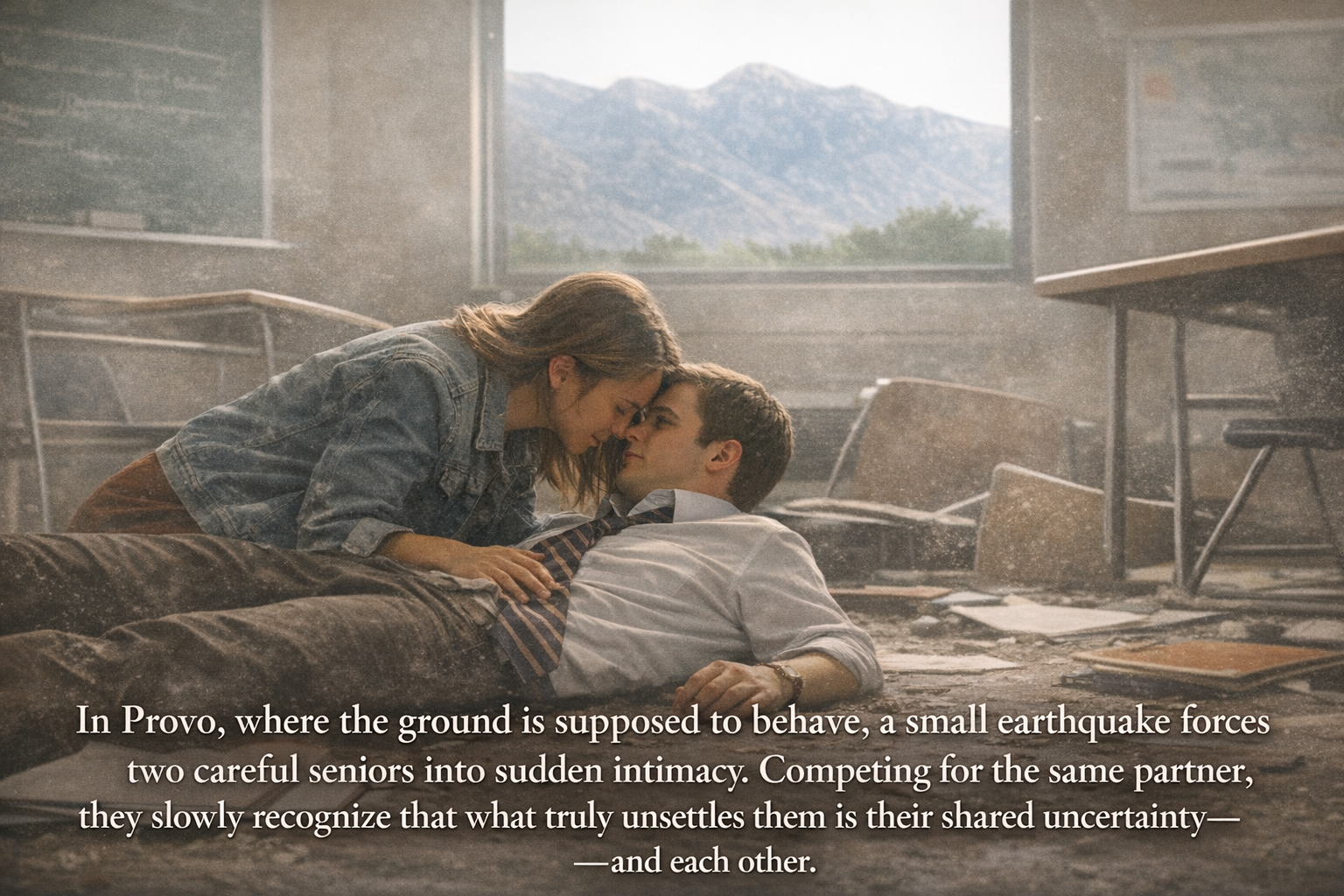
Three Minutes Ago
W…ritten by
jaron summers © 2026
The earthquake began in a classroom where no earthquake was expected.
That is not a metaphor. It is a geological fact. Provo is not Los Angeles. In Los Angeles, the ground clears its throat now and then just to remind you who is in charge. In Provo, the ground behaves. It attends church. It majors in accounting.
So when Brother Wilcox said, “In the event of seismic activity, one must avoid panic,” the floor shifted slightly to the left, as if correcting him.
No one moved.
Except me.
I was in the third row of Earthquake Preparedness 201, which I was not technically taking. I was auditing it because I missed home and because preparedness felt like a transferable skill.
Also, because the boy two seats over had asked a question the previous week about load-bearing walls that was unnecessarily thorough.
His name was David Hales. Senior. Accounting. Hair that parted obediently. He wore his student ID clipped to his belt as if he expected inspection.
The lights flickered. A binder slid off a desk. Someone laughed nervously.
David did not laugh.
He froze.
It was not dramatic freezing. It was internal. His shoulders tightened. His eyes fixed on something only he could see—perhaps a mental spreadsheet calculating odds of ceiling collapse.
The ceiling tile above him cracked.
I moved.
I have lived through four Los Angeles tremors, one of which interrupted a dinner involving a very hot pan of oil and a man who later became a cautionary tale. You do not analyze in a quake. You act.
So I tackled David.
I am not large. David is not small. The physics were imperfect.
We landed hard. My knee collided with something academic. The room tilted in what I would describe as a polite shrug.
Dust fell.
David closed his eyes.
That annoyed me.
“David,” I said. No response.
His pulse was technically present, but subtle. I could not find it immediately, which in a shaking classroom feels like an omen.
“Wake up,” I said, because that is what you say in movies.
No response.
So I did what instinct and mild panic instructed.
I kissed him.
Not romantically. Administratively.
Mouth to mouth.
It turns out that giving rescue breaths to someone who is perfectly alive but surprised is an intimate experience.
“Wake up,” I whispered. “You’re okay. You’re okay.”
The shaking stopped.
Silence settled.
David opened one eye.
“I was okay three minutes ago.”
The entire class was staring.
Brother Wilcox had one hand still braced against the whiteboard, as if the doctrine of preparedness required witness.
I was on top of David.
Which is not how I imagined my senior year unfolding.
Afterward, there were apologies.
From me. Several.
From him. Fewer.
He brushed ceiling dust off his jacket with the meticulous irritation of someone whose insurance premiums might increase.
“I was following protocol,” he said.
“You were lying down.”
“That is not the same thing.”
I liked that he did not accuse me of overreacting. He simply observed.
“I thought you were unconscious,” I said.
“I was evaluating.”
“Your eyes were closed.”
“I was assessing structural acoustics.”
“That’s not a thing.”
“It could be.”
We walked out of the classroom together because leaving separately would have implied something happened, which of course it had, but we were not prepared to classify it.
Outside, the sky over Provo was offensively calm.
“You’re from California,” he said, as if diagnosing.
“Yes.”
“That explains the tackling.”
“That explains the surviving,” I said.
He almost smiled.
Almost.
I learned later that David had signed up for Earthquake Preparedness because, in his words, “low-probability events still require mitigation.” He was going to be an accountant, and I suppose if you are the kind of person who thinks about earthquakes in Utah, you are also the kind of person who balances emotional ledgers before committing to a purchase.
We discovered our shared complication two days later.
I was at a small gathering in Heritage Halls—someone’s pre-midterm attempt at social normalcy. Mark was there. Mark was stable. Mark was admired. Mark was, in many ways, the campus equivalent of reinforced concrete.
Mark was also, it turned out, David’s date for Friday.
And mine.
The revelation arrived casually.
“Oh, you know David?” Mark said to me.
“Intimately,” David replied.
I glared.
“He saved my life,” I clarified.
“She nearly ended it,” David said.
Mark laughed, because Mark laughed at most things. Mark believed in systems. Mark believed in order. Mark believed in timelines.
David and I believed in neither, though we would not have said so aloud.
It is possible to worship someone’s certainty even while suspecting it might be quicksand.
David argued gently in favor of structures. Of staying. Of not overreacting.
I argued gently for instinct. For movement. For acknowledging when the ground shifts.
We sparred lightly. We competed politely. We dated Mark responsibly.
And all the while, I kept remembering the look on David’s face before I tackled him—not fear exactly, but calculation. As if he were trying to predict the tremor instead of feeling it.
I recognized that look.
I had worn it myself.
One evening, after a study session that drifted into theology and then into silence, David said, “Do you ever feel like we’re preparing for something we don’t actually believe will happen?”
“That’s what insurance is,” I said.
“That’s not what I meant.”
We were sitting on a bench outside the library. The Wasatch Mountains loomed with excessive confidence.
“I don’t know what I believe,” he said quietly.
The ground did not move.
But something shifted.
“I don’t either,” I said.
We did not tackle each other.
We did not kiss.
We did not solve anything.
We simply sat there, two seniors in a town built on stability, acknowledging uncertainty.
It felt more dangerous than the earthquake.
Weeks later, a minor tremor passed through campus—barely perceptible.
A few students paused. A few did not notice.
David and I looked at each other.
He didn’t close his eyes.
I didn’t tackle him.
“I’m okay,” he said.
“I know,” I answered.
And this time, the ground was honest.