
In the summer of 1964, at twenty-two, I boarded the RMS Queen Mary in Southampton, bound for New York.
I was returning from two years in New Zealand as a Mormon missionary.
The Church paid our transportation, and through some arrangement involving Pan Am, church accounting, and a God whose travel department worked in mysterious ways, I found myself aboard one of the most famous ships in the world.
I could never have afforded it.
The Church couldn’t quite afford it either, judging by my cabin.
The Queen Mary had carried thousands of Allied troops during the war, earning the name “The Grey Ghost.”
In peacetime, she carried wealthy people in magnificent surroundings and the rest of us somewhere near the machinery.
My cabin was below the waterline. I shared it with five or six young men, their socks, and what remained of the air.
If the ship sank, we would be the first to know.
Fortunately, before leaving Hong Kong, I had bought several excellent suits.
At twenty-two, I believed a good suit could get you almost anywhere. This turned out to be true, provided you didn’t stop to ask permission.
Passengers from our section were forbidden to enter first class.
After a day or two, several of us discovered that this rule depended heavily on our willingness to obey it.
We found other arrangements.
Upstairs there were orchestras, magicians, singers, dancers, and women who looked as though someone had sent them ahead to make sure the champagne was cold.
Below decks, we had socks.
I became friendly with several Ivy League boys whose fathers apparently owned everything I hoped someday to get a job at.
They drank constantly.
I didn’t drink at all.
This made me an unusual addition to their circle: a young man in a good suit who could remember the evening.
I was still trying to be a good Mormon, although my religious certainty had begun to wobble in New Zealand.
I had gone there to explain the meaning of life and returned with several questions the instruction manual hadn’t covered.
An elegant older woman took an interest in me.
She was perhaps fifty, an age I then considered advanced and now regard as barely supervised youth.
Her stateroom was worth more than my future.
She explained that she and her husband had made their fortune supplying portable toilets to construction sites.
I told her I wanted to become a writer.
She thought this was a dreadful idea.
Portable toilets, she explained, were the future.
I had spent two years preaching eternal truths. Here was a woman who had found something people actually needed.
There was also a girl about my age.
Beautiful. Sophisticated. Rich.
I had the suits.
One evening we dined together. She touched my hand and smiled, which exhausted most of my experience with women.
I walked her toward her cabin, trying to look like a man who had done this before.
For two years, I had maintained a respectful distance from women.
Now I was standing outside a beautiful girl’s door with no companion, no pamphlet, and no approved procedure.
“May I kiss you?” I asked.
“Don’t be ridiculous,” she said.
I had crossed half the world explaining what God meant.
I couldn’t work out what this girl meant.
Sixty years later, I’m still reviewing the evidence.
Two nights later, the voyage changed.
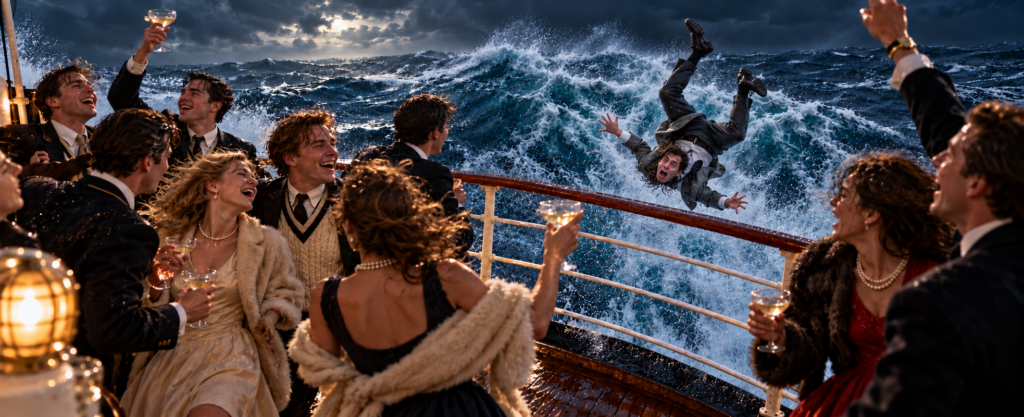
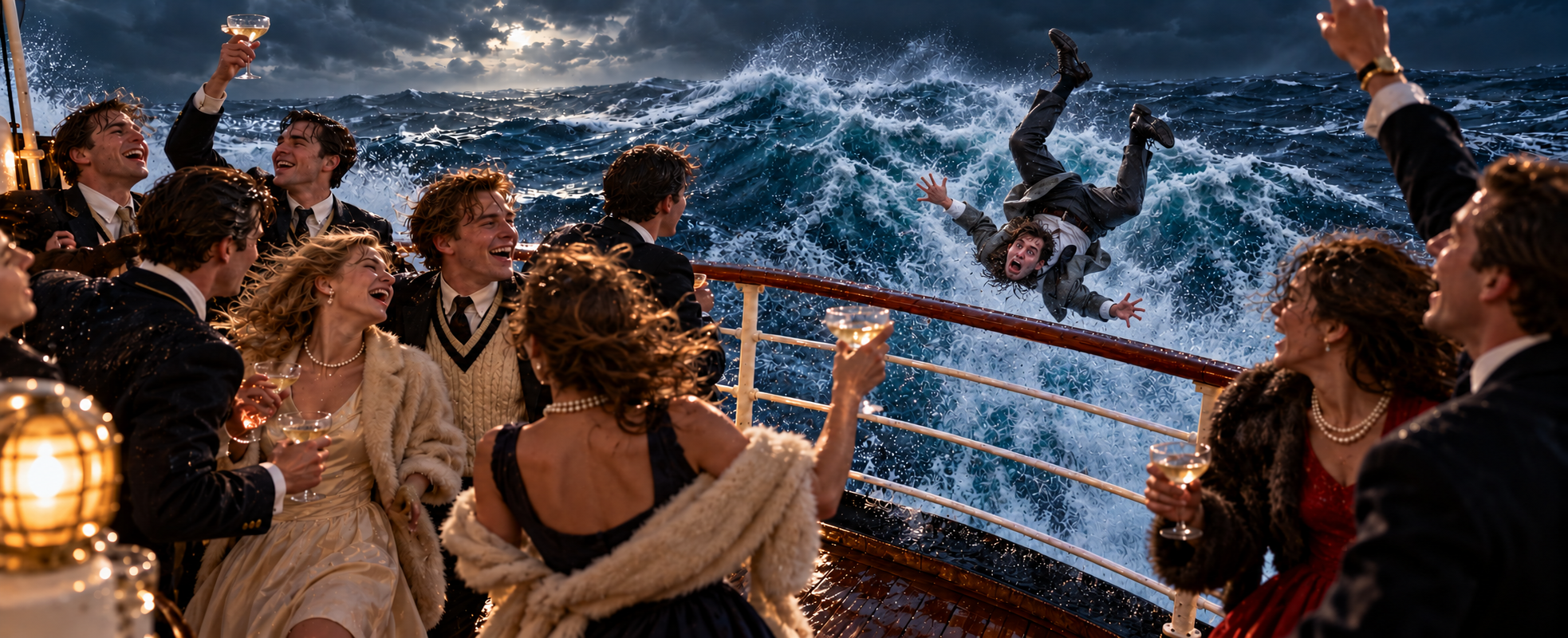
We were somewhere in the North Atlantic. A storm had risen, and enormous waves rolled behind the ship.
On the rear deck, several of the Ivy League boys had invented a game.
They jumped into the wind and let it carry them backward toward the railing.
The girls screamed and laughed.
The boys jumped again.
I remember thinking someone was going to get hurt.
Then one boy jumped especially high.
At that instant, the Queen Mary dropped into a deep trough.
The railing was no longer where he expected it to be.
He missed it by perhaps a foot.
I still see his face.
First surprise.
Then the understanding of what had happened.
Then he was gone.
The laughter stopped. Everyone stood motionless, staring at the place where he had been.
I found an emergency phone and shouted that a man had gone overboard.
I said the captain had to turn the ship around immediately.
A calm voice asked where I was and told me to stay there.
Several minutes later, an officer appeared in immaculate white.
He took statements.
The following morning, he questioned me again.
I asked whether they were searching.
“Young man,” he said, “your friend was dead before he hit the water.”
I had seen his face. I couldn’t understand how the officer could be so certain.
I still can’t.
Nothing appeared in the ship’s newspaper.
I found nothing in the New York papers.
I checked.
Perhaps there was a report somewhere.
Perhaps people were doing things I knew nothing about. I was twenty-two, traveling below the waterline, and nobody felt obliged to explain.
What I knew was that a young man had vanished in front of me, and the great ship kept going.
I had boarded the Queen Mary worried about whether my suits were good enough to pass for first class.
I remember the woman who believed in portable toilets. I remember the girl whose answer I couldn’t decipher.
I can still find the comedy in the earnest young missionary trying to look worldly.
But whenever I think of that crossing, I eventually find myself back on the rear deck.
The boy jumps.
The ship drops.
For sixty years, I have wanted to reach the part where somebody catches him.
I wanted to become a writer.
This is the story I have never been able to give a better ending.