
The chaos was already bad when the phone rang.
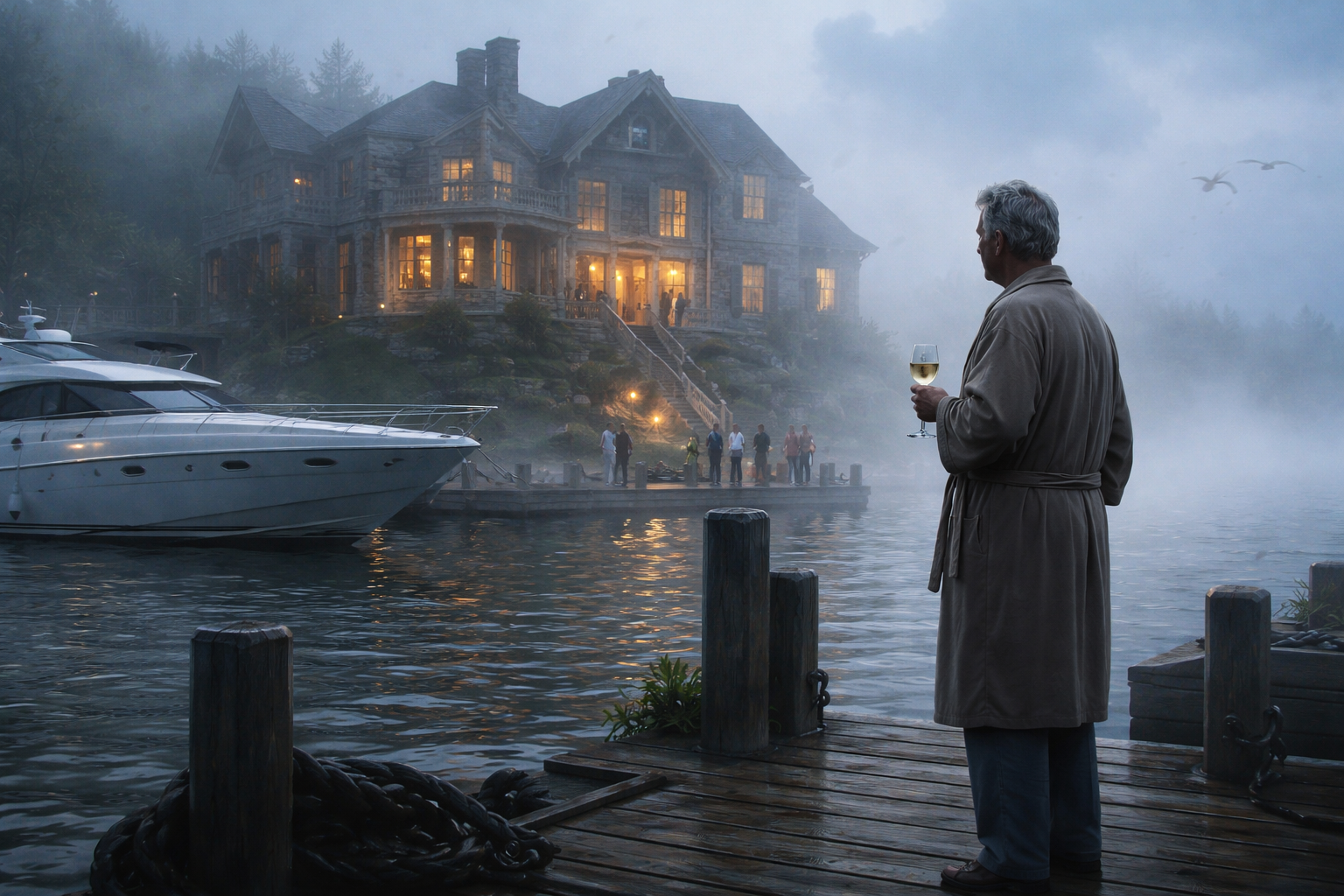
On St. Margaret’s Bay, loons sang silly songs in the Nova Scotia fog while McDuff, seventy-one and overweight, sat bolt upright in his enormous second-floor suite. Even on his massive Simmons Beauty Rest memory-foam bed, he felt insignificant. Nestled beside him, his third wife, Danielle, thirty-five, opened her green eyes.
“Who calls?” she murmured.
Their starter castle had devoured their last twenty thousand dollars. Oak doors leaned beside unfinished doorways because there was no money left for hinges or strike plates.
Nothing in the mansion was complete. Not the bathrooms. Not the heating and air conditioning. Not the window coverings. In the granite kitchen, the only appliances were a used microwave and an electric can opener.
Outside, Atlantic fog chewed at the great stone blocks supporting the house. Through the mist, a forty-five-foot yacht floated at the pier. McDuff’s father had once worked Newfoundland’s Grand Banks in a vessel half that size, risking everything with a brass compass and a gambler’s heart. McDuff liked to think the family gift had come down intact.
The cell phone rang again.
“Turn it off,” said Danielle. She squirmed across him and checked the display. “California number.”
“Could be important.”
“Boil up those lobsters your nephew left. We’ll have a delicious day. Forget mortgages and plumbers and carpenters and hustlers.”
McDuff peered at the Blackberry. “Jack Spring stayed in Toronto last night. He just flew into Halifax. He expects me to pick him up.”
Danielle grabbed the phone and scrolled through the messages. “Oh no. He’s come with his wife. They expect to stay most of the week.” She shoved McDuff out of bed and began stripping off the six-hundred-count sheets. “Up.”
“What are you doing, woman?”
“I won’t have time to wash these before they get here. I’ll hang them out so at least they’ll smell fresh.”
“They don’t know where we live, and I’m not going to get them.”
Another message appeared. Jack and his wife had rented a Mustang and were already headed toward St. Margaret’s Bay. They wanted directions.
Danielle clutched the sheets to her chest. “Lordy. In this fog they’ll only get wetter. Damn the cleaners for holding my dresses and our bed linens.”
“Our check was good,” said McDuff.
She gave him a look. “I know about your good checks. We have nothing to feed these people.”
“Sweetheart,” he said, “this idiot does not have our address. The bay is over three hundred square miles. They’ll never find us. And if they do, we’ll be on the boat and the gates will be locked.”
“You promised no more houseguests.”
“This is the last time. I swear it. I didn’t think they’d actually come. Jack Spring is a big-time Hollywood producer and writer. Remember how much we made from The Perfect Storm just by lining up a few boats?”
“None of your so-called friends will front you a cent to produce a slide show. We can’t afford a pair of rubber boots.”
There came a soft tap at the bedroom door.
Only one other person was staying in the mansion: Wing, the air-conditioning engineer from Edmonton. He usually slept past breakfast.
Again the knock. “Can I come in?”
“Just a sec.”
McDuff pulled on his vicuña robe and padded to the door, one of the few that had actually been hung before the money ran out. He opened it a crack and looked up at Wing, six-foot-four, two hundred and seventy pounds, shaggy and perpetually hungry.
“We left some cornflakes on the counter, Wing.”
“Ate ’em. But a guy named Jack and his wife are on their way here.”
“You know them?”
“No, but the guy who introduced me to you called. Told me to call Jack. I did. Jack asked how to get here, so I told him. All right?”
McDuff stared at him. “Yeah. Sure.”
He shut the door and leaned against it.
“Wing ate all the cornflakes,” he told Danielle.
“Let’s get dressed, lock the gates, and take him on the boat with us.”
“No can do, sweetheart.”
“You said when they got here we’d be out on the boat and the place would be locked.”
“Not enough diesel to go twenty feet.”
Outside, tires crunched on gravel.
Danielle looked out the window. “It’s a Mustang convertible.”
They heard car doors slam, whispers, footsteps, the chime of the doorbell. Then Wing lumbering downstairs and unlocking the main entrance.
“Get down there before they bring their bags in,” Danielle hissed.
“We’re trapped like lobsters in a parlor,” said McDuff.
“Not if we don’t feed them. What’s the wife’s name?”
“Jill. Like Jack and Jill.”
Half an hour later, McDuff and Danielle sat at the granite breakfast nook across from Jack and Jill, while Wing stared mournfully into his empty cereal bowl.
“Sorry,” said Wing, as his stomach rumbled.
“This is a beautiful kitchen,” said Jill.
“Thank you,” said Danielle. “I still can’t get over your names. Jack and Jill.”
“Just like the nursery rhyme,” said McDuff.
He longed for a cappuccino, but he and Danielle had agreed: no food, no drink, no encouraging hospitality of any kind. Jill had mentioned they’d eaten breakfast in Toronto five hours earlier. With luck, hunger and thirst would do the work for them.
“How did you make that stone archway into the great room?” Jill asked.
“Nova Scotia know-how,” said McDuff, pleased she had noticed one of the house’s few finished triumphs.
“I’d love to see the rest of it,” she said.
So McDuff gave the tour.
He showed them the grand staircase with wrought-iron balusters forged in Thailand, the giant hemlock beams, the steps down to the slips, the basement pool nearly ready for water, the wine cellar with what little remained of his ice wine, and the third floor that had been “almost ready” for paint and wallpaper for six months.
He even opened a bottle of ice wine and poured a taste. Everyone marveled at it.
On the top floor, Jill looked up at a four-foot gash in the ceiling.
“Going to make another level?” she asked, a little slurred now.
“No,” said McDuff. “Just wanted a look around the attic. Place belonged to a Russian fellow before us. Disappeared after 9/11. I thought he might have hidden gold up there.”
Jack laughed. “Did he?”
“No. But I may have gotten carried away.”
He gestured toward the ripped-up floors and busted-open walls. “I should never have offered those workmen a reward.”
“Looks like they used dynamite,” said Jack.
“I’m sure they would have if I’d suggested it.”
Jill asked to use the bathroom, and McDuff had to explain that while it was functional, the Spanish tile had not yet been installed. Then neighbors began arriving at the dock, just as he remembered he had told half a dozen of them to drop by anytime they saw the yacht tied up.
Then Jill emerged from the bathroom, changed into something more comfortable, and somehow got the impression that she and Jack would be staying in the guest room. The damn fool engineer helped carry in their suitcases while Danielle glowered in the background.
And then the neighbors arrived in earnest, tied up their larger and newer yachts, and opened more bottles of wine.
McDuff’s seafood instincts took over.
He lit the propane burner beneath the hundred-gallon lobster kettle and shouted for Danielle to make salad. He loved the smell of coarse rock salt dissolving in boiling water. That and real melted butter, he believed, were the only secrets to a proper lobster. To hell with his diet, or anyone else’s diabetic one.
As usual, the disaster somehow turned into a success.
A few of his wealthy neighbors asked why Jack was there at all, since they had already declined to finance the boxing movie McDuff had been pitching for a year. McDuff had met the washed-up local light heavyweight in a beer parlor and instantly seen his life story as either a moving tribute or a quick payday, preferably both.
He cracked open succulent lobsters and listened as one of the neighbors said:
“That Hollywood guy really understands film. If I’d known Jack Spring was this good, I might have put in some money.”
“Not too late,” said McDuff quickly.
“Afraid so, old man,” the neighbor replied. “Our accountant stuffed all our spare cash into bonds. But those lobsters look marvelous.”
Over the next three days, McDuff and Danielle shared their only working bathroom with Jack and Jill. Wing had his own shower in the maid’s room, where he slept on the floor. Jack insisted on taking everyone out for dinner the next two nights and, thank God, paid every bill. McDuff’s credit cards were maxed out, so whenever the check arrived he made sure to be in the bathroom.
Every time Jack brought up the boxing film he had come to discuss, McDuff answered with a new line of conversation and steered him elsewhere.
Meanwhile, while the others slept, McDuff and Wing argued until three in the morning.
In his frantic hunt for the Russian’s imaginary gold, McDuff had torn apart the heating and cooling system. Building inspectors now threatened to declare the house uninhabitable if the heat was not brought back up to code before fall. Wing said a quick fix would cost a hundred grand and then presented McDuff with a bill for five thousand dollars for plans and consulting.
McDuff promised to pay him on the way to the airport the next day.
Instead, to avoid the final confrontation, he persuaded Jack and Jill to drive Wing there themselves.
While they were gone, McDuff called bankers and brokers and pleaded for more funding. One laughed. Two hung up.
When Jack stopped at the Royal Bank so Wing could pick up McDuff’s check, there was no check.
Wing boarded his flight in a fury.
On the third day, Jack finally cornered his host.
“You told me you’d have money to make the film and cash for me to write the script. Are you playing games with us the way you played games with that engineer?”
“He’s an idiot,” said McDuff. “I said if you came here, I’d try to put something together. Until I get the hog project finished, I can’t do anything else.”
“I heard you talking about swine the first night,” said Jack. “I thought you meant an actor.”
“I meant agriculture. There are over a hundred million pigs slaughtered in North America. They produce an ungodly amount of waste. I’ve developed a system to turn that waste into renewable energy. You invest one dollar, you make fifty in two years. Bring in friends and there’s a bonus.”
“Not interested,” said Jack. “I flew ten thousand miles on my own dime to listen to this?”
“I invited you for a visit. I never said I was definitely making a film.”
“Your rich friends probably took one look at your finances and killed the idea. Then you dumped us at the airport.”
“No way. My Blackberry was dead.”
Jack stared at him. “Right. And last night at four a.m. I didn’t see you siphoning gas from my rental car.”
McDuff blinked. “Absurd.”
“I’ve got a photo.”
“You’re embarrassing yourself.”
Jack and Jill packed and left.
McDuff watched them go. Someday he would make a movie, and when he did, he certainly would not need some slick screenwriter from California. Canada had plenty of perfectly good meat-and-potatoes writers.
Then the cordless phone rang.
It was Hans from Germany, who knew more about pig manure disposal than anyone else in Europe, and possibly the world. McDuff had met him on a golf course in Scotland, and for the last year the two men had been calling and emailing each other as if they were about to reshape civilization.
“I’m taking Lufthansa to Toronto, then Air Canada to Halifax on Thursday,” Hans said.
“Wonderful,” said McDuff. “After I cook you an Atlantic lobster, you’ll think you’ve died and gone to heaven.”
“I look forward to it. Everything cool with the investors?”
“They can’t wait to meet you,” said McDuff. “I know you said the pig plant would cost ten million, but if it goes over budget, don’t worry. Your technology is going to make us all rich.”
“Speaking of money, what about the reimbursement check for my airline tickets?”
“Already taken care of. And make sure you bill us for first class. Call the moment you land. By the time you’ve got your luggage, I’ll be at the terminal.”
McDuff hung up and immediately called the neighbors with the biggest yachts. He promised them lobster beyond belief at his place on Thursday.
Then he watched Danielle hanging Jack and Jill’s sheets on the clothesline.
He opened the last bottle of ice wine, poured a little into a crystal flute, and trudged down to the dock. Sitting alone, he stared into the fog and wondered how long he could keep his creditors at bay.
Maybe a month.
The loons kept singing their silly songs as the Nova Scotia mist crept in and slowly obliterated McDuff.