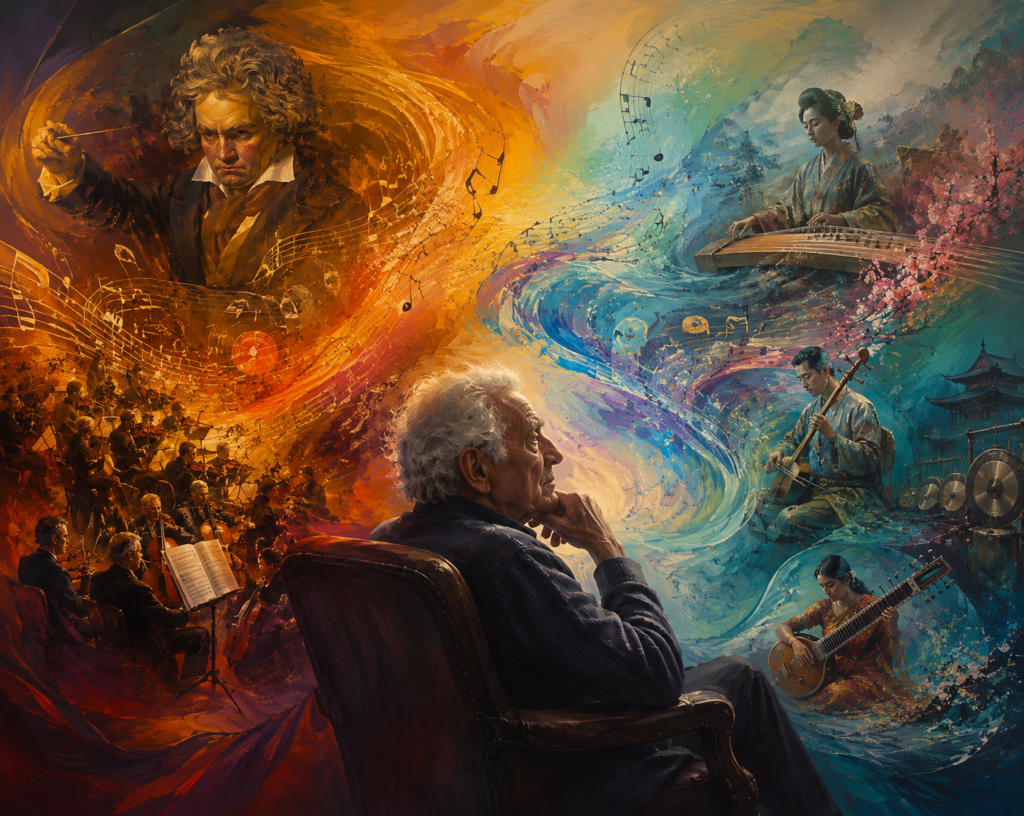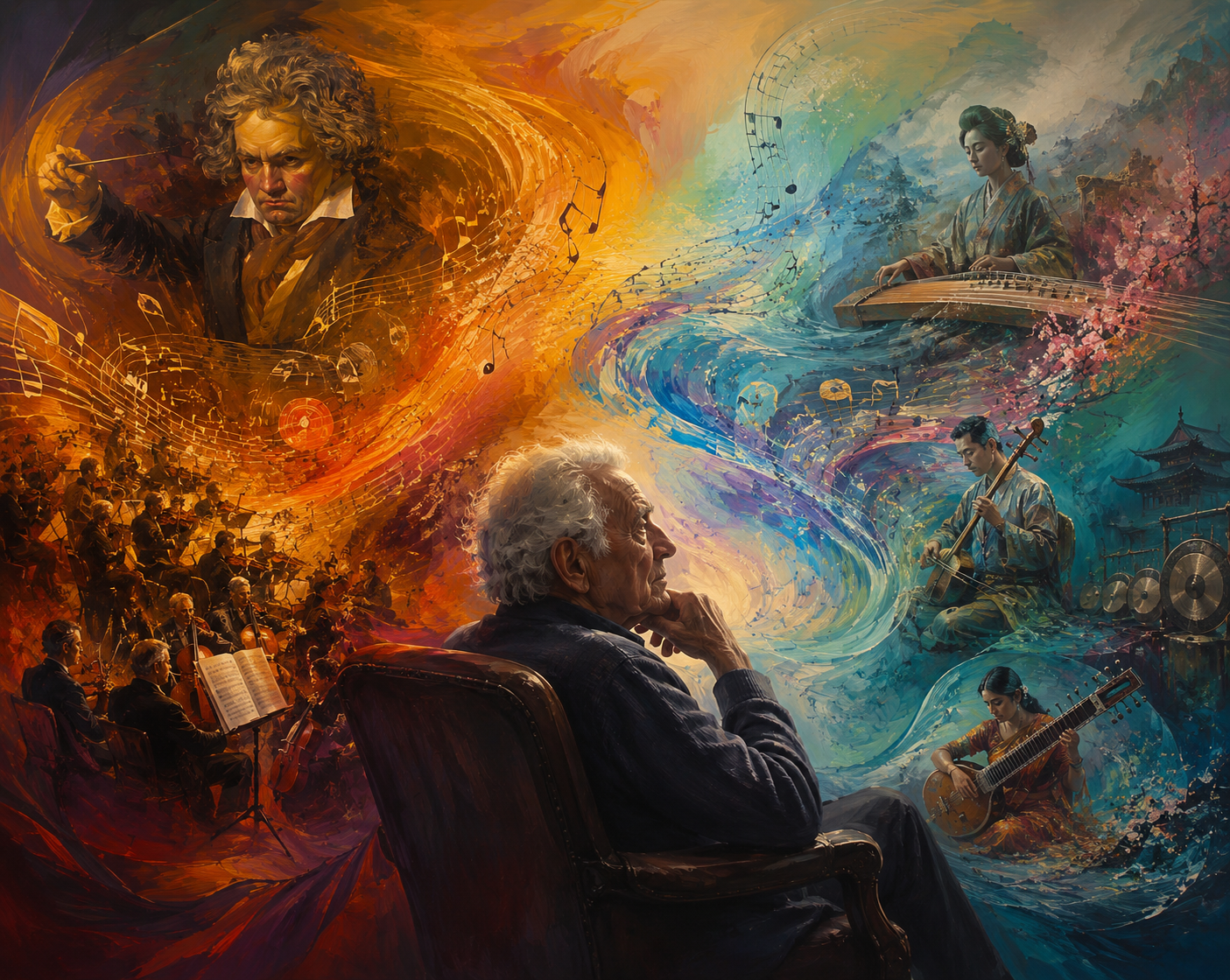

I was raised listening to the music of Canada and America. And somewhere along the way I discovered Beethoven and Mozart.
They seem like magic to me.
I don’t understand precisely what Beethoven is doing to my brain, but apparently Beethoven does. He can make an orchestra whisper, argue, threaten civilization and then, several minutes later, convince me that everything is going to be all right.
Mozart is worse.
He makes it sound effortless.
Then there is Asian music.
I have tried.
Chinese music. Japanese music. Indian music. Various traditional forms.
And much of the time I sit there thinking:
What the hell is going on?
I don’t dislike it.
That’s the strange part.
I simply don’t seem to get it.
Other people are obviously hearing something wonderful. They become moved, excited, nostalgic or contemplative.
Meanwhile, I’m waiting for the musical bus to arrive.
Apparently, there is a reason.
My brain was trained.
Not deliberately. Nobody sat me down as a child and explained Western harmony.
I simply heard it.
Songs on the radio. Music in movies. Hymns. Popular songs. Christmas carols. Dance music. Television themes. Eventually classical music.
Thousands upon thousands of hours of it.
Without realizing it, my brain learned the grammar of Western music.
It learned that certain notes create tension.
Others provide resolution.
It learned that a melody can wander away from home and eventually come back.
It learned to anticipate what might happen next.
And composers discovered something even more interesting.
Once they know what you’re expecting, they can fool you.
You expect A.
Beethoven gives you B.
You think C is coming.
He refuses to give it to you.
He wanders around for a while, leaving you musically suspended over a cliff.
And then—
there it is.
The resolution.
You don’t need to know what a dominant seventh chord is.
Your brain knows.
It has been waiting for the damn thing.
Which explains some of my difficulty with music from other cultures.
There really isn’t one thing called “Asian music.”
India, China, Japan, Indonesia and dozens of other cultures developed enormously different musical traditions.
Some use different scales.
Different tuning.
Different rhythms.
Different instruments.
And, most importantly, different ideas about where music is supposed to go.
My Western-trained brain keeps trying to predict the next sentence in a language it doesn’t speak.
It’s a little like attending a comedy performance in Mandarin when you know twelve words of Mandarin.
The comedian says something.
Eight hundred people collapse laughing.
And I think:
I assume something wonderful just happened.
The fascinating thing is that the reverse must also be true.
Someone raised without much exposure to Western classical music could listen to forty minutes of Beethoven and wonder why a hundred people are attacking musical instruments simultaneously.
I hear a journey.
They may hear an expensive commotion.
There is a term for all this:
musical enculturation.
From childhood, our brains absorb the musical rules of the culture around us.
We become fluent without knowing we’ve learned a language.
And fluency creates pleasure because music becomes a magnificent game between prediction and surprise.
Too predictable and it’s boring.
Too unpredictable and it’s noise.
Somewhere between the two is magic.
Which raises an intriguing possibility.
Perhaps I don’t actually dislike Asian music.
Perhaps I simply can’t hear all of it yet.
So I’ve decided I should conduct an experiment.
Instead of plunging directly into musical traditions completely unfamiliar to me, I can begin with composers who built bridges between East and West.
The Japanese composer Tōru Takemitsu, for example, absorbed Western composers such as Debussy while retaining distinctly Japanese ideas about sound and silence.
Chinese composer Tan Dun has combined Western orchestras with Chinese instruments and traditions. Millions of Western listeners have already heard his music in Crouching Tiger, Hidden Dragon without realizing they were standing on a bridge between musical worlds.
So perhaps I’ll start there.
Listen.
Then listen again.
And eventually venture farther from home.
I’m 84.
My brain has spent roughly eight decades learning one musical language.
It seems a little unreasonable to play something entirely different for four minutes and announce:
Well, that makes no sense.
Perhaps the music isn’t failing me.
Perhaps, for once, I’m the one who needs lessons.
And wouldn’t it be wonderful if somewhere inside music that presently sounds incomprehensible to me there is another Mozart waiting to be discovered?
Not another Mozart, of course.
Something even better.
Something I don’t yet have a name for.
Because I haven’t learned how to hear it.