
I guess when you’re young there are some things you don’t understand. When you grow up, you think about them again.
In my case it was Father Dodo, which just happened to be what everyone called him. I think his real name was Father Van Tellie, but now that doesn’t atter much.
Even the Catholics said he was a strange man for a priest. His black pants shone all the time from ironing. The belt that held them up had broken years before and had been mended with a bit of wire, probably salvaged from one of the junk heaps around the rectory. For some reason he never looked ridiculous, only different.
It could have been his eyebrows. I saw them once when they weren’t caked with sweat and sawdust. They were thick and fierce enough to make him look exactly the way a boy imagines a saint might look if saints climbed scaffolding and swore under their breath in six languages.
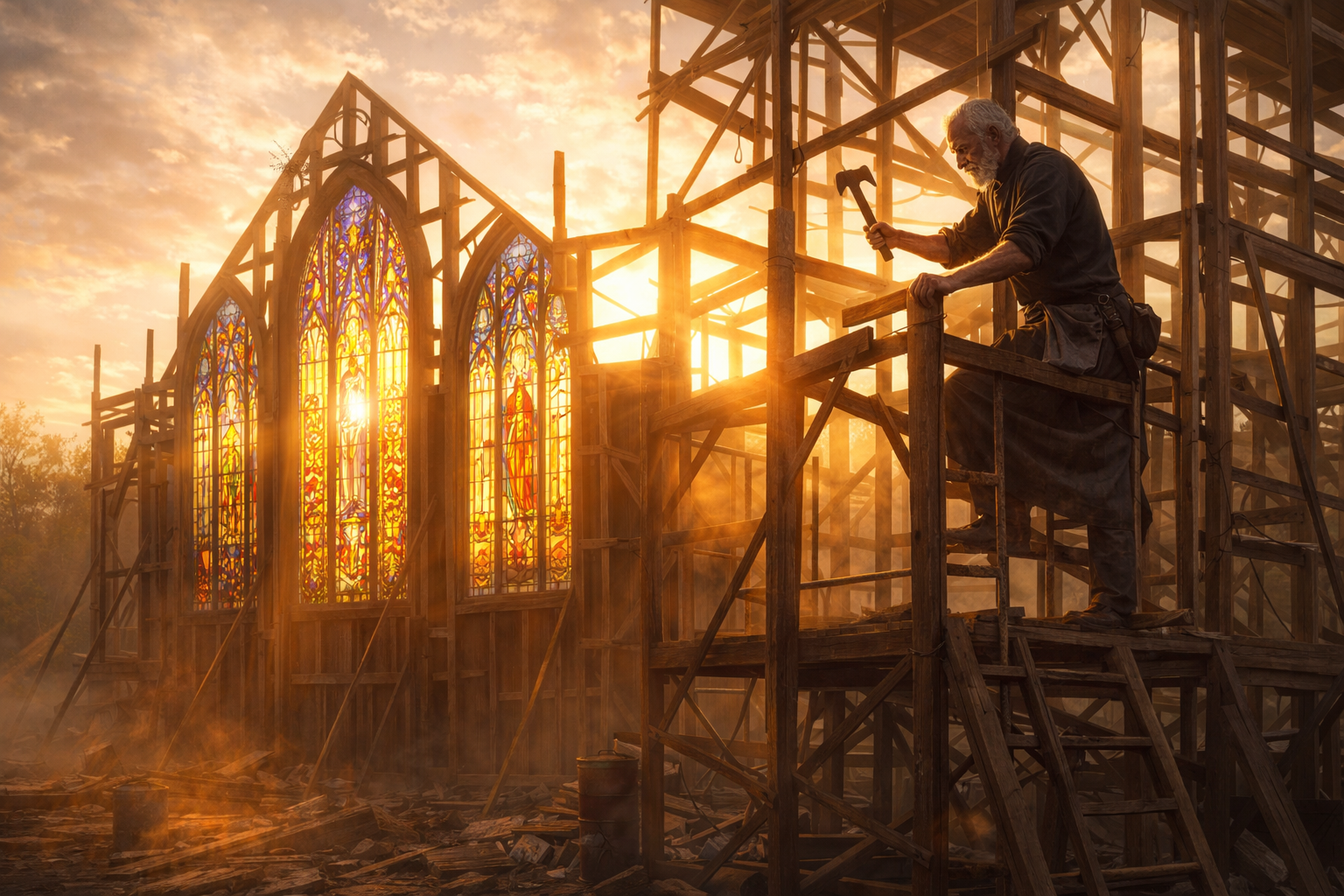
Many times I walked past his church. He worked on it nearly all the time. Even on Sunday. I never knew a man so tenacious. Seemingly oblivious to danger, he delighted in scaling the rickety scaffolding that swayed crazily from side to side. Maybe he thought God had sent angels to protect him. Maybe He had. For years I watched that sixty-year-old priest edge along the roof or skip from one rafter to the next as if he were a boy playing hopscotch.
Sometimes he would find an old board with a nail still in it. He’s spend three or four minutes worrying the rusted piece of metal free, then stand up slowly with the expression of a man who had just rescued buried treasure. The nail would be slipped into some special fold in the shabby cassock he wore on windy spring days, and then he would pause to relight his pipe.
My dad, who had done plenty of contracting, said Father Dodo was daft because the old priest had put the windows in first and built the church around the glass. He didn’t even have a plan. There wasn’t much to talk about in our town, so nearly every conversation drifted back to Father Dodo’s church since it dominated the skyline.
Stranger soon realized the church was the town’s unofficial attraction. Once a man from the city came to our house. He was interested in unusual buildings. Dad took him over to see the church, and afterward the man said he figured Father Dodo possessed genes, possibly from Rasputin.
I didn’t think Father Dodo was any kind of mad monk. He only had four fingernails. He said the Nazis had pulled the others out, and that was all he would say, even though I wanted to hear more.
Although his English wasn’t very good, he got by in six other languages. He had been to every country I could think of. I asked him why he was building a church, and he replied in his strange accent, “It vill be goot after I go.”
He was just a man getting old, driven to leave something behind for people to remember him by.
He perched on dangerous timbers, often waving to his parishioners below. Few of them ever helped him with the church. I wasn’t a Catholic, but I wanted to help. My mother said it was too dangerous for a fifteen-year-old boy. So I didn’t help.
Now when I look back, I don’t think anyone really wanted their children to be around him, except one boy who had no place else to go. He was called John, and he didn’t belong anywhere except, maybe, with Father Dodo.
There were about thirty-five of us in Scouts. We never called him Father Dodo, just Father, because none of us could think of his real name. I wish the townspeople could have seen him the way we did. He was a decent man, and he knew things. How could he not? He seemed to know more about knots than any sailor. He said he had learned while a cabin boy for an English captain.
Father Dodo’s hands were rough and strong. His biceps were as large as my thighs, though he was always gaunt. He never got angry when two of the boys went to his house, which was attached to the unfinished church, and smoked some of his Dutch pipe tobacco.
Sometimes he wrestled with us. I remember once he took us camping. After we had eaten, he climbed a haystack and buried himself waist-deep in it.
“Try me,” he challenged, and we rushed him in pairs and threes. Once or twice somebody managed to pounce on his back, but those huge hands of his would lift the boy high into the air and roll him almost tenderly down the side of the haystack.
Whether we broke a window by accident or filled his rubber boots with water, he seemed to understand. He only showed angry once, and that was when John came to a meeting.
John was, in my opinion, and probably in the opinion of most of the town, high-end halfwit. So were his mother and father and first cousins. Dad said people like that shouldn’t be allowed to breed.”
Anyway, John was strange. Father Dodo hadn’t arrived yet when John wandered in. We were playing tag. Right away everybody stopped and stared. Then someone, I think it was a bigger boy, yelled, “Hey, watcha doin’ here, Nit?”
“Yeah, whatcha doing, idiot?” somebody else demanded.
John stood there blinking at us as if he couldn’t see the half-finished hall or the bright light sliding down from the odd windows Father Dodo had set in the bare floorboards.
Finally Bruce Page sneaked up behind him and hit him hard across the ear with a Scout staff. I guess Page never realized how much leverage there is in a six-foot staff. Poor John blinked his watery blue eyes and collapsed to the floor.
“You’ve killed the stupid bugger,” screamed Tripper Toft.
Usually nobody paid much attention to him. “I’m going to get Father Dodo.”
“Dat is not necessary,” Father Dodo said from nowhere. Fixing Bruce Page with an almost clutching stare, he asked in a terrifyingly low voice, “Vat haf you done to dis boy?”
John started to moan and sit up. The priest knelt and put his big hand on the boy’s shoulder.
“Are you hurt, child?”
“No,” John said, drawing the word out into a long, uncertain sound.
The lines in Father Dodo’s face seemed to contract. Even old man Ellis, when he caught us stealing carrots, had never looked so angry.
“Vhy,” Father Dodo said, “haf you done dis? Vhy?”
Everybody turned toward Bruce Page.
It was the first time there had ever been real silence in that hall. Finally Bruce said, “That stupe tried to hit me, but I hit him first. Ask him. He glared at John. “Is dat right?”
John’s eyes opened wide. He shook his head and whispered, “He hit me fer fun.”
The priest looked down at Bruce’s feet. “You vill go now.”
“I ain’t going on account of no idiot. I ain’t done nothing.”
“You vill go or I vill strike you.” Father Dodo’s eyes had traveled to Bruce’s shirt pocket.
“Priests ain’t allowed to strike nobody.”
I don’t know what priests are allowed to do now. I only know what Father Dodo did then.
He hit Bruce Page across the ear. Hard. Page looked more surprised than hurt, then bolted for the door. We could hear him yelling all the way home, which was only a block from the church.
“Dat boy is a coward,” Father Dodo said. “No von has de right to hurt no von. John vill be vid us now. I vant all you boys to be nice to John. Is dat understood?”
We nodded so hard our heads nearly came off.
“I haf a game for you.” Father Dodo pulled a stubby pencil and a scrap of paper from somewhere inside his clothes.
We had been playing about ten minutes when the door was almost thrown off its hinges and in burst Mr. Page, followed by Bruce. Mr. Page had worked for the railroad. When he was younger, people said, he had been a scrapper. Now he was forty-five and only fought when he got drunk. And that was often enough. His arm looked about as big as Father Dodo’s.
“Priest, I want to talk to you. What the hell’s the idea of beatin’ up on my kid?”
“I haf not beat him.”
“He’s got a black-and-blue mark on his head. You coulda killed him.” I think Mr. Page had been drinking.
“Yes,” Father Dodo said. “I cudda.”
“Then you did hit him, you filthy son of—”
“You vill leave, please.” Father Dodo was looking at Mr. Page’s feet.
“I’ll not leave till I’m done talking to you—”
“Ve are havin’ a meeting. You vill please leave.” Father Dodo was looking at Mr. Page’s stomach.
“Dad, he ain’t kiddin’. Watch his hands.” Young Page acted scared, trying to egg his father on at the same time.
Father Dodo looked at Bruce. “You are not velcome.” Then, ignoring Mr. Page completely, the priest stepped toward the boy.
Mr. Page caught Father Dodo in the chest with a punch. If he had hit a normal man, I suppose he would have knocked the wind out of him. It looked to me as though all the years in the prison camp had done something to Father Dodo. He only coughed. Then he slowly grabbed Page’s shirt. It looked as if he were going to throttle him when Sheriff White walked in.
We heard later that Mr. Page had phoned him.
“Leave him be, Father.”
The priest let go.
Mr. Page looked bewildered. “You kids get home now.”
As I was walking away, I looked back and saw Mr. Page talking angrily to the sheriff, while Bruce grinned. On the way home, one of the boys beat John up for causing trouble. From then on, John’s life became one street beating after another.
There was quite a fuss. Mr. Page was going to take Father Dodo to court, and Sheriff White said that if he did, Bruce would maybe have to stand trial in juvenile court. Sheriff White was a Catholic.
The outcome was that nobody took anyone to court. Still, the PTA held a special meeting and the whole town talked. Most of the parents were either mad at Mr. Page or at Bruce. All of us kids hated John.
Mr. Page owed my dad some money and said it was too bad Dodo hadn’t wrung all the Page family’s necks. He also said I could go to the next Scout meeting, though I should be sure not to cross Dodo. My mother thought it would be dangerous, but Dad had already given permission. He never went back on his word, and when Mother finally said she would drive me to the meeting, I went.
Only three other boys showed up, and John didn’t really count. Father Dodo promised he would phone us when things got reorganized. He never did, because the Pages were related to a lot of people in town. Everyone was afraid to send their children back. I heard Mother tell Dad that Mrs. Page had spread some terrible lies about Dodo.
After a few weeks things returned to normal, except there were no more Scouts. The United Church started a new boys’ program, but they held it in a new building that wasn’t nearly as much fun as the hall Father Dodo had made.
The minister there was weak and four or five of us could beat him up without trouble. Besides, he had to think twice before he tied his shoes. I don’t think he could have laid a half-hitch if his life depended on it.
Father Dodo kept working on the church. After a while Mother stopped talking about how dangerous the place was, and I went around to watch him again. He seemed the same, but now I think he was hurt. He taught me how to play chess. He was pretty good. I beat him once, though.
Things weren’t as much fun as they had been before Scouts ended. Just about every time I went there, John was hanging around. At first Father Dodo tried to get us to play chess together, but I wouldn’t, and I never did.
I did notice a change in John. He began to dress a little better. His nose was usually wiped. If he had been born somewhere else, maybe things would have been different for him. Bruce Page gave him a rough time whenever he could. He must have beaten him fifty times.
About the only thing there was to do was go to school, play pool, or drive cars. Some of us were starting to get driving lessons. Poor John could never have passed the test. Even if he could, no one would have been crazy enough to lend him their car.
At shows Page would sit behind John, lay his feet on the outcast’s shoulders, and spit on him. Bruce thought it was funny. People laughed at him instead of with him, but John was so slow he didn’t know.
Now that I think of it, John never did have one friend other than that Catholic priest. Maybe it was just as well. The priest had more patience with him than any normal man could have. Mom said it would have been best for all concerned if John’s mother had sent him to another town. He was nearly seventeen, I guess, and too far gone to improve, except in the priest’s eyes. That was just out of pity, and a few dollars a week.
Besides, John wasn’t smart enough to leave home. His mother was dumb too, but at least she fed him and gave him clean clothes. As long as he lived there, the government gave his mother an allowance for him.
Some of the town people said John and the priest made a good pair. A year passed. For a while it looked as though Father Dodo had nearly finished the church. It was beginning to look like a real church, though he had decided to build another annex or something onto it. The frame for two great panes of glass stood up on the north side, and everybody started talking again.
I was seventeen and had the car one Friday night. Coming home from a school dance, I heard the fire engines. Father Dodo’s church was on fire.
By the time I got there, half the town was standing in the road watching the volunteer firemen. The church was nearly gone, and the black where Father Dodo lived was covered in smoke and steam.
One Catholic woman with a statue of the Virgin Mary clutched to her chest wanted to know where Father was. Tripper Toft said he must still be inside. All at once John leaped out from the crowd and ran past the rope the firemen had strung up to keep people back. A fireman tried to stop him, but John was so quick, it looked as though he wanted to burn himself up the way he dove through a broken window.
Everyone was surprised when he came out a minute later with Father Dodo in his arms.
It was too late, though.
The priest was dead. Not even Doc Roberts could bring him around with oxygen. Some of the women began to cry. John stood at the edge of the crowd and started to weep. Bruce Page came up beside him and gave him a poke in the ribs with his elbow.
“Act like a man, you bastard,” he said, laughing.
The guys with him didn’t laugh. Even then it didn’t look funny to see a big guy like John crying. He wasn’t even a Catholic. After that night I can’t remember Bruce ever bothering John again. I guess he didn’t think it was fun if no one laughed.
I wanted to go to Father Dodo’s funeral. Mom said no, because finals were coming and I had dreams. So I never went. I’m glad now that I didn’t. I think it is better to remember Father Dodo the way he was instead of shut inside a coffin.
I did go to the pool hall, though. The men there said Father Dodo’s church could be rebuilt and that the Catholics ought to name it after him.
It seemed a lot of people, though they didn’t want to admit it, were sorry to see Father go. There was just one thing that I’ve never really been able to figure out, and that was something Mr. Page said.
“Yeah, it was a good funeral. Too bad that crazy boy John had to laugh when they were carrying Father Dodo out. Always figured that boy was nuts.”
Dying people looked like they were laughing, Dad said. Maybe that was it. Or maybe Mr. Page had simply seen what he expected to see.
I only know what I saw.
I saw John pull the only friend he ever had out of a burning church.