
I guess when you’re young, there are some things you don’t understand. When you grow up, you think about them again.
In my case, it was Father Dodo—which just happened to be what everyone called him. I think his real name was Father Van Tellie, but now that doesn’t matter much.
Even the Catholics said he was a strange man for a priest. His black pants shone from over-ironing. The belt that held them up had broken years before and had been mended with a bit of wire, probably salvaged from one of the junk heaps around the rectory. For some reason, he never looked ridiculous—only different.
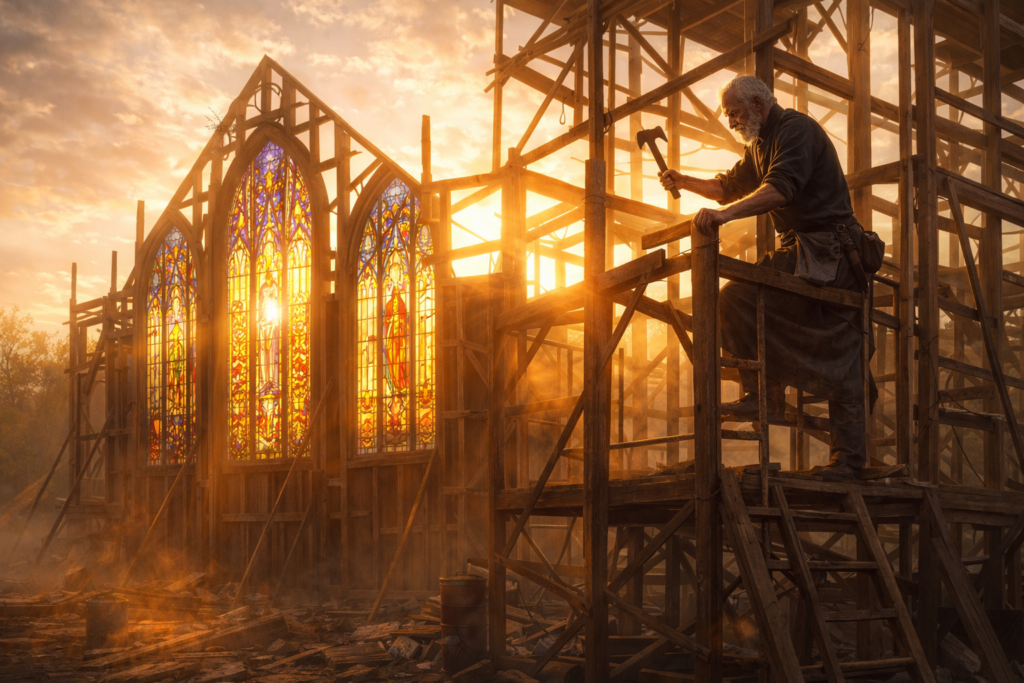
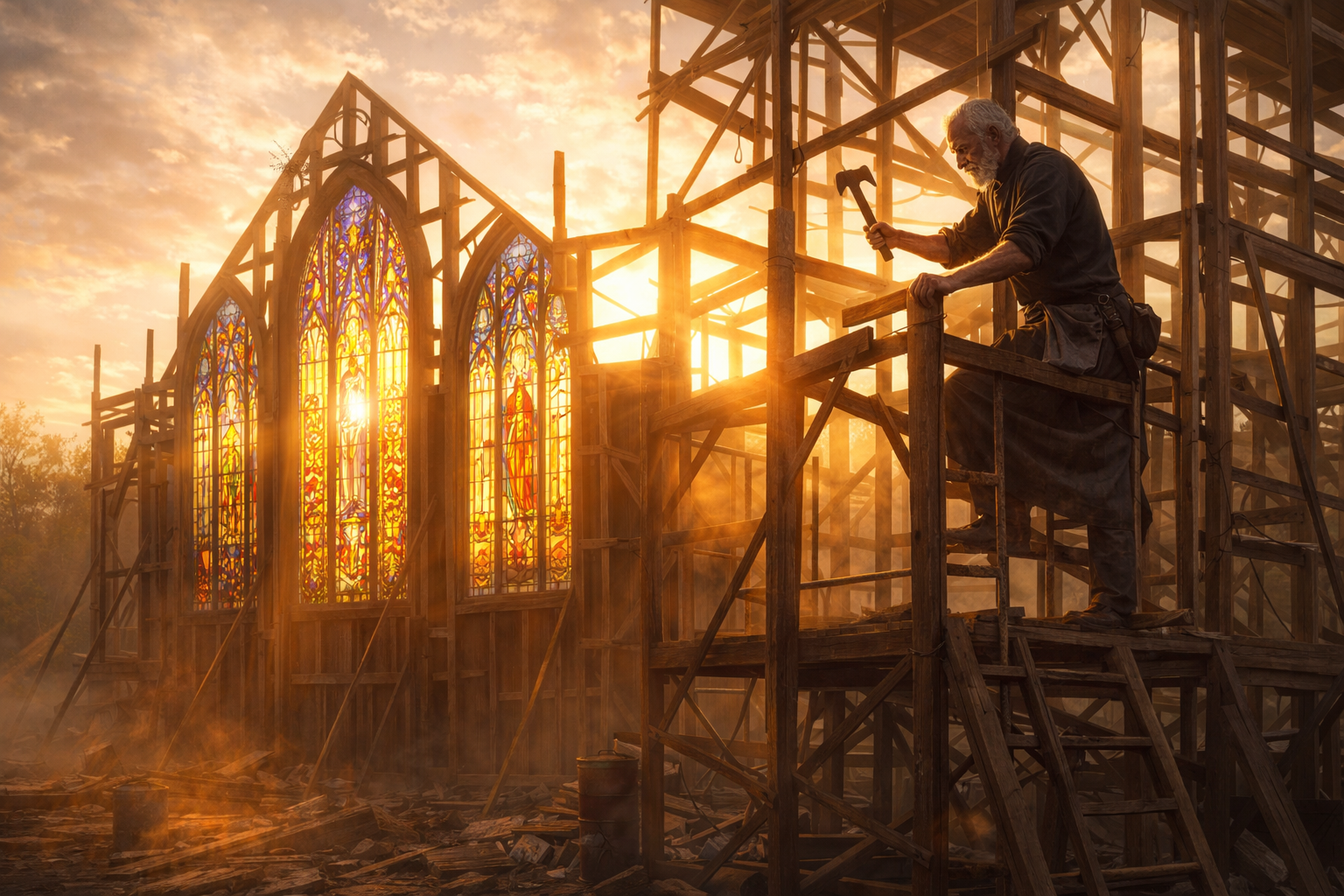
It could have been his eyebrows. I saw them once when they weren’t caked with sweat and sawdust. Thick and fierce—exactly the way a boy imagines a saint might look, if saints climbed scaffolding and swore under their breath in six languages.
Father Dodo worked on his church nearly all the time. Even on Sunday.
I never knew a man so tenacious.
He climbed rickety scaffolding that swayed side to side, as if the wind were part of the plan. Maybe he thought God had sent angels to protect him. Maybe He had.
I watched that sixty-year-old priest edge along the roof or skip from one rafter to the next—an old toddler playing hopscotch.
Sometimes he’d find a board with a nail still in it. He’d spend minutes worrying the rusted metal free, then stand up slowly, triumphant, like a man who had unearthed buried treasure. The nail would disappear into some hidden fold of his cassock. Then he’d pause and relight his pipe.
My dad said anyone who put in windows before walls didn’t understand gravity or wind. There was plenty of both in Coronation, population—950.
Truth was, there wasn’t much to talk about in Coronation, and since the church dominated the skyline, conversation always came back to Father Dodo.
A man from the city once came to see the town’s unfinished house of God. Afterward, he said the priest probably had genes from Rasputin.
I didn’t think he was any kind of mad monk. He had four fingernails. Said the Nazis had pulled the others. That was all he’d say.
His English wasn’t good, but he spoke six other languages. He’d been everywhere.
I asked him why he was building the church.
“It vill be goot after I go.”
Mother said he was just a man getting old, trying to leave something behind.
High above the ground, he’d wave to people passing below. Few ever helped him.
I wanted to.
Mother said no. Too dangerous for a fifteen-year-old boy.
So I watched.
Looking back, John was the only one who spent real time with him.
John—the village idiot.
Dad said it wasn’t his fault—first cousins. I asked what we should do about it. Dad said, “Try not to fall for Priscilla. She’s your only girl cousin.” Then he laughed.
John carried a pail of water everywhere.
Not just to Boy Scouts meetings. Everywhere. Down the street, past the pool hall, even into the grocery store if no one stopped him.
We tried to get him to put his water down once or twice, just to see what he’d do. He wouldn’t. Not for anything.
My dad said it was easy.
One afternoon, when John walked past our place, Dad stepped onto the porch and waved at him with one hand.
“Hello, John.”
John smiled and waved back with his free hand.
Then Dad raised both hands. Gave John a double wave. “Hello.”
John stood there a second, confused. Then, slowly, he set the pail down and waved with both hands.
Dad grinned. “See. Everybody’s got a way in… if you’re patient.”
John picked the pail up and kept walking.
There were thirty-five of us in Scouts. We called the priest Father. None of us knew his real name. He was a natural as a Boy Scout leader. Strong. Hands like rope. Biceps bigger than my thighs. He knew knots better than any sailor.
He never got mad—even when boys stole his pipe tobacco.
He wrestled us.
Once, he buried himself waist-deep in a haystack. “Try me.”
We rushed him. He tossed us aside like we were nothing—careful not to hurt us.
He understood everything.
Except once.
That was the day John came to Scouts.
He was carrying the pail.
We stopped and stared.
“Watcha doin’ here, Nit?”
“Whatcha doing, idiot?”
John blinked at us.
Bruce Gage stepped behind him and swung a Scout staff.
The crack was loud.
John dropped.
“You’ve killed him!” someone said.
Father Dodo was suddenly there. He knelt beside John. “Are you hurt?”
“No.”
“Vhy?”
Silence.
“He hit me fer fun.”
The priest looked at Bruce Gage.
“You vill go now.”
“I ain’t going.”
“You vill go or I vill strike you.”
“Priests can’t—”
He struck him.
Hard.
Gage ran.
“No von has de right to hurt no von. John vill be vid us now.”
We nodded.
None of us had ever seen him angry.
Minutes later, Gage came back with his father.
Drunk.
“You hit my boy?”
“Yes.”
The punch landed in the priest’s chest.
Nothing happened.
Then Father Dodo grabbed him.
For a second, it looked like something terrible had ignited.
Sheriff White stepped in. “Let him be, Father.”
The priest released him.
“Go home, boys.”
We did.
On the way home, someone beat John up.
After that, it kept happening.
The Scouts ended.
No one wanted trouble with the Gages.
Father Dodo kept building.
John kept carrying his pail.
Everywhere.
Like it mattered.
I was seventeen the night the church burned.
By the time I got there, half the town was watching.
Flames had taken most of it.
“Where’s Father?” someone shouted.
No one knew.
Then John ran. Through the rope. Through a broken window.
Still holding the pail.
A minute later he came out—carrying Father Dodo.
The priest was soaked.
The pail was gone.
Father Dodo was dead.
Bruce Gage stepped beside him. “Act like a man,” he said. “You think that bucket was gonna stop a fire?”
No one laughed.
Not one of us.
After that, Gage never touched John again.
I didn’t go to the funeral.
Mother said I’d have nightmares. Maybe she was right.
I still remember him the way he was—on the scaffolding, alive.
Later, I heard something I’ve never been able to figure out.
Mr. Gage said: “Too bad that retard laughed….”