The first memory I have of my father is his bald head.
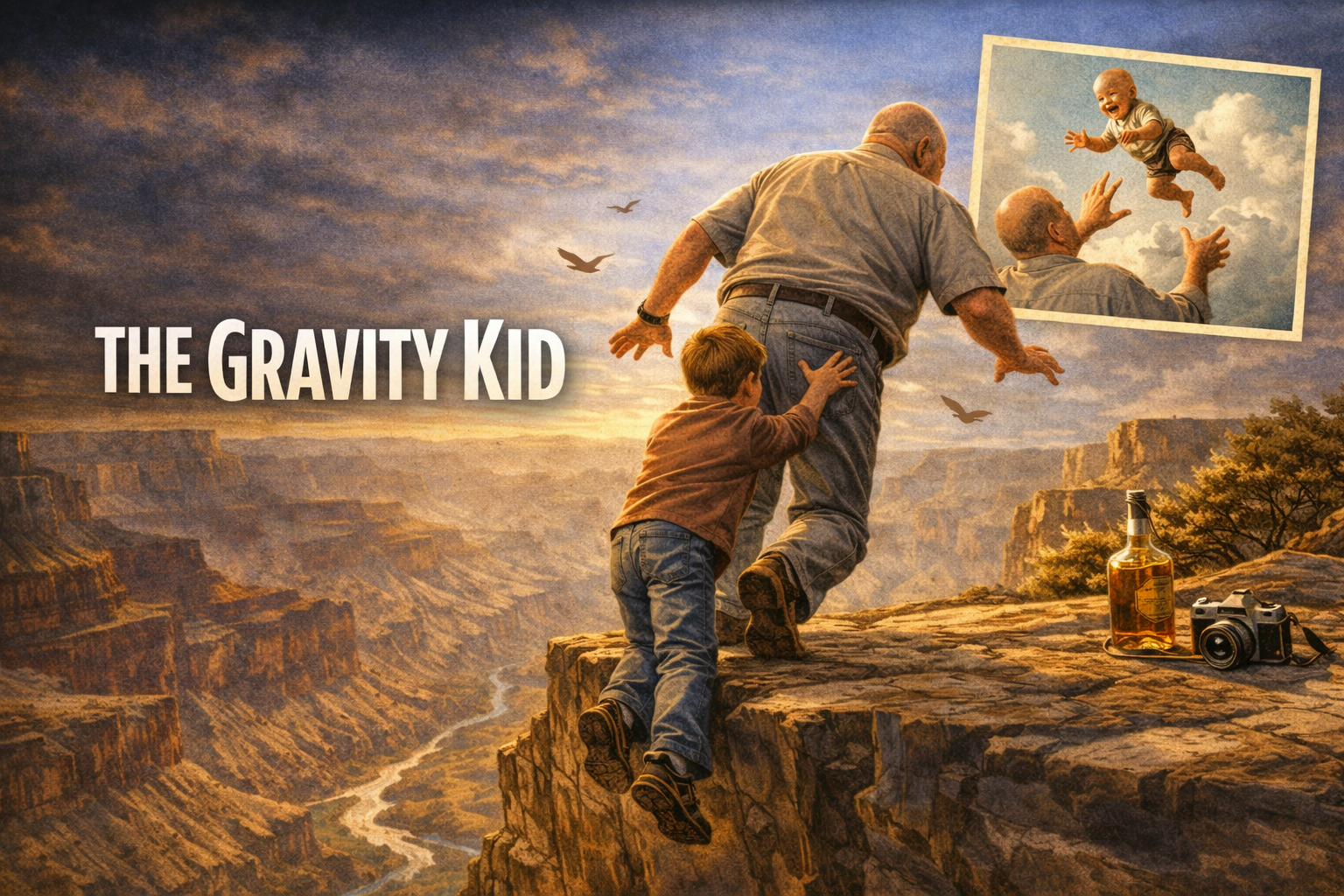
I was bald too, having been on the planet only three weeks. I was not yet strong enough to toss my father into the air and catch him, so he did the honors for both of us. Dad flipped me like a pancake above his head, then plucked me out of the ether after what I am fairly sure was a double gainer. At the apex of one of those flights, I became aware of his shiny skull.
Dad was not like Mom. She cuddled me and smelled of flowers. Dad smelled of something brewed out of barley and wheat, with a Scotch-whiskey afterthought. My birth, as I later gathered, had inspired in him a month-long bender.
You may think I was one of those exceptional children who remembers life back to the delivery room. No. A child psychiatrist, a family friend, explained that many of my earliest recollections were probably phantom memories — scenes patched together from things I overheard my parents say about me.
Mother admitted to a friend that yes, Dad tossed me in the air, but he always caught me. My mother, who seldom lied, witnessed enough of his behavior to supply the rest. She retold those episodes often enough that they passed into family history and then into my head.
There was, for instance, Banff National Park.
Signs everywhere warned visitors not to feed the bears. My father, as I remember it through the filter of Mother’s retellings, feared neither God nor bear. He was convinced the bears were his brothers and sisters. Naturally, he decided to share his Scotch with them.
Mother objected to Dad’s bonding with wildlife. She was especially alarmed because while he refilled saucers with booze for his furry companions, he held baby-me in his left arm.
Then there was the well incident.
My father apparently tied a rope around my ankles and lowered me headfirst into a deep well so I could retrieve a hat that had blown off his head. Mother considered this poor judgment, largely because both the hat and I were nearly lost. Dad accepted my refusal to go down wells headfirst after that, though he regretted that I would never make much of a chimney sweep.
Whenever Mother was annoyed with Dad, she brought up the well.
“If you lose your damn hat,” she told him, “powder your noggin. It’s not worth murdering our only child over.”
There came a time when my father stopped drinking.
I was about ten when our little family returned from visiting my grandparents. On the drive home we stopped, as we often did, at the Grand Canyon. In those days there were fewer fences, fewer warning rails, and apparently fewer objections to idiots testing natural selection in front of their children.
Dad took my hand and led me toward the rim. Mother sensed danger the way birds sense weather. She called me back to help her set up our picnic.
My father, standing inches from the edge, tossed me into the air and pretended to miss me. Mother shouted again. Dad gave me one of his little nods that meant: obey your mother. I scampered back.
To prove how safe the rim was, Dad leaned farther out for a better look. Loose stones skipped into the abyss. He had been hitting the sauce again. Even at my age I could tell the afternoon still had room to worsen.
Mother invited him to join us for his favorite sandwiches — onion, cheese, and tomato. Dad instead spread his arms like propellers and began “buzzing” the Grand Canyon, sprinting and slipping along the rim within inches of death. Finally he laughed and flew back to us.
We ate on a park table twenty yards from the edge. It was bright and sunny except for sudden gusts that ripped at our paper tablecloth. Most of the time I believed my parents loved each other, but that day I could tell Mother was furious. She looked Dad dead in the eye and said he was never again to risk my life for a laugh.
I remembered another visit a few years earlier when I had peered over the edge of the canyon and Dad had sneaked up behind me and given me a playful shove. I pitched forward, but he caught me easily, swept me into his arms, and warned me never to fool around near the rim.
He smelled then of chocolates and peppermint, the way he did when pretending to be the Easter Bunny. His whiskers scratched my cheeks. We laughed. I never felt safer than I did in his arms.
Now here we were again.
Mother carried our rubbish to a wire basket and said that if Dad ever took me near the rim again, she would personally throw him into the canyon. Then she told us both to wait in the car.
We obeyed. At least at first.
When she ducked into one of the roadside privies, Dad announced that he needed one last photograph of one of the great wonders of the world. I asked if I could come.
“Your mother’s acting up,” he said. “You’ve upset her enough for one day.”
He ordered me to stay in the car, took a nip from a pocket flask, winked, and staggered back toward the rim.
I watched him plant himself above the mile-deep canyon and snap picture after picture with his back to me. I remembered how he had teased me on our earlier visit.
So I got out of the car, closed the door softly, crept up behind him and gave him a little push.
He lurched forward. I grabbed the back of his trousers and pulled with all my strength. The Scotch had turned him to rubber. For one hopeful instant I thought I might stop him, but the gravel gave way and Dad tipped slowly forward. He glanced back with an expression that seemed to say he suddenly understood what kind of miniature monster he and Mother had produced.
“Pull me back, son,” he slurred. “Pull.”
“I’m trying, Daddy!”
If I lost him, I would lose more than my father. I would lose the world as I knew it.
Dad flapped his arms against the air. That did not help. He seemed to realize he was about to plunge to his death — and take me with him.
“Let go of me, you crazy bastard.”
“No! I’m sorry!”
“I love you. Now let go!”
I had rarely disobeyed my father, but this time I shut my eyes and held on. We slid forward together toward that staggering void.
I prayed that God would help.
A gust swept up from the canyon and checked our motion. For a fraction of a second I became a true Christian.
Then the wind dropped.
I stopped being a Christian.
There were no miracles.
Just then a figure materialized beside us. In one swift motion Mother grabbed Dad by the collar and hauled him back. Somehow, between the wind, my mother’s strength, and perhaps a passing flicker of divine mercy, gravity was denied its due.
And in that moment I understood something else. Drunk or sober, ridiculous or reckless, my father was willing to take the fall for me.
On the drive home he announced that he was giving up drinking and smoking.
And he did.
For almost a month.
During those glorious thirty days he bought me more toys than I had ever imagined possible.
Later I overheard Mother’s best friend ask if she intended to remain married.
Mother said, “I’m not sure. This summer has turned into such a cliffhanger.”
That was the last summer we visited one of the great wonders of America.