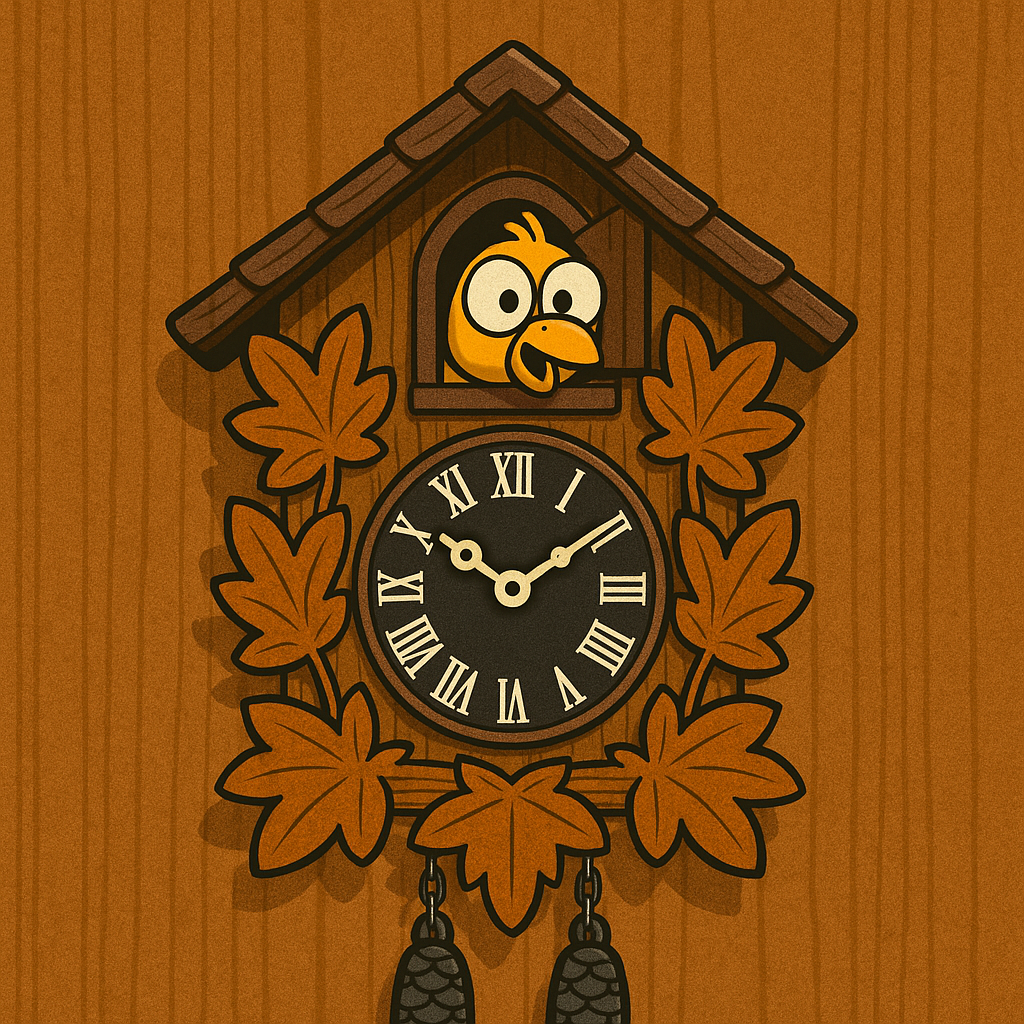
Why There Are 12 Hours on a Clock (and Why the Bird Isn’t Crazy)
jaron summers © 2026
Several people have suggested — gently, and not so gently — that I may be cuckoo.
This suspicion is usually raised around the time I start talking about clocks.
Not digital clocks. Those are appliances.
I mean clocks with opinions. Clocks that make noise. Clocks that open a little wooden door and send out a bird to interrupt your thoughts and remind you that time, like life, is not entirely under your control.
Recently, I learned something that reassured me. Not about myself — about the clock.
First, the alleged error.
On many old clocks, the number four is written IIII instead of IV. This looks wrong. People point at it the way they point at modern art and say, “That can’t be right.”
But it is right. Clockmakers have done this for centuries because IIII balances VIII, avoids confusion with VI, and keeps the dial visually calm. In other words, the clock is correct and the viewer is impatient.
Which brings us to the bigger question.
Why are there 12 hours on a clock in the first place?
The answer begins thousands of years ago with people lying on their backs in the sand, staring at the sky, and trying to divide the day into something manageable before lunch.
The ancient Egyptians split daylight into twelve parts based on star movements. Night got twelve more. The hours were uneven — longer in summer, shorter in winter — because nature didn’t care about fairness yet.
Why twelve?
Because twelve is a friendly number. You can divide it by two, three, four, or six without breaking anything. It’s the same reason we have twelve months, twelve inches in a foot, and 360 degrees in a circle.
And here’s the part I like best:
You can count to twelve on one hand.
Each finger has three segments. Your thumb points. Ancient merchants did this all the time. No abacus. No chalkboard. Just a hand and a deal.
When mechanical clocks arrived centuries later, nobody said, “Let’s rethink everything.” They said, “Twelve works. Don’t touch it.”
Which is why, today, a wooden bird pops out every hour to announce a system invented by stargazers, merchants, and people with sand in uncomfortable places.
So yes — I may be cuckoo.
But the clock?
The clock is very old, very practical, and doing exactly what it was designed to do:
interrupt us gently and say,
Pay attention. Time is passing. But not as urgently as you think.