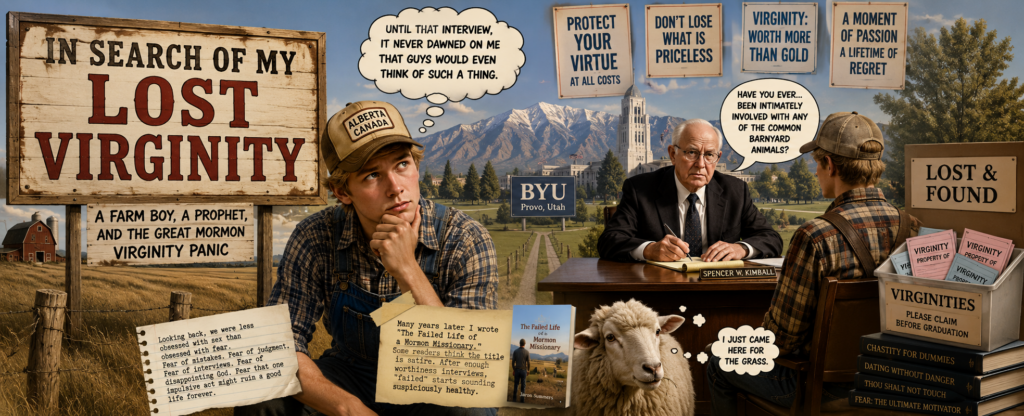
I grew up in a small farming community in Alberta.
We worried about hailstorms, broken machinery, rust, gophers, and whether the wheat would survive another week without rain.
As near as I could tell, the sheep worried about grass.
Then one day I was called in for a private interview with Spencer W. Kimball before leaving on my Mormon mission.
At the time, Kimball was one of the most respected religious leaders on earth.
People spoke of him in hushed tones.
If he had walked across the Sea of Galilee while glowing faintly in the moonlight, nobody in Utah would have considered it unusual.
I entered the interview terrified he might ask if I had ever tasted coffee.
Instead, within minutes, I began to suspect the man had spent years investigating crimes at petting zoos.
Until that moment, it had never occurred to me that farm boys might become romantically involved with livestock.
Honestly.
We had cattle, sheep, horses, pigs, chickens, and one rooster so hateful he could have qualified for public office.
But nowhere in my youthful imagination did I picture teenage boys looking at a barnyard and thinking:
“You know… maybe.”
But suddenly there I was.
Sitting across from one of the most powerful religious men in America while he carefully explored possibilities that had never entered my innocent Canadian brain.
The truly amazing part?
The first human being to place those images into my head was not a drunken farmhand, a criminal, or a deranged traveling salesman.
It was the prophet.
I walked out of the interview feeling less sinful than deeply confused.
I remember staring at a field afterward thinking:
“Good Lord… what have people been doing out here?”
Years later I attended Brigham Young University.
At BYU, virginity was discussed with the intensity usually reserved for nuclear launch codes.
Virginity was not merely a condition.
It was an endangered species.
A sacred relic.
The Shroud of Turin with hormones.
Entire systems existed to protect it.
Meetings.
Lectures.
Pamphlets.
Firesides.
Interviews.
Middle-aged men monitored virginity like air-traffic controllers guiding a damaged aircraft through a storm.
And the language fascinated me.
People constantly warned us not to “lose” our virginity.
Lose it?
What did that even mean?
Was it small?
Could it slip out unnoticed while jogging?
Did some poor freshman accidentally leave hers in the library beside a chemistry textbook?
Why wasn’t there a Lost and Found Department at BYU?
“Excuse me, Sister Jensen, someone turned in a slightly used virginity near the vending machines.”
The more I thought about it, the stranger it became.
Nobody ever says:
“I lost my appendix.”
Or:
“I misplaced my pancreas during spring break.”
But virginity apparently wandered off constantly.
And people reacted as though this invisible object was more valuable than gold, diamonds, or functioning spinal tissue.
Some students became so terrified of “losing” it that dating resembled hostage negotiations.
A young man could place his arm around a girl during a movie and both would react as though federal charges might follow.
Meanwhile, I was still trying to recover from the revelation that somewhere in North America there apparently existed young men requiring official church warnings about sheep.
Looking back, I honestly think many of us were less obsessed with sex than obsessed with fear.
Fear of mistakes.
Fear of judgment.
Fear of interviews.
Fear of disappointing God.
Fear that one impulsive act might somehow ruin an otherwise decent human life forever.
That’s a heavy burden to place on young people.
Especially young people already trying desperately to be good.
Many years later I wrote The Failed Life of a Mormon Missionary.
Some readers assume the title is satire.
But after enough worthiness interviews, “failed” can start sounding suspiciously close to emotionally healthy.
As for my virginity, I still haven’t located it.
If you happen to see it wandering across the Alberta prairie with a confused sheep and a BYU guidance counselor, please let me know.
Disclaimer: This humorous essay reflects personal memories, exaggerations, confusion, prairie mythology, and the lingering psychological effects of too many church interviews. Any resemblance to actual sheep, guidance counselors, prophets, or missing virginities is purely coincidental.