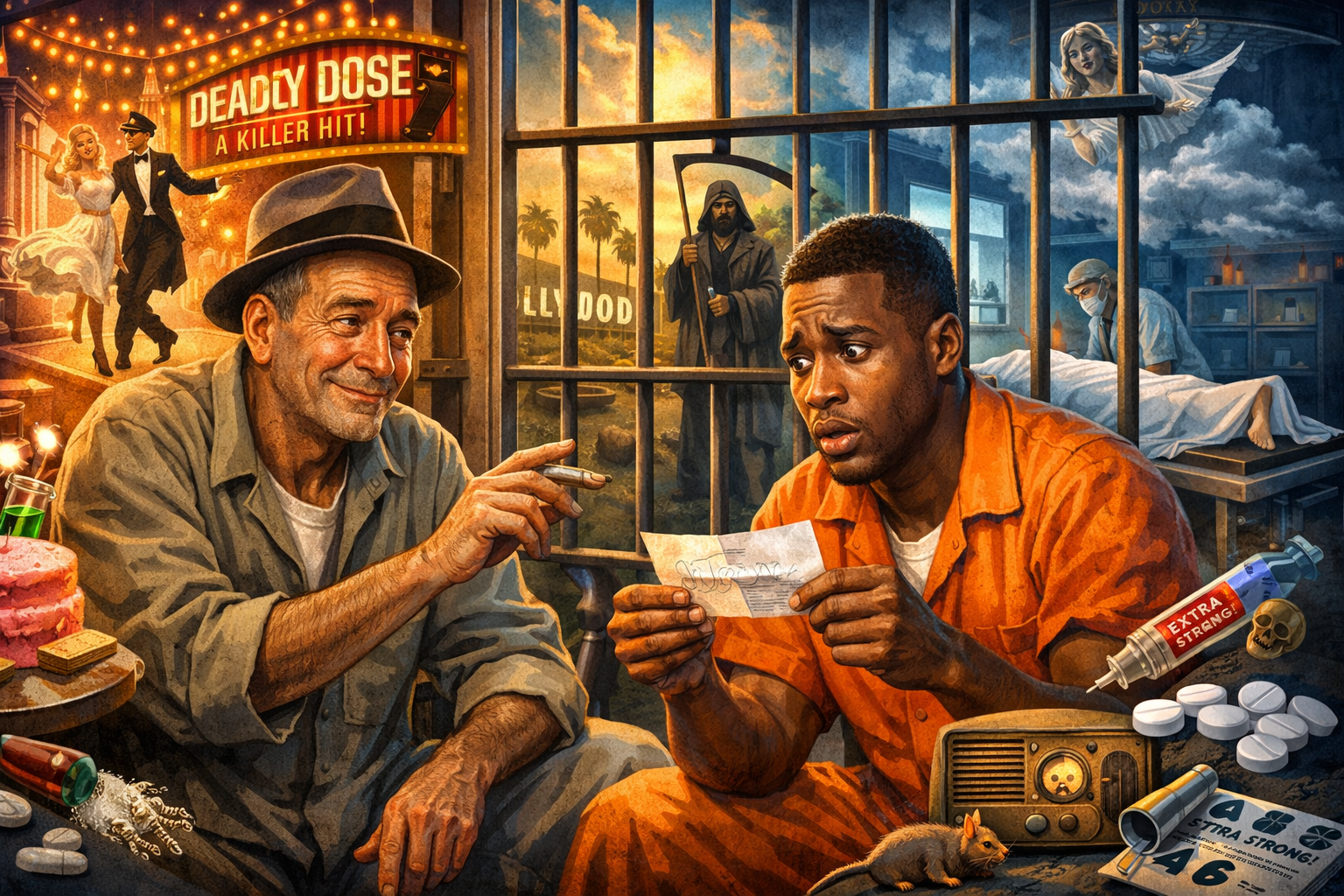

“Back in my day,” said Leon Purvis, who had done enough time to qualify as a public landmark, “a man could at least trust his poison to be honest.”
Darnell, who was twenty-three and still wore the baffled expression of someone who had not expected life to end up as a concrete bunk and an aluminum toilet, looked up from his mattress.
“That may be the oldest sentence ever spoken in a correctional facility,” he said.
Leon nodded. “And one of the soundest. There used to be standards.”
“In jail?” said Darnell.
“Especially in jail. Out there people lie professionally. In here they used to lie with craftsmanship.”
“You’re telling me crime used to be more ethical?”
“No. I’m telling you it used to be more competent.”
Leon leaned back against the wall with the ease of a man who had spent a quarter of his life in rooms furnished by people with a personal grudge against hope. “A vice used to have some dignity. Bad for you, sure. Illegal, often. Morally suspect, almost always. But at least you had a rough idea what was in it. Now a fellow takes one puff off a strip of paper and winds up auditioning for the morgue.”
Darnell laughed. “That’s what gets me. We have become such an advanced civilization that even the stationery wants to kill you.”
“Exactly,” said Leon. “You get a letter from your mother, a legal memo, maybe a birthday card with a balloon on it, and next thing you know six men are standing over you asking if anybody has Narcan.”
“It’s no way to run a country,” said Darnell.
“It’s no way to run a postcard,” said Leon.
For a moment they sat in silence, listening to the usual prison orchestra: metal clanks, distant profanity, and somebody down the tier delivering an emotional speech about peanut butter.
Darnell shook his head. “I heard about a guy who bought a piece the size of a driver’s license for eight hundred bucks.”
“Inflation,” Leon said.
“He smoked half of it and folded like cheap patio furniture.”
Leon lifted a finger. “That is because nobody knows what any of this stuff is anymore. It’s not drugs. It’s chemistry showing off. Some maniac in a lab invents a new alphabet, sprays it on paper, and suddenly your buzz comes with five mystery ingredients and a prayer.”
“You make it sound like a casserole,” said Darnell.
“A casserole has the decency to smell like trouble.”
Darnell laughed, then went quiet. “What was it like in your day?”
Leon’s face took on the soft, faraway look of a man remembering an era that was terrible, but terrible in a familiar way.
“Primitive. Reassuring. You had hooch that could strip paint. Pills of uncertain ancestry. Weed that smelled like your uncle’s shed. Everything was awful, but it was awful in a recognizable style. A man could ruin himself with confidence.”
“And now?”
“Now he ruins himself experimentally.”
That, in one sentence, may be the modern condition.
We still want escape. We have always wanted escape. During the Great Depression, people were broke, hungry, humiliated, and one missed paycheck away from panic.
Yet they still scraped together a quarter for the movies.
They sat through double features, newsreels, cartoons, and stars so elegant they seemed to belong to another species entirely.
Fred Astaire danced as if gravity had been paid off. Ginger Rogers looked like rent had never been invented. Clark Gable smirked in a way that suggested charm might still rescue a person from the bill collector.
That was not stupidity. That was survival.
People wanted ninety minutes without landlords, debt, shame, or the daily insult of being alive at the wrong moment in history. They wanted music, glamour, wisecracks, and a clean temporary lie.
Now a desperate person looking for one clean minute without fear, boredom, memory, regret, lawyers, exes, judges, or his own thoughts can wind up with a piece of paper soaked in twelve laboratory nightmares and leave the world in a body bag.
“The product got modern,” Leon said.
That may be the bleakest business analysis in America, but it is hard to improve on it.
The old underworld, for all its defects, at least understood customer relations. They might rob you, threaten you, break your kneecaps, or run off with your wife, but if they sold you a vice, it was generally the vice advertised.
Now the underworld has become a tech startup: disruption, scalability, no quality control, and the consumer dies during beta testing.
Darnell sat up laughing. “That’s it. The whole thing sounds like it ought to come with a slide deck.”
Leon nodded. “A very short slide deck.”
What makes the whole business especially grim is not just the chemistry. It is the impersonality of it. The old dangers used to have faces. A crooked cop. A jealous husband. A mobster. A drunk with a knife. A bad neighborhood after midnight. You could at least point to your problem.
Leon tapped the wall with one knuckle.
“Now danger comes by mail,” he said.
That line belongs in a museum.
It also happens to describe the age rather well.
Everything now is synthetic, optimized, miniaturized, scaled, and detached from responsibility. Food is engineered. Faces are adjusted. Politics is packaged. Friendship is branded. Outrage is automated. Why, in a country that has managed to counterfeit nearly every other human experience, should poison be the last honest thing?
It isn’t.
That is the joke, if joke is still the word.
We have modernized vice the way we have modernized everything else: made it sleeker, faster, more profitable, and less accountable. The old sins at least arrived wearing their own clothes. The new ones come disguised as convenience.
When Darnell asked Leon what the lesson was, Leon stood up, adjusted his prison pants with the solemnity of a senator preparing to mislead the nation, and gave his verdict.
“In the good old days,” he said, “a vice might break your heart, empty your wallet, wreck your marriage, and leave you singing in the alley.”
He took a step toward the bars.
“Now it can do all that and kill you before the chorus.”
Darnell grinned. “You really missed your calling.”
Leon looked back over his shoulder.
“Kid, this is my calling. I’m the last reviewer left from a time when even corruption had production values.”
That may be exaggerated.
Then again, maybe not by much.
We flatter ourselves that we live in a more sophisticated age. We have better screens, better branding, better jargon, and worse surprises. We can deliver danger faster, cheaper, and in more attractive packaging than any civilization in history.
That is progress, I suppose, if you are grading on a curve drawn by the devil.
Leon gave Darnell a final nod.
“Remember this,” he said. “A society is in real trouble when even its escapism needs a toxicology report.”
We can deliver danger faster, cheaper, and in more attractive packaging than any civilization in history.
That is progress, I suppose, if you are grading on a curve drawn by the devil.
Leon gave Darnell a final nod.
“Remember this,” he said. “A society is in real trouble when even its escapism needs a toxicology report.”