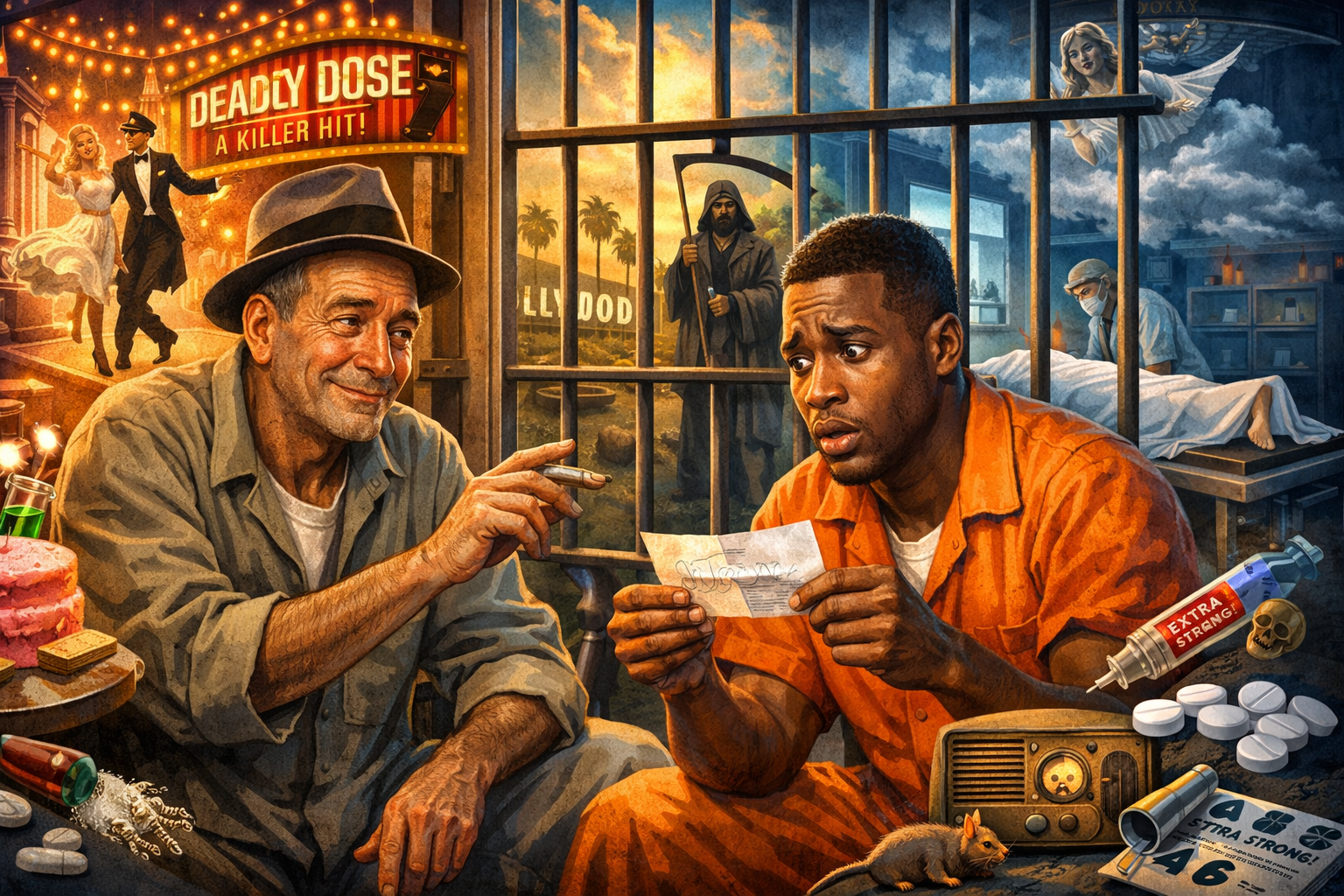
“Back in my day,” said Leon Purvis, who had done enough time to qualify as a public landmark, “a man could at least trust his poison to be honest.”
Darnell, who was twenty-three and still wore the baffled expression of someone who had not expected life to end up as a concrete bunk and an aluminum toilet, looked up from his mattress. “That may be the oddest sentence ever spoken in a correctional facility,” he said.
Leon nodded. “And one of the soundest. There used to be standards.”
“In jail?”
“Especially in jail. Out there people lie professionally. In here they used to lie with craftsmanship.”
“You’re telling me crime used to be more ethical?”
“No. I’m telling you it used to be more competent.”
Leon leaned back against the wall with the ease of a man who had spent a quarter of his life in rooms furnished by people with a personal grudge against hope.
“A vice used to have some dignity. Bad for you, sure. Illegal, often. Morally suspect, almost always. But at least you had a rough idea what was in it. You bought trouble, you got trouble. It didn’t arrive disguised as office supplies.”
Darnell smiled. “You sound nostalgic.”
“I’m not nostalgic,” Leon said. “I’m alarmed.”
They sat for a moment, listening to the usual prison orchestra: metal clanks, distant profanity, and someone down the tier delivering a passionate speech about peanut butter.
Darnell said, “I heard about a guy who bought something the size of a driver’s license for eight hundred bucks.”
“Inflation,” Leon said.
“He smoked half of it and folded like cheap patio furniture.”
Leon nodded. “That’s because nobody knows what any of this is anymore. It’s not drugs. It’s chemistry showing off.”
“Meaning?”
Leon leaned forward slightly. “Meaning some genius with a lab and no supervision invents a new alphabet, tweaks a molecule just enough to give it a new name, and suddenly it’s not illegal anymore. Not yet.”
Darnell frowned. “That’s all it takes?”
“That’s all it takes,” Leon said. “Move one atom over, add a flourish, call it something catchy, and now you’re selling something nobody’s tested, nobody understands, and nobody’s written a law against.”
“So it’s legal?”
“For about five minutes,” Leon said. “Until someone dies and the paperwork catches up.”
He shrugged.
“By then the guy in the lab is already working on the next version.”
Darnell stared at him. “That’s insane.”
“No,” said Leon. “That’s modern.”
Leon tapped the mattress lightly. “Then they spray it on paper, and now your buzz comes with five mystery ingredients and a prayer.”
Darnell laughed uneasily. “You make it sound like a casserole.”
“A casserole has the decency to smell like trouble.”
Darnell shook his head. “That’s the part I don’t get. Paper?”
“Paper,” Leon said. “Letters. Legal mail. Greeting cards. Somebody sends you a nice note, maybe a little balloon on the front, and next thing you know six men are standing over you asking if anybody’s got Narcan.”
Darnell stared at him. “You’re kidding.”
“Kid,” Leon said, “I’ve been in places where the most dangerous thing in the room was a paperback.”
That hung there for a moment.
“A book?”
“A book,” Leon said. “Pages treated like a science experiment. Tear one out, smoke it, and congratulations—you’ve just rolled the dice with a laboratory you’ve never seen.”
He settled back again.
“In my day, everything was terrible, but it was terrible in a recognizable way. Hooch that could strip paint. Pills of uncertain ancestry. Weed that smelled like your uncle’s shed. A man could ruin himself with confidence.”
“And now?”
“Now he ruins himself experimentally.”
That, in one sentence, may be the modern condition.
We have always wanted escape. That part hasn’t changed. What’s changed is the delivery system.
There was a time when a person looking to forget his troubles went to the movies. He got music, glamour, wisecracks, and ninety minutes where nothing could reach him. The lie was clean. Temporary. Harmless, more or less.
Now a man looking for one quiet minute without fear, boredom, memory, regret, lawyers, exes, judges, or his own thoughts can wind up with a square of paper soaked in twelve laboratory surprises and leave the world before he figures out what he bought.
“The product got modern,” Leon said.
The old underworld, for all its defects, at least understood customer relations. They might rob you, threaten you, or break your kneecaps, but if they sold you a vice, it was generally the vice advertised.
Now the whole operation feels like a tech startup: disruption, scalability, no quality control, and the consumer dies during beta testing.
Darnell laughed. “That’s it. That’s exactly it.”
Leon tapped the wall lightly with one knuckle. “The worst part isn’t even the chemistry,” he said. “It’s the distance. The old dangers had faces. A dealer. A cop. A guy in a bad mood with a knife. You could at least point to your problem.”
He paused.
“Now it comes by mail.”
Darnell looked down at his hands. “So what’s the lesson?”
Leon stood, adjusted his prison pants with the solemnity of a man about to deliver something important, and stepped toward the bars.
“In the good old days,” he said, “a vice might break your heart, empty your wallet, wreck your marriage, and leave you singing in the alley.”
He glanced back over his shoulder.
“Now it can do all that and kill you before the chorus.”
Darnell grinned. “You really missed your calling.”
Leon shook his head.
“Kid, this is my calling. I’m the last reviewer left from a time when even corruption had production values.”
He gave a small nod. “Remember this,” he said. “A society is in real trouble when even its escapism needs a toxicology report.”
