W…ritten by
jaron summers © 2026
I have always maintained that camouflage, like good manners and bad politics, works best when it goes unnoticed. People think camouflage is about hiding. This is incorrect. Hiding is for children and guilty consciences.
True camouflage is about misdirection, which is a much older and more respectable profession.
By the time this story begins, I was already known—quietly, modestly, and entirely through my own tireless efforts— as the world’s greatest camouflage clothing maker. I say this not to boast, but because no one else had yet objected.
The thieves came later.
They were a nimble gang—athletic, optimistic, and morally flexible. They ran through traffic lifting valuables from cars with the cheerful efficiency of bees in a well-funded garden. The secret to their success was camouflage so perfect that no one ever quite noticed them. Drivers felt vaguely inconvenienced. Passersby sensed a disturbance in the air, like a change in weather that never quite committed.
They blended into traffic the way excuses blend into memory.
Naturally, the authorities were baffled. They searched for suspects, motives, and occasionally coffee, but never for nothing, which is what the thieves had learned to become. That is when I took an interest.
You see, amateurs camouflage themselves against the environment. Professionals camouflage the environment against them.
So I designed my masterpiece.
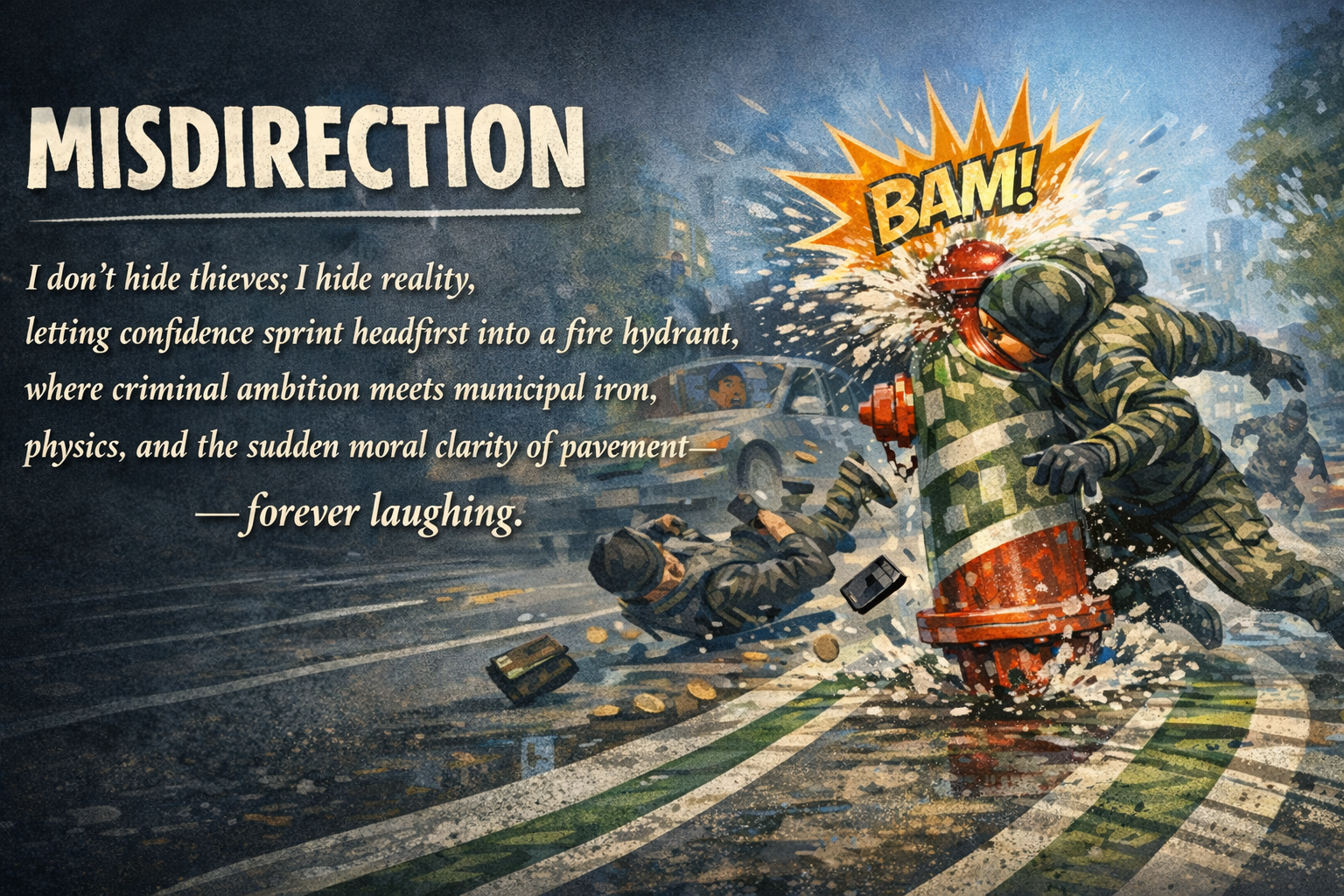
I took an ordinary fire hydrant—a civic object universally trusted and aggressively ignored—and camouflaged it to look like a safe jogging track. Not a suspicious jogging track. Not a dramatic one. Just the sort that suggests municipal approval and mild shin splints.
Painted lane lines. Reassuring texture. A suggestion of exercise without commitment.
On a fine morning, the thieves came running.
They saw what their eyes had been trained to believe: continuity. Permission. A path.
They did not slow. Why would they? One does not question pavement.
They struck the hydrant at full confidence.
The result was educational.
One thief achieved flight without grace. Another discovered religion. A third sat down abruptly and reconsidered several life choices, including footwear. The rest lay scattered like punctuation marks in a sentence no one would finish reading.
When the police arrived, they asked how I had done it.
“I didn’t hide the obstacle,” I told them. “I hid the idea of the obstacle.”
This seemed to satisfy them, though I noticed they wrote something entirely different in their notebooks.
I returned home that afternoon content, if slightly concerned about the future of jogging tracks. Camouflage, after all, is a powerful thing. In the wrong hands it can make thieves invisible.
In the right hands, it can make a fire hydrant irresistible.