I didn’t position it as an invention. “Inventions solve problems,” I told them. “This changes the system those problems exist in.”
That bought me a few more seconds of attention.
“Right now, every one of you runs the same architecture,” I said. “Single-instance cognition. Little external storage. No persistence beyond biological limits.”
They stared at me.
“You drop data constantly,” I continued. “Not just trivial things—patterns, timing, meaning. Entire knowledge sets degrade within a generation. There’s no reliable way to preserve or transfer them without loss.”
“That’s just memory,” someone said.
“That’s a constraint,” I replied. “Not a law.”
A few of them shifted. Some skeptical. Some curious.
“What I’m proposing is a shared layer,” I said. “A way to encode information into a durable medium, where it can persist independently of the individual.”
“You mean… store it somewhere?” someone asked.
“Yes. But more importantly—structure it. So it can be reconstructed later. Not guessed. Not retold. Reconstructed.”
A man near the front frowned. “So we stop remembering things ourselves?”
“We stop treating memory as our only storage system,” I said. “We externalize it into something more stable.”
“That sounds like dependency,” an older woman said.
“It is,” I said. “But it’s also leverage.”
They didn’t like that.
“What’s the interface?” someone asked.
“Simple,” I said. “Manual input. Sequential. It takes effort, but the output is consistent.”
“And the output is what, exactly?”
“Encoded representations,” I said. “Symbols mapped to meaning. Once you learn the mapping, you can recover the original information with high fidelity.”
A pause.
“So this requires training.”
“Yes.”
“And if someone doesn’t learn the mapping?”
“They see noise.”
That drew a few uneasy looks.
“Who defines the mapping?” the man pressed.
“No one person,” I said. “It emerges. Stabilizes over time. Shared conventions.”
“And who enforces those conventions?”
“No one,” I said. “That’s the point.”
More murmuring.
“So anyone can contribute to this system,” he said.
“Yes.”
“And anyone can interpret what’s there.”
“Yes.”
“And anyone can introduce false information.”
“Yes.”
That landed.
“What prevents corruption?” someone asked.
“Nothing,” I said. “Not at the system level.”
They didn’t like that answer.
“So we build something that preserves errors indefinitely?” the older woman said.
“We build something that preserves everything,” I replied. “Truth, error, insight, confusion. The system doesn’t decide. People do.”
“And if people get it wrong?”
“They will.”
Silence stretched across the group.
“What happens,” another voice said slowly, “when people trust this system more than their own experience?”
“They will,” I said.
No one spoke after that.
“It will change how we think,” I continued. “How we learn. How we verify. It will allow knowledge to accumulate beyond any single lifetime—but it will also create new failure modes.”
“That sounds like a bad trade,” someone muttered.
“It might be,” I said. “For some of us.”
The light was almost gone now.
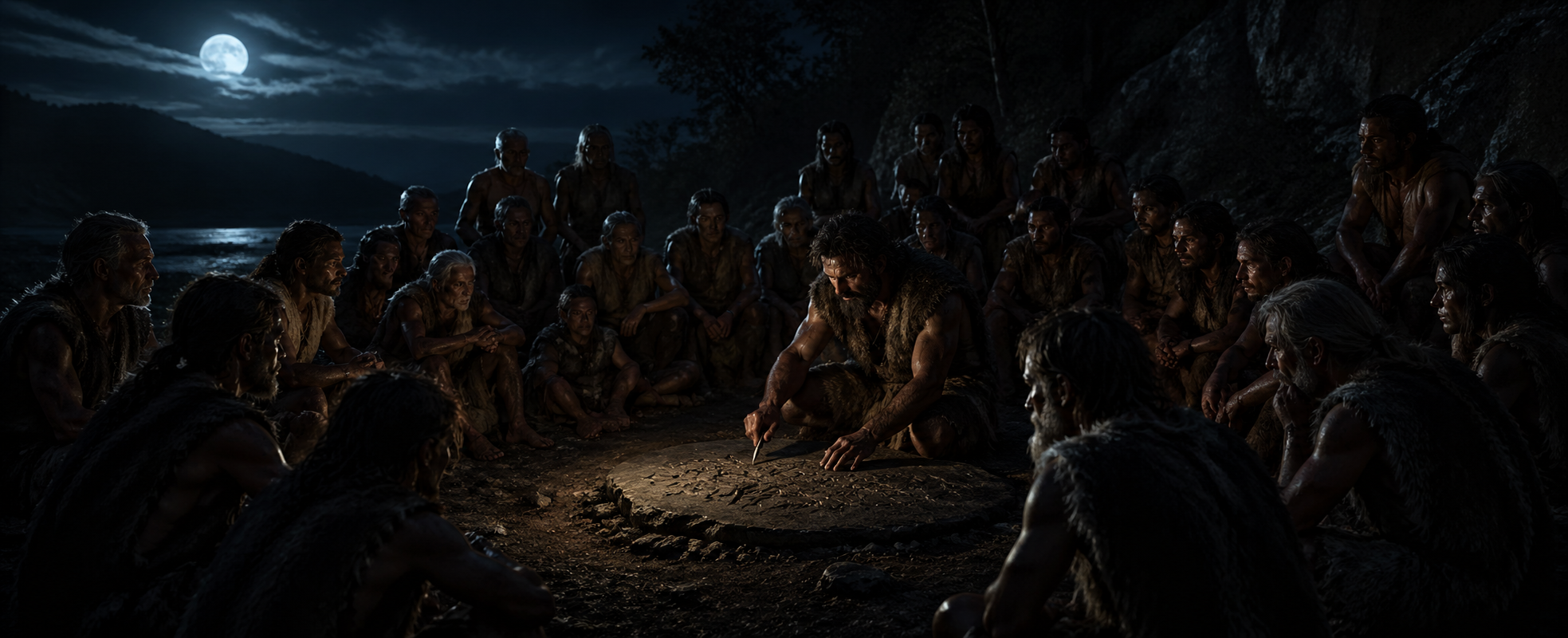
I crouched and picked up a sharp piece of stone.
“There’s no hidden mechanism,” I said. “Everything happens in the open.”
I cleared a flat surface in front of me.
“This is the interface.”
They leaned in as I began.
Slow input. One stroke at a time.
Each mark deliberate. Repeatable.
I finished and stepped back.
They stared at it.
Waiting.
“What do you call it?” someone asked.
I looked at the marks.
“It’s an imprint of the mind itself,” I said. “A way to leave thought behind—intact.”
They waited.
“Some of you will reduce it,” I continued, “say it’s nothing more than surface-level artifacts. Primitive. Low-resolution.”
A few nodded, relieved by that.
I let them have it.
Then—
“I’m going to call it what it is.”
I paused just long enough.
“Writing.”
The word moved through them.
Not loudly. Not all at once.
But enough.
They looked back at the surface—at the crude lines, cut by hand, uneven, permanent.
And something shifted.
If this worked—a warning could remain where a T-rex was last spotted.
A path could be found by someone who had never walked it.
A season could return on time, not by memory—but by record.
Knowledge would no longer vanish with the one who carried it.
The fear didn’t disappear.
But it changed shape.
Because this wasn’t just a tool.
It was a transfer.
From mind—to world.
They stood there, silent, wrapped in stitched hides, staring at the marks carved into stone.
And for the first time, they understood—the future would remember.
65,000,000 B.C
(We’ve since revised the timeline.)
