
The first cut hurt less than I expected.
That was my first surprise.
The second was that I was not dead.
The man standing over me seemed disappointed by both facts. “Hold still,” he said.
I considered explaining that I was tied to my own bed and therefore had limited mobility options.
Instead, I stared at the black dotted outline he had drawn across my chest with a felt marker.
Apparently that was my right lung.
As a physician, I felt obligated to admire the accuracy.
As a patient, I found it less impressive.
The knife returned.
A hunting knife.
Large enough to field dress an elk.
Not generally recognized by the medical profession as a surgical instrument.
The man holding it was named Carl Jensen.
Three years earlier his mother had died.
For reasons that made perfect sense to Carl and almost none to anyone else, he blamed me.
His mother had come to me with cancer.
Advanced cancer.
The sort of cancer that appears in textbooks under the heading “Bad News.”
Operating would have shortened her life.
Not operating gave her another eight months.
Eight reasonably good months.
Carl remembered only that she was dead.
The blade touched my skin.
A shallow cut.
Just enough to produce a thin line of blood.
Carl smiled.
I did not.
The room was dark except for a bedside lamp.
Outside, wind rattled the eucalyptus trees.
Or something rattled them.
Carl paused.
“Did you hear that?”
“No,” I said.
This was technically true.
I was too busy considering my own obituary.
He listened for several seconds.
Nothing.
The knife moved toward my chest again.
Then the bedroom wall exploded.
That is the only phrase that adequately describes what happened.
One moment there was a wall.
The next there wasn’t.
Wood, plaster, insulation, and several framed photographs launched themselves across the room.
Carl spun around.
I remember his expression.
Not fear.
Confusion.
The kind of confusion people experience when reality suddenly violates its own rules.
Something enormous stepped through the hole.
At first my brain refused to identify it.
The human mind has safeguards.
Certain sights are rejected automatically.
Flying elephants.
Talking mountains.
Politicians keeping promises.
My brain examined the creature and suggested several possibilities.
A bear.
An industrial accident.
A helicopter assembled incorrectly.
Then understanding arrived.
A bee.
A queen bee.
Roughly six feet tall.
Carl fired twice.
The shots accomplished nothing useful.
The bee crossed the room so quickly that I barely saw her move.
One moment she was by the shattered wall.
The next she was standing over Carl.
The struggle lasted perhaps three seconds.
Possibly four.
When it ended, Carl no longer represented a threat to anyone.
The giant bee turned toward me.
Moonlight from the broken wall illuminated her.
Golden eyes.
Amber wings folded behind her back.
A face that was somehow both alien and strangely familiar.
She looked at me with what appeared to be concern.
Then she spoke.
Not with buzzing noises.
Not telepathically.
Perfect English.
“You appear injured.”
I stared at her.
“You appear to be a bee.”
For a moment neither of us spoke.
Then, to my astonishment, she laughed.
It was the warmest sound I had heard all night.
Twenty minutes later the police arrived.
The bee was gone.
Carl was dead.
My bedroom wall was missing.
And I was preparing to explain to two homicide detectives that a giant extraterrestrial queen bee had saved my life.
In retrospect, that conversation could have gone better.
The detectives were named Morris and Vale.
Morris was broad, gray, tired, and had the expression of a man who had heard every lie available in Los Angeles County and had grown disappointed with the newer ones.
Vale was younger, sharper, and more polite, which made him more dangerous.
They sat across from me in a small interview room that smelled of stale coffee, floor cleaner, and human regret.
“Tell us again,” Morris said.
“Again?” I asked.
“Yes, Doctor. Again.”
“A man broke into my house.”
“Carl Jensen.”
“Yes.”
“He tied you up.”
“Yes.”
“He planned to remove your lung.”
“That appeared to be his goal.”
“With a hunting knife.”
“Not my recommendation.”
Vale leaned forward.
“And then what happened?”
This was the difficult part.
In life there are many sentences one hopes never to say while being questioned by homicide detectives.
The sentence then a giant queen bee came through my bedroom wall is near the top of the list.
So I lied.
Badly.
I told them I must have blacked out.
I said there may have been another intruder.
Possibly several.
I suggested Carl might have been attacked by someone from his past.
It was the sort of story a frightened man invents when the truth has wings.
Morris listened without blinking.
Vale took notes.
Neither believed a word.
“You understand,” Vale said, “that we have a dead man in your house.”
“I do.”
“A dead man who was killed with considerable force.”
“He was a determined fellow.”
Morris sighed.
“Doctor, your bedroom looks like it was hit by a truck.”
“That was my impression also.”
“But there are no tire tracks.”
“That does complicate the truck theory.”
They kept me for twenty-four hours.
At least that was the promise.
Twenty-four hours for clarification.
Twenty-four hours to compare statements.
Twenty-four hours to let everybody calm down.
The first twenty-four hours became forty-eight.
Then four days.
Then a week.
No charges.
No answers.
No shoes with laces.
I had spent my adult life telling patients to remain calm in stressful situations.
This turns out to be much easier when you are wearing a white coat and the other person is in a paper gown.
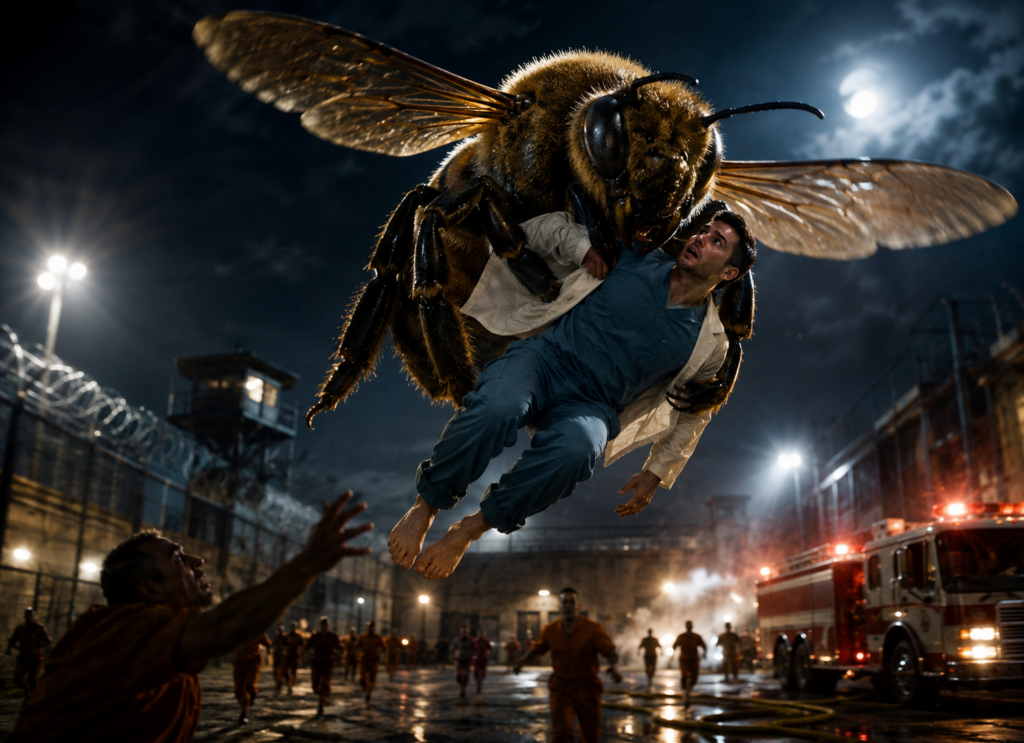
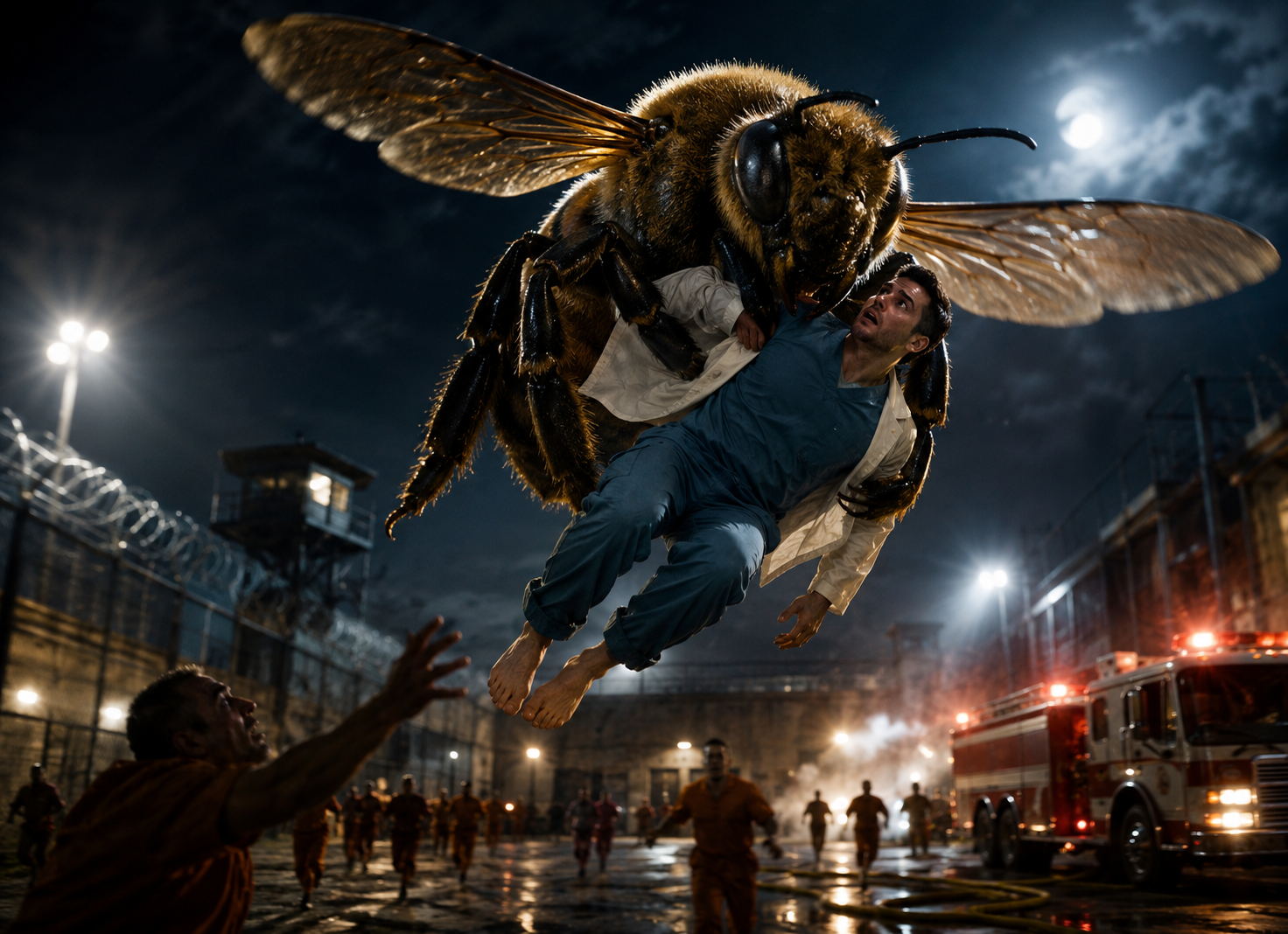
On the seventh night, the fire alarm went off.
At first nobody moved.
Jails are full of men who have learned not to trust bells.
Then smoke began curling from the far end of the corridor.
Doors opened.
Guards shouted.
Inmates were herded into the yard under floodlights while fire engines screamed into the lot.
It was chaos.
Beautiful, official chaos.
I stood in a line of men wearing orange, trying to look like a physician rather than a cautionary tale.
That was when someone said my name.
“Jed.”
I turned.
A man twice my width and almost my height was staring at me.
His face carried the Jensen family resemblance.
Carl’s eyes.
Carl’s jaw.
Carl’s apparent commitment to poor decision-making.
“You killed my cousin,” he said.
“I didn’t.”
“That’s what they all say.”
“Actually, in this case, it’s unusually accurate.”
He took a step toward me.
I took one back.
A guard shouted somewhere behind us.
Smoke drifted across the yard.
The floodlights flickered.
Then everything went dark.
Not dim.
Dark.
Hundreds of inmates shouted at once.
The cousin lunged.
I ran.
I am not proud of this.
But I am alive because of it.
I ran past a fire engine, past a coil of hose, past two guards who were arguing about who had the keys, and into a narrow service alley between the jail and a maintenance building.
Behind me, the cousin was gaining.
He was faster than he looked.
Unfortunately, I was exactly as fast as I looked.
My lungs burned.
My bare feet slapped against wet pavement.
Sirens wailed.
Men shouted.
Somewhere glass broke.
I reached the end of the alley and realized there was a chain-link fence in front of me.
Very high.
Very locked.
Very final.
I turned around.
The cousin slowed and smiled.
“Now,” he said, “we talk.”
“I would prefer correspondence.”
He came closer.
Then I heard it.
A low vibration above us.
Not a helicopter.
Not a drone.
A sound I knew from childhood, magnified until it seemed to fill the sky.
Wings.
The cousin looked up.
So did I.
Something enormous dropped out of the darkness.
The queen bee descended like a golden judgment.
Her arms closed around me.
The pavement vanished beneath my feet.
The cousin shouted.
The jail fell away.
So did the fire engines.
So did the floodlights, the guards, the smoke, the sirens, and every sensible explanation I had ever believed in.
We rose into the night.
I should have screamed.
Instead I laughed.
Possibly from terror.
Possibly from relief.
Possibly because no medical school in the world prepares a man to be abducted from jail by an extraterrestrial queen bee.
She held me carefully.
Not like prey.
Like something fragile.
Like something worth saving.
The city glittered beneath us.
Los Angeles looked peaceful from above, which is how Los Angeles lies.
After several minutes, she spoke.
“You lied to them.”
“Yes.”
“To protect me?”
“Mostly.”
“What was the other reason?”
“I didn’t want to be known as the doctor who claimed he was rescued by a giant bee.”
She considered this.
“Your species is very concerned with reputation.”
“Only constantly.”
We flew west, toward the dark hills.
I could feel the strength in her arms and the impossible rhythm of her wings.
She had saved me twice.
Once from a murderer.
Once from a world that would never believe what had happened.
That was when I understood something.
The first rescue might have been chance.
The second was a decision.
She had come back for me.
And though I did not yet know her name, or where she came from, or how a creature with wings could cross the stars, I knew my life had separated into two parts.
Before her.
And after.
I have no idea where story ideas come from.
If I did, I would go there more often.
Perhaps it is a warehouse somewhere outside Bakersfield staffed by retired screenwriters and mildly intoxicated angels.
All I know is that once in a while I wake up and discover that my subconscious has been working the night shift.
This one may have started when I was sixteen and tending a small colony of bees in Alberta.
I brought them water in the hot sun.
I floated Popsicle sticks on the surface so they would not drown.
I came to believe they knew I meant them no harm.
Scientists might not approve of that conclusion.
The bees seemed fine with it.
Years later, after reading about the astonishing intelligence of bees, I began to wonder whether we have misunderstood them entirely.
Perhaps intelligence does not always sit inside one skull.
Perhaps sometimes it is distributed across thousands of bodies.
Perhaps a hive is not a collection of insects.
Perhaps it is a mind.
If aliens watched Earth from a safe distance, perhaps they would not be impressed by us at all.
Perhaps they would look at bees and say, “There. That species understands civilization.”
Then they would look at humans, watch us argue about everything, and move along to a more promising planet.
Unless, of course, one of them stayed.
A queen.
A scientist.
An explorer.
A visitor from a civilization so old that crossing between stars is not a miracle to them.
Maybe they do not travel faster than light.
Maybe they travel differently.
Maybe they send living seeds across space.
Maybe queens sleep for centuries inside biological vessels, waking only when they reach a world worth studying.
Or maybe they have discovered something Einstein missed.
If so, I hope they explain it slowly.
I am still trying to understand my television remote.
What I do know is this:
A doctor is nearly murdered.
A giant queen bee saves him.
The police do not believe him.
The world becomes dangerous.
She returns.
And somewhere between terror, gratitude, wonder, and flight, a love story begins.
Not with candlelight.
Not with violins.
With wings in the dark.
Which, now that I think about it, may be the only honest way a love story should begin.