Quiet Glow
W…ritten by
jaron summers © 2026
A few weeks ago I bit down on something hard and got a sharp reminder from a tooth that had been quietly loyal for decades.
The dentist examined it, frowned gently, and said, “That’s old work.” He meant it respectfully.
Old work.
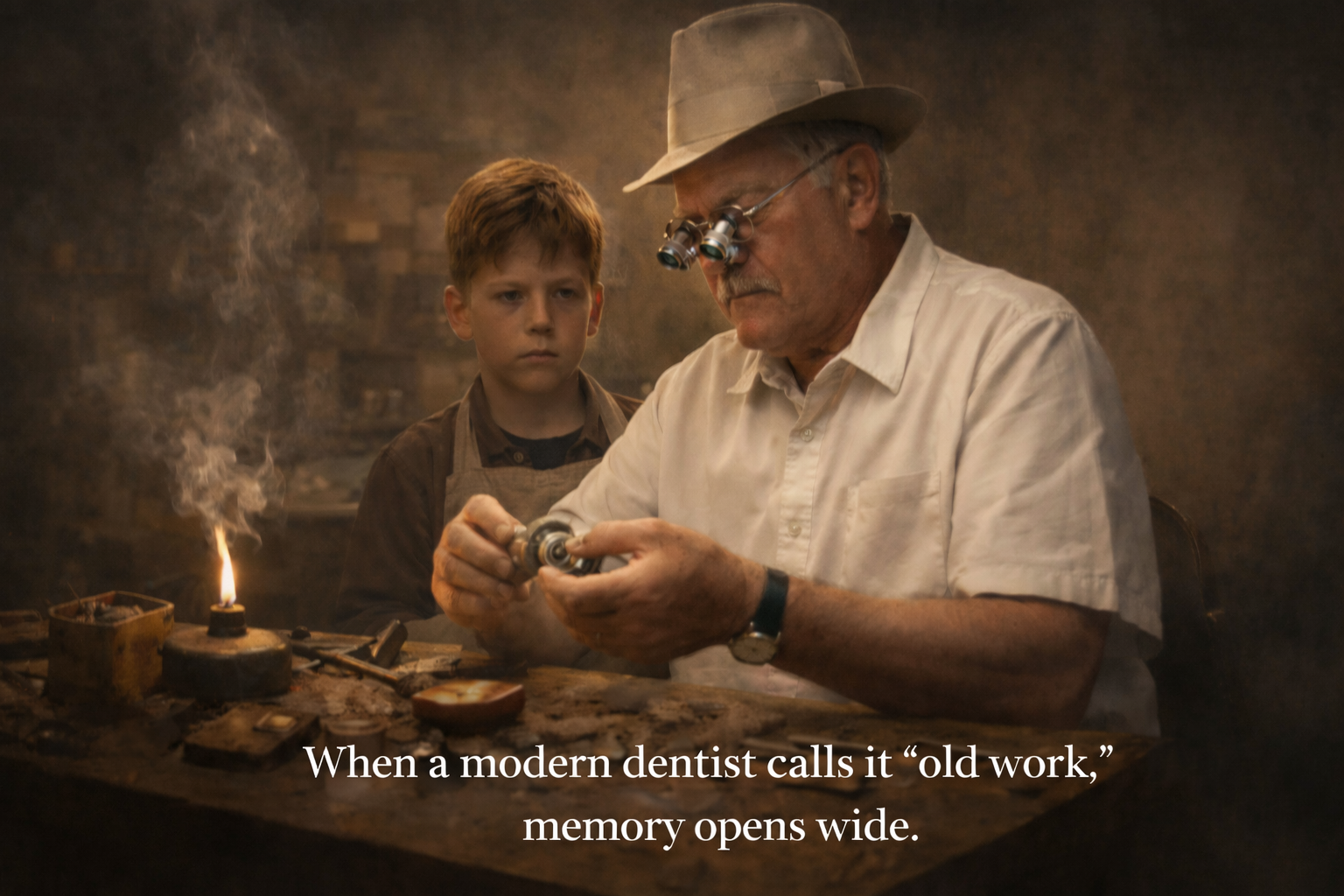
And just like that I was no longer in the chair. I was back in a small office with a man who mixed amalgam in the palm of his hand.
He didn’t use capsules. He didn’t use a timer. He used feel.
He would pour the silver powder into his left palm, add the mercury, and begin to knead it with rhythmic confidence. His hands were strong. There was always a faint sheen of sweat. He believed the warmth of the hand helped the mix—helped the bond.
He packed it in firmly. Smoothed it carefully. Burnished it until it shone.
“That,” he would say, leaning back slightly, “is the glow.”
I never questioned it. When you are young, you assume the man who holds the drill understands the universe.
Years later, sitting in the modern dental chair with filtered lights and sealed capsules and polite suction, I realized something.
The glow wasn’t about mercury. It wasn’t about polish.
It was about touch.
It was about a generation that did things with their hands and believed in pressure and friction and finishing what they started.
My father belonged to that generation.
Sure, he mixed amalgam in his palm, but he also mixed other things there—opinion, discipline, silence, conviction. He believed in packing things tight so they would hold.
There were subjects we circled like bad weather on the horizon—close enough to darken the day, never close enough to name.
We could discuss work, money, travel, and the proper way to fix a problem.
But some truths—other people’s, sometimes our own—stayed sealed up like capsules: safer, cleaner, and never quite touched.
Time does that. It removes the heat and leaves the shine.
The dentist finished the repair and said something about crowns and longevity. I nodded, paid, and left.
Walking to the car, I felt something more permanent than dental work.
I felt the residue of hands-on living: men who believed in pressure, in friction, in setting something properly so it would last.
They are mostly gone now.
The new methods are cleaner—probably safer, likely smarter.
But every so often you can still see it: an old filling that held longer than expected.
A small silver crescent, still faintly luminous.
The glow.