Rearranged Marriage
W…ritten by
jaron summers © 2026
I’ve been studying the word submission, which is dangerous business for a married man.
The Greeks — who invented philosophy, olives, and arguments that last two thousand years — used a term meaning “to arrange under.”
It sounds tidy. Respectable. Architectural. Like stacking books by height and pretending that proves something about civilization.
But marriage is not a bookshelf. It is more like a traveling circus that renews its license every morning and occasionally sets fire to its own tent.
Some religiously socialized women over-internalize submission because harmony becomes holiness.
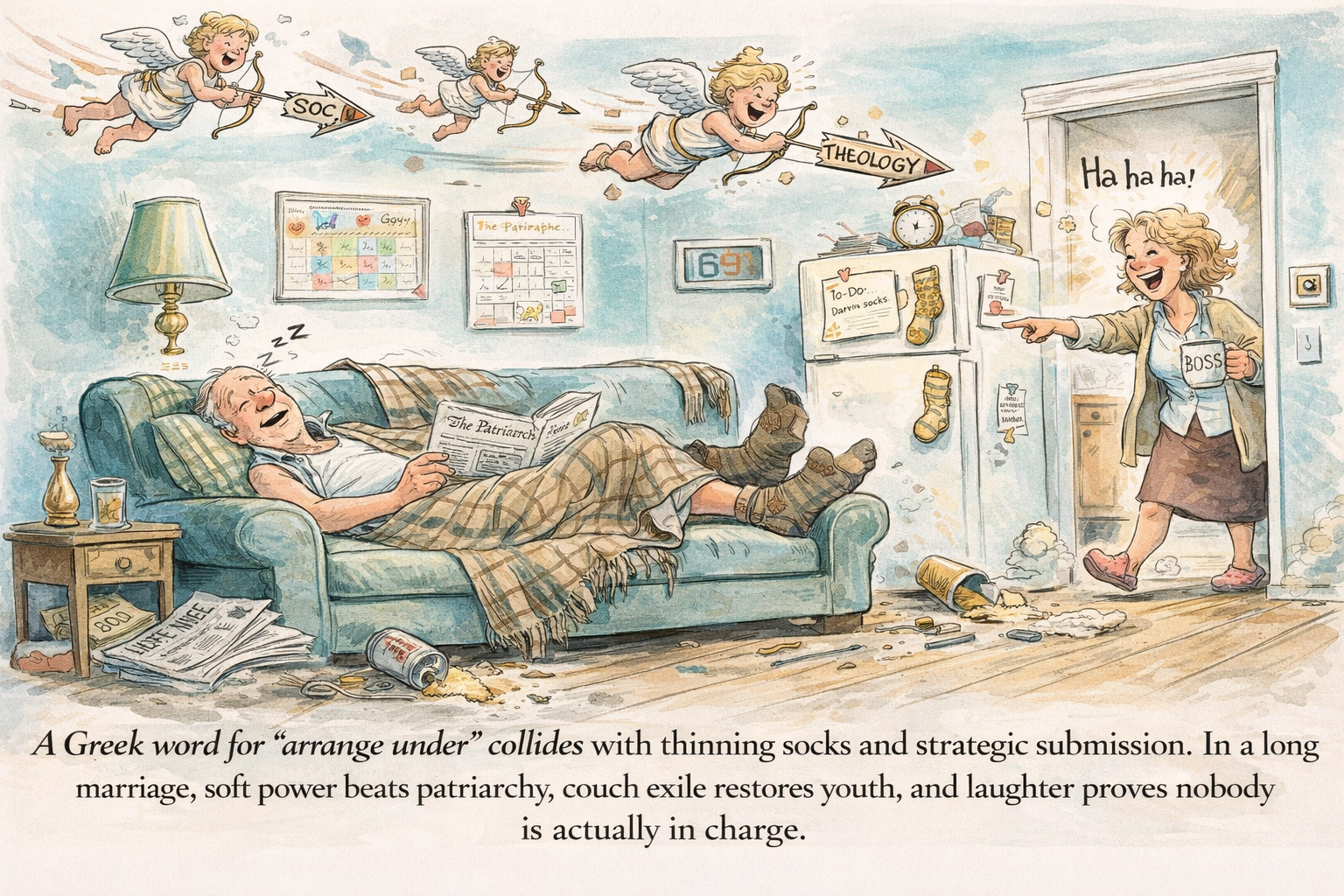
If peace equals virtue, then managing becomes ministry. Interrupting your husband about his socks at 6:12 a.m. is not control — it is stewardship.
Threads must be mended. Ankles must be defended. Civilization hangs by cotton and punctual vigilance.
Now here is the turn in the road.
Some men secretly enjoy being managed.
They deny it in public. A man must preserve appearances.
He will sigh, he will grumble, he will defend the independence of his hosiery as though it were a constitutional right.
But inwardly he knows that being managed means being noticed. Someone is keeping track of the thinning fabric of his ankles, which is more attention than most empires ever receive.
That is not domination.
That is attachment disguised as logistics.
In long marriages, power does not arrive wearing a crown. It does not pound the table. It drifts in quietly through the ordinary:
- Who adjusts the thermostat.
- Who controls the calendar.
- Who interrupts whom.
- Who removes the shoes.
On paper, she “arranges under.”
In practice, she steers.
Soft power, I have observed, often outperforms hard power. The Mississippi River never argues with the shore; it simply rearranges it over time.
And if a man is wise, he learns to admire the river instead of attempting to dam it with pride.
Occasionally, for sport, I exaggerate the submission. I demand it theatrically.
I scold her for not darning socks at four in the morning. I invoke patriarchal compliance as though I were issuing railway regulations to a nation in peril.
Something miraculous happens.
She laughs.
The entire hierarchy collapses like a cheap tent in a Kansas wind.
If she truly deferred — truly stepped back and surrendered the steering wheel — I would feel less alive.
A man does not want obedience nearly so much as he wants opposition with affection. He wants voltage. He wants someone smart enough to see through him and kind enough to stay anyway.
The tragedy, if there is one, is that she is smarter than I am. This is inconvenient for governance but excellent for survival.
I could not design a better partner in my wildest imagination. I would take a bullet for her — preferably in the fleshy part of my leg, where it might improve my character without impairing my mobility.
And when she laughs from the other room while I am sleeping on the couch — laughter audible even through REM — I do not feel defeated.
I feel eighty years younger.
The Greeks may keep their definitions.
Empires may keep their chains of command. In my house, authority lasts precisely until someone starts laughing.
And when that laughter rolls down the hallway like a riverboat horn on the Mississippi, every grand theory of submission sinks quietly beneath it.
What remains is not dominance. Not obedience. Not victory.
What remains is partnership — noisy, irreverent, electrically alive.
And if two imperfect people can keep rearranging each other without bitterness, if they can turn power into play and correction into comedy, if they can let laughter outrank pride — then there is hope for the rest of us.
Which is the only arrangement that has ever truly lasted.