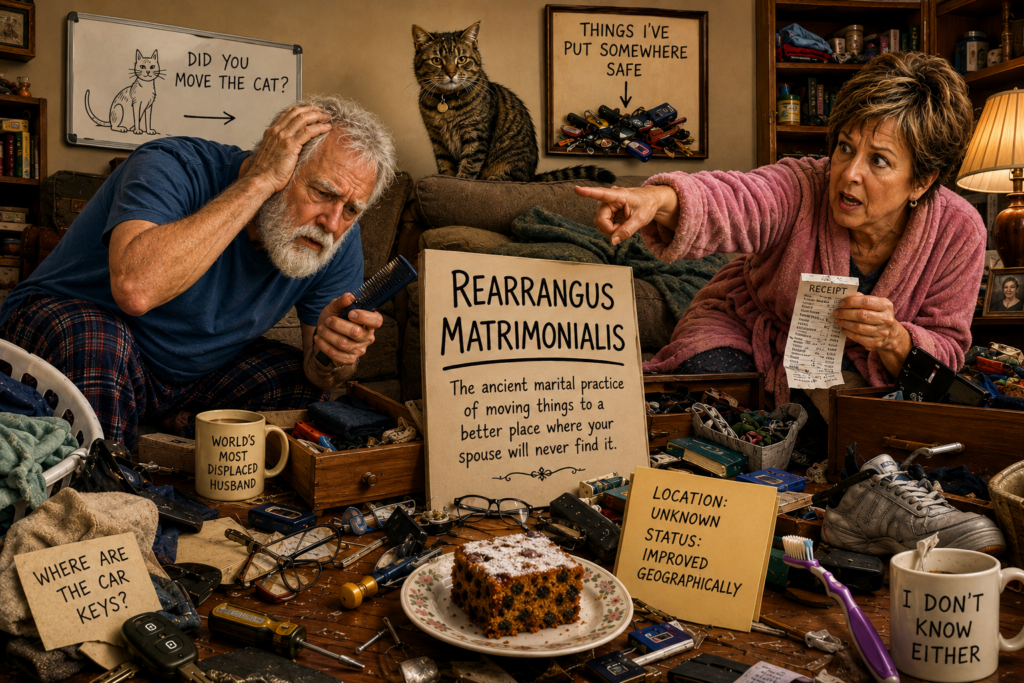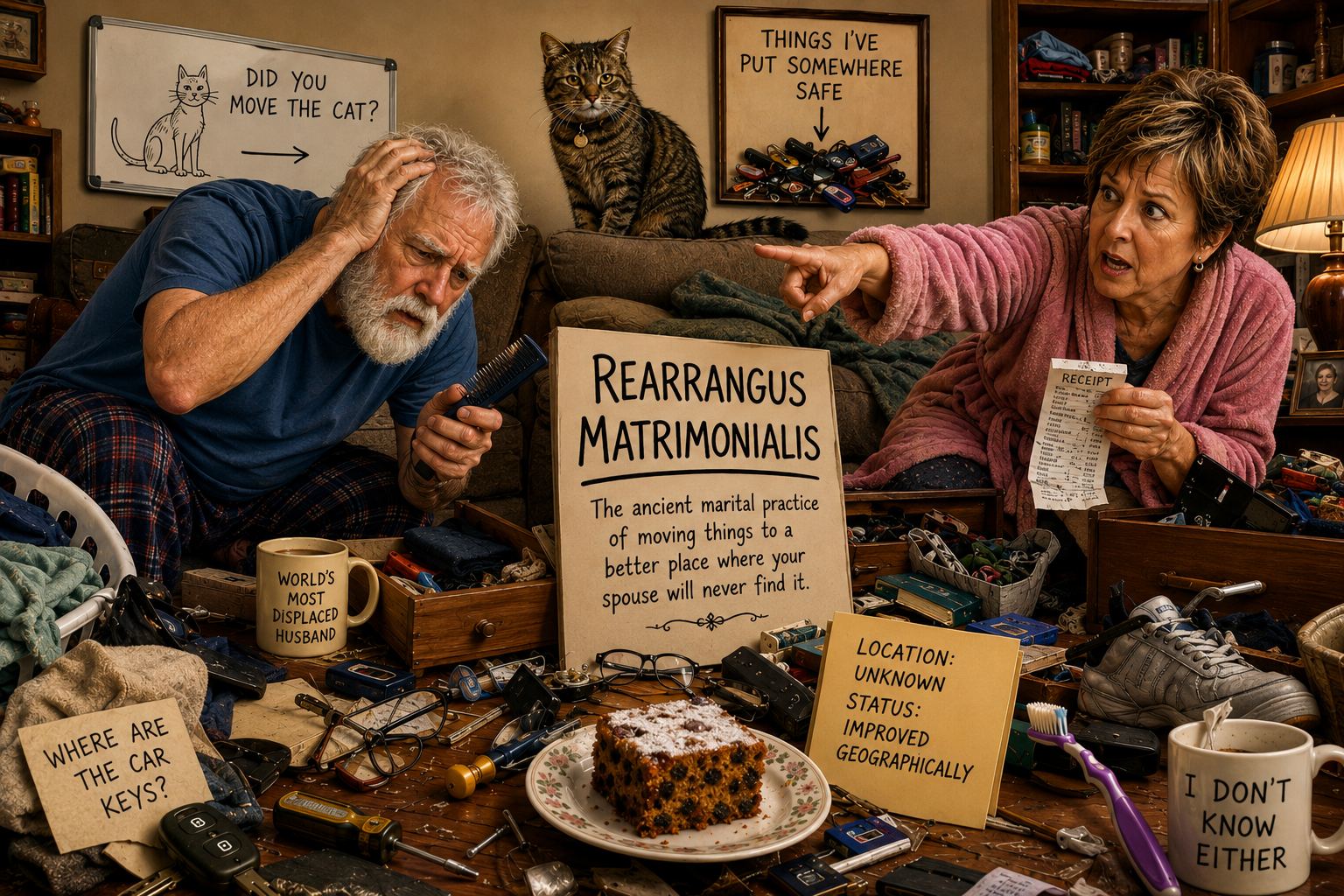

Kate and I have discovered a serious problem in our marriage.
We move each other’s stuff.
Not steal it.
That would be much easier.
If Kate stole my comb, I would know the comb was gone.
Instead, she moves it.
This means the comb continues to exist, but in a location known only to Kate, God, and possibly the cat.
I do the same thing to her.
This has been going on for years.
A receipt is sitting on the kitchen counter.
I think:
That shouldn’t be there.
So I put it somewhere safe.
Three days later Kate says, “Where’s my receipt?”
“What receipt?”
“The receipt that was on the kitchen counter.”
“Oh. I put it somewhere safe.”
“Where?”
And there we encounter the central weakness in my system.
I have absolutely no idea.
I believe there should be a legal term for this.
There probably isn’t because most legislators are married and don’t want to draw attention to themselves.
So I have invented one:
Rearrangus Matrimonialis
It’s Latin.
Well, it isn’t.
But it sounds Latin, and that’s really all Latin has going for it these days.
Rearrangus Matrimonialis is the ancient marital practice of moving something belonging to your spouse from the place where your spouse deliberately put it to a much better place where your spouse will never find it.
The important distinction is that the object is not lost.
It is improved geographically.
Marriage is filled with this.
Combs.
Glasses.
Receipts.
Keys.
Fruitcake.
A screwdriver.
A letter from the bank.
One shoe.
Occasionally a cat.
The cat creates a special legal problem because sometimes neither spouse moved it.
The cat moved the cat.
Nevertheless, accusations are made.
“Did you move the cat?”
“No.”
“Well, he’s not where I left him.”
Cats apparently have no respect for property law.
Degrees of Rearrangus Matrimonialis
First Degree: You move your spouse’s property deliberately and don’t tell them.
Second Degree: You move it somewhere “more logical.”
This is worse because the phrase more logical has ended more marriages than adultery.
Third Degree: You move something and later deny moving it.
“I didn’t touch your glasses.”
“You were wearing them.”
“That proves nothing.”
Fourth Degree: You move the object and then help your spouse look for it.
This is particularly sinister.
For twenty minutes you search together.
You look under cushions.
You check drawers.
You examine the refrigerator.
You both become increasingly concerned.
Finally you discover the missing object in a drawer.
And suddenly you remember.
“Oh, yes. I put it there.”
At this point the marriage enters a delicate constitutional phase.
Penalties
I think penalties are necessary.
First offense: a warning.
Second offense: make coffee.
Third offense: surrender control of the television remote for one evening.
Fourth offense: the injured spouse receives the legal right to relocate one item belonging to the offender without disclosure.
This is known as Mutually Assured Displacement.
It should rarely be invoked.
Once both spouses begin retaliatory relocation, civilization collapses remarkably quickly.
My toothbrush disappears.
Kate’s hairbrush migrates to the basement.
My slippers turn up in the linen closet.
Her reading glasses are discovered beside the furnace.
Someone moves the toaster.
Eventually NATO gets involved.
The International Court of Household Objects
There should also be an International Court of Household Objects.
Three retired judges would hear cases.
“Mr. Summers, did you or did you not remove Mrs. Summers’ fruitcake from the dining-room table on December 14?”
“I relocated it.”
“Where?”
“I don’t recall.”
“Was it subsequently recovered?”
“Yes, Your Honour.”
“Where?”
“In my underwear drawer.”
“Why?”
“I must respectfully decline to answer on the grounds that I have no bloody idea.”
The court would then order restitution.
I return the fruitcake.
Kate returns my comb.
The cat returns whenever he feels like it.
Peace is restored.
Until someone asks:
“Where are the car keys?”
Silence.
Kate looks at me.
I look at Kate.
We both look at the cat.
And somewhere in our home, two perfectly competent adults begin another archaeological expedition through their own possessions.
Which may explain why some marriages last sixty years.
It isn’t necessarily love.
Sometimes neither person can find the paperwork for the divorce.