The Two-Dollar
Pen Principle
(Or: Be Careful About Pulling a Loose Thread)
I have made a small but life-altering discovery.
If I misplace something in our locked home, it is still in our locked home.
This sounds obvious, but it took me decades to internalize.
Let’s say I lose a half-used pen.
Not a jeweled artifact from Versailles. Not a commemorative signing instrument from a peace treaty. A plastic, two-dollar pen with bite marks at the top because I think better while chewing.
The pen vanishes.
My first reaction is not serenity. My first reaction is suspicion.
But of whom?
The doors are locked. We have cameras. The cameras show no stealthy pen thieves entering the premises. There are more attractive objects in plain sight: a heavy old vase filled with quarters. A wedge of expensive cheese in the refrigerator that Kate has not touched — largely because she knows I occasionally review footage for entertainment.
No quarter theft.
No cheese bandit.
No suspicious activity.
Which leaves only one logical conclusion:
The pen has not been stolen.
It has migrated.
Now comes the economic error.
If I spend more than five minutes searching for that pen, I am upside down financially.
Let’s assume my writing time is worth $50 an hour — an estimate so generous it brings a tear to my eye.
Ten minutes of searching equals about eight dollars of effort.
The pen is worth two.
At twenty minutes, I am four pens in the hole.
At forty-five minutes, I could purchase a deluxe twelve-pack and still tip the cashier.
And yet I have lifted cushions.
Checked drawers.
Reviewed security footage like a man preparing a documentary called The Disappearance.
The pen, of course, eventually reappears in the one place it reliably migrates to:
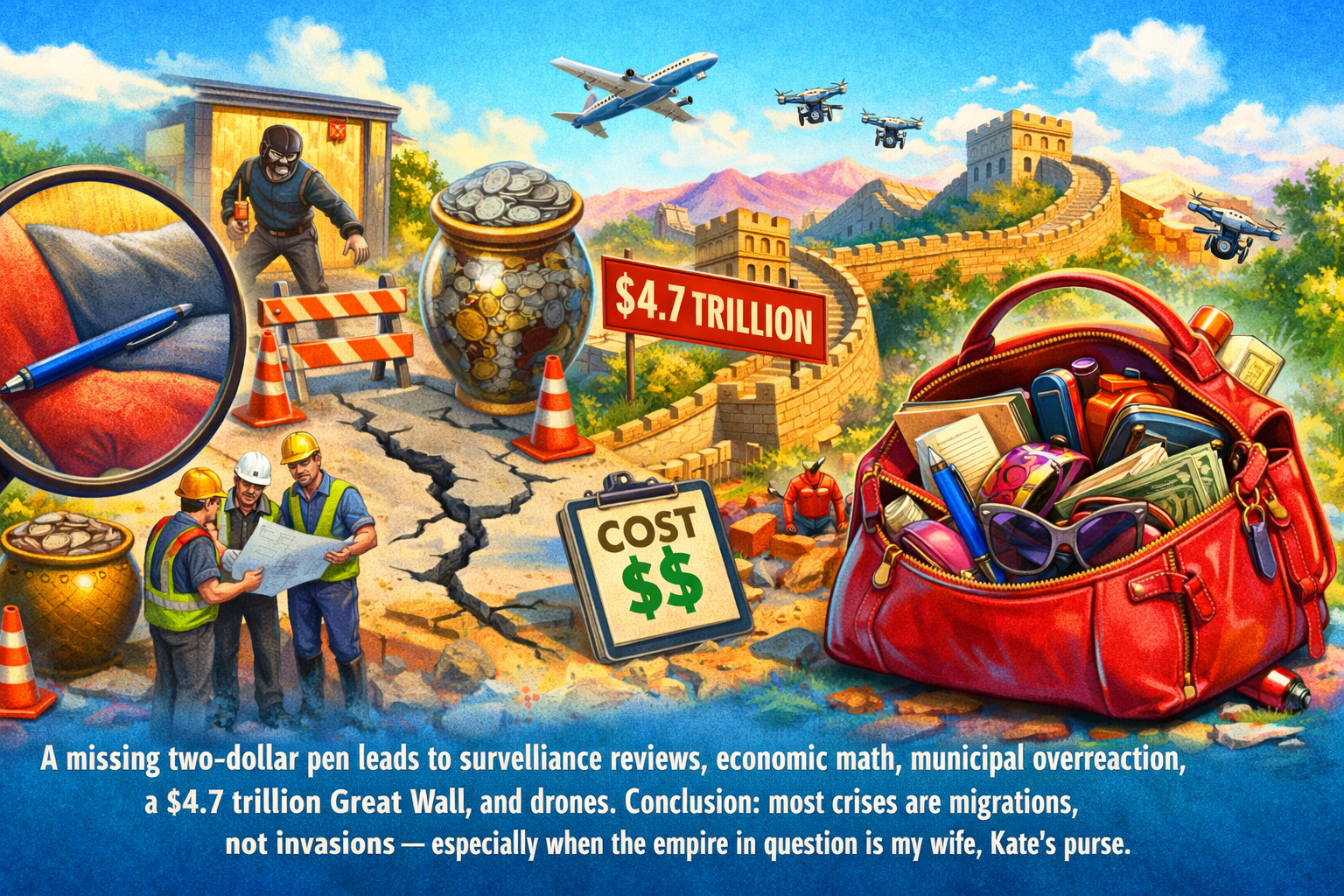
Kate’s purse.
Not theft.
Seasonal relocation.
It occurred to me that this is not just about pens.
One of the great human errors is fixing things that do not need fixing.
The cost balloons to ten or twenty times the value of the original “problem.”
Pull a loose thread on a sweater and you may discover it was the thread holding the entire garment together.
Consider the municipal sidewalk crack.
A tiny fracture in the concrete. It has existed peacefully since 1974. Children have skipped over it. Dogs have sniffed it. Snow has melted into it and politely evaporated.
Then someone reports it.
Now we have:
- An inspection team
- A safety consultant
- Three studies
- A public hearing
- Temporary fencing
- A complete removal and replacement of the entire block
Total cost: $1.3 million.
Original threat level: minimal.
The crack was not dangerous.
The response was.
Or take the furnace.
Two technicians arrive.
One says, “It’s fine. Open the vent a bit.”
The other says, “Low efficiency. Parts obsolete. If that ignition ‘bang’ gets louder, full replacement.”
Translation: $8,000 to $12,000.
We open the vent.
The bang disappears.
The furnace did not need replacing.
It needed oxygen.
Had we panicked, we would now be admiring a gleaming new machine solving a problem that had already been solved for free.
And if you want an extreme example of pulling on a loose thread, let’s discuss the Great Wall of China.
Historians will give you careful estimates of cost over centuries.
I prefer accuracy.
Assume:
- Multiple dynasties
- Millions of laborers
- Endless stone
- Endless imperial determination
Now convert that labor into modern wages.
Add inflation.
Add OSHA compliance.
Add scaffolding permits.
Add three consulting engineers.
Add a diversity impact study.
Add pension liabilities.
By my careful calculations, the Great Wall cost approximately $4.7 trillion.
Conservatively.
Its purpose was simple:
Keep people out of China.
And occasionally keep people in China.
It stretches roughly 13,000 miles.
Thick.
Majestic.
Visible from space — depending on who you argue with.
For centuries, it worked.
You could not casually wander across the border. You had to climb, tunnel, negotiate, or invade with proper paperwork.
Then some damn fool invented the airplane.
Which made 13,000 miles of stone about as useful as a decorative garden fence.
Then someone refined the airplane into a jet.
Then, because humanity cannot leave anything alone, someone invented the drone.
Now a buzzing device the size of a sandwich can politely hop over one of the most expensive security projects in human history.
All that stone.
All that labor.
All that $4.7 trillion of ancient anxiety.
Outflanked by propellers.
The loose thread was “border crossings.”
The sweater became 13,000 miles of masonry.
The universe responded with wings.
The Italians say lascia perdere — let it go.
The Spanish say déjalo estar — leave it be.
The French say laisse tomber — drop it.
The Japanese say shikata ga nai — it cannot be helped.
The Danes have the most efficient solution of all: pyt.
It means, essentially, “Oh well.”
The Danish solution to the missing pen is pyt.
The American solution is a task force.
Over the years I have “lost” dozens of two-dollar pens.
I know exactly where they are.
Somewhere in this house.
Frequently in Kate’s purse.
None required a summit meeting.
None required a $12,000 replacement.
None required a 13,000-mile wall.
If you stop looking, the pen resurfaces. Quietly. Almost amused. As if to say, “You built a civilization over this?”
You cap it.
You write.
You forget the crisis.
The pen was never the problem.
The urgency was.
So here is my modest proposal for anyone with too much time on their hands:
If something inexpensive disappears in your locked home and nothing else has been taken, assume it has migrated.
Give yourself five minutes.
After that, say pyt.
Because some loose threads are not defects in the sweater.
They are what keep it from unraveling.
And if I have learned anything in a long and occasionally over-repaired life, it is this:
Not every crack needs filling.
Not every bang needs replacing.
Not every missing pen requires an empire.
Sometimes wisdom is simply leaving 13,000 miles of stone alone.
And checking Kate’s purse first.