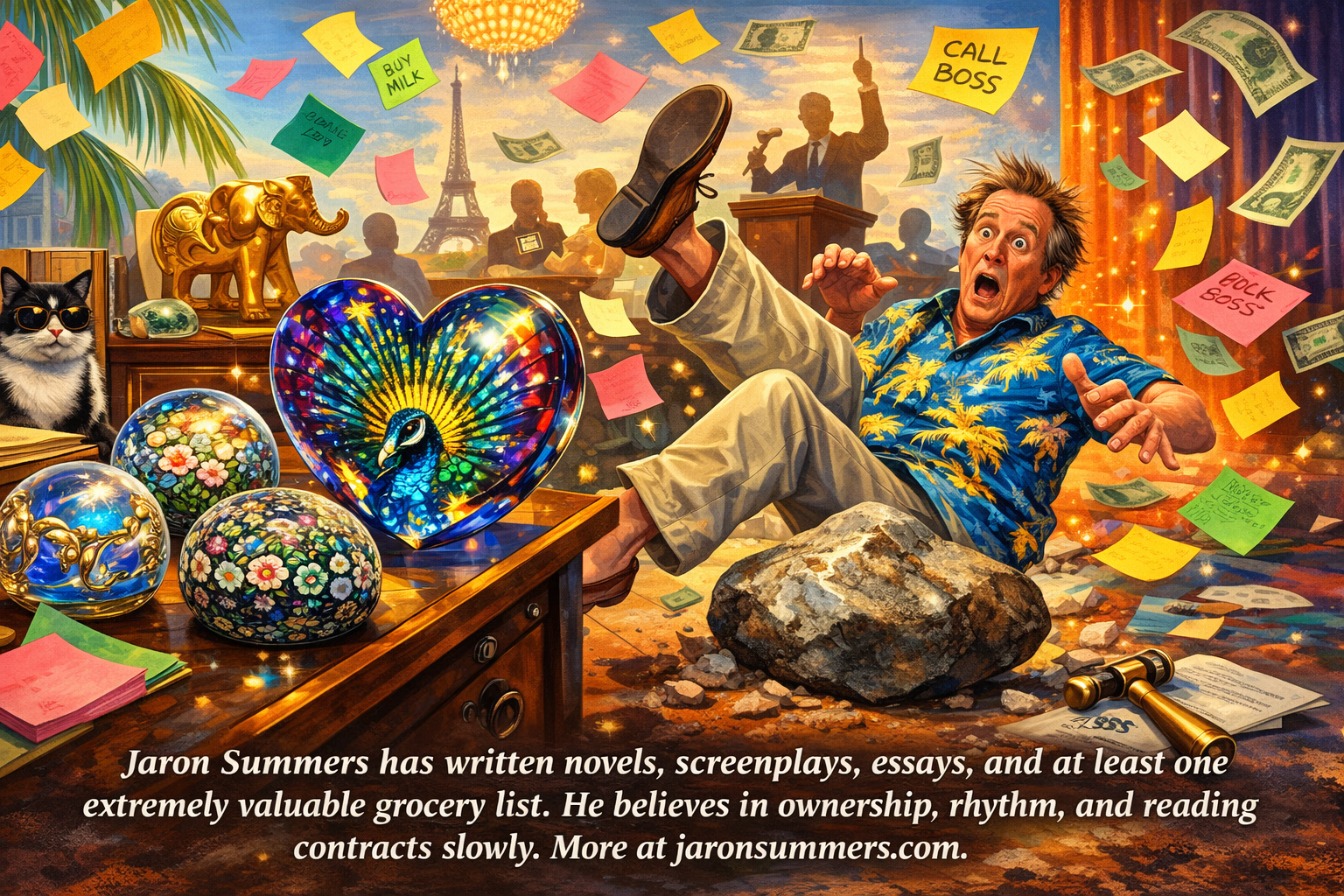
I woke to a breeze slipping through our tiny condo a few miles from UCLA and watched my Post-it notes lift off like a coordinated air force.
They rose from the desk in disciplined formation — grocery lists, reminders, fragments of dialogue, one ambitious note that simply said “EMPIRE?” — and drifted across the room with the confidence of creatures who knew they had union protection.
Post-its are held in place by a glue that is both miraculous and selectively loyal.
It adheres to desks, lamps, computer monitors, refrigerators, and, presumably, minor government officials — but not to the moving air of Los Angeles.
And since I do not own an agile cat, I cannot test the theory that they refuse feline surfaces on moral grounds.
What I needed was not a better adhesive. What I needed was mass.
So naturally I began researching the world of elite paperweights.
The Shock of Heft
I learned that paperweights are not merely desk accessories. They are heritage objects. Some are traded like minor Renaissance paintings.
A 19th-century French Clichy “basket” paperweight once sold for over a quarter of a million dollars at auction.
There are modern Saint-Louis crystal weights priced in the thousands. Studio glass artists like Paul Stankard create botanical paperweights that trade like fine art.
In short, there exists a parallel universe where the sole function of an object is to sit still — and it does so magnificently.
I briefly considered that perhaps I could solve my Post-it problem and accidentally become an investor.
Because if one is going to hold down paper, one might as well hold down value.
The Post-it Revelation
Then I drifted into another fact — one I should have known.
Post-it Notes themselves were an accident.
In 1968, a 3M scientist named Spencer Silver was attempting to develop a super-strong adhesive.
Instead, he created a weak, pressure-sensitive glue that stuck lightly and could be removed without damage. It was, in corporate terms, a failure.
Years later, Art Fry, another 3M employee, used the adhesive to anchor bookmarks in his church hymnal. That “failed” glue became one of the most successful office products in history.
Today, 3M’s Post-it line generates billions of dollars in annual revenue. Americans alone spend hundreds of millions of dollars a year on sticky notes — those small, fluttering squares of optimism.
Offices buy them by the pallet. Writers buy them by the existential crisis.
An accidental invention turned into a global staple.
And there I was, in a condo near UCLA, being outmaneuvered by it.
The Luxury Detour
I visited crystal boutiques in my imagination. Velvet trays. Hushed voices. Words like millefiori whispered as if invoking saints.
I could see myself explaining to friends: “Oh, this? Limited edition French crystal. It discourages clutter emotionally.”
I studied auction records the way prospectors study riverbeds.
I imagined buying something rare enough that it would one day fund a modest scholarship in paper management.
But every time I looked at the price tags, I had the quiet suspicion that I was attempting to solve a fifty-cent problem with a five-figure solution.
Which, admittedly, is one of my recurring hobbies.
The Trip
Then I tripped.
Literally.
Outside near the trash was a three-pound rock. Not decorative. Not polished. Not signed by a French artisan. Just dense. Solid. Dismissed.
I picked it up.
It had weight — actual authority. The kind of geological certainty that predates auction houses and velvet displays.
I washed it. Scrubbed off the dust. Polished it until it revealed faint streaks of color I hadn’t noticed before.
I brought it inside.
Placed it on the desk.
The Post-its surrendered immediately.
No negotiation. No flight.
The Discovery
The expensive paperweights were beautiful. Some may indeed appreciate in value. They carry provenance, artistry, lineage.
But this rock had something more primal: gravity.
It cost nothing. It cannot depreciate. It will never trend downward because a collector’s taste shifts from floral motifs to abstract swirls. It does not require insurance beyond common sense.
It simply holds.
And in that moment, I understood something oddly similar to the Post-it story.
The adhesive that changed office life was born from failure.
The paperweight that solved my problem was born from garbage.
Both were accidental investments.
One turned into a billion-dollar product line.
The other turned into a three-pound monument to common sense.
What I Discovered
- People will spend thousands to keep paper still.
- People collectively spend hundreds of millions each year on tiny squares of paper designed to move.
- Some of the best tools in life are the unintended byproducts of someone else’s mistake.
- And sometimes the perfect solution is not rare, branded, or authenticated.
It is simply heavy.
My desk is calm now.
The breeze still wafts through the condo. The light is the same. UCLA remains a few miles away. The Post-its remain ambitious.
But they are pinned in place by a rock that once sat in a trash pile — and now presides over my empire of small reminders with the quiet dignity of geology.
And if it never appreciates in value?
It already paid dividends.