There comes a moment in every man’s life when he realizes he is not at the top of the food chain.
For some, it happens on safari.
For others, in a boardroom.
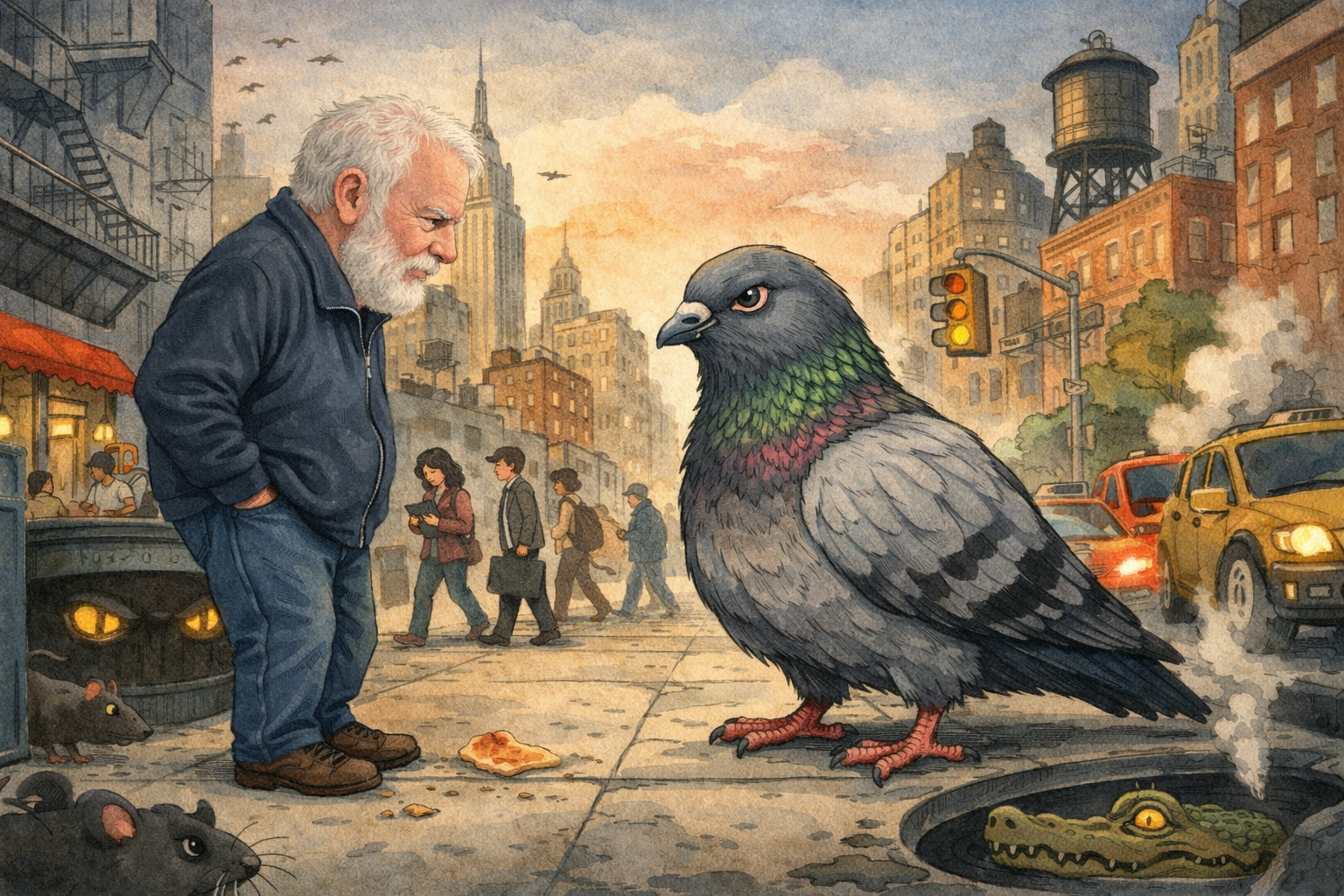
For me, it happened on a Tuesday morning in Los Angeles when a pigeon refused to move.
I don’t mean it hesitated.
I mean it stood its ground—calm, centered, spiritually grounded—like a small gray monk who had taken a vow never to yield to traffic or human ambition.
I stepped left.
It did not move.
I stepped right.
It did not move.
We made eye contact.
And in that moment, I understood something I had not previously considered:
This was not my sidewalk.
I had always assumed, in a vague and unexamined way, that cities were built for people.
We have the keys, after all.
We sign the leases.
We complain to management.
But the pigeon standing in front of me had clearly not read the lease.
He was not impressed by my shoes.
He showed no respect for my schedule.
He did not seem to care that I had somewhere to be, though I have since forgotten where that was.
What he cared about, apparently, was a small crumb and his right to stand near it indefinitely.
And in this, he was unwavering.
A few days later, I encountered a rat.
Not socially.
We did not exchange names.
He crossed the street at dusk with the quiet confidence of someone who had survived several administrations and had no plans to retire.
He did not scurry.
That’s the myth.
He walked.
Purposefully.
As if late for something important, possibly involving cheese or a committee.
And once again, I felt that small, unsettling shift in the universe:
I was not observing the city. I was in it.
The subway (or, in Los Angeles, its philosophical equivalent: traffic) confirmed the theory.
Cars do not move because we wish them to.
They move—or fail to move—according to rules that appear to have been drafted by a committee of exhausted squirrels.
You sit.
You wait.
You inch forward.
And gradually, you begin to understand that you are not driving the system.
The system is driving you.
It was around this time that I began to reconsider my position.
Not dramatically.
I did not quit society or begin foraging.
But I did begin to suspect that I occupied a middle tier.
Above the rats, perhaps.
Though they would dispute this.
Below the pigeons.
No question.
And roughly equal to a well-adjusted parking meter.
We like to think of ourselves as the designers of cities.
But if an alien were to arrive—and they will, though probably not on a Tuesday—they might take notes that look something like this:
- The tall structures appear to be nesting grounds
- The smaller creatures (humans) move in predictable herds
- The dominant species is unclear, though the winged gray ones show remarkable confidence
- The underground is controlled by whiskered specialists
- All species seem mildly irritated
And then, perhaps, they would underline one conclusion:
No one is in charge.
There is, oddly, a comfort in this.
Once you accept that you are a mid-level urban mammal, certain pressures fall away.
You no longer need to win the city.
You only need to navigate it with a degree of grace and avoid stepping in anything that requires explanation.
You begin to notice things:
A pigeon that has chosen a life of stillness.
A rat that has mastered timing.
A human who has learned, against all odds, to merge.
Each of them, in their own way, is succeeding.
The pigeon eventually moved.
Not because of me.
Let’s not exaggerate.
He moved because he had finished whatever it was he was doing—which, from my perspective, appeared to be nothing, but from his may have been everything.
As he walked away, unhurried and entirely unbothered, I felt a strange respect.
He had no briefcase.
No phone.
No visible anxiety.
And yet he seemed perfectly adapted to the environment.
I, on the other hand, checked my watch.
Which is, I suppose, how you can tell the difference between species.
Jaron Summers has written novels, screenplays, essays, and at least one extremely thoughtful interaction with a pigeon who declined to cooperate. He believes in observation, timing, and occasionally yielding the sidewalk.