Fred first heard the quote at a conference where the coffee cost fourteen dollars and the name tags were thicker than the annual reports.
“All I want to know,” the speaker said, invoking Charlie Munger with a kind of financial reverence, “is where I’m going to die, so I’ll never go there.”
The room laughed the way wealthy rooms laugh—softly, as if the punchline were tax deductible.
Fred did not laugh.
He wrote it down.
Fred had money. Not yacht-shaped money. Not cryptocurrency-with-a-mascot money. Patient, compounding Midwestern money that arrived quietly and stayed for dinner. He had built three companies, sold two, and kept one because he liked having somewhere to go on Tuesdays.
He had also buried his wife, Eleanor.
That had not compounded well.
Eleanor had died in a hospital room that faced west. The sunset had come in sideways through the blinds and laid orange stripes across her blanket. Fred had stood there thinking sunsets should be suspended during such moments. Decorative light felt unnecessary.
After she was gone, people said time would soften things.
Time did not soften.
Time clarified.
Fred did not fear pain. He did not fear judgment. He did not even fear extinction in the abstract. What he feared was missing her longer than necessary.
If death meant seeing Eleanor again—and Fred was not claiming it did, but if it did—then death was not the enemy.
But premature death? Accidental death? A sloppy, inefficient ending?
That would be intolerable.
So when he heard the quote, something inside him aligned like a spreadsheet balancing.
Find the place.
Avoid the place.
Live longer.
Get closer.
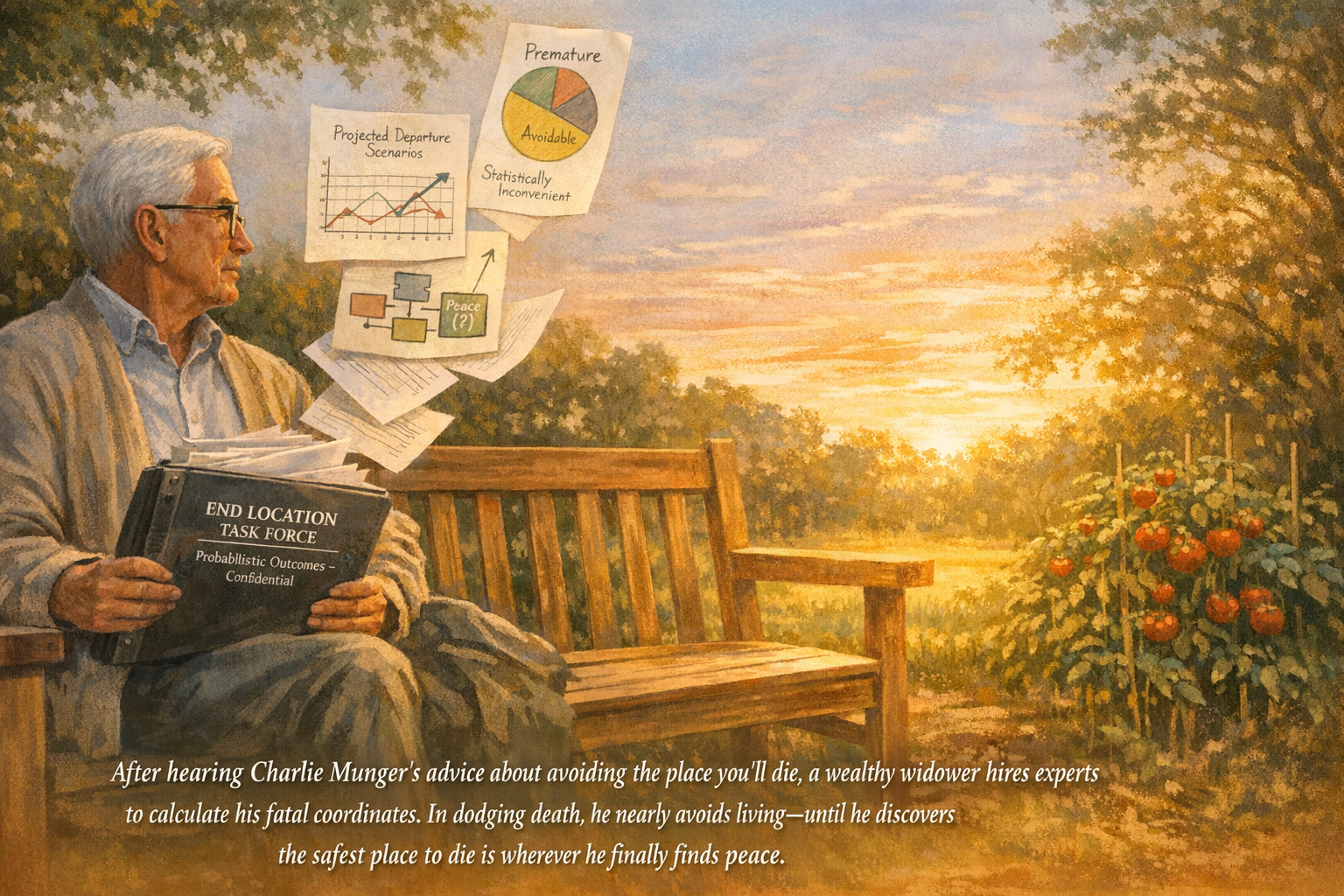
Within a week he had assembled what his assistant labeled, with professional restraint, the End Location Task Force.
There was Dieter, a Swiss actuary who could describe mortality tables the way sommeliers describe wine. A climate modeler with three degrees and a permanent expression of mild alarm. A behavioral psychologist who specialized in terminal regret. A former FEMA director. A data scientist with a ponytail. And, retained quietly through an LLC, a woman in Santa Fe who spoke of “transition thresholds.”
Fred told them plainly, “I would like to know where I am most likely to die.”
They assumed he meant geographically.
Fred meant strategically.
If Eleanor had taught him anything in thirty-seven years of marriage, it was this: preparation is an act of love.
He would not arrive late.
They met every Wednesday in Fred’s library beneath a portrait of Eleanor taken the year they bought their first house. She was laughing in it, head tilted back, as though dismissing something Fred had said. He had always suspected she laughed at him more than with him. It was one of her finer qualities.
Dieter began with charts.
“Statistically,” he said, “men of your age and profile most frequently die either in hospitals or at home.”
“Define home,” Fred said.
“Primary residence.”
Fred owned four.
The climate modeler cleared her throat. “Heat events, air quality, coastal flooding—”
“Sell Malibu,” Fred said, and it was sold.
The behavioral psychologist leaned forward. “People often die in familiar environments. Places associated with emotional safety.”
Fred glanced at Eleanor’s portrait.
“Remove familiarity,” he said.
Within months, Fred’s life resembled a tasteful witness protection program.
He rotated bedrooms nightly. He embedded biometric sensors in hallway molding. He eliminated throw rugs. He redesigned staircases to incline at what Dieter called statistically indifferent angles.
He stopped driving. Intersections, it turned out, were ambitious.
He sold the convertible Eleanor had loved. He kept the garage empty because garages suggested carbon monoxide, and carbon monoxide suggested carelessness.
Hospitals were obvious risks, so he invested in a private offshore medical vessel equipped with cardiac specialists, trauma surgeons, and a pastry chef who made surprisingly credible éclairs.
He stopped flying commercial. Then he stopped flying private. Then he stopped flying altogether after the data scientist presented a slide titled: “Gravity: Still Operational.”
Friends described him as careful.
His daughter described him as tired.
“Dad,” she said over video one evening, “you know Mom didn’t avoid things.”
“She avoided undercooked poultry,” Fred replied.
“She didn’t avoid living.”
Fred smiled politely and changed the subject to her tomatoes.
By autumn, the Task Force had narrowed probabilities using actuarial modeling, environmental projections, behavioral analytics, and energetic mapping.
They delivered their findings in a sealed envelope.
Fred opened it alone.
The document was brief.
Highest probability location of death:
Where subject experiences sustained emotional peace.
Fred read it twice.
Then a third time.
Peace meant stillness. Peace meant familiarity. Peace meant lowering one’s guard.
Peace meant the garden bench where Eleanor used to sit and critique his tomatoes.
He had avoided that bench for three years.
That afternoon, without advisors, without sensors, without checking wind speed or pollen count, Fred walked outside.
He sat.
The bench did not collapse. No sirens sounded. The sky remained professionally blue.
He waited.
He felt something loosen inside him—not pain, not fear. Something he had been gripping too tightly.
He stayed until the light shifted.
For the first time since the hospital room with western windows, the sunset did not feel decorative.
It felt earned.
Fred did not die that afternoon.
Nor the next.
The garden bench became a small rebellion. He began sitting there nightly. Ten minutes at first. Then twenty. Then long enough to forget to count.
The Task Force’s memos grew seasonal rather than urgent. The climate modeler retired. The data scientist joined a meditation startup. Dieter sent a polite note suggesting that at some point probability becomes biography.
Fred reduced their retainers.
He began sleeping in the same room two nights in a row. Then three. He allowed a throw rug back into the hallway. He planted tomatoes again—not because they were safe, but because Eleanor had enjoyed mocking his seriousness about them.
His daughter visited more often. They argued about nothing and everything. He even traveled once—to see her recital in Chicago. He took the stairs in the auditorium and did not evaluate their incline.
Years passed.
Fred turned ninety-eight. Then one hundred.
A business magazine credited his longevity to disciplined risk mitigation. A podcast host asked him to summarize his philosophy.
Fred said, “Don’t rush.”
At one hundred and two, his body began its quiet negotiations.
There was no catastrophe. No intersection. No offshore emergency. Just fatigue.
His daughter sat beside his bed. The room faced west.
“Are you afraid?” she asked.
“I spent years avoiding the place I would die,” he said. “Turns out it was wherever I finally stopped running.”
That night he slept deeply.
In his dream he stood in a garden that looked suspiciously like his own, except the tomatoes behaved themselves.
Eleanor sat on the bench.
She wore the expression from the portrait—the one that suggested she was about to laugh at him.
“You took your time,” she said.
“I was diversifying,” he replied.
She patted the space beside her.
Fred sat.
There was no tunnel of light. No orchestra. Just late afternoon warmth.
When his daughter checked on him at dawn, Fred was still.
On the bedside table lay a small notecard in his handwriting.
It read:
Turns out you can’t avoid the place you’ll die.
But you can choose to like it.
And that, for Fred, was finally a sound investment.