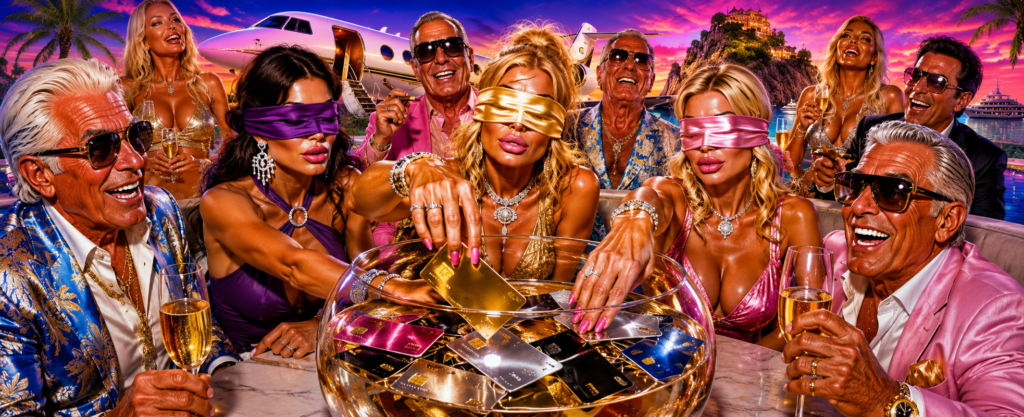

There was a time in America when bored married couples held what were known as “key parties.”
This was before the internet, before dating apps, and before billionaires started launching themselves into orbit because Earth had become too crowded with people who expected them to pay taxes.
At these suburban gatherings, guests drank heroic quantities of alcohol while pretending they were emotionally liberated pioneers instead of orthodontists, insurance agents, and assistant principals wearing too much cologne.
At some point in the evening, the men tossed their car keys into a large fishbowl.
The women — often blindfolded — reached in and selected a set of keys.
Whoever owned the keys became their temporary romantic partner for the evening.
Historians now believe this was the exact moment America began drifting away from agriculture.
The original key parties seem almost innocent compared to what came later.
Back then, people drove Buicks, cocaine still seemed festive, and somebody’s wife always brought a cheese ball the size of a human head.
There was usually one dentist involved.
There is always one dentist involved.
But as decades passed, the nation evolved.
Or possibly molted.
Today, ordinary fishbowls are no longer sufficient for the wealthy.
Modern billionaires cannot merely swap spouses.
That is something poor people do after three margaritas and a Fleetwood Mac album.
No.
The ultra-rich created something more refined.
The rules are elegantly simple.
At a private gathering somewhere between Monaco and moral collapse, the billionaires arrive by Gulfstream.
Instead of dropping car keys into a bowl, they contribute platinum credit cards, private jet access, island memberships, biometric passwords, encrypted travel wallets, and one emergency phone number for a man named Klaus.
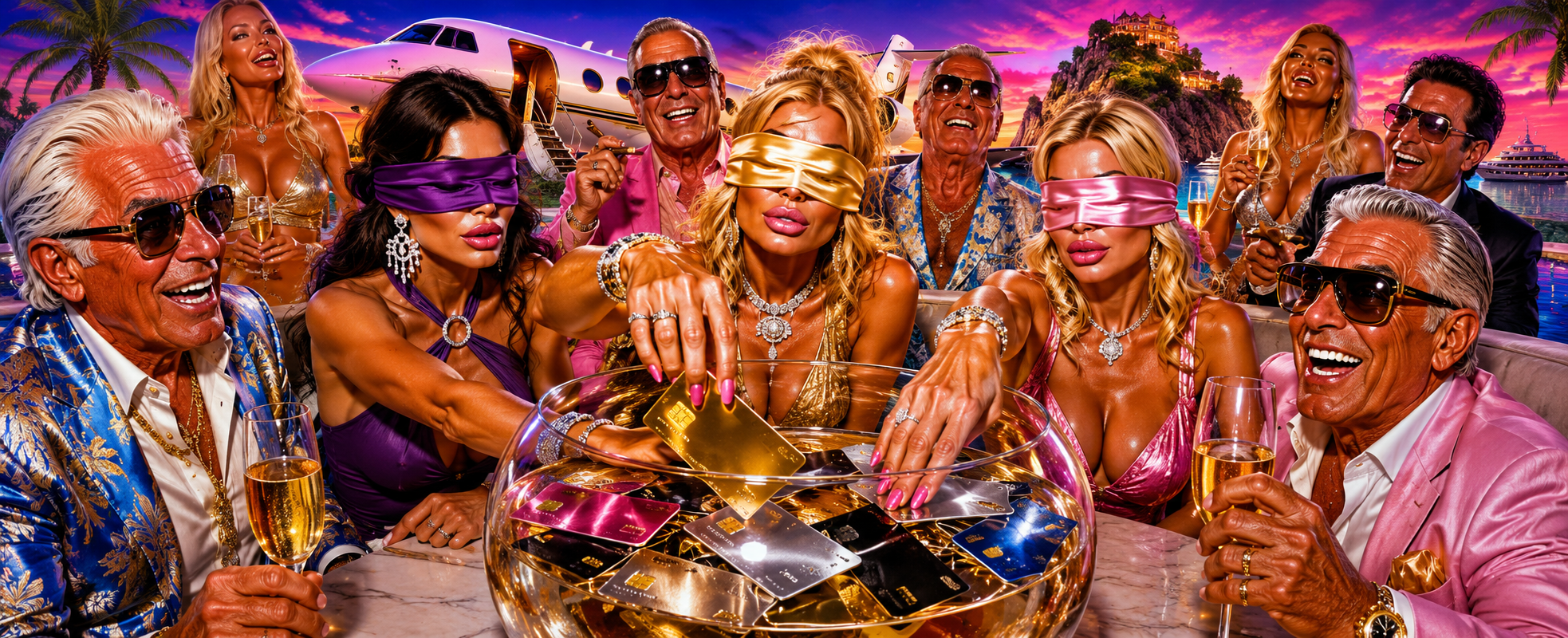
The women attending the event are blindfolded and select one credit card. The kind that can buy a fleet of Rolls Royces.
Wherever the card leads, they spend an all-expenses-paid weekend anywhere in the world with a temporary billionaire husband.
Paris.
Dubai.
Singapore.
A volcano-shaped spa in Iceland where everyone whispers, eats moss, and pretends hot stones are a personality.
Naturally, the billionaires insist this is not swinging.
It is:
“Disruptive intimacy.”
Several attendees are tech moguls.
Many have private islands.
A few have visited other people’s private islands and now flinch whenever anyone says the word “documentary.”
Nobody mentions this directly.
At these parties, silence is considered a luxury brand.
One billionaire named Trevor made his fortune creating an app that delivers emotional-support therapists to your yacht within fifteen minutes.
Another sold a startup that used artificial intelligence to determine whether your marriage still had “scalable synergy.”
The AI later divorced him.
Then there was Bryce.
Bryce looked like a bald eagle that had learned coding.
He wore a black turtleneck so tight it appeared medically supervised.
Bryce explained to everyone that human romance was inefficient and needed optimization.
During dinner he unveiled a PowerPoint presentation titled:
Scaling Intimacy Verticals
Nobody understood it.
Including Bryce.
One woman selected Bryce’s platinum card and spent a weekend with him in Tokyo.
When she returned, she told the others:
“He tried to A/B test foreplay.”
Apparently Bryce stopped kissing her every few minutes to harvest performance metrics from a biometric wristband.
At one point he whispered:
“Interesting. Candlelight increased emotional engagement by fourteen percent.”
The woman gave him a two-star review.
Bryce immediately spent 400 million dollars developing a new algorithm capable of detecting female disappointment in real time.
The system exploded during beta testing in Palo Alto after misidentifying every woman in the room as “the legal department.”
Another billionaire became obsessed with improving his Fishbowl rating after a former yoga instructor described him online as:
“Aggressively moisturized.”
Soon the billionaires were competing with one another.
One rented the Louvre.
Another rented a glacier.
One flew a woman to Venice, then spent the entire weekend monitoring cryptocurrency markets while eating pistachios in silence.
She described the trip as:
“Like dating a haunted vending machine.”
Meanwhile, the billionaires themselves slowly became paranoid.
Nobody knew who was blackmailing whom anymore.
Guests began suspecting the bartenders were intelligence agents, the masseuses worked for the SEC, and the yoga instructors were secretly recording everyone for Netflix documentaries.
Every attendee signed a confidentiality agreement approximately the length of the Old Testament, but with fewer miracles and more Delaware corporations.
One man accidentally surrendered mineral rights to Nevada.
Another discovered he had agreed to marry a blockchain.
And yet beneath all the absurdity, something strange began.
The women discovered many of the billionaires were profoundly lonely.
Not movie-star lonely.
Real lonely.
The kind of loneliness that develops when every human interaction comes with a nondisclosure agreement, a security sweep, and a man in sunglasses pretending not to listen.
One woman returned from Monaco and quietly said:
“I thought I’d meet Zeus. Instead I met a frightened man refreshing stock prices at three in the morning while asking if people genuinely liked him.”
That silenced the room.
For almost six seconds.
Then Trevor snorted ketamine off a heated sushi tray and announced he was buying Greenland.
In the old days, Americans dropped car keys into fishbowls because they feared boredom.
Today the wealthy drop platinum cards into fishbowls because they fear meaninglessness.
Progress is a mysterious thing.
Especially when it arrives by private jet, wears Italian loafers, and needs three lawyers to experience affection. By the way you are not invited.