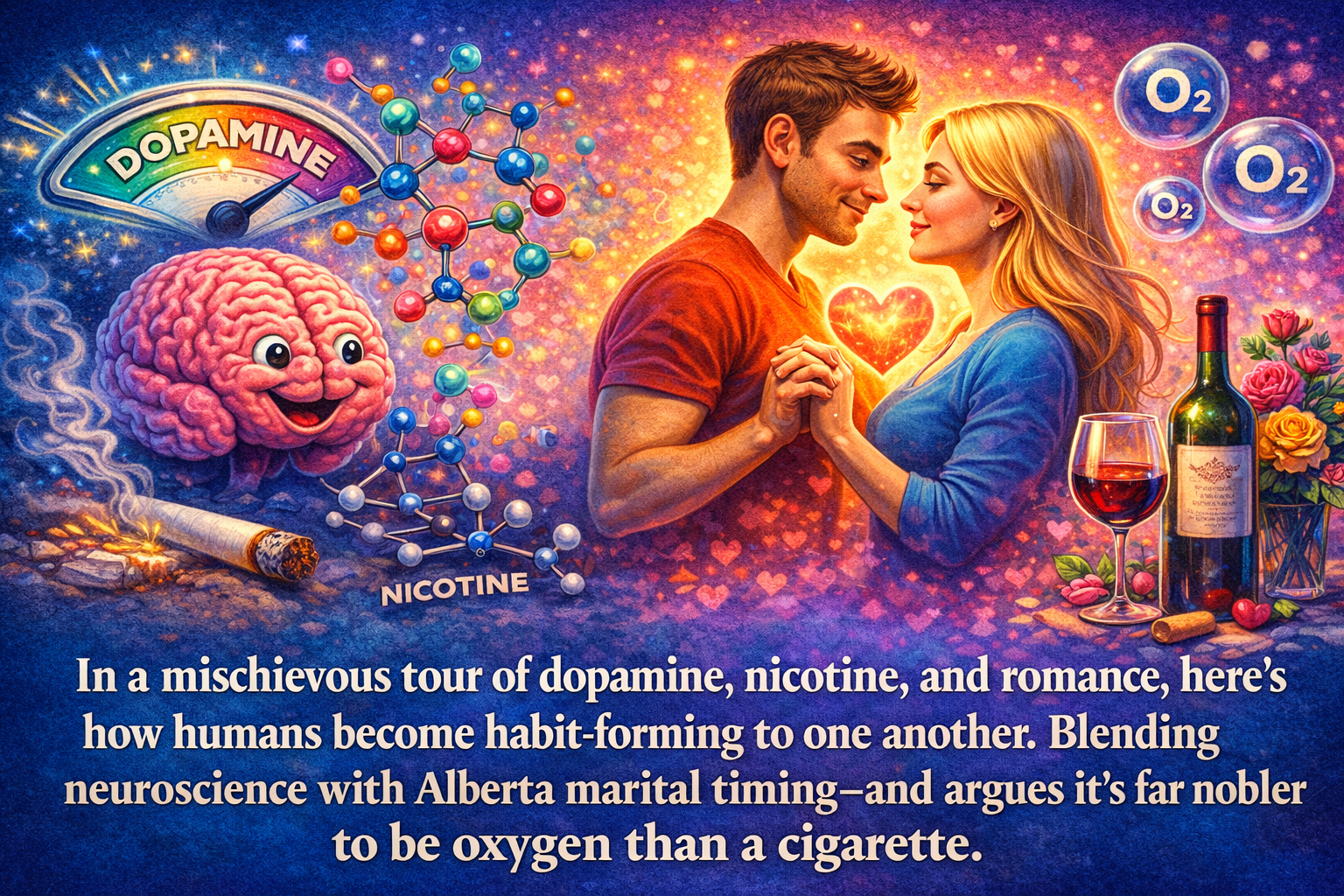
I once read that the average smoker takes a puff about every seventeen seconds. This is not because cigarettes taste like heirloom peaches and integrity. It’s because nicotine—an industrious little alkaloid with the work ethic of a Victorian chimney sweep—reaches the brain in roughly the time it takes a teenager to deny being on their phone.
Then the brain performs its favorite magic trick: it mislabels relief as pleasure.
The smoker feels “better.” But what often happens is subtler and more insulting to human dignity: the smoker feels less worse than they did a moment ago. The nervous system sighs. The reward circuitry hums. The nucleus accumbens throws a small parade. Dopamine rises like a curtain. Anxiety drops like a mic.
This is what neuroscientists call reinforcement. This is what tobacco companies call business.
Now here’s where it gets interesting. Humans run on similar circuits. We are creatures of anticipation, calibration, and something scientists call reward prediction error—which is a fancy way of saying your brain gets extra excited when something pleasant happens that it didn’t fully see coming. The same mechanism that keeps people pulling slot-machine levers and refreshing inboxes can also show up in romance, friendship, and social climbing.
We don’t merely chase pleasure. We chase the possibility of pleasure.
Which brings us—inevitably—to the idea of becoming “habit-forming.” Not “lovable.” Not “compatible.” Not “good company.” Habit-forming. The kind of person who leaves someone checking their phone, thinking, “Maybe he’ll text,” the way a smoker thinks, “Maybe I’ll just have one.”
And yes, the mechanism exists. It’s real. It works.
It also comes with a moral hazard sign the size of Saskatchewan.
Titration: The Most Romantic Word in the Laboratory
Let’s begin with a word I adore: titration.
In chemistry, titration is how you measure concentration by adding a solution drop by drop until you hit an endpoint—often signaled by a color change. Not too much. Not too little. Exactly enough. It’s controlled dosing with a straight face.
In medicine, to titrate is to adjust medication gradually to achieve the desired effect without overshooting. You titrate blood pressure meds. You titrate sedation. You titrate pain relief. You do not, ideally, titrate your in-laws.
Now for the etymology, because etymology is where words take their hats off and show you the scar. Titration comes through French, related to titre, meaning a “standard” or “measure,” the idea of determining strength or concentration. In other words: titration is the slow reveal of potency.
And if that isn’t a definition of human charm, I don’t know what is.
People—consciously or not—titrate their presence in each other’s lives. They adjust warmth. They calibrate attention. They dose approval. They decide how much mystery to keep and how much comfort to provide. Sometimes this is healthy, the way you titrate vulnerability and trust like a sane person.
Sometimes it’s not sane at all.
How Attachment Gets Engineered (And Why It Often Looks Like Love)
Over the years I’ve worked with gifted people—brilliant, talented, often slightly cursed by their own horsepower. I had a habit of making them feel better about themselves, without being obvious. I’d notice their good work. I’d ask questions that let them talk. I’d shine a light on the best parts of them, the way a good editor does when he says, “This paragraph is alive—do more of this.”
And then something strange would happen.
Within a few weeks, some of them seemed to want to be around me more than felt strictly necessary for the project. I was startled. Not smug. Not calculating. Startled—like a man who picked up a violin and accidentally summoned a wolf.
Later I understood the mechanism. People don’t especially care what you have to say when they first meet you. They care about what they get to say in your presence. They want to feel interesting, competent, funny, powerful, or at least not mildly doomed.
When someone talks about themselves—especially in a safe, curious environment—the brain often rewards that with a little dopamine. Not because the listener is magical. Because self-disclosure itself is rewarding. It’s identity reinforcement. It’s narrative control. It’s the human animal saying, “Here is my tribe story—please do not laugh.”
Do it well, and your presence becomes associated with that reward. You become a reliable stimulus. A cue. A warm lab environment in which their best self emerges.
This is the benevolent version.
There is also a darker version, in which the person providing the “reward” is not offering oxygen but selling nicotine.
The Alberta Anniversary: Love, Legislation, and the Stopwatch
I’ve watched certain people “marry up,” as the phrase goes, which is one of those expressions that makes romance sound like a real-estate transaction. Sometimes it was genuine—two decent humans finding each other in the fog, building a life, growing older, becoming mutually weird in the same direction.
Other times it was a business plan wearing perfume.
More than once I saw a woman marry a rich fellow and the relationship lasted, with astonishing punctuality, one year and one day. It was as if the marriage contract contained a hidden timer, like a parking meter you can’t feed coins. I was told that, in Alberta, certain financial advantages begin after the one-year mark. I am not a lawyer, but I am a reader of human behavior, and the calendar has a way of revealing intent.
Love, in these cases, did not end. Love reached maturity.
You could practically hear the paperwork being titrated.
The Seductive Trap: Becoming Someone’s “Cigarette”
Now we arrive at the forbidden idea: “How do you addict someone to you?”
Let’s be clear. I am not advocating this. I’m describing what I’ve seen, the way a naturalist describes a snake. It’s useful to understand the snake. You simply don’t want it in your bed.
Here’s the trap: many of the behaviors that create genuine closeness can also be used to create dependency. The difference is intention and outcome. Real affection expands the other person. Manipulation centralizes them around you.
Dependency is not the same as devotion. It’s devotion with a leash.
Nicotine works by creating a cycle: slight discomfort, then relief. Slight discomfort, then relief. The relief is interpreted as pleasure. But it’s really just the nervous system returning to baseline. Emotional nicotine works the same way when someone becomes both the cause of longing and the source of relief. You create a small absence. Then you return with warmth. The brain learns: “When he appears, I feel better.”
And, because humans are tragically efficient, the brain begins to titrate you.
A little more attention. A little less. A small compliment. A pause. A burst of connection. A gap. The nervous system keeps adjusting the dose in search of the “endpoint,” like a chemist waiting for the solution to change color.
If that sounds like romance, it’s because romance and reinforcement share a kitchen.
Science Terms, For Those Who Like Their Satire With Latin
To summarize the machinery in a respectable list of ominous phrases:
- Mesolimbic dopamine pathway (the “this matters!” circuit)
- Nucleus accumbens (the “repeat that” clerk)
- Intermittent reinforcement (the engine of obsession)
- Variable reward schedule (slot machines, notifications, and certain lovers)
- Attachment circuitry (bonding, safety, the wish to sit closer)
- Oxytocin (the “stay with the tribe” molecule)
- Cortisol (stress, uncertainty, the thing you pretend doesn’t exist)
- Reward prediction error (extra dopamine when the good thing surprises you)
In the wrong hands, this becomes a user manual.
In the right hands, it becomes an ethical warning label.
Why It’s Usually a Bad Idea
The reason manipulation is so tempting is that it works quickly. It creates results. It can make you feel powerful, like a magician pulling desire out of thin air.
But the problem with being someone’s cigarette is this: cigarettes don’t build anything. They maintain a loop. And loops are small. They don’t grow into trust. They don’t mature into partnership. They don’t survive Tuesday afternoon when the dishwasher is leaking and nobody feels like being a king or queen.
If you build attachment by engineering dependency, you must keep dosing the system. You must keep titrating the reinforcement. The relationship becomes an ongoing chemical experiment, and sooner or later your subject either develops tolerance, grows resentful, or realizes they have been living in a lab.
Love can contain mystery. Love can contain desire. Love can contain surprise.
But love should not require a dosage chart.
Be Oxygen, Not Nicotine
There is a higher version of this whole business—and it looks similar from the outside, which is why cynics get confused.
The higher version is not: “How do I make someone crave me?”
It’s: “How do I make someone more themselves when I’m around?”
That is the difference between nicotine and oxygen. Nicotine binds. Oxygen frees. Nicotine centralizes. Oxygen expands. Nicotine creates relief from a discomfort it helped generate. Oxygen simply lets you breathe.
Yes, you can manipulate someone for personal gain. You can become habit-forming. You can titrate attention like a chemist in a romance novel. You can turn yourself into a warm little slot machine of validation.
But if you have a conscience—and I recommend one, despite the maintenance—there’s a better ambition.
Be the person who makes others feel intelligent without inflating them. Strong without flattering them. Seen without trapping them. Better—not because they need you like a cigarette, but because you reminded them they already had lungs.
That’s not just nicer.
It’s also more durable.