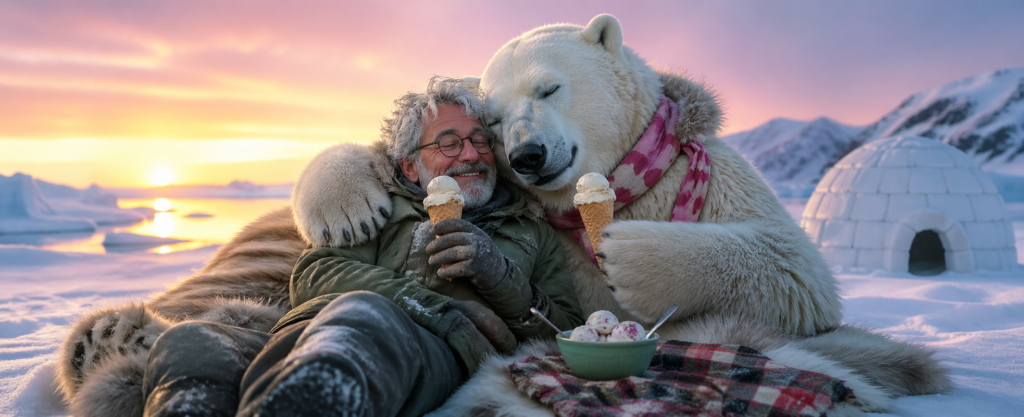
Driving a female wild is something every red-blooded male has considered.
Dr. Con S. Erve did much more than consider it.
He was a world-famous botanist—and, I might add, a confirmed bachelor. Readers will recall that Dr. Erve, while attempting to save the whooping moose from extinction, inadvertently finished the job.
After this minor professional setback, the botanist withdrew to the Northwest Territories. Alone, with only a high-powered rifle, a satellite phone, and the kind of guilt normally reserved for Greek tragedy, the PhD roamed the tundra trying to find himself.
He awoke one morning to discover that a polar bear had gnawed through his sleeping bag and was preparing to include him in breakfast.
Dr. Erve shot the bear.
A moment later, to his astonishment, he heard a cub whimpering behind a drift of snow.
So began a most unusual friendship.
Over the next eighteen months, Dr. Erve and the feral female cub became intimately dependent upon one another. He named her Snowball, which showed either tenderness or a dangerous lack of imagination.
Eventually he returned to the university to lecture—and brought Snowball with him.
She became an instant sensation. Students adored her. Children rode the gentle bear while Dr. Erve beamed with paternal pride. She appeared in television commercials, attended football games, and developed a weakness for ice cream cones, which she and the doctor shared in the campus cafeteria.
Dr. Erve even designed a special safety belt so Snowball could accompany him on errands. They turned heads everywhere they went, though mostly away.
Then fate—as she so often does when humans become smug—pounced.
Snowball, it turned out, had trichinosis. And since it had become Dr. Erve’s habit to share his bed with her, he had contracted the disease as well.
Trichinosis is usually acquired by consuming undercooked pork or wading barefoot through pig manure. As it happens, bears and pigs are closely related in the animal kingdom, a fact that becomes more interesting after one has made poor sleeping arrangements.
I discovered that Dr. Erve had less than a year to live. Snowball, on the other hand, might last another ten.
Looking back, I realize I should never have told him.
Dr. Erve was not concerned for himself. He had the calm of a man who had already killed a species and lowered his expectations accordingly. His only worry was Snowball.
“What will become of her?” he asked.
After several sleepless nights, the biologist reached a conclusion.
“I must return her to the tundra,” he said. “But first—I must make her wild again.”
What followed was not, in any scientific sense, science.
He locked Snowball up, deprived her of food, and subjected her to shrill gangsta rap at full volume.
The bear began to waltz.
He purchased boxing gloves and sucker-punched her.
She hugged him.
He introduced a tire chain.
She purred and assumed he had invented a new game.
It became increasingly clear that Snowball had no intention of becoming wild again. If anything, she was becoming more affectionate, which in a 2,000-pound polar bear is less a personality trait than a zoning problem.
In desperation, Dr. Erve consulted Dr. Lisa Lucey, an animal behavior specialist.
On the appointed day, Dr. Lucey arrived wearing a white parka and the faint confidence of a recently divorced woman who believed she had seen everything.
She had not.
What occurred inside Snowball’s mind remains a mystery. Perhaps she mistook Dr. Lucey for a rival. Perhaps she misunderstood the hand-holding. Perhaps she saw the white parka and concluded that another large pale female had entered her territory with romantic intentions.
Or perhaps Snowball simply understood the situation better than anyone else.
She broke free of her enclosure and charged.
Before the assembled students and faculty could intervene, Snowball ate both doctors, thereby resolving several academic disputes at once.
Authorities later tranquilized the bear and airlifted her back to the tundra. Though groggy, Snowball still managed to chew off the copilot’s right great toe during the release, suggesting that Dr. Erve’s program had not been entirely without results.
Subsequent reports described her chasing down hunters, killing anything that crossed her path, and knocking over boulders for no apparent reason, which experts agreed was a promising return to form.
As I said, driving a female wild is something every man considers.
But Dr. Con S. Erve is the only man I ever knew who actually did it.
He was late, of course.
But with females, timing has always been the dangerous part.
(This is an old children’s story that you guys can read to your girls here: https://jaronsummers.com/whooping-mooses/)