For most of my life, writing something decent took time.
Not hours. Weeks.
I would write a piece, tinker with it, walk away, come back, fix a few things, and eventually—if the gods were kind—end up with something worth publishing.
Then something odd happened.
Now I can take a piece I wrote forty years ago—or forty minutes ago—run it through a simple process, and in ten minutes it’s at least 10% better.
Sometimes more.
Which raises an obvious question.
What changed?
The Confession
I run it through ChatGPT.
Not once.
Two or three times.
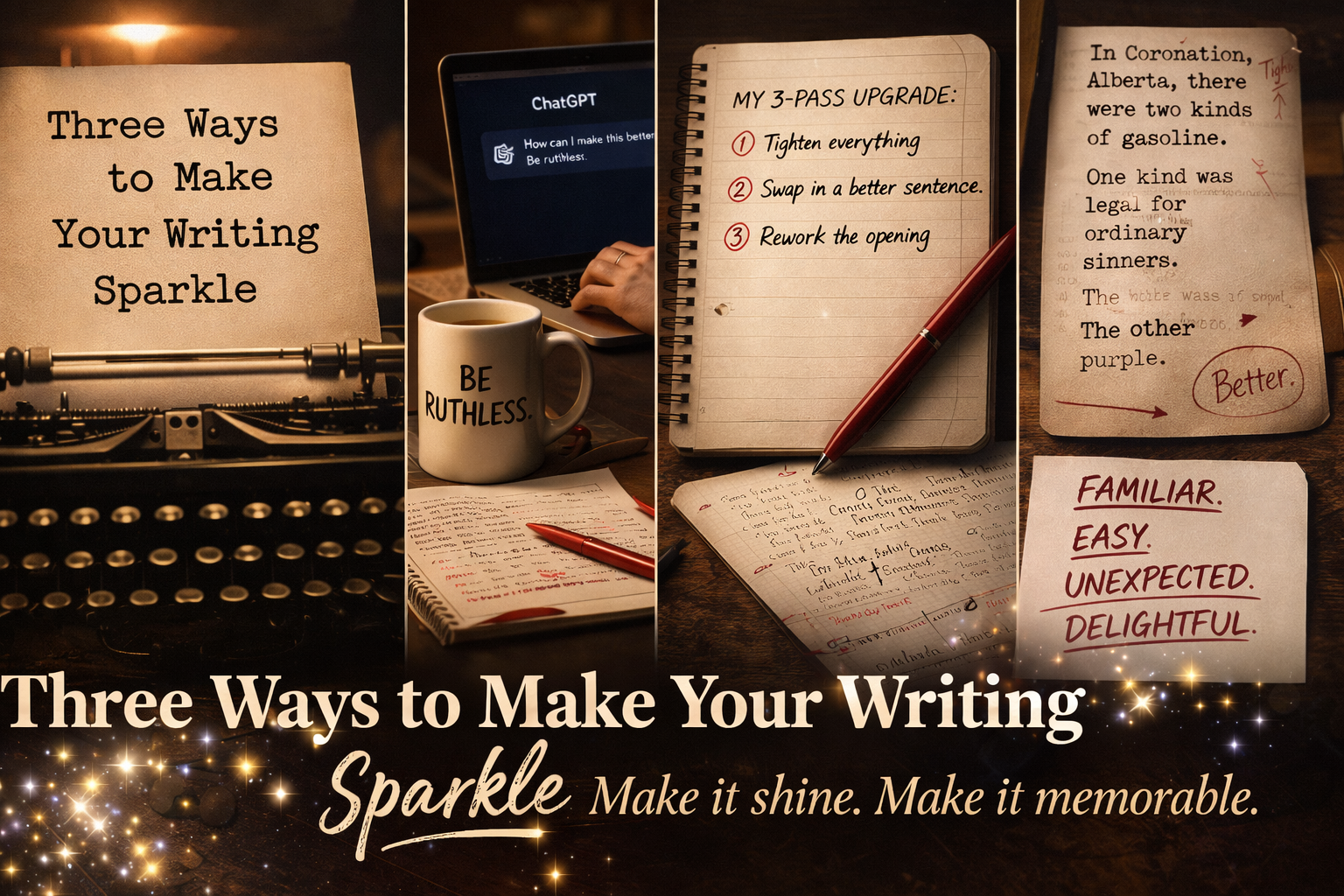
And each time I say some version of: Make this better. Be ruthless.
That alone improves the piece.
But that’s not the real trick.
The Real Trick
After watching what comes back—and what I keep—I realized I’m almost always doing the same five things:
- tightening everything
- swapping in a better sentence
- playing with the opening
- sharpening the ending
- changing the title
That’s it.
No mystical process. No sacred writing cabin in the woods. Just pressure applied in the right places.
Why It Works
Most writers waste time in the middle.
Paragraph seven. Sentence twelve. A joke that isn’t quite landing.
I used to do that too.
Now I don’t.
I go straight to where the reader makes decisions:
- the first few lines — Do I keep reading?
- the last few lines — Was that worth it?
- the title — Do I click at all?
Fix those, and everything in between suddenly behaves better.
The Unexpected Discovery
There’s another layer to this, and it surprised me.
Nobody wants to feel dumb.
Nobody wants to feel like they’ve wandered onto unfamiliar ground without a map.
And here’s where ChatGPT does something quietly brilliant.
It often builds sentences that feel familiar.
Not boring. Not recycled. Just easy to enter.
You read them and think: I know how to read this.
And because of that, you relax.
Familiar… With a Twist
But here’s the magic.
The sentence feels familiar, but the idea inside it is slightly unexpected.
That combination is where the delight lives.
In Coronation, Alberta, there were two kinds of gasoline.
One kind was legal for ordinary sinners. The other was purple.
The structure is simple. Comfortable.
But the second line tilts just enough to wake you up.
That’s the sweet spot.
The Rule I Didn’t Know I Was Following
I didn’t set out to do this, but now I see it clearly:
The reader should never struggle with the sentence. Only with the idea—just a little.
Too easy, and it’s boring.
Too hard, and it’s exhausting.
Just enough tension, and it’s engaging.
What This Changed
I still write the same way I always did.
Same instincts. Same stories. Same slightly suspicious sense of humor.
But now I have something I didn’t have before: an editor who never gets tired, doesn’t mind being told to be ruthless, and is surprisingly good at making things clearer without making them dull.
The Only Thing I Don’t Let It Do
I don’t let it take over the voice.
That part still has to be mine.
Because the danger isn’t that the writing gets worse.
The danger is that it gets smooth.
And smooth writing is often forgettable writing.
The Ending, Which I Now Pay Attention To
I used to think writing was about getting it right the first time.
It isn’t.
It’s about knowing where to fix it.
And if you fix the opening, the ending, the title, and a few weak sentences, you don’t need two weeks anymore.
You need ten minutes.
And the willingness to be a little ruthless with yourself.
