Human beings claim to love answers.
That is one of our more charming lies.
We say we want clarity. We say we want facts. We say we want everything laid out plainly, like a decent breakfast menu in a respectable diner.
But the truth is, what really hooks us is mystery.
Give us a clean explanation and we nod politely, the way we do when someone explains taxes or grout.
Give us something strange, something unfinished, something that refuses to sit still long enough to be understood, and suddenly we are alive. Now we are leaning forward. Now we are telling our friends. Now we are making a religion out of it.
A sealed letter does this.
A dead father with a final request does this.
A monument on a hill in Georgia, built by a man who used a fake name and then vanished without a handshake, definitely does this.
Once something withholds itself from us, it gains power.
Not because it becomes wiser. Not because it becomes holier. Often it is neither. But the moment a thing refuses to explain itself, we begin doing the work for it. We project onto it. We enlarge it. We polish it with our own curiosity until it shines like revelation.
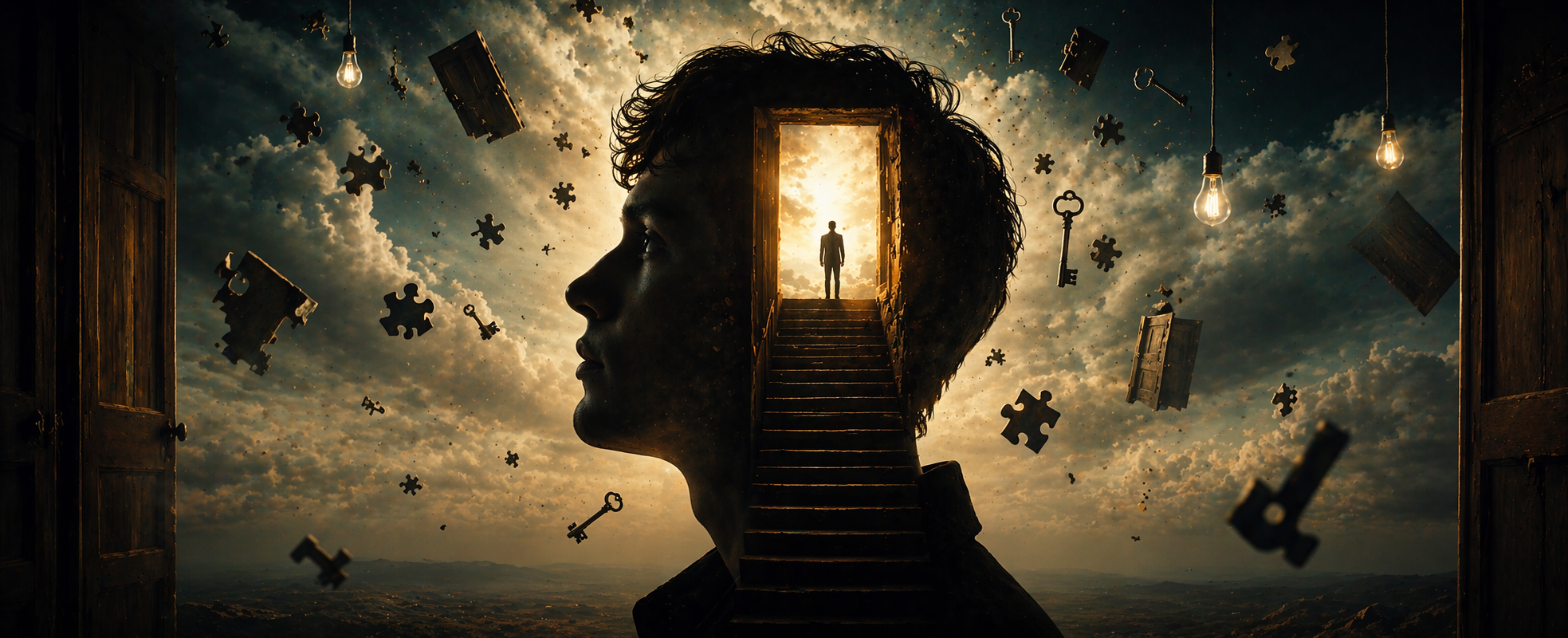
This is why people will walk past ten obvious truths in order to stare at one locked door.
A locked door is an argument against indifference.
It suggests there is something on the other side worth hiding.
That may not be true, of course. On the other side of many locked doors there is nothing but a mop, a bucket, and the accumulated disappointment of a maintenance department.
But that is not how the mind works.
The mind is a gossip with a graduate degree.
It wants motive. It wants secrecy. It wants a missing piece. It wants the one sentence nobody was supposed to hear.
That is why mysteries last longer than explanations.
An answer closes the file.
A mystery keeps recruiting.
Once a thing is fully explained, it may still be admired, but it is no longer magnetic. It has given up its private life. It has become, in the saddest sense, available.
Mystery, by contrast, keeps a little money in the bank.
It earns interest.
It grows in the dark.
Some of the most durable things in human life are durable not because they are true, but because they are unresolved. Old crimes. Disappearances. Unfinished books. Buried treasure. Lost love. Religion. Other people’s marriages.
We circle these things because they do not end properly. They leave a gap. And the human mind, being part bloodhound and part busybody, cannot resist a gap.
There is also something flattering about mystery.
When we stand before a thing we cannot quite decode, we feel that perhaps we are being invited upward. Perhaps there is more here. Perhaps, if we study long enough, we will prove equal to it.
This may be why people are drawn to symbols, rituals, old stones, coded messages, obscure paintings, ancient ruins, and anyone who speaks in a low voice and charges by the hour.
The unexplained offers us a role in the drama.
It says: perhaps you are the one who will figure this out.
Usually we are not.
Still, it is flattering to be asked.
Even bad mysteries have stamina. In fact, a bad mystery often has more stamina than a good explanation. A sensible answer has the decency to stop. A weird possibility can breed for decades.
You can see this all through history. The secret manuscript. The hidden chamber. The coded map. The unnamed donor. The unidentified body. The rich eccentric who leaves instructions for the future and disappears into the mist.
Explain one of these things fully and public interest drops by half before lunch.
Leave it partly in shadow and it may live forever.
This is not just a weakness in us. It is also one of our engines.
Curiosity has built ships, telescopes, novels, religions, lawsuits, and at least three quarters of modern science. A species without curiosity would still be sitting in a cave, proudly understanding everything in it.
What draws us forward is not certainty.
It is the suspicion that something remains hidden.
So perhaps the strange things that endure do so because they understand us better than the clear things do.
They do not hand us a conclusion.
They hand us a trail.
They leave room for obsession. Room for argument. Room for private theories and public nonsense. Room for wonder.
And wonder, even when it is a little ridiculous, is still one of the better states a human being can occupy.
People prize what they don’t understand at least as much as what they do.