
By the time I noticed the man in the three-tone shoes, he had already ordered my breakfast.
Not approximately my breakfast.
Exactly my breakfast.
Two eggs over easy.
Bacon.
Dry wheat toast.
Black coffee.
No sugar.
No cream.
The waitress wrote it down without hesitation. Apparently she had seen stranger things in Los Angeles.
I folded my copy of the Los Angeles Times and studied him over the top edge.
Mid-forties.
Thin.
Nervous.
The sort of nervous that appeared permanent. His fingers tapped the counter as though receiving messages from another dimension.
“Do I know you?” I asked.
The tapping stopped.
He looked relieved. “I was wondering how long it would take.”
That wasn’t an answer.
“Have we met?”
“No.”
“Then why did you order my breakfast?”
His expression brightened.
“To save time.”
“Time for what?”
“Our conversation.”
That answer wasn’t any better.
The waitress delivered our plates. The stranger rearranged his bacon into a perfectly parallel formation.
I watched.
He noticed. “I like symmetry.”
“I like explanations.”
He nodded.
“Fair.”
Then he thought about what I had said, placed a forefinger on either side of his nose, and cracked it. It sounded like it was broken.
“It’s not broken,” he said. “I suffer from a deviated septum. This helps. You wrote an article on August fourteenth, five years ago.”
I blinked.
“Did I?” What the fuck was going on?
“It was your mother’s birthday.”
My fork stopped halfway to my mouth.
“You listed five ways she made your life better.”
I set the fork down.
The article had run in the Sunday magazine section. Most people had forgotten it before lunch. “What was number four?”
“She taught me that kindness and weakness are frequently mistaken for one another by people possessing neither.”
My exact sentence. Word for word. I stared.
He smiled apologetically. “My memory is unusual.”
“Could it be a trifle deviated?”
“Photographic.”
“Must come in handy.”
He shook his head. “Not really.”
The answer sounded sincere. That was the first thing he said all morning that did.
“Who are you?”
“Tuggle.”
“First or last name?”
“Yes.”
I waited.
He didn’t elaborate.
“Why have you been following me?”
“Because you made me.”
That was the second strange answer.
I was beginning to suspect there would be a third. “Explain.”
“You’ve written every important thing in my life.”
I laughed. “No, I haven’t.”
“You have.”
“I’ve never heard of you.”
“You weren’t writing about me.”
“Then what was I writing about?”
“The future.”
Tuggle was insane. Not dangerous. Not violent. Just enthusiastically detached from reality. Unfortunately, he immediately began proving otherwise.
He quoted another article.
Then another.
Then another.
Every one of them accurate.
Every date.
Every sentence.
Every paragraph.
He corrected my recollection of something I had written twelve years earlier.
The worst part was that he turned out to be right.
“What do you want?” I asked.
Relief crossed his face, as though we had finally reached the reason he had sat down.
“I need to meet your publisher.”
“No.”
His expression fell. “You haven’t heard why.”
“I don’t care why.”
“I need fifteen minutes.”
“Get your own appointment.”
“I can’t.”
“Why not?”
“Because nobody believes me.”
“There’s a lesson there.”
He ignored that.
“I need to talk to him about a book.”
“What book?”
His eyes moved toward the newspaper. Then back to me. “A book that hasn’t been written yet.”
That should have ended the conversation.
Instead, I heard myself asking, “What’s so important about this book?”
Tuggle looked frightened.
Not nervous.
Not eccentric.
Frightened.
“If it’s published,” he said quietly, “it could destroy Los Angeles.”
For several seconds neither of us spoke.
The waitress arrived with fresh coffee.
Tuggle reached for the cream. His elbow struck the cup. Coffee launched itself across the counter. Half of it landed on my jacket. The other half landed in my lap.
I stood up.
The waitress apologized.
The manager appeared.
Napkins arrived from every direction.
Somewhere inside the confusion I heard Tuggle say, “Sorry.” Then he leaned close enough for me to smell the coffee on his sleeve. “I won’t be seeing you again,” he said.
“That is the first good news I’ve had all morning.”
He looked at me with something close to pity. “But next time we meet, one of us will be dead.”
I stared at him. “That sounded unnecessarily dramatic.”
“It won’t be me,” he said. He left.
The breakfast remained.
The coffee remained.
The explanation did not.
Against my better judgment, I arranged the meeting.
That sentence could serve as the title of my autobiography.
My publisher was Harold Venn. He had white hair, beautiful suits, and the permanent expression of a man who had once read something disappointing and never fully recovered.
He did not enjoy surprises.
He did not enjoy eccentrics.
He did not enjoy being asked for favors before lunch.
In fairness, very few publishers do. “Who is this man?” Harold asked.
“Tuggle.”
“First or last name?”
“Yes.”
Harold removed his glasses.
“Is that supposed to be funny?”
“Not yet.”
He sighed.
“Why am I meeting him?”
“Because he knows things.”
“Everyone knows things.”
“Not these things.”
“Is he a writer?”
“God, I hope not.”
That was when Tuggle entered Harold’s office. He looked exactly as he had in the diner.
Thin.
Nervous.
Too polite.
The three-tone shoes were back.
Harold looked at them with open hostility. “Mr. Tuggle,” he said.
“Just Tuggle.”
“Of course.”
Harold gestured toward a chair. “You have fifteen minutes.”
Tuggle sat.
His knees pressed together.
His hands folded in his lap.
He looked like a man waiting to be sentenced.
“I need to warn you about a book,” he said.
Harold glanced at me.
“Sallow has already mentioned that.”
“It hasn’t been written yet.”
“Many of the worst books haven’t.”
“This one will be different.”
“They all say that too.”
Tuggle closed his eyes.
For a moment I thought he might faint. Then he opened them and looked directly at Harold. “Your daughter is going to call you at 2:17 this afternoon.”
Harold’s face changed. Only slightly. But I knew him well enough to see it. “I don’t have a daughter.”
“You do.”
“No,” Harold said coldly. “I don’t.”
“Not officially.”
The room went quiet.
Harold stood.
“This meeting is over.”
“Her name is Claire.”
Harold did not move.
“She will ask whether you remember a blue bicycle.”
Harold’s face had gone pale.
“Get out.”
“She’ll be crying.”
“Get out.”
“And you should take the call.”
For several seconds nobody spoke. Then Harold said, softly, “How do you know that?”
Tuggle looked embarrassed.
“I don’t know how I know.”
“That’s convenient.”
“No,” Tuggle said. “It’s awful.”
That was when the secretary came in with coffee.
Three cups on a tray.
Harold did not take cream.
I did not take cream.
Tuggle apparently did not need cream to cause disaster.
He stood too quickly. The tray tilted.
One cup hit Harold’s desk.
The second hit Harold’s sleeve.
The third went directly into Harold’s lap.
Harold made a sound I had never heard from a publisher.
It was almost human.
The secretary screamed.
I grabbed napkins.
Harold began saying words that had never appeared in his catalogue.
Tuggle backed toward the door.
“I’m sorry,” he said.
“You are not sorry!” Harold shouted.
“I am frequently sorry,” Tuggle said.
Then he was gone.
Harold turned on me.
“Who the hell was that?”
“I was hoping you could tell me.”
“Is this some kind of joke?”
“No.”
“Then why is my office covered in coffee?”
“That seems to happen around him.”
Harold stared. “Get out.”
“I brought him here as a favor.”
“Then do me another favor.”
“What?”
“Never favor me again.”
Harold called three or four weeks later.
I recognized his voice immediately. Not because I had known him for twenty years. Because he sounded scared. People reveal themselves most clearly when they are scared.
“The thing happened,” he said.
“What thing?”
“The thing your friend mentioned.”
“Tuggle isn’t my friend.”
“I don’t care if he’s your dentist. The thing happened.”
I leaned back in my chair. Outside my office window Los Angeles continued doing what Los Angeles does.
Traffic.
Noise.
Arguments.
Construction.
Three helicopters.
A city perpetually attempting to become a different city.
“What happened?” I asked.
There was a pause.
“My daughter called.”
I remembered Tuggle mentioning that.
A call at precisely 2:17.
A call concerning a blue bicycle.
An absurd prediction.
Until it happened.
At 2:17.
Exactly.
“Coincidence,” I said.
“I thought so too.”
“What changed your mind?”
“The second prediction.”
“And?”
“It happened.”
The third prediction happened the following week.
Then the fourth.
By then neither of us was laughing.
The problem wasn’t that Tuggle predicted the future.
The problem was that he only seemed interested in one part of it.
The manuscript.
The unwritten book.
The one that would supposedly destroy Los Angeles.
We eventually found the author.
A political scientist from Berkeley.
Brilliant.
Obsessive.
Unknown.
The manuscript was still being written.
Nobody had read it.
Nobody except the author.
And apparently Tuggle.
Harold wanted to kill the deal.
I wanted to meet the author.
The author wanted to meet nobody.
Which should have been our first warning.
Three months later the manuscript arrived.
Five hundred pages.
I read it in two nights.
Then I read it again.
Not because it was good.
Because it was terrifying.
Every chapter connected powerful people to things they preferred remain unconnected.
Developers.
Politicians.
Judges.
Police.
Corporations.
Criminals.
Most of it was documented.
Some of it was explosive.
A few sections were probably enough to bankrupt entire careers.
Harold locked himself in his office for a weekend.
On Monday he announced the book would not be published.
The author sued.
News leaked.
Other publishers became interested.
Then the manuscript escaped.
Nobody ever discovered how.
Within weeks copies appeared everywhere.
The internet did the rest.
Investigations began.
Resignations followed.
Indictments followed the resignations.
Television stations devoted months to it.
The city did not literally burn.
But reputations did.
Institutions did.
Careers did.
The author became famous.
Then disappeared.
Harold retired.
Several politicians discovered sudden enthusiasm for spending time with their families.
Los Angeles survived.
Cities usually do.
The version of Los Angeles that existed before the book did not.
That part Tuggle had gotten right.
Five years passed.
Then ten.
Occasionally I wondered whether Tuggle had imagined everything.
Then I would remember details nobody could have known.
The phone call.
The lawsuit.
The leak.
The dates.
The times.
The deviated septum.
The coffee.
Especially the coffee.
I concluded that if Tuggle was a fraud, he was the most successful fraud in human history.
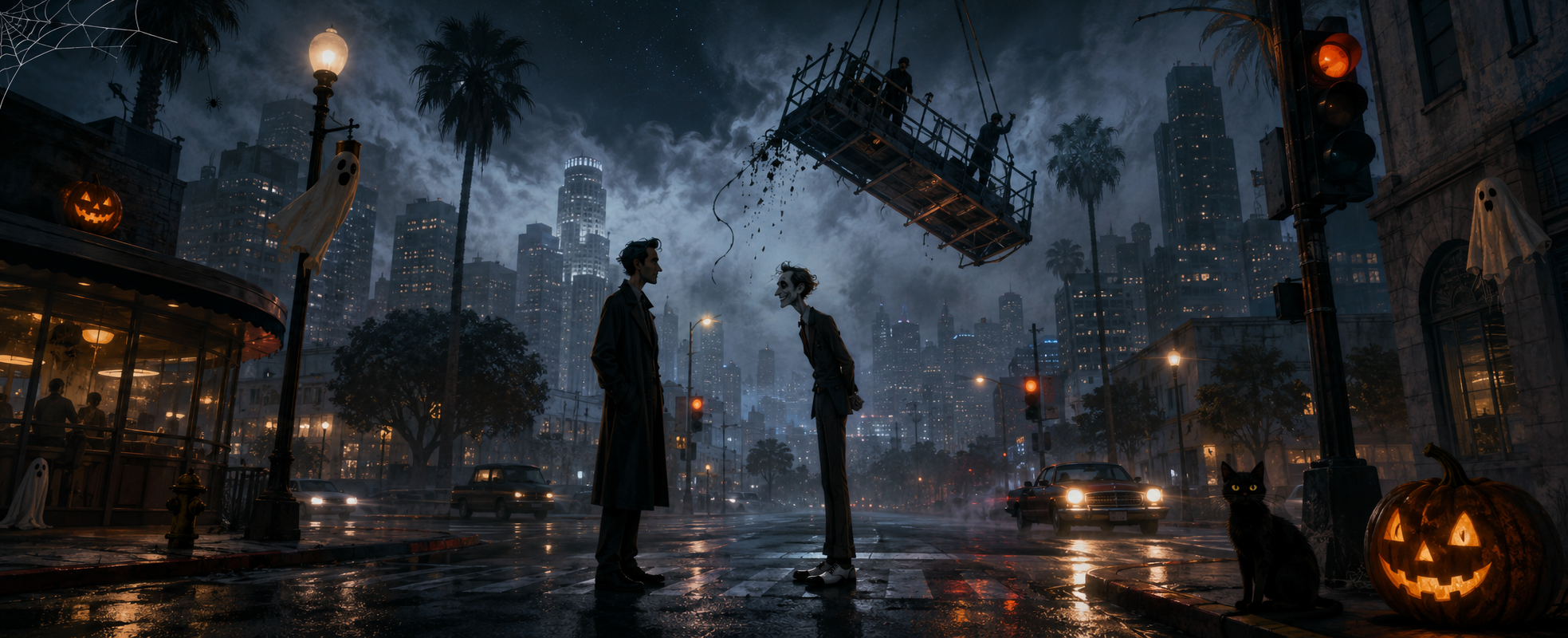
Then one Thursday morning, nearly twelve years after breakfast at the diner, I saw him.
I was crossing Olive Street.
He was standing on the opposite corner.
Same narrow shoulders. Same nervous posture. Same ridiculous three-tone shoes. Older. But unmistakably Tuggle.
For a moment neither of us moved.
Then he smiled.
Not warmly.
Not happily.
More like a man noticing that an equation had finally balanced.
The traffic light changed.
I stepped into the street.
So did he.
Halfway across, we stopped.
Cars flowed around us.
Neither of us spoke.
I said, “I thought you were dead.”
He nodded. “So did I.”
That was not the answer I expected. “You were wrong about one thing.”
“What?”
I smiled.
“The city survived.”
For the first time in twelve years he looked relieved. Then he glanced toward a nearby office tower. A tall office tower. The sort of building whose upper floors disappear into low clouds.
When he looked back at me, the relief was gone. “I wasn’t talking about the city.”
The world seemed unusually quiet.
Even for Los Angeles.
Then he checked his watch.
The gesture appeared innocent.
It wasn’t.
Tuggle looked up.
Directly at the building.
Then back at me.
And sighed.
“I really do have plans for Thursday.”
I followed his gaze.
A maintenance cradle was hanging high above the street.
Two workers.
One cable.
One bad angle.
I heard the sound.
Metal snapping.
People shouting.
The cable whipped loose.
The cradle began to fall.
Straight toward the intersection.
Toward one of us.
Tuggle smiled sadly. The way a man smiles when a mystery has finally become an answer. “You remember what I told you?”
I did.
Twelve years earlier.
At the diner.
Right after he had soaked me in coffee.
“I won’t be seeing you again. But next time we meet, one of us will be dead. It won’t be me.”
The falling cradle screamed toward the pavement.
Toward us.
Toward destiny.
And for the first time in my life I realized something Tuggle had understood all along.
Knowing the future is not the same thing as escaping it.
The cradle struck.
And I understood why he had always looked nervous. He had been carrying tomorrow his entire life. And tomorrow is a heavy thing.
