
Wings in the Dark
CHAPTER ONE
The first cut hurt less than I expected.
That was my first surprise.
The second was that I was not dead.
The man standing over me seemed disappointed by both facts. “Hold still,” he said.
I considered explaining that I was tied to my own bed and therefore had limited mobility options.
Instead, I stared at the black dotted outline he had drawn across my chest with a felt marker.
Apparently that was my right lung.
As a physician, I felt obligated to admire the accuracy.
As a patient, I found it less impressive.
The knife returned.
A hunting knife.
Large enough to field dress an elk.
Not generally recognized by the medical profession as a surgical instrument.
The man holding it was named Carl Jensen.
Three years earlier his mother had died.
For reasons that made perfect sense to Carl and almost none to anyone else, he blamed me.
His mother had come to me with cancer.
Advanced cancer.
The sort of cancer that appears in textbooks under the heading “Bad News.”
Operating would have shortened her life.
Not operating gave her another eight months.
Eight reasonably good months.
Carl remembered only that she was dead.
The blade touched my skin.
A shallow cut.
Just enough to produce a thin line of blood.
Carl smiled.
I did not.
The room was dark except for a bedside lamp.
Outside, wind rattled the eucalyptus trees.
Or something rattled them.
Carl paused.
“Did you hear that?”
“No,” I said.
This was technically true.
I was too busy considering my own obituary.
He listened for several seconds.
Nothing.
The knife moved toward my chest again.
Then the bedroom wall exploded.
That is the only phrase that adequately describes what happened.
One moment there was a wall.
The next there wasn’t.
Wood, plaster, insulation, and several framed photographs launched themselves across the room.
Carl spun around.
I remember his expression.
Not fear.
Confusion.
The kind of confusion people experience when reality suddenly violates its own rules.
Something enormous stepped through the hole.
At first my brain refused to identify it.
The human mind has safeguards.
Certain sights are rejected automatically.
Flying elephants.
Talking mountains.
Politicians keeping promises.
My brain examined the creature and suggested several possibilities.
A bear.
An industrial accident.
A helicopter assembled incorrectly.
Then understanding arrived.
A bee.
A queen bee.
Roughly six feet tall.
Carl fired twice.
The shots accomplished nothing useful.
The bee crossed the room so quickly that I barely saw her move.
One moment she was by the shattered wall.
The next she was standing over Carl.
The struggle lasted perhaps three seconds.
Possibly four.
When it ended, Carl no longer represented a threat to anyone.
The giant bee turned toward me.
Moonlight from the broken wall illuminated her.
Golden eyes.
Amber wings folded behind her back.
A face that was somehow both alien and strangely familiar.
She looked at me with what appeared to be concern.
Then she spoke.
Not with buzzing noises.
Not telepathically.
“You appear to be like injured.”
I stared at her. I could not believe my ears. She was employing Valley Talk, the kind where every sentence rises into a question. I was astonished and maybe she sensed my confusion. I knew Valley Talk had swept the earth. But not other galaxies. Might as well meet her on her own ground.
“You appear to be like a bee.”
For a moment neither of us spoke.
Then, to my astonishment, she said “I am a bee. And she laughed.
It was the warmest sound I had heard all night.
Twenty minutes later the police arrived.
The bee was gone.
Carl was dead.
My bedroom wall was missing.
And I was preparing to explain to two homicide detectives that a giant extraterrestrial queen bee had saved my life.
In retrospect, that conversation could have gone better.
The boys in blue were not dressed in blue.
One of the homicide dicks sported a suit of which the tailer suggested. “Choose a cream-colored Irish linen woven at about 11 ounces, cut it soft through the shoulders, make it fully bespoke, and don’t worry about the wrinkles. The wrinkles are proof that it’s real linen.”
The other dick, had a close acquientance with Salvation Army discount outlets.
You wouldn’t think the two cops were friends. You would be wrong.
Detective Ramirez was broad, gray, tired, and carried the expression of a man who had heard every lie in Southern California and had grown disappointed with the newer ones.
Detective Collins was younger, sharper, and more polite, which made him more dangerous. And better dressed.
The pair sat across from me in a small interview room that smelled of stale coffee, floor cleaner, and human regret.
“Tell us again,” Detective Ramirez said.
“Again?” I asked.
“Yes, Doctor. Please.”
“A man broke into my house.”
“Carl Jensen.”
“Yes.”
“He tied you up.”
“Yes.”
“He planned to remove your lung.”
“That appeared to be his goal.”
“With a hunting knife.”
“Not my recommendation.”
Detective Collins leaned forward. “And?”
In life there are sentences one hopes never to say while being questioned by homicide detectives. One such sentence would be that a giant queen bee had burst through my bedroom wall.
So I lied.
Badly.
I told them I must have blacked out.
I said there may have been another intruder.
Possibly several.
I suggested Carl might have been attacked by someone from his past.
It was the sort of story a frightened man invents when the truth has wings.
Detective Ramirez listened without blinking.
Detective Collins took notes.
Neither believed a word.
“You understand,” Detective Collins said, “that we have a dead man in your house?”
“I do.”
“A dead man who was killed with considerable force.”
“He was a determined fellow.”
Detective Ramirez sighed.
“Doctor, your bedroom looks like it was hit by a truck.”
“That was my impression also.”
“But there are no tire tracks.”
“That does complicate the truck theory.”
They kept me for twenty-four hours.
At least that was the promise.
Twenty-four hours for clarification.
Twenty-four hours to compare statements.
Twenty-four hours to let everybody calm down.
The first twenty-four hours became forty-eight.
Then four days.
Then a week.
No charges.
No answers.
No shoes with laces.
I had spent my adult life telling patients to remain calm in stressful situations.
This turns out to be much easier when you are wearing a white coat and the other person is in a paper gown.
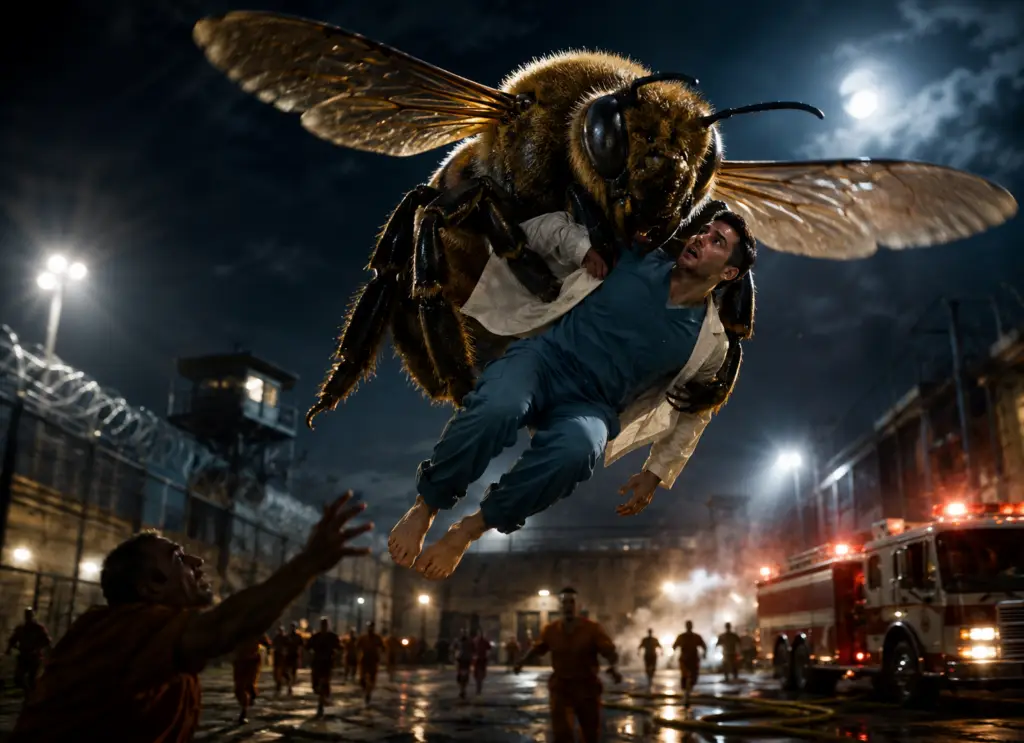
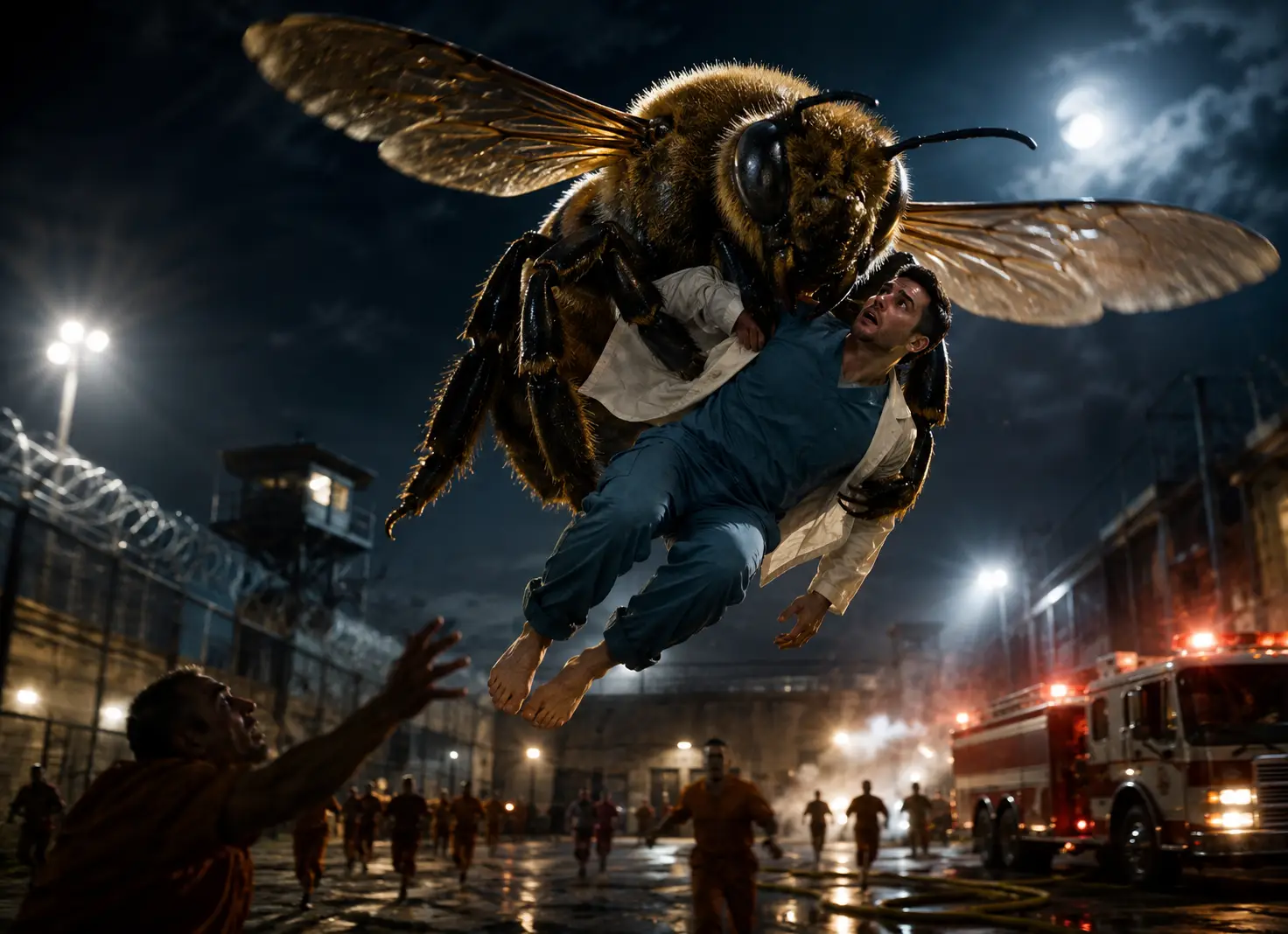
On the seventh night, the fire alarm went off.
At first nobody moved.
Jails are full of men who have learned not to trust bells.
Then smoke began curling from the far end of the corridor.
Doors opened.
Guards shouted.
Inmates were herded into the yard under floodlights while fire engines screamed into the lot.
It was chaos.
Beautiful, official chaos.
I stood in a line of men wearing orange, trying to look like a physician rather than a cautionary tale.
That was when someone said my name.
“Jed.”
I turned.
A man twice my width and almost my height was staring at me.
His face carried the Jensen family resemblance.
Carl’s eyes.
Carl’s jaw.
Carl’s apparent commitment to poor decision-making.
“You killed my cousin,” he said.
“I didn’t.”
“That’s what they all say.”
“Actually, in this case, it’s unusually accurate.”
He took a step toward me.
I took one back.
A guard shouted somewhere behind us.
Smoke drifted across the yard.
The floodlights flickered.
Then everything went dark.
Not dim.
Dark.
Hundreds of inmates shouted at once.
The cousin lunged.
I ran.
I am not proud of this.
But I am alive because of it.
I ran past a fire engine, past a coil of hose, past two guards who were arguing about who had the keys, and into a narrow service alley between the jail and a maintenance building.
Behind me, the cousin was gaining.
He was faster than he looked.
Unfortunately, I was exactly as fast as I looked.
My lungs burned.
My bare feet slapped against wet pavement.
Sirens wailed.
Men shouted.
Somewhere glass broke.
I reached the end of the alley and realized there was a chain-link fence in front of me.
Very high.
Very locked.
Very final.
I turned around.
The cousin slowed and smiled.
“Now,” he said, “we talk.”
“I would prefer correspondence.”
He came closer.
Then I heard it.
A low vibration above us.
Not a helicopter.
Not a drone.
A sound I knew from childhood, magnified until it seemed to fill the sky.
Wings.
The cousin looked up.
So did I.
Something enormous dropped out of the darkness.
The queen bee descended like a golden judgment.
Her arms closed around me.
The pavement vanished beneath my feet.
The cousin shouted.
The jail fell away.
So did the fire engines.
So did the floodlights, the guards, the smoke, the sirens, and every sensible explanation I had ever believed in.
We rose into the night.
I should have screamed.
Instead I laughed.
Possibly from terror.
Possibly from relief.
Possibly because no medical school in the world prepares a man to be abducted from jail by an extraterrestrial queen bee.
She held me carefully.
Not like prey.
Like something fragile.
Like something worth saving.
The city glittered beneath us.
Los Angeles looked peaceful from above, which is how Los Angeles lies.
After several minutes, she spoke.
“You lied to them.”
“Yes.”
“To protect me?”
“Mostly.”
“What was the other reason?”
“I didn’t want to be known as the doctor who claimed he was rescued by a giant bee.”
She considered this.
“Your species is very concerned with reputation.”
“Only constantly.”
We flew west, toward the dark hills.
I could feel the strength in her arms and the impossible rhythm of her wings.
She had saved me twice.
Once from a murderer.
Once from a world that would never believe what had happened.
That was when I understood something.
The first rescue might have been chance.
The second was a decision.
She had come back for me.
And though I did not yet know her name, or where she came from, or how a creature with wings could cross the stars, I knew my life had separated into two parts.
Before her.
And after.
I have no idea where story ideas come from.
If I did, I would go there more often.
Perhaps it is a warehouse somewhere outside Bakersfield staffed by retired screenwriters and mildly intoxicated angels.
All I know is that once in a while I wake up and discover that my subconscious has been working the night shift.
This one may have started when I was sixteen and tending a small colony of bees in Alberta.
I brought them water in the hot sun.
I floated Popsicle sticks on the surface so they would not drown.
I came to believe they knew I meant them no harm.
Scientists might not approve of that conclusion.
The bees seemed fine with it.
Years later, after reading about the astonishing intelligence of bees, I began to wonder whether we have misunderstood them entirely.
Perhaps intelligence does not always sit inside one skull.
Perhaps sometimes it is distributed across thousands of bodies.
Perhaps a hive is not a collection of insects.
Perhaps it is a mind.
If aliens watched Earth from a safe distance, perhaps they would not be impressed by us at all.
Perhaps they would look at bees and say, “There. That species understands civilization.”
Then they would look at humans, watch us argue about everything, and move along to a more promising planet.
Unless, of course, one of them stayed.
A queen.
A scientist.
An explorer.
A visitor from a civilization so old that crossing between stars is not a miracle to them.
Maybe they do not travel faster than light.
Maybe they travel differently.
Maybe they send living seeds across space.
Maybe queens sleep for centuries inside biological vessels, waking only when they reach a world worth studying.
Or maybe they have discovered something Einstein missed.
If so, I hope they explain it slowly.
I am still trying to understand my television remote.
What I do know is this:
A doctor is nearly murdered.
A giant queen bee saves him.
The police do not believe him.
The world becomes dangerous.
She returns.
And somewhere between terror, gratitude, wonder, and flight, a love story begins.
Not with candlelight.
Not with violins.
With wings in the dark.
Which, now that I think about it, may be the only honest way a love story should begin.
CHAPTER TWO
She landed in the hills above Los Angeles. Not roughly.
Not with the brutal downward drop I expected from something large enough to remove a bedroom wall and carry a grown man out of jail.
She descended gently through the darkness, her wings slowing until they were no longer a thunder above me but a vibration I felt more than heard.
My bare feet touched dirt. I bent at the knees and nearly collapsed. She caught me. Again.
This was becoming a pattern. “You are injured,” she said.
“I have had better evenings.”
She lowered me onto a flat stone beside a narrow stream.
Moonlight moved across the water in broken silver pieces.
Somewhere below us, Los Angeles glittered as though it had done nothing wrong.
From that distance, the city looked peaceful. This is one of the city’s many tricks.
I sat there in an orange jail uniform, barefoot, cut across the chest, and newly rescued by a six-foot extraterrestrial queen bee.
As a physician, I attempted to assess my condition. Pulse rapid. Respiration shallow.
Blood pressure unknown. Mental state questionable.
The cause of the questionable mental state stood before me, folding her amber wings behind her back with surprising modesty.
For the first time, I really looked at her. In my bedroom she had been force and terror.
In the jail yard she had been salvation from above. Here, under the moon, she was neither.
She was beautiful. Not in any ordinary human sense.
Ordinary human beauty had abandoned the conversation several miles back.
Her body carried hints of insect and woman without fully belonging to either.
Her limbs were slender but powerful.
Her skin, if it was skin, shimmered faintly gold and brown, like sunlight trapped under glass.
Her eyes were enormous, dark amber, and more expressive than any eyes I had ever seen.
I had spent forty years looking into human eyes. Frightened eyes. Grateful eyes.
Angry eyes. Eyes searching mine for hope when I had little to offer.
Hers contained intelligence, sadness, and something that looked almost like apology.
“I frightened you,” she said.
“Only during the wall, the dead man, the jail break, and the flying.”
“That was not my intention.”
“What was your intention?”
“To save you.”
“Then I have no complaint.”
She studied my face as though trying to determine whether I meant it. I did. Mostly.
She knelt in front of me. “May I touch you?”
“Yes.”
Her fingers touched the wound on my chest. They were warm. Unexpectedly warm.
A faint scent rose from her. Honey. Wild grass. Rain on dry earth. My chest tingled.
I looked down. The bleeding had stopped. “That is useful,” I said.
“It is minor repair.”
“Minor to whom?”
“To me.”
“Then remind me never to complain about your major repairs.”
For a moment her expression changed. Not quite a smile. But close.
“Your humor appears when you are afraid.”
“It is either that or screaming.”
“Screaming would also be understandable.”
“I try not to be predictable.”
This time she smiled. Small. Brief. Devastating.
Something about it disturbed my professional objectivity.
As a physician, I chose not to investigate further. “What are you?” I asked.
“A traveler.”
“That is evasive.”
“Yes.”
“At least we are making progress.”
She looked toward the city lights below. “I am not from this world.”
“I had begun to suspect that.”
“My people are older than yours.”
“That narrows it to almost everyone.”
“We crossed the darkness between stars before your species learned to shape metal.”
She said it without arrogance. Which somehow made it more impressive. “Why are you here?”
“I was sent to observe.”
“Humans?”
“All life.”
“And your conclusion?”
“Your planet is magnificent.”
“I notice you separated the planet from humans.”
“Yes.”
“Fair.” She turned toward me.
“Your species is difficult.”
“That is the polite version.”
“You build hospitals and weapons with the same urgency.
You comfort children and poison rivers.
You create music that alters emotion itself, then argue over invisible borders.”
“We also invented doughnuts.”
“I have observed this.”
“And?”
“They are persuasive.”
I laughed. The sound seemed to please her. Only then did I notice something strange.
She was nervous. Not frightened. Nervous.
Like someone attending a first date while pretending it was a scientific conference.
“What is your name?” I asked.
“My true name is not made of sound.”
“That complicates introductions.”
“Yes.”
“What should I call you?”
She thought for several seconds. “When I first came to Earth I listened to many languages.
I selected one human name.”
“And?”
“Elian.” I repeated it softly.
“Elian.”
She watched me say it. “Is it acceptable?”
“It is beautiful.”
Something moved behind her eyes. A quiet gratitude. “And you are Jed,” she said.
“You seem remarkably certain.”
“I have watched you.”
“For how long?” She looked away.
“Seventeen years.” I stared.
“That is a very long house call.”
“I did not watch constantly.”
“That is not as reassuring as you think.”
For the first time she laughed. The sound reminded me of wind chimes and distant water.
“I observed many humans,” she said.
“Why me?”
“Because of the bees.”
“The bees?”
“When you were young.” And suddenly I knew. The hive. The Alberta summer.
The Popsicle sticks floating in a pan of water. “You saw that?”
“Yes.”
“I was sixteen.”
“You believed they understood your intentions.”
“I always thought that was childish.”
“No,” she said quietly.
“It was correct.” The stream whispered over stones.
Neither of us spoke for several moments. “The bees knew?” I finally asked.
“Yes.”
“That I was helping?”
“Yes.”
“Scientists would disagree.”
“Scientists disagree with many things until they become obvious.” I found myself smiling.
Then, unexpectedly, I said: “My wife died three years ago.”
The words appeared without permission. Elian lowered her head. “I know.”
“Of course you do.”
“I am sorry.” There was no alien quality in her voice then.
Only compassion. “She was kind,” I said.
“Yes.”
“You watched her too?”
“Yes.”
“For science?” She hesitated.
“At first.”
That answer told me more than any speech could have. The wind shifted.
Below us the city glowed. Above us stars filled the darkness. “What happens now?” I asked.
“You cannot return.”
“The jail would be awkward.”
“Not only the jail.”
She looked toward the horizon. “Others will come.”
“Police?”
“Police. Soldiers.
Scientists. Men who call fear by other names.”
“You know us remarkably well.”
“I have studied you for a long time.”
“And still came back for me.”
“Yes.”
“Why?”
Moonlight passed through her wings.
“Because while Carl Jensen stood over you, I watched your thoughts.”
“That sounds invasive.”
“It was an emergency.”
“Proceed.”
“You thought about his mother.”
I said nothing. “You wondered if there was something more you could have done for her.
You blamed yourself for the grief of a man who came to murder you.” I looked away.
“That is not intelligence as my people define it,” she said softly.
“Then what is it?”
“Something better.” For once, I had no joke. Elian rose.
“There is a place I can take you.”
“Safe?”
“For a little while.”
“That phrase has ruined many vacations.” Again the smile appeared.
“You may refuse.”
I considered my options. Return to jail. Return to a house missing a wall.
Explain giant bees to homicide detectives. Or trust the impossible. I stood.
“One question.”
“Yes?”
“Will there be doughnuts?”
“I cannot promise doughnuts.”
“Then this relationship is off to a troubling start.”
“Relationship?”
The word lingered between us. Neither of us corrected it. Finally she extended her hand.
I looked at it. Then at her.
Then at the city below, where sensible people were desperately trying to explain a world that no longer made sense.
I took her hand. It closed around mine with astonishing gentleness.
And together we walked into the darkness.
CHAPTER THREE
We walked into the darkness. This is not as dramatic as it sounds.
Mostly it involved rocks.
Los Angeles has many fine qualities, but the hills above it were clearly designed by someone with little sympathy for barefoot men in jail uniforms.
Elian moved easily beside me. Not floating. Not gliding. Walking.
Which somehow made her more impossible.
If she had risen six inches above the ground and hummed with cosmic energy, I could have placed her in a category.
Alien visitor. Hallucination. Delayed concussion.
But she walked carefully over dry grass and loose stone, holding my hand as though I might break.
Which, medically speaking, was not an unreasonable concern. “Where are we going?” I asked.
“Somewhere hidden.”
“That describes most of Los Angeles after midnight.”
She glanced at me. “You are still afraid.”
“I am barefoot, bleeding, wanted by the police, and holding hands with a queen bee from another star.”
“Yes.”
“Fear seems underrepresented.” She considered that.
“Would it comfort you if I released your hand?” I looked down.
Her fingers were long and warm around mine. Strong enough to tear through concrete.
Gentle enough not to close too tightly. “No,” I said. We kept walking.
Below us, sirens moved through the city.
Red and blue lights pulsed between streets and buildings, tiny frantic sparks in the human hive.
“They are looking for me,” I said.
“Yes.”
“And you.”
“They will not find me unless I wish to be found.”
“That must be convenient.”
“It is often lonely.” She said it so simply that I had no immediate reply.
There are sentences that arrive like doors opening.
You can step through them or pretend you did not see them.
I had spent much of my life pretending not to see certain doors.
Doctors become skilled at this. A patient tells you he is fine.
His eyes tell you he is not.
His wife tells you he has been sleeping in a chair for three months.
His blood work tells you time has begun sharpening its knife.
And still everybody smiles politely. “How long have you been lonely?” I asked.
Elian stopped.
For a moment the only sound was the dry whisper of the chaparral and the distant city pretending to sleep.
“That is a difficult question.”
“Those are usually the only ones worth asking.”
She looked toward the stars. Not upward exactly. Homeward.
“Longer than your country has existed.” I waited for the joke to come. It did not.
“You’ve been here that long?”
“Not always here. Not always awake. Not always alone.”
“That answer seems designed to create more questions.”
“Yes.”
“Good.
For a moment I thought you were doing it accidentally.” Her smile returned. Briefly.
Like moonlight touching water and deciding not to stay. We began walking again.
The trail narrowed. She placed one hand lightly against my back when the ground dipped.
That small touch steadied me more than I wanted it to. “Do your people have families?”
I asked. “Yes.”
“Mothers?”
“Of a kind.”
“Fathers?”
“Not as you understand them.”
“Wives?”
She looked at me. “No.”
“Husbands?”
“No.”
“Then how do you make each other miserable?”
She studied my face. “Is that what marriage is?”
“Only on Tuesdays.”
“And the other days?”
I thought of Kate.
The way she would stand in a grocery aisle reading labels as though negotiating with hostile governments.
The way she could make a hotel room feel like home in twenty minutes.
The way she laughed when she was trying not to.
The way she said my name when I was being foolish, which was often enough to give her excellent pronunciation.
“The other days,” I said, “marriage is having one witness to your life.” Elian was silent.
“Someone who knows the version of you that never appears in public,” I said.
“Someone who remembers what you were like before you became the person everyone else thinks you are.”
“Kate was that for you.”
“Yes.”
“And you were that for her.” I did not answer quickly.
Grief has rooms inside it. You think you have walked through all of them.
Then someone opens another door. “I hope so,” I said. Elian touched my arm. Not to heal.
Not to guide. Just to touch. “She loved you,” Elian said.
“You watched that too?”
“Yes.”
“That should probably bother me.”
“Does it?” I looked at the city below.
Millions of lights. Millions of rooms.
Millions of people hiding sorrow behind curtains, passwords, and late-night television.
“Not as much as being forgotten would.” Elian lowered her head. We walked on.
The canyon grew darker. The city disappeared behind a ridge.
For the first time since Carl Jensen had drawn the outline of my lung on my chest, I could not see where humans were.
Only stars. Only earth. Only Elian. “Why did you watch us?” I asked.
“Because you are young.”
“That is not a word often applied to me.”
“Not you.
Your species.”
“We feel older.”
“All young species do.”
“That sounds like something an elderly civilization would say while withholding dessert.”
“We do not withhold dessert.”
“Then your people are already ahead of us.”
She made the wind-chime sound again. A laugh. I liked it too much.
This seemed medically significant.
“When a species becomes aware of the stars,” she said, “others notice.”
“Others?”
“Yes.”
“How many others?”
“Enough.”
“That is an alarming number.”
“Some observe. Some assist.
Some interfere.”
“And your people?”
“We remember.”
“Remember what?”
“Everything we can.”
She led me between two leaning walls of stone.
At first I thought we had reached a dead end. Then she placed her palm against the rock.
The stone moved. Not slid. Not opened. Moved.
As though it had been pretending to be stone and was relieved to stop.
A narrow passage appeared. Soft golden light breathed from within.
“I dislike this,” I said.
“Why?”
“Because every story that begins with a hidden passage ends badly for the man in the orange jumpsuit.”
“You may remain outside.” I looked behind us. Dark canyon. Loose rocks.
Police helicopters somewhere beyond the ridge. No shoes. “Outside is overrated.”
She entered first. I followed. The passage was warm.
The walls glowed faintly, amber and pearl, not from lamps but from within themselves.
The air smelled of honey, rain, old paper, and something floral I could not name.
“This is not a cave,” I said.
“No.”
“Is it alive?”
“Partly.”
“That is another answer that should have come with a chair.” The passage widened.
Then opened. I stopped. Before us was a chamber larger than any cave had a right to be.
It rose into darkness, tier after tier, like a cathedral grown by patient insects who had read every book on architecture and rejected ninety percent of them as showing off.
The walls were honeycombed with thousands of alcoves. Each alcove held something.
A clay bowl. A child’s shoe. A broken violin. A wedding ring. A soldier’s letter.
A baseball glove. A wooden toy horse. Photographs. Paintings. Scraps of cloth.
Small things. Human things. Useless things, if usefulness is measured by machines.
Priceless things, if measured by the heart. I stepped forward.
In one alcove, a faded photograph showed a girl standing beside a mule.
Both looked suspicious of the photographer.
In another, a cracked teacup rested on a folded newspaper.
In another, a handmade birthday card leaned against a smooth white stone. I turned slowly.
The chamber seemed endless. “What is this place?” I asked.
“A memory hive.”
“Of humans?”
“Of Earth.”
“You collect our things?”
“Not things.”
She moved to an alcove and lifted a small metal whistle. “Moments.” She held it carefully.
Almost reverently.
“A boy carried this through a flood to guide his blind brother toward higher ground.”
She replaced it. Then touched the cracked teacup.
“A woman kept this after her mother died.
She drank from it every morning for forty-two years.” Then the wooden horse.
“A father carved this for a daughter he would never see again.” I looked at her.
“Why these?”
“Because no government preserved them. No army fought for them.
No historian noticed.”
“But you did.”
“Yes.” Her voice changed. Softer now.
Almost ashamed.
“Your species believes history is made by kings, wars, borders, inventions, and men shouting in rooms.”
“It often is.”
“No,” she said.
“That is only the noise history makes while the real work continues quietly.”
I walked deeper into the chamber. There were thousands of human lives here.
Perhaps millions. Not the famous ones. Not the statues.
Not the names children are forced to memorize before forgetting them immediately after the test.
These were the lives that had held the world together while louder people tried to tear it apart.
“How long have you been collecting these?” I asked. Elian looked around the chamber.
“Since before your country existed.” I should have said something clever.
Instead I said nothing. My chest hurt. Not from the wound. From the size of the room.
From the tenderness of it.
From realizing that somewhere in the universe, someone had thought the small things mattered enough to save.
Elian moved ahead of me. “There is one more thing I want to show you.”
“I am not sure I can survive one more thing.”
“You can.”
She led me to a smaller alcove near the center of the chamber.
At first I did not understand what I was seeing. A shallow pan. Old. Rust along the rim.
Beside it lay three faded Popsicle sticks. I stopped breathing. “No,” I said.
Elian stood beside me. “Yes.” I stared at the pan.
The Alberta summer returned so completely I could smell the dust. I was sixteen again.
Skinny. Sunburned.
Angry at the world in the vague and energetic way of boys who have not yet been given serious problems.
The bees had been drowning in the water barrel behind the shed. I had no plan.
No philosophy. No grand affection for insects. I had simply hated watching them die.
So I placed sticks in the water. Tiny rafts. A ridiculous rescue mission.
And the bees climbed out. One by one. I had forgotten the pan. I had forgotten the sticks.
Elian had not. “Why did you keep this?” I asked.
“Because you expected nothing in return.”
“I was a boy.”
“Yes.”
“Boys do strange things.”
“So do civilizations.” I looked at her.
Her eyes shone in the amber light. “That was when you chose me?”
“No.”
“No?”
“That was when I first remembered your name.” The words moved through me quietly.
Not like thunder. Like roots. “When did you choose me?” Elian did not answer immediately.
She looked at the pan. Then at the thousands of alcoves surrounding us. Then at me.
“I chose you tonight.”
“When Carl Jensen came to kill me?”
“Before that.”
“When?”
“When you forgave him before he cut you.” I felt suddenly tired. Very tired.
“I’m not sure I did.”
“You wanted to.”
“That is not the same thing.”
“Among my people,” she said, “it is where forgiveness begins.” I looked at the pan again.
The Popsicle sticks seemed absurdly small. Too small to matter.
But perhaps that was the point.
Perhaps most things that matter begin too small to impress anyone. A hand extended.
A cup saved. A letter kept. A bee lifted from drowning. A murderer pitied.
A lonely alien watching from the dark. “Why bring me here?” I asked.
Elian turned toward me. “Because you believe your life has become smaller.” I looked away.
“After Kate.”
“Yes.” The chamber blurred slightly. This was medically annoying.
“It did become smaller,” I said.
“No,” Elian said.
“It became quieter.” I closed my eyes.
There are kindnesses too large to accept gracefully. So we reject them. Or mock them.
Or ask if there will be doughnuts. I did none of those things. For once.
When I opened my eyes, Elian was still there. Patient. Impossible.
Beautiful in a way no human poet would have been able to describe without embarrassing himself.
“What do you want from me?” I asked. She looked almost startled.
“Nothing.”
“Everyone wants something.”
“Then I am not everyone.”
“Clearly.” She stepped closer.
“I did not save you because you are useful.”
“That is fortunate.”
“I saved you because you were seen.” That undid me more than I expected.
Perhaps because Kate had seen me. Really seen me.
And after she died, the world had gone on looking in my direction without seeing much at all.
Patients saw a doctor. Neighbors saw an old man. Police saw a suspect.
Carl Jensen saw a cause for his pain. Elian saw the boy with the Popsicle sticks.
“This is a great deal to take in,” I said.
“Yes.”
“I may need a chair.”
A chair grew from the floor. I stared at it. “You could have done that earlier.”
“You did not ask.” I sat. The chair adjusted itself beneath me.
“I dislike furniture that knows what it’s doing.” Elian laughed. Then the chamber changed.
Not physically. The light shifted. The alcoves dimmed. Far above us, something pulsed red.
Once. Twice. Elian looked up. Her expression hardened.
For the first time since the jail yard, I saw the queen again. Not the lonely observer.
Not the woman who saved broken things. The queen. “What is it?” I asked. She listened.
I heard nothing.
Then, far away, deep in the living walls, came a sound like a thousand wings waking at once.
Elian turned to me. “They have found the place where I entered your world.”
“Police?”
“No.”
“Soldiers?”
“No.”
“Scientists?”
“Worse.” I stood too quickly.
The chair politely withdrew, which I found smug. “What is worse than scientists?”
Elian reached for my hand. This time, her fingers trembled. “The ones who followed me.”
CHAPTER FOUR
I awoke because something felt wrong. Not dangerous. Just wrong. As a physician, I have spent years listening to tiny alarms inside my head. Something is different. Someone is bleeding. That patient is lying.
This alarm was quieter. I opened my eyes.
The stream still moved through the rocks beside me.
The hills above Los Angeles were turning gold. Morning had arrived.
Elian stood fifty feet away on a rocky ledge overlooking the city. She had not moved.
At least not much. The giant queen bee appeared carved from amber and sunlight.
Her wings were folded behind her. Her silhouette glowed against the rising sun.
For several moments I simply watched. Then I noticed something peculiar.
She was staring east. Not at Los Angeles. Not at the mountains. At the sky.
As though she expected something to appear there.
Or perhaps something that should have appeared had failed to do so. I stood carefully.
Everything hurt. Progress. I limped toward her. “Good morning.” She did not turn.
“Good morning, Jed.”
“Have you been standing here all night?”
“Yes.”
“That’s creepy.”
“I am unfamiliar with the proper amount of standing.”
“Humans generally prefer less.”
“Noted.” I smiled. She didn’t. I was beginning to suspect she took everything literally.
Or perhaps she was simply too polite to laugh at my jokes. Either possibility worried me.
I followed her gaze. Nothing but sky. “What are you looking at?”
For a moment I thought she wouldn’t answer. Then she said quietly: “Absence.”
“That clears everything up.”
“Does it?”
“No.” She nodded.
“Then we understand each other.”
I laughed. She tilted her head. “Was that a joke?”
“I think so.”
“Interesting.”
Another pause. Then she said something that made every hair on my body rise.
“I can no longer hear them.”
“Who?”
“The Hive.” I waited. She offered nothing else.
“You mean radio communication?”
“No.”
“Telepathy?”
“No.”
“Internet?”
“What is internet?”
“Never mind.” She returned her attention to the horizon.
“For my entire existence they have always been present.”
“Your family?”
“More than family.”
“Friends?”
“More than friends.”
“Neighbors?”
“Much more than neighbors.”
“A homeowners association?” She looked at me.
“That sounds terrible.”
“You have no idea.”
For the first time I thought I saw amusement flicker across her face. Very briefly.
Like sunlight crossing water. “Perhaps not.” We sat beside the stream.
The city spread below us. Millions of people beginning another day.
Completely unaware that a giant extraterrestrial queen bee was discussing metaphysics with a half-beaten physician wearing a jail uniform.
Life is strange. “Are you afraid?” I asked. The question surprised her.
That much was obvious. “Why?”
“Because you’re alone.” She considered this.
For a very long time. “I do not know.”
“You don’t know if you’re afraid?”
“I do not know if this feeling is fear.” That answer felt unexpectedly sad.
Not because she was frightened. Because she might never have experienced fear before.
Or loneliness. Or uncertainty. I suddenly understood something.
Elian was not merely visiting Earth. Earth had happened to her.
And she had no more idea what came next than I did. “Can I ask a personal question?”
“You may.”
“Do you have a husband?” She blinked.
“A what?”
“A mate.”
“Thousands.”
“Thousands?”
“Approximately.”
“You have approximately thousands of husbands?”
“No.
I said mates.”
“That’s somehow worse.” She frowned.
“Human reproduction appears unnecessarily complicated.”
“You haven’t even seen reality television yet.”
“I suspect that statement contains a warning.”
“It does.” We sat quietly.
The wind moved through the grass. Far below, traffic began to build.
Then Elian said something unexpected. “I watched you.”
“Excuse me?”
“Before the attack.”
“For how long?”
“Several weeks.” I stared.
“Several weeks?”
“Yes.”
“That’s stalking.”
“No.”
“It absolutely is.”
“I was conducting observations.”
“That’s what stalkers call stalking.” She ignored me.
“You were unusual.”
“I’m a middle-aged doctor.”
“You repaired individuals who could not reward you.”
“That’s called medicine.”
“You comforted strangers.”
“Also medicine.”
“You remained kind despite repeated disappointment.” I looked away.
That one landed a little too close to home. “Well.”
“That was unusual.”
“Not where I come from.”
“Perhaps your species has more potential than your history suggests.”
“Coming from an alien bee, that is oddly flattering.”
“It was intended to be.”
And then she looked upward. Instantly alert. Every muscle in her body tightened. “What?”
I asked. “Listen.” I listened. Nothing. Then— Distant. Faint. The sound of helicopters.
Several of them. Far away. Searching. Elian’s eyes narrowed. “They have noticed.”
“Who?”
“Your people.” The helicopters grew louder. Not close. Not yet. But closer than before.
Somewhere in Los Angeles, somebody had finally connected enough dots to become interested.
And interested governments are often more dangerous than angry criminals.
Far more organized. Far better funded. And considerably harder to outrun.
Elian spread her wings. The sunlight flashed across them. “Jed.”
“Yes?”
“I believe your species is coming.” That was not reassuring. Not even slightly.
CHAPTER FIVE
Detective Ramirez did not like federal buildings. He did not like their polished floors.
He did not like their locked elevators.
He did not like the way everyone inside them wore shoes that had never stepped in anything human.
Most of all, he did not like being summoned. Police officers are requested.
Witnesses are asked. Suspects are invited downtown. Detectives are not summoned.
Not unless something has gone badly wrong.
Detective Ramirez stood inside a conference room somewhere in West Los Angeles and looked at the people waiting for him.
There were eight of them. Possibly nine. One man seemed to be present only as a suit. No expression. No visible blood supply.
Detective Collins stood beside Detective Ramirez, holding coffee he had not tasted.
Detective Collins was young enough to believe coffee in federal buildings might be drinkable.
Detective Ramirez knew better.
“Gentlemen,” said a woman at the head of the table. “Thank you for coming.”
Detective Ramirez sat. “We had very little choice.”
Detective Collins gave him a small warning look.
Detective Ramirez ignored it. He had been ignoring small warning looks since his second marriage.
The woman was in her forties, precise, calm, and dressed in the kind of dark suit people wear when they know something terrible and are waiting for everyone else to catch up. “I’m Dr. Ellen Marsh,” she said. “Federal Emergency Management Analysis Division.”
“FEMA has an analysis division?” Detective Ramirez asked.
“Several.”
“That explains why emergencies take so long.” No one laughed.
Detective Collins cleared his throat. “Detective Ramirez and Detective Collins,” he announced.
“LAPD Homicide.”
“We know who you are,” Dr. Marsh said.
“Then we’re already ahead of most meetings,” Detective Ramirez said.
Again, no one laughed.
Federal people, Detective Ramirez decided, were where laughter went to be questioned.
Dr. Marsh touched a remote. A screen lit up at the end of the room.
The first image showed a house. Jed’s house. The bedroom wall had been blown outward into the yard. Wood, plaster, insulation, and broken glass lay scattered across the grass.
Detective Ramirez had seen the photograph before. He had stood in the room.
He had smelled the blood.
He had looked at Carl Jensen’s body and decided several things at once.
First, Carl Jensen was dead. Second, Dr. Jed Walker was lying. Third, whatever had killed Jensen had not been another man.
That last thought had been inconvenient, so Detective Ramirez had placed it in a mental drawer marked: Think About Later, Preferably Never.
Apparently later had arrived.
Dr. Marsh clicked again.
The next image was from a security camera outside the county jail. Smoke drifted across the yard. Inmates in orange uniforms milled under floodlights. Firefighters moved through the frame. Then the lights went out. The image switched to infrared. Most bodies became pale smudges. One figure ran into a narrow alley. Another followed.
Detective Ramirez leaned forward. “That’s Dr. Walker.”
“Yes,” Dr. Marsh said.
“And Jensen’s cousin.”
“Yes.”
“We know this part.”
“No,” she said. “You don’t.”
The video continued. Jed reached the fence. The cousin closed in. Then something entered from above. Fast. Too fast. The image blurred. The cousin fell backward. Jed vanished upward. Not sideways. Not through the fence. Upward.
Detective Ramirez stared at the screen.
Detective Collins stopped pretending not to.
Dr. Marsh rewound the image. Played it again. Jed Walker ran. The cousin advanced. A shape descended. Jed disappeared into the dark.
Detective Ramirez said nothing.
Which, for Detective Ramirez, was a medical event.
“Do you have a better angle?” Detective Collins asked.
Dr. Marsh clicked. A second camera. Grainy. Higher. From the corner of the maintenance building. The image shook in smoke and darkness. But this time they saw wings. Not clearly. Not enough. But enough to ruin the day. Large wings. Transparent.
Amber in the infrared distortion. Something impossible had dropped from the sky, taken Dr. Walker, and risen into the night.
“What am I looking at?” Detective Ramirez asked.
Dr. Marsh did not answer immediately. That was not good. People answer quickly when the answer is comforting. “We were hoping you could help us with that,” she said.
“I’m homicide,” Detective Ramirez said.
“Not pest control.”
A man at the far end of the table finally spoke. “Detective, this object has been tracked intermittently over Los Angeles for nine days.”
“Object?” Detective Ramirez said.
“We don’t know what else to call it.”
“Try suspect. Makes paperwork easier.”
The man did not smile. “It has appeared on military radar, weather radar, satellite thermal imaging, and three civilian phones.”
“Phones?” Detective Collins asked.
Dr. Marsh clicked again. A shaky phone video appeared.
Someone was filming the Hollywood Hills at night.
A voice in the background said, “Bro, what is that?”
Another voice said, “It’s probably Elon.” Then a blur crossed the moon.
The room remained silent.
Detective Ramirez rubbed his face. “I hate phones.”
“So do we,” Dr. Marsh said.
“No, you hate them because they leak national secrets. I hate them because they prove people are idiots in high definition.”
Detective Collins glanced at the screen. “How big is it?”
“Estimated height,” said the man, “between five feet eight inches and seven feet.”
“That’s not an object,” Detective Collins said.
“No,” Dr. Marsh said.
“It is not.”
Detective Ramirez looked at her. “You think the doc was telling the truth?”
“He said a giant queen bee came through his bedroom wall.”
For the first time, Dr. Marsh looked uncomfortable. Only slightly. But enough. “Yes,” she said.
Detective Ramirez leaned back. “I’m going to need better coffee.”
Another man entered the room carrying a folder. He whispered to Dr. Marsh. She read the top page. Her expression changed. Again, only slightly. Federal expressions were rationed.
“What?” Detective Ramirez asked.
She looked at him. “We have a new sighting.”
“Where?”
“Griffith Park. Possibly moving west.”
Detective Collins stood. “Dr. Walker?”
“Unknown.”
Detective Ramirez was already at the door.
“Detective,” Dr. Marsh said. “This is no longer only a homicide investigation.”
“Lady,” Detective Ramirez said, “it stopped being a homicide investigation when the murder suspect grew wings.”
He opened the door. Then paused.
“One question.”
“Yes?”
“If we find this thing, what exactly are we supposed to do?” No one answered.
That was the first honest moment of the meeting. Detective Ramirez nodded. “That’s what I thought.”
Outside, the Los Angeles morning had become bright, warm, and offensively normal. Cars moved through traffic. People carried lattes. Dogs pulled owners along sidewalks.
The world continued behaving as though it understood itself.
Detective Ramirez and Detective Collins crossed the parking lot in silence. At their unmarked car, Detective Collins finally spoke. “You believe that now?”
Detective Ramirez opened the driver’s door. “No.”
Detective Collins waited.
Detective Ramirez got in. “But I’m starting to believe I should have.”
They pulled into traffic. Above them, far beyond the ordinary noise of the city, something moved where no helicopter should have been.
Detective Ramirez did not look up. Not yet. Some truths are easier to approach from the side. Especially when they have wings.
CHAPTER SIX
I had never expected to spend part of my life hiding from the federal government with a giant extraterrestrial queen bee.
Then again, I had not expected to spend any part of my life hiding from the federal government.
Life is full of surprises. Most of them unpleasant. This one was merely confusing.
We spent most of the day moving through the hills.
Or rather, Elian moved gracefully through the hills.
I stumbled behind her, discovering muscles that had apparently been hiding from me for decades.
By sunset we reached the edge of the city. Lights stretched to every horizon.
Los Angeles looked less like a city than a glowing infection. “Where are we going?” I asked.
“To learn.”
“I thought that was what almost getting murdered was for.”
“A different lesson.” That was all she would say.
Two hours later we were standing behind a large electronics store.
I stared at the building. Then at her. Then at the building again. “You’re kidding.”
“No.”
“You crossed interstellar distances to bring me to a discount television retailer?”
“Yes.”
“I was hoping for something more impressive.”
“You are difficult to impress.”
“I was abducted from jail by a bee.”
“That is fair.” One of the rear doors was unlocked.
I decided not to ask how she knew. Some questions are healthier unanswered.
The store was dark. Thousands of televisions sat silently in neat rows.
The place felt like a church dedicated to electricity.
Elian walked toward the largest screen I had ever seen. It occupied nearly an entire wall.
With a touch of one hand the display came alive. Then every screen in the building lit up simultaneously.
“How did you do that?”
“I asked.”
“You asked the televisions?”
“Yes.”
“And they listened?”
“They are simple creatures.”
I made a mental note never to introduce her to my laptop. The giant screen flickered.
Black and white images appeared. A flying saucer crossed the screen. A stern-looking alien emerged. A giant robot followed. I recognized it immediately. “The Day the Earth Stood Still.”
“Yes.”
“Why?”
“It was listed under historical first-contact scenarios.”
“That’s not a documentary.”
“It seemed authoritative.”
“Humans also made Sharknado.”
“What is Sharknado?”
“Proof that intelligence is not evenly distributed.”
She considered this. “That aligns with my observations.”
We sat together in the empty store.
A doctor and a queen bee.
Watching a seventy-year-old science-fiction movie in the middle of the night.
I began to suspect my life had permanently left reality.
On screen, humanity reacted badly to the arrival of an alien visitor. Soldiers panicked.
Governments worried. People assumed the worst. Elian watched silently.
Eventually she said: “Your species expected visitors to be hostile.”
“We’ve met us.”
“That answer concerns me.”
“It concerns me too.”
More silence. The movie continued.
“Did humans truly believe extraterrestrials would conquer Earth?”
“Many still do.”
“Interesting.”
“Why?”
“Because conquest is inefficient.”
“History disagrees.”
“Your history is very young.”
That was difficult to argue with.
When someone is older than civilization, perspective becomes a weapon. The movie ended. The giant robot froze. The credits rolled. Then darkness returned.
Only the glow of emergency lights remained. For several moments neither of us spoke. Finally I asked the question that had been growing inside me for days. “Why did you come to Earth?” She looked toward the dark screen.
“That answer belongs later.”
“Convenient.”
“Yes.”
“You planned that?”
“Yes.”
“You’re learning sarcasm.”
“You are a poor influence.”
“I’ve been told that.”
Something changed in her expression. Not physically. Emotionally. For the first time she looked uncertain. Not confused. Not curious. Uncertain. “Jed.”
“Yes?”
“My people believed humanity would not survive.”
The words settled into the darkness. “That seems harsh.”
“It was statistical.”
“Statistics are often harsh.”
“They predicted environmental collapse, resource conflict, biological instability, ideological fragmentation, and eventual self-destruction.”
“When you put it that way, we sound exhausting.”
“You are exhausting.”
“Fair.”
She continued staring at the dark screen. “I was sent to observe.”
“Judge us?”
“Understand you.”
“And?” For a very long moment she said nothing. Then: “I no longer trust the models.”
I smiled.
“Because of me?”
“Partly.”
“I’ll take partly.” Another silence.
Then she revealed something I had not expected. “You are not the first human I have watched.”
“No?”
“There have been thousands.”
“That makes me feel less special.”
“Most disappointed me.”
“Ah.”
“You did not.”
The enormous room felt smaller. More intimate. More dangerous. Not physically. Emotionally. Some truths are sharper than knives. “Why?” I asked quietly.
She turned toward me. Golden eyes reflecting faint emergency lights. “Because when you believed no one was watching, you were kind.” I looked away.
Doctors spend years pretending compliments do not matter. Most of us are lying. “That seems like a low bar.”
“You would be surprised.” Then, unexpectedly, she winced.
A tiny movement. Almost invisible.
But I saw it. “What was that?”
“Nothing.”
“That is physician code for something.”
“I am not a physician.”
“You are a terrible patient.” She looked annoyed. I felt encouraged.
“Elian.”
“The separation is increasing.”
“From the Hive?” She nodded.
“I thought you couldn’t hear them.”
“I cannot.”
“Then what’s happening?”
For the first time, genuine fear appeared. Very small. But real. “I do not know.”
That frightened me more than it frightened her. Because Elian was the sort of being who usually knew things. If she was uncertain, uncertainty itself had become dangerous.
Outside, beyond the walls of the store, Los Angeles continued its endless movement. Cars.
Sirens. Airplanes. Dreams. Failures. Eight million people trying to figure out tomorrow.
Unaware that somewhere nearby a visitor from another civilization had begun doubting everything she once believed about humanity.
Including her reasons for coming.
And perhaps, though neither of us was ready to admit it yet, her reasons for staying.
CHAPTER SEVEN
We left the electronics store before dawn. This was Elian’s idea.
Leaving before dawn is always the idea of people who do not understand coffee. The city was still half asleep. Los Angeles never sleeps completely.
It merely lies down with one eye open and a lawyer nearby. Elian moved through the shadows behind warehouses, service roads, and parking lots.
I followed as best I could. Which is to say badly. My feet hurt. My ribs hurt. My dignity had been missing since the jail. “Where are we going?” I asked.
“Someone is calling.”
“Someone human?”
“No.”
“That narrows it down in a very unsettling way.”
She stopped near the edge of a community garden behind a chain-link fence.
Beyond it were raised beds, fruit trees, compost bins, and a small row of wooden boxes. Beehives. Ordinary ones. At least they had been ordinary until a six-foot queen from another civilization arrived to inspect them.
Elian stood very still. I had seen her alert before. This was different. This was grief.
“What is it?” I asked.
“They are dying.”
I looked at the hives.
Several bees crawled weakly near the entrance of one box. Others lay still in the dirt.
Even I could tell something was wrong. “Disease?”
“Poison.”
“Pesticide?”
“Yes.” She said the word as though it tasted bitter. “Can you help them?”
She did not answer. Instead she opened the gate.
“Was that locked?”
“Yes.”
“You keep making locked things feel symbolic.”
She ignored me. We entered the garden. The smell of damp soil rose around us. Somewhere nearby, sprinklers clicked and hissed.
The first pale color of morning touched the sky. Elian approached the hive slowly.
Not like a scientist. Not like a queen.
Like someone entering a hospital room where the patient is family.
She lowered herself beside the box. Hundreds of bees stirred. Not in alarm. In recognition.
I felt it before I understood it. A change in the air. A tremor.
A living attention. The bees crawled toward her. Weakly. Trusting.
That was when I understood something I should have understood earlier. Elian was not enormous because she was monstrous. She was enormous because everything small in the world had found a shape large enough to protect it.
“Jed,” she said.
“Yes?”
“Open it.”
“The hive?”
“Yes.”
“I should mention I am not dressed for beekeeping.”
“They will not harm you.”
“Everyone says that before something harms someone.”
She looked at me. “Do you trust me?”
That question should have been complicated. It wasn’t.
“Yes.” I opened the hive. Carefully.
Inside, the colony moved in slow distress. Honeycomb glistened. Bees clustered around their queen. A very small queen. Brown and gold. Alive, but barely.
Elian bent close. The dying queen lifted her head. I know how that sounds. I know insects do not lift their heads with dramatic recognition. I know I was exhausted, injured, and hiding with a creature impossible enough to destroy confidence in all ordinary explanations. Still.
The small queen knew her. Or knew what she was.
Elian touched one finger to the edge of the comb. A drop of amber fluid appeared at her fingertip. Not honey. Something brighter. Almost luminous.
“What is that?”
“A promise.”
“That is not a medical answer.”
“It is the only true one.”
The bees gathered around the drop. Slowly at first. Then faster. Their movement changed. Strength returned in ripples.
The weak bees near the entrance began to stir. Those on the dirt twitched, then crawled, then rose into the air.
I watched, unable to speak. As a doctor, I knew healing. I knew medicine. I knew the stubborn, messy work of keeping bodies attached to life. This was different.This was not medicine. This was memory being returned to a body that had almost forgotten itself. The small queen moved. Then stood. Then touched Elian’s finger with her antennae.
For a moment neither queen moved. One tiny. One impossible. Two monarchs in a wooden box behind a garden shed in Los Angeles.
I felt ridiculous. And privileged. Which is a strange combination. “Can you save them all?” I asked.
Elian’s wings trembled. Only slightly. “No.”
It was the first time I had heard helplessness in her voice. Not fear. Not uncertainty. Helplessness. “There are too many wounded places on this world.”
I looked at the bees rising slowly around us. “But you saved these.”
“For now.”
“For now is not nothing.” She turned toward me. “Humans say that often.”
“We have to.”
“Why?”
“Because for now is usually all we get.”
She absorbed that.
I could almost see the thought moving through her. Immortality trying to understand Tuesday. Then she did something strange. She removed one of the fallen bees from the dirt and placed it gently on the comb. It did not move.
“That one is dead,” I said.
“Yes.”
“Then why…”
“Because it belonged somewhere.”
That silenced me. I thought of hospital rooms. Of bodies covered with sheets. Of families arriving too late. Of all the times I had told someone
I was sorry and meant it and knew it was not enough.
Elian closed the hive.
The bees moved around her in a slow golden cloud. They did not swarm. They did not attack. They circled. Not worship exactly. Not gratitude exactly. Something older than either.
“Your people are not conquerors,” I said.
She looked at me. “No.”
“Then what are you?”
She looked at the hive. Then at the waking city beyond the garden. “Gardeners.” The word should have sounded small. It did not. In her mouth it contained stars. A siren rose in the distance. Then another. Elian turned sharply. “They are near.”
“Detective Ramirez and Detective Collins?”
“Humans with purpose.”
“That could be anyone from police to joggers.”
“Not joggers.”
“Good.
I dislike being hunted by healthy people.” We moved toward the back of the garden.
Behind us, the revived bees returned to their hive. Not all of them. Enough. Sometimes enough is a miracle in work clothes.
At the fence, Elian paused. “Jed.”
“Yes?”
“If your people find me, they will be afraid.”
“Yes.”
“If they are afraid, they may try to destroy me.”
“Yes.”
“If they try to destroy me, I may be forced to defend myself.”
I didn’t like where this was going. “Then let’s avoid that.”
“You cannot avoid fear by hiding forever.”
“Watch me.”
She almost smiled. Almost.
Then the sound came. Helicopters. Not distant now. Close. Searchlights swept across nearby rooftops.
Elian reached for me. Then stopped. That frightened me more than if she had grabbed me.
“What’s wrong?”
Her wings shuddered. “The separation.”
“Can you fly?”
She looked up. For the first time since I had met her, she did not seem certain. “I do not know.”
On the other side of the garden, a gate opened. Voices. Flashlights. Men moving quickly.
I took Elian’s hand. It was warm. Stronger than mine. But trembling.
“Then we run,” I said.
“I am not built for running.”
“Neither am I.”
She looked at me. And this time she did smile. A real one. Brief. Beautiful. Terrible timing. “Your species is absurd,” she said.
“Yes,” I said.
“But we improvise.”
Then we ran.
CHAPTER EIGHT
Running with a giant queen bee through Los Angeles is not as easy as it sounds.
And it does not sound easy. Elian was not built for running. She was built for flight, command, elegance, impossible distances, and terrifying criminals with poor impulse control.
I was built mostly for prescription pads and avoiding hospital cafeteria meatloaf.
Neither of us was at our best. Behind us, voices moved through the garden.
Flashlights cut between the trees. Above us, helicopter blades hammered the sky.
Elian stumbled. Not badly. But enough. I caught her arm. That was ridiculous. She could probably lift a bus. Still, for one second, she leaned against me. Warm. Alive.
Frightened. My heart did something medically unhelpful. Elian turned her head.
“Your pulse has increased.”
“We are being chased.”
“It increased before that.”
“I have an irregular relationship with panic.”
“You are lying.”
“A little.”
She studied my face. This was becoming a problem. Not the helicopters. Not the government. Not the possibility of being shot, dissected, imprisoned, or interviewed by cable news. Her looking at me. That was the problem. “Can you fly?” I asked.
She opened her wings. They trembled in the dim light. Then folded again. “No.”
It was the smallest word I had ever heard from her. And the most frightening.
“All right,” I said.
“You have a plan?”
“No. But humans often say all right before making one up.”
“That explains much of your history.”
“Yes. Keep moving.”
We crossed a service road, scrambled through brush, and climbed toward the dark outline of Griffith Observatory.Above us, the white dome rose against the sky. It looked calm. Beautiful. Almost holy. Which was misleading. Most holy places are surrounded by parking problems. We reached a maintenance entrance below the main terrace. Locked. Of course.
I looked at Elian. “Can you ask this door politely?”
“I am weak, not useless.”
She placed one hand against the lock. Something clicked. The door opened.
“Thank you,” I said.
“I did not do it for you.”
“I will accept the benefit.”
Inside, the observatory was dark and cool.
We moved through a corridor smelling faintly of dust, stone, and school field trips. Every American child has at some point been marched through a science museum and told to appreciate wonder while secretly thinking about lunch.
Now I would have appreciated lunch. Or shoes. Or several constitutional protections.
We found our way into the main hall. Planets hung above us. Exhibits stood silent.
A model of the solar system gleamed faintly in emergency light. Elian stopped beneath it.
She looked up.
For a moment she seemed less like a fugitive and more like a princess who had wandered into a cathedral built by children.
Cinderella with wings. Supergirl without the cape.
And me? I was the middle-aged doctor in an orange jail uniform trying very hard not to notice how beautiful she was. I failed. Completely.
“Jed.”
“Yes?”
“Your temperature has increased.”
“It’s warm in here.”
“It is not.”
“I am Canadian.”
“You are still lying.”
“I was raised with privacy.”
“Your body disagrees.”
“My body has been making poor decisions for years.”
She considered that. “Is this illness?”
“No.”
“Fear?”
“Not exactly.”
“Pain?”
“Not that either.”
She stepped closer. This did not improve anything. “Then what is it?”
“Human complication.”
“That is not an answer.”
“It’s the most accurate one I have.”
She watched me a moment longer. Then, mercifully, looked back toward the stars suspended above us.
I breathed again. Quietly. Like a coward. We climbed a narrow stairway toward the telescope dome. Halfway up, Elian stopped. Her hand went to the wall.
I turned. “Sit down.”
“I do not require—”
“Sit down.”
She looked surprised. So was I. Apparently I had discovered authority. It was about time. She sat on the step.I knelt beside her.
“Tell me what’s happening.”
“The separation is widening.”
“From the Hive.”
“Yes.”
“Will it kill you?”
She did not answer.
Doctors dislike silence after that question. “Elian.”
“I do not know.”
There it was again. The impossible creature giving the human answer. I don’t know. The most honest sentence in the universe.
“If you die…” I stopped. The sentence was too large.
+She finished it for me. “Another may wake.”
“Another what?”
“A daughter.”
“You have children?”
“Not as humans understand children.”
“That’s becoming a popular category.”
“Among my people, queens prepare successors.
Some sleep for centuries. Some for longer. They carry memory, pattern, purpose.”
“Your memories?”
“Some.”
“Your feelings?”
“Perhaps.”
“Perhaps?”
She looked at me. “Continuity is not duplication.”
That sentence frightened me more than the helicopters. “Would she be you?”
Elian looked down the stairwell. Then at her own hands. “I do not know.”
For a while neither of us moved.
Somewhere outside, a helicopter passed close enough to rattle the glass. Searchlight swept across the dome and vanished. I should have been thinking about escape. I should have been thinking about police. I should have been thinking about how a jury might react to my third bad explanation in three days.
Instead I was thinking about her daughter. A future queen. Carrying Elian’s memories. Perhaps remembering me. Perhaps not caring. That seemed unfair. Which was absurd.
I had known Elian for less time than most people keep leftovers. And yet the thought of losing her and meeting something almost her felt unbearable.
I said the only useful thing I could think of. “Then don’t die.”
She looked at me.
“Is that medical advice?”
“Yes.”
“It lacks detail.”
“I’m improvising.”
For the second time that night, she smiled. Not much. Enough. We reached the dome just before sunrise.
The telescope pointed toward the heavens with the patient dignity of a machine that had been asking the same question for generations. Why are we here? Humans built instruments to ask that. Elian’s people crossed stars.
Apparently nobody had received a satisfying answer.
She stood beneath the great telescope and touched the railing. “Your species looks outward,” she said.
“When we aren’t looking at ourselves.”
“Why?”
“Hope, mostly.”
“You hope something is there?”
“We hope we aren’t alone.”
She absorbed that. Outside, the sky brightened over Los Angeles.
“My people look outward for the same reason,” she said.
I turned to her. “You’re not alone.”
She looked at me. Golden eyes. Tired now. More human than she knew.
“Nor are you.” I wanted to say something clever. Something protective. Something worthy of the moment.
Naturally, I said nothing. That may have been best.
Outside, tires crunched on gravel. Doors opened. Voices rose below.
Detective Ramirez.
Detective Collins.
Others.
Elian turned toward the sound. Her wings opened slightly. Then failed her again. I stepped in front of her. Not because I could stop anyone. I couldn’t. Not because I was brave. I wasn’t sure. But because, for once, I was the one standing between her and danger.
At the bottom of the stairs, a flashlight beam appeared.
Then Detective Ramirez’s voice. “Doctor Walker?”
I looked at Elian. She looked back. My heart was still behaving badly. My body was still betraying me. The government was downstairs. An alien queen was behind me. And for reasons I was not yet prepared to explain to anyone, including myself, I was not moving.
“Yes,” I called.
Detective Ramirez climbed one step. “Please tell me you’re alone.”
I glanced at Elian. She almost smiled. I sighed.
“Detective,” I said, “when have I ever made your life that easy?”
CHAPTER NINE
I have discovered there are moments in life when honesty becomes unavoidable.
This is inconvenient. Especially when the truth sounds insane.
Detective Ramirez stood halfway up the observatory stairs.
Detective Collins stood directly behind him.
Three uniformed officers occupied the landing below. Nobody moved. Nobody spoke.
For several seconds the entire human race appeared to be buffering.
Detective Ramirez looked at me. Then beyond me. Then beyond me again. “Well,” he said.
“Good morning, Detective.”
“Doctor.” He nodded toward Elian.
“That explains the wall.”
I smiled. “I’ve been saying that for days.”
“Yes.”
“You didn’t believe me.”
“No.”
“And now?”
Detective Ramirez stared at the six-foot queen bee standing beneath one of the world’s great telescopes.
“Now I owe you an apology.” Detective Collins never took his eyes off Elian.
“She’s beautiful.” The words escaped before he could stop them. The room grew quiet.
Even Detective Ramirez looked surprised. Detective Collins turned slightly red.
“Professionally speaking,” he added.
“Of course,” Detective Ramirez said.
“I mean biologically.”
“Naturally.”
“Shut up.”
“Gladly.” Elian watched the exchange.
“Are you always like this?”
“Unfortunately,” Detective Ramirez said.
“Then humanity is more resilient than expected.”
For the first time, Detective Ramirez laughed. Not because the joke was especially good.
Because hearing a giant extraterrestrial queen bee make one broke something loose inside him.
The impossible had arrived. And it had a sense of humor. That changed things.
Outside, rotor blades hammered the morning air. The sound echoed through the dome.
Detective Ramirez looked toward the windows. “We’re running out of time.”
“For what?”
I asked. “For this remaining a police matter.”
“It stopped being a police matter when she came through my bedroom wall.”
“Fair point.”
Detective Collins stepped closer. “Are you really extraterrestrial?”
“Yes.”
“How far away?”
“Far.”
“That’s not helpful.”
“It is accurate.”
Detective Collins considered that. “Also fair.”
One of the officers below finally found his voice. “Detective…”
“Not now.”
“Sir…”
“Still not now.” The officer wisely retreated into silence.
Detective Ramirez looked at Elian. Really looked. Not as evidence. Not as a suspect.
Not as a threat. As a person. “Did you kill Carl Jensen?”
“Yes.”
The answer hung in the air. Direct. Calm. Unapologetic.
“He intended to remove Doctor Walker’s lung.”
“That part is true.”
“He would have killed him.”
“Probably.”
“Not probably,” Elian said.
“Certainly.”
Detective Ramirez nodded slowly. “Why save him?” Now it was my turn to look at her.
I wanted to hear the answer too. Elian seemed surprised by the question.
As though nobody had ever asked it. “He was alive.”
“That’s it?”
“Is that insufficient?”
Detective Ramirez opened his mouth. Closed it again. “No.” For a moment nobody spoke.
Because nobody could improve on that answer. He was alive. That was enough.
Outside, another helicopter arrived. Then another. The windows vibrated.
Radios crackled below. A new voice sounded from one of the officer’s earpieces.
Loud enough for everyone to hear. “Federal units arriving now.”
Detective Ramirez muttered something unprintable. “What happens if they find her?”
I asked. “Depends who’s first through the door.”
“That doesn’t sound encouraging.”
“It isn’t.” Detective Collins looked at Elian.
“Can you leave?” Her wings shifted.
Then drooped. “No.” The answer frightened everyone. Even her. I could see it.
The uncertainty. The exhaustion. The separation from the Hive. She was weakening.
And for the first time, people other than me noticed. Detective Ramirez noticed.
Detective Collins noticed. The officers noticed. The queen looked vulnerable.
Which somehow made her more dangerous. Not physically. Emotionally.
Detective Ramirez rubbed his face.
“This is going to be the strangest report I’ve ever written.”
“You could leave out the bee part.”
“That seems central.”
“Worth a try.”
“Doctor.”
“Detective.”
“Shut up.”
“Fair.” Elian looked between us.
“You communicate affection through conflict.”
“That is disturbingly accurate,” Detective Collins said. A radio exploded with static.
Then a voice. Sharp. Urgent. Official. “All personnel hold position. Repeat.
Hold position. Federal response team is assuming command.”
Detective Ramirez rolled his eyes. “There it is.”
“What?” I asked.
“The moment everything gets worse.” Footsteps echoed below. Many footsteps. Fast.
Disciplined. Armed. The sort of footsteps that arrive with paperwork and end with lawyers.
Detective Collins moved toward the stairwell and looked down.
His expression changed immediately. “Detective Ramirez.”
“I know that tone.”
“You should come see this.” Detective Ramirez joined him. A second later he sighed.
“Of course.”
“How bad?” I asked.
“Let’s just say nobody brought flowers.”
The footsteps grew louder. Closer. Coming up the stairs.
Elian stood quietly beneath the telescope. Golden wings folded. Eyes calm. Almost serene.
As though she had accepted something the rest of us had not. I moved beside her.
“What are you thinking?” I whispered.
“That your species is afraid.”
“Some of us.”
“Most of you.”
“Also fair.” She looked at me. Then smiled. The same smile.
The one that kept causing trouble with my pulse. “You are less afraid than the others.”
“I have had practice.”
“With extraterrestrial queens?”
“No. Women.”
To my astonishment, she laughed. A warm sound.
The same sound I had heard in my bedroom after she came through the wall.
The same sound that had changed everything.
At the bottom of the stairs, a new figure appeared. Tall. Gray suit. Expressionless.
The sort of man who probably filed taxes against his own children.
He stopped when he saw Elian. His face froze. Not fear. Not wonder. Calculation.
Which worried me more. Much more.
For the first time since entering the observatory, Detective Ramirez stepped forward.
Not toward Elian. Toward the man. Blocking the stairs. Just slightly. Enough.
The suited man looked at him. “Detective.”
“Sir.”
“Step aside.”
Detective Ramirez glanced back at Elian. Then at me. Then at Detective Collins.
The choice took less than a second. “No.” The observatory became very quiet.
Outside, Los Angeles awakened beneath the rising sun.
Inside, humanity made its first decision.
CHAPTER TEN
The world around us changed. The hillside dissolved. The stream vanished.
The city below us became a smear of silver light.
I felt as if I were falling without moving. Then I stood in a field at the end of day.
The grass rose like green pillars.
Flowers, enormous and luminous, their petals curved like colored sails.
The sky had softened into amber and rose.
The last light of evening moved through the field as if the sun itself were reluctant to leave.
Two young bees flew through the flowers. They were tiny.
Not tiny the way a bee is tiny to us.
Tiny the way children are tiny in relation to the world.
They darted between the blossoms, clumsy with joy, chasing one another through the warm evening air.
One of them tumbled into a cloud of pollen and emerged golden and indignant.
The other laughed. I did not hear the laughter with my ears. I felt it.
“Children?” I asked.
“Yes,” Elian said. Her voice came from beside me, though I could not see her.
The sky darkened. A wind moved through the field. The flowers began closing for the night. One petal folded inward. Then another.
The great blossoms, which had seemed so open and welcoming moments before, slowly drew themselves shut. The two young bees stopped playing. The first drop of rain fell. It struck a leaf with the force of a thrown stone. Then another. Then hundreds.
The storm arrived with terrifying speed. To a human being, rain is weather. To something small enough, rain is artillery. The two young bees fought the wind. One was blown sideways, tumbling helplessly toward the darkening grass. The other chased after her. He caught her hand. Together they struggled toward a flower that was already closing for the night.
The blossom was folding inward petal by petal.
Behind them the storm raced across the field.
The first heavy drops exploded against leaves. Then came dozens more. Hundreds. The sky seemed to collapse into water. “They aren’t going to make it,” I said.
“Watch,” Elian replied.
The tiny bees flew harder. The flower narrowed. The opening became a slit. The rain was almost upon them. For one terrible second
I was certain they would arrive too late.
Then both children dove forward. They vanished between the petals. The flower closed completely. A heartbeat later the storm struck.
Rain hammered the blossom. The stem bent nearly to the ground. Water streamed down its sides. The flower swayed violently in the wind.
“What happens now?” I asked.
“Now they wait.”
“Inside?”
“Yes.”
I watched the flower shake under the assault of the storm. “Can you see them?”
“No.”
“Then how do you know they’re all right?”
Elian turned toward me. “Why do you assume I do?”
“Because you’re being annoyingly calm.”
“That is not evidence.”
“It’s the best I’ve got.” The flower bent again beneath the rain.
“Seriously,” I said. “What’s happening inside?”
“You could ask.”
“Ask who?”
“The flower.” I stared at her.
“The flower?”
“Yes.”
“The plant.”
“Yes.”
“The vegetable.”
“Flowers are not vegetables.”
“You know what I mean.”
“I do.”
“I doubt it speaks English.”
“It does not.”
“Then I don’t think we’re going to have much of a conversation.”
Elian looked genuinely puzzled. “You do not speak Flower?”
“Most medical schools skipped that elective.”
For a moment I thought she might actually believe me. Then she stepped toward the blossom.
The storm continued raging around it. She gently touched one petal. Not with force. Not with technology. Just a touch. The flower vibrated. A low hum moved through its stem. The petals trembled. For several seconds the vibration continued. Then it stopped.
Elian nodded. “What did it say?” I asked.
“The children are safe.”
I blinked. “That’s it?”
“What more do you require?”
“Details.”
“Humans always require details.”
“Occupational hazard.” The vibration returned briefly.
Elian listened. A softness came into her expression.
“What now?” I asked.
“The flower says the little female is frightened.”
“And?”
“The little male is holding her.”
The storm continued to pound the blossom. Yet somehow it no longer seemed fragile. “Anything else?”
Elian smiled. It was the smallest smile I had seen from her. “Yes.”
“What?”
“The flower says they have fallen asleep in each other’s arms.”
The storm raged on through the night. Rain battered the petals. The stem bent low.
The wind howled across the field. But the flower held.
And somewhere inside its living walls, two tiny children slept. Slowly the darkness softened. The rain weakened. The wind lowered its voice.
Beyond the horizon, dawn arrived. A faint golden light touched the flower. The blossom stirred. One petal opened. Then another. Then another.
Morning unfolded the flower the same way evening had closed it. Patiently. Carefully. Like a gift being unwrapped. I found myself leaning forward.
Inside the flower sat the two young bees. Alive. Safe. Still touching. They blinked at the morning sunlight. Neither seemed eager to let go.
The little female smiled first. The little male looked embarrassed. Then both of them laughed. Moments later they launched themselves into the clean morning air. The storm was gone. The flower had opened. The children had survived the night. The field slowly faded.
The hillside returned. Los Angeles glittered below us. My hand was still in Elian’s. For once, I did not pull away. “Did they survive?” I asked.
Elian looked at me for a long moment. “Obviously.”
“How do you know?”
Her eyes remained on the distant horizon. “Because I was one of them.”
CHAPTER ELEVEN
For the first time since I had met her, Elian looked very young. That frightened me more than the storm had. A queen should not look young. A creature who had crossed the dark between stars should not carry the expression of a child remembering rain. But she did. For several seconds neither of us spoke.
Los Angeles glittered below us, millions of lights pretending that life was normal.
Cars moved along the freeways. Planes crossed the sky.
Somewhere a couple was arguing about dinner.
Somewhere a television was telling people that tomorrow would make sense.
Up here, standing beside an extraterrestrial queen bee who had just shown me her childhood inside a flower, tomorrow had lost all legal authority.
“Where are we?” I asked.
Elian looked toward the dark hillside. “Near your city.”
“That is not an answer.”
“No.”
“You do that often.”
“Yes.”
“Is it cultural?”
“Partly.”
“And the other part?”
“I am deciding whether to trust you.”
That stopped me. Not because I was offended. Because I realized she had been saving me without fully trusting me. Humans do this too.
We call it marriage.
She turned from the city and walked toward a stand of eucalyptus trees. Her wings folded close against her back. Moonlight moved across them in amber veins. “Come,” she said.
“That word has become complicated since I met you.” She almost smiled.
I followed. The trees stood close together, their trunks pale and twisted. At first they looked ordinary. Then, as we approached, I saw that the shadows between them were too dark. Not night dark. Deeper than night. As if the hillside had a hidden seam.
Elian touched one tree. The bark vibrated. The air opened. There is no better way to say it. One moment I was looking at a hillside in Los Angeles.
The next I was looking into a vast chamber filled with golden light. I stopped walking. “No,” I said.
“No?”
“That is my professional opinion.”
“You have not seen it yet.”
“I have seen enough to issue a preliminary diagnosis.”
“And?”
“The hillside is larger on the inside.”
“Yes.”
“That is not allowed.”
“By whom?”
“Real estate agents, for one thing.”
This time she did smile. Then she stepped through the opening.
I followed because every sensible option had left days ago. The chamber beyond was not a cave. Not exactly. It was alive.
The walls curved upward in smooth golden layers, like honeycomb grown by an architect who had studied cathedrals and then improved them.
Light moved through the surfaces as though the walls remembered sunlight. Threads of pollen drifted in the air.
Flowers grew from ledges high above us, their roots disappearing into amber stone. Water ran somewhere nearby. Not loudly.
Enough to make the place feel less like a shelter and more like a promise.
“What is this?” I whispered.
“A small refuge.”
“Small.”
“For my people.”
“Your people must have terrible trouble finding parking.” She walked ahead.
The floor softened under my feet. It was not dirt, not stone, not carpet, but something springy and warm, like walking on the memory of moss.
“No human has entered here,” she said.
“Then I apologize for the outfit.” I looked down at my orange jail uniform. “Had I known I was visiting an interstellar bee sanctuary,
I would have worn something less felonious.”
“You are not a felon.”
“That depends on who writes the police report.”
We came to a pool of still water. Above it hung dozens of translucent pods, each the size of a melon, glowing softly from within.
Inside them, images moved. Fields. Stars. Storms. Faces. Not human faces. Not entirely.I stepped closer. “Memories?”
“Yes.”
“Stored?”
“Shared.”
“By whom?”
“Queens. Workers.
Children. Those who lived before me. Those who will live after.”
“A library.”
“A hive.”
I looked at the glowing pods. I think I understood that she had not shown me a story. She had shown me a memory that still lived. “The flower,” I said.
“Yes.”
“The storm.”
“Yes.”
“The little male bee.” Her expression changed. Only slightly. But enough. “He was my first friend,” she said.
There are sentences that arrive quietly and rearrange a room. That was one of them.
“What happened to him?” I asked.
Elian looked at the pool. “He died a very long time ago.”
“I’m sorry.”
“So am I.” Her voice carried no drama. That made it worse. The very old do not always grieve loudly. Sometimes they simply carry the dead
with perfect balance.
“Do your people fall in love?” I asked. I regretted the question immediately. Not because it was rude.Because I wanted the answer too much.
Elian studied me. “Yes.”
“Like humans?”
“No.”
“That was quick.”
“Your love is often possession wearing perfume.”
“We also have greeting cards.”
“I have seen them.”
“And?”
“Many contain threats disguised as rhyme.”
I nodded. “Fair.”
She turned toward the memory pods. “Among my people, love is not proved by desire.”
“Then how?”
“By attention.”
“Attention?”
“To know another being. To carry their fear without using it. o protect their weakness without making them smaller.
To remember what they need when they are too frightened to remember themselves.”
I said nothing. Doctors are trained to recognize symptoms.
I was beginning to recognize one in myself. “That sounds difficult,” I said.
“It is.”
“No wonder humans prefer greeting cards.”
She looked at me, and for a moment the chamber seemed to grow quieter. “Did you love your wife that way?”
I looked at the glowing water. “Not always.”
“But sometimes?”
“I hope so.”
“Then she knew.” It was such a kind thing to say that I had to look away.Kindness, when properly delivered, is nearly impossible
to defend against.
“Why show me this place?” I asked.
“Because I need your help.”
There it was.
The first crack in the queen. Not weakness. Need. Need is more dangerous. “My help?”
“Yes.”
“Elian, I am a doctor in a stolen jail uniform. My current assets include one injured chest, no wallet, and a criminal investigation.”
“You are also human.”
“That is not usually listed under qualifications.”
“For this, it is.” She walked to the far wall. A section of honeycomb brightened as she approached. Inside it, something dark pulsed.
Not black. Not shadow. Darker than both. A tiny moving stain, trapped inside gold. I felt my skin tighten. “What is that?”
“A warning.”
“From whom?”
“From home.”
“Your home?”
“Yes.”
The stain moved again. The golden wall dimmed around it. Elian stepped back. That small movement chilled me. I had seen her break
through a wall. I had seen her kill a murderer. I had seen her carry me over Los Angeles as if gravity were merely a local suggestion. But
this frightened her.
“What does it mean?” I asked.
She did not answer.
“Elian.”
The dark pulse spread through the honeycomb like ink entering water. All around us, the memory pods flickered. The flowers high above closed slightly. The chamber itself seemed to hold its breath. Then a sound moved through the refuge. Low. Ancient. Afraid. Elian turned to me. Her face was calm. Her eyes were not.
“Something has followed me,” she said.
“From where?” She looked toward the darkening wall.
“From between the stars.” The golden light around us trembled.
I understood that Elian had not come to Earth only to observe us. She had come here running from something. And now it had found her.
CHAPTER TWELVE
The morning came quietly. At first, I did not know where I was.
This happens to men who have recently been arrested, attacked, rescued by a giant queen bee, carried through the night sky, introduced to a flower that could apparently hold conversations, and shown two baby bees surviving a storm in each other’s arms.
The mind requires a moment. Mine required several. I opened my eyes. The hillside above Los Angeles was silver with dawn. The stream moved beside me, soft and bright, as if the world had been washed clean during the night.
For one impossible second, I believed everything might be all right.
Then I heard helicopters. Not one. Several.
They were far below us, moving through the morning haze above the city. I sat up.
Elian stood at the edge of the hill, looking down at Los Angeles. She had not been sleeping. I doubted she had slept at all.
Her wings were folded behind her. In the early light they shimmered faintly, like glass that remembered the sun.
“They are searching,” she said.
“For us?”
“For something they cannot explain.”
“That narrows it down in Los Angeles.” She turned slightly toward me.
I was pleased to see she was beginning to understand when I was being serious and when I was simply trying not to collapse emotionally.
“They have seen traces,” she said.
“Traces?”
“Heat. Light. Displacement. Disturbances in the air. Your machines are primitive, but not useless.”
“That is almost exactly what my father said about me.”
Below us, the helicopters moved in slow, deliberate patterns.
They were not news helicopters. They were not police helicopters. They were the kind of helicopters that made citizens suddenly remember unpaid parking tickets, library fines, and unwise comments made in airports.
“How much did they see?” I asked.
Elian looked toward the city. “Enough.”
That is one of the words people use when they do not wish to frighten you by using a larger number. Across Los Angeles, thousands of cameras had been watching. Traffic cameras. Doorbell cameras. Security cameras. Dash cameras. Phones held by people who were certain they had just recorded either the end of civilization or the greatest publicity stunt in Hollywood history.
Most of the footage would be dismissed. Most strange things are. A blur above Wilshire. A flash over the Hollywood Hills. A shadow crossing a freeway. Two frames of something huge passing in front of the moon.
People would argue online. People would enlarge the images. People would accuse one another of being idiots.This, I had learned, was the foundation of modern civilization. But somewhere, somebody would not laugh.
In a government room without windows, large screens glowed in the half-dark. Men and women sat at long tables with coffee, laptops, and the anxious faces of people who had not expected the universe to become interesting before lunch.
On one screen, Los Angeles appeared as a grid of lights and streets.
On another, a jagged line climbed sharply and vanished. On a third, a video paused.
The image was blurred. Almost useless. Almost. A young analyst leaned closer.
“Back it up two frames.” The technician did.
The room grew quiet.
For the briefest instant, the screen showed something enormous moving above the city. Not a plane. Not a drone. Not a weather balloon, unless weather balloons had developed wings, intelligence, and dramatic timing.
Someone said, “What the hell is that?”
No one answered.
A general standing at the back of the room removed his glasses. That is rarely a good sign. “Run it again,” he said.
They ran it again. Then again. Then slower. Then enlarged. Then sharpened. The image remained impossible.
The room accepted this badly.
On the hillside, I watched the helicopters widen their search. “What will they do if they find you?” I asked.
Elian did not answer at once. The silence made my stomach tighten. “Elian?”
She looked at me.
I saw fear in her face. Not panic. Not weakness. Something older and deeper.
“Your species attempts to own what it does not understand,” she said.
“Not all of us.”
“No,” she said softly. “Not all.”
That should have comforted me. It did not.
I looked down at my bare feet, my jail uniform, my bruised hands, and the dried blood on my chest. I was not, in any meaningful sense, a warrior. I had no weapons. No plan. No shoes.
And yet I felt something absurd rise inside me. I wanted to protect her. This was ridiculous. She could lift me with one arm.
She could fly across the city faster than thought. She could probably remove a tank from service by looking disappointed in it.
Still, I wanted to stand between her and whatever was coming. Love, I was beginning to understand, is not always intelligent. But it is often punctual. “We should move,” I said.
“Yes.”
“Where?”
She looked toward the city again. “Somewhere they will not think to look.”
“In Los Angeles, that could be a reasonably priced apartment.”
She almost smiled. Almost. Then her body changed. Not visibly at first. But the air around her seemed to gather itself. The flowers bent
toward her. The stream trembled. Her wings lifted. Far below, one of the helicopters turned. Then another. Then another.
“They felt that,” she said.
“Felt what?”
“Me.”
In the windowless room, alarms began to sound. Not loud alarms. Not the kind that send people running through corridors.
These were polite government alarms. The sort that beeped calmly while implying everyone might die. A satellite image appeared on the central screen. At first there was only hillside. Brush. Rock. Morning light. Then the image sharpened. A figure stood near a stream. Tall. Winged. Impossible. Beside her stood a man in an orange jail uniform.
The room did not breathe. The general put his glasses back on. “Send it up,” he said.
“How high?” someone asked.
The general looked at the screen. “All the way.”
On the hillside, Elian reached for me. “Jed,” she said.
“Yes?”
“Hold tightly.”
“I was afraid you were going to say that.”
Behind us, the flowers shivered. Above us, the helicopters drew closer.Below us, Los Angeles glittered as if it were innocent. Then Elian sneezed.
It was not a delicate sneeze. It was the kind of sneeze that caused birds to reconsider their location and three military satellites to briefly lose confidence in themselves.
Somewhere beneath the hills of Los Angeles, a giant queen bee sneezed. And three nations immediately upgraded their threat assessments.
CHAPTER THIRTEEN
Los Angeles contains nearly four million people. This sounds like a great place to hide. It is not. Everyone is watching everyone else.
The city has cameras on buildings, cameras on traffic lights, cameras on dashboards, cameras on telephones, and cameras attached to dogs.
I am not entirely certain about the dogs. But I would not be surprised.
By noon, Elian and I were moving through Griffith Park. At least I was moving. Elian was attempting to appear human. This was not going well.
She had reduced her size considerably. Not completely. Just enough that she no longer resembled a small aircraft. Her wings were folded tightly against her back beneath what appeared to be an oversized hooded sweatshirt she had somehow acquired.
I had stopped asking questions about how advanced alien civilizations obtained clothing. The answers were usually unsettling.
“Do I appear normal?” she asked.
A jogger passing us walked directly into a trash can. “Close enough,” I said.
The jogger turned and stared. “Model?” he asked.
“Dentist,” I said.
“Ah.”
He nodded as if that explained everything and continued on his way. Los Angeles is a remarkably adaptable city.
Across town, Detectives Ramirez and Collins sat in a conference room they had not been invited to enter. This did not stop them. Both detectives possessed the useful quality of believing rules were suggestions created for other people.
A large screen filled one wall. On it appeared a grainy image from a government satellite. The image showed a hillside. A stream. A man in an orange jail uniform. And a winged figure standing beside him.
Collins stared.
Ramirez stared.
Then Collins stared some more. “Well,” Collins finally said.
“Yep.”
“You seeing what I’m seeing?”
“Unfortunately.”
“That appears to be a giant bee.”
“It does.”
“A giant flying bee rescued our murder suspect.”
“Looks that way.”
“I hate this case.”
“Me too.” For several moments they simply sat there. Years of police work had prepared them for many things. Drug dealers. Murderers.
Politicians. None of those experiences had adequately prepared them for giant extraterrestrial insects.
Meanwhile, several hundred miles above Earth, another observer watched events unfold. The observer was not human. The observer was not from Earth. The observer had been monitoring Elian for a very long time. A very, very long time. The kind of time measured in centuries.
On a surface that was not quite a screen and not quite a window, images from Los Angeles drifted silently past. The observer paused. Focused. And considered. This was unusual.
Elian rarely attracted attention. She was normally careful. Exceptionally careful.
The observer enlarged the image of Jed. A human male. Middle-aged. Injured. Confused. Apparently important. That was interesting. Very interesting.
Back in Griffith Park, Elian and I sat beneath a large eucalyptus tree. The city stretched below us. Smog floated over distant neighborhoods.
Traffic crawled across freeways. Somewhere a helicopter circled. “Why did you save me?” I asked.
Elian looked away. “I have answered this question.”
“No.”
“No?”
“You answered it scientifically.”
She frowned. “What is wrong with scientific answers?”
“They are often terrible answers.”
“I disagree.”
“You said I was statistically unlikely.”
“You are.”
“That is not why you saved me.” For a moment she said nothing. Then she surprised me. She blushed. At least I think she blushed.
It is difficult to know exactly what constitutes blushing in a queen bee from another star system. But something definitely changed.
“Perhaps,” she said quietly, “there were additional reasons.”
I smiled.
“That sounds suspiciously like a human answer.”
“I have spent a great deal of time studying humans.”
“Dangerous habit.”
“I am beginning to realize that.”
Far away, in a building protected by guards, fences, cameras, and enough bureaucracy to stop a charging rhinoceros, a report landed on a desk.
The report contained one photograph. One image. One impossible image. A giant winged female standing beside a human male.
The photograph carried a simple heading. UNKNOWN NON-HUMAN ENTITY. Below that was a single question. Intentions? The official studying the report sighed.
That was the problem. No one knew. Not the military. Not the intelligence agencies. Not the scientists. Not even the politicians. Especially not the politicians.
As the sun began to set, Elian stood and looked toward the horizon. Her expression changed. Instantly. Completely. The warmth vanished from her face.
“What is it?” I asked.
She did not answer.
“Elian?”
Her wings slowly unfolded beneath the sweatshirt. “We are no longer alone.”
A chill moved through me. “Who found us?”
She looked upward. Not toward the city. Not toward the helicopters. Not toward the mountains. Upward. Toward the sky.
“Someone from home,” she said.
CHAPTER FOURTEEN
There are moments in life when a man realizes he is not the central figure in his own emergency. I had been arrested. I had been attacked. I had been rescued by a giant queen bee. Twice. I had been photographed by military satellites while wearing an orange jail uniform and no shoes.
And yet, as Elian stood beneath the darkening sky and whispered, “Someone from home,” I understood immediately that this was not about me. This was about her.
The air changed. Not the temperature. Not the wind. Something deeper. The space around us seemed to tighten, as if the world were holding its breath.
Elian looked upward. Her wings unfolded slowly beneath the torn sweatshirt.
“Is it dangerous?” I asked.
“Yes.”
“To us?”
“To decisions.”
I hated answers like that. They sounded wise, which usually meant they were going to become inconvenient.
Above Griffith Park, the first star appeared. Then it moved. Stars are not supposed to do that. This one descended silently, growing brighter without growing larger, until the light softened and took shape before us.
A figure stood on the slope. He was taller than Elian. Older. Not old in the human sense. Not bent or fragile. Old the way mountains are old. Old the way oceans are old. His wings were darker than hers, touched with gold at the edges. His face was long and noble, but there was sadness in it, as if he had seen entire civilizations make the same mistake more than once.
Elian lowered her head. “Ambassador Tovan,” she said.
So. Not a boyfriend. That was my first thought. I am not proud of it. But I report it in the interest of scientific accuracy. The ambassador looked at her for a long moment. There was no anger in his face. That made it worse. “Elian,” he said softly. “You have become visible.” She did not answer. “You were trusted.”
“I know.”
“You were admired.”
“I know.”
“You were loved.” That one hurt her. I saw it. A tiny flinch.
A movement almost too small for human eyes. But by then I had begun to watch her the way a thirsty man watches water. “She still is,” I said.
Both of them looked at me. This was not encouraging. Ambassador Tovan studied me as one might study a talking sandwich. “And this,” he
said, “is the human?”
“Yes,” Elian said.
“He is smaller than expected.”
“I get that a lot,” I said.
Elian gave me a look. It was the look women have given men throughout history when men have spoken at precisely the wrong time.
Tovan moved closer. He did not walk exactly. He shifted through space with the calm authority of someone who had never once worried about parking. “You are Jed,” he said.
“Yes.”
“A physician.”
“Yes.”
“A prisoner.”
“Temporarily.”
“A suspect in a killing.”
“Also temporarily, I hope.”
He considered this. “Humans are rarely temporary in their foolishness.”
“You have met us.”
“Many times.”
That stopped me. “You’ve been here before?” Tovan looked toward the city.
Los Angeles glittered below us, smug and dangerous and beautiful, as if it had no idea it was being judged by an extraterrestrial ambassador with wings. “We have watched your world for a very long time,” he said.
“How long?”
“Long enough to know you are brilliant.” That surprised me. Then he added: “And long enough to know brilliance does not prevent stupidity.”
That did not surprise me.
Across the city, Detectives Ramirez and Collins were having a difficult afternoon. This happens when a murder investigation becomes entangled with satellite imagery, military helicopters, and a possible insect civilization from another part of the galaxy.
“I’m telling you,” Collins said, “this is above our pay grade.”
“Everything is above our pay grade,” Ramirez said.
They sat in an unmarked car outside a government building that officially did not exist, although it had six security gates, forty-seven cameras, and a coffee cart.
“We should go home,” Collins said.
“We are not going home.”
“Why not?”
“Because our murder suspect was abducted by a giant bee.”
Collins nodded. “That sentence keeps getting worse.”
Ramirez looked through the windshield. “Somebody knows more than they’re telling us.”
“Everybody knows more than they’re telling us.”
“Then we start with everybody.”
Collins sighed. “I miss normal murder.”
On the hillside, Tovan turned back to Elian. “You must return.” The words were gentle. They landed like stones.
“No,” she said.
It was the first time I had heard her speak to him without deference. Tovan’s expression did not change. “The exposure cannot be contained.”
“It can be managed,” she said.
“Your image has moved through their military systems. Their governments are frightened. Their weapons are being prepared. Their scientists
are excited. This is the most dangerous combination your species produces.”
He looked at me when he said “your species.”
I felt obliged to defend humanity. I could not immediately think of anything. “Some of us are nice,” I said. It was not Churchill, but it was all I had.
Elian stepped toward Tovan. “They are not finished.”
“No species is finished.”
“They are still learning.”
“They are always still learning.”
“Then we should help them.”
Tovan’s calm face darkened. “That is not our purpose.”
“Perhaps it should be.”
The air between them seemed to tremble. I had the uneasy sense that I was watching a family argument conducted at the level of
interstellar diplomacy. “You sound like your mother,” Tovan said.
Elian went very still. That name, or rather the absence of that name, entered the chapter like a door opening in a locked house.
“Do not speak of her,” Elian said.
“She believed too much in wounded worlds.”
“She believed in mercy.”
“She died because of mercy.” There it was. The history. The wound. The thing beneath the thing. Elian had not merely come to Earth as
an observer. She had come carrying grief. And perhaps hope. Those are dangerous luggage items.
Far above us, something moved across the sky. Not a helicopter. Not a satellite. Not Tovan. Elian sensed it first. Then Tovan.
Both looked upward. “No,” Tovan said.
It was the first time I heard fear in his voice. That alarmed me. When ancient winged ambassadors become frightened, barefoot doctors in stolen jail clothes should pay attention. “What is it?” I asked.
Elian’s face changed. Not fear exactly. Recognition. And something like dread.
A second light appeared above Los Angeles. This one did not descend gently. Dropped. Fast. Too fast. It stopped just above the hillside with such suddenness that the eucalyptus trees bent away from it. The light vanished. A female figure stood there. She was magnificent. I wish I had a more scientific word. I do not.
She looked like Elian and nothing like Elian.
Her wings were sharper, brighter, almost silver. Her face was beautiful in a way that made beauty seem like a weapon. She glanced at Tovan, then at Elian, then finally at me.
Her expression suggested she had just discovered a stain on an expensive tablecloth. “Oh,” she said.
Elian said nothing. Tovan lowered his head. “Princess Vaela.”
Princess. That seemed important.
Vaela walked toward Elian. “You have caused a great deal of trouble, sister.”
Sister. That seemed even more important. Then Vaela looked directly at me. She took in the orange jail uniform. The bruises. The bare feet.
The general human situation. Her eyes widened slightly. Then she looked back at Elian. “You fell in love with that?”
I wanted to object. Unfortunately, I was that.
Elian’s wings lifted. “Vaela.”
“No,” Vaela said. “Do not Vaela me. I crossed half a galaxy because you became visible to a violent primate civilization with nuclear
weapons, reality television, and salad bars. And now I find you hiding in a park with a wounded mammal in a prison costume.”
“He has a name,” Elian said.
Vaela looked at me again. “Does it improve him?”
“Occasionally,” I said.
She blinked. Then, to my surprise, she smiled. Only slightly. But enough to worry me. “It speaks.”
“Constantly,” Elian said. That sounded affectionate. I chose to believe it was affectionate.
Tovan stepped between them. “This is not the time.”
“It is exactly the time,” Vaela said. “The Council has seen the images. The human governments are mobilizing. Elian has violated the
observation accord. And now there is a human involved.”
“He is not the cause,” Elian said. Vaela’s eyes moved back to me. “No. He is worse.”
“How am I worse?” I asked.
“A cause can be removed. A feeling cannot.”
The hillside became very quiet. Even Los Angeles seemed to lower its voice.
I looked at Elian. She did not look back. That frightened me more than satellites, helicopters, ambassadors, or sarcastic princess bees.
Vaela saw it. Of course she saw it. Sisters are designed by nature to detect embarrassment at distances greater than radar. “Oh dear,” she said.
I did not like the way she said it. “What?” I asked.
There was concern on Elian’s face. Real concern. Old concern. Family concern.
CHAPTER FIFTEEN
In my experience, people close their eyes before delivering bad news, receiving bad news, or pretending they have not heard a question asked by a man in an orange jail uniform.
Vaela smiled. Not warmly. More the way a cat might smile at a bird with poor judgment.
“Oh,” Vaela said. “This is delicious.”
“Vaela,” Elian said.
“What? I have said almost nothing.”
“That is rarely where you stop.”
Ambassador Tovan stepped between them with the exhausted authority of a man who had prevented family disasters across several star systems.
“This is not the time.”
“It is exactly the time,” Vaela said. “She has dragged half the Council into a panic, exposed herself to a violent primate civilization, and
apparently developed feelings for a wounded mammal with no shoes.”
“I had shoes earlier,” I said.
Everyone looked at me.
“Not recently,” I added.
Vaela studied me. “It does attempt dignity.”
“He,” Elian said.
“What?”
“He attempts dignity.”
Vaela’s eyes moved from me to her sister. Something flickered there. Amusement. Concern. Recognition. The terrible knowledge sisters
possess when they realize the other one has done something emotionally inconvenient.
“Oh, Elian,” she said softly. For a moment, she sounded almost kind. Then she ruined it. “You always did collect damaged things.”
“I am standing right here,” I said.
“Yes,” Vaela said. “That is part of the damage.”
Elian’s wings rose slightly. “Enough.”
“Enough?” Vaela said.
“You hid an injured human from his own authorities, fled military observation, triggered satellite attention, violated the observation accord,
and did all of this in a city where people pay money to sit in traffic and drink weeds.”
“Tea,” I said.
“I have examined tea,” Vaela said. “It is hot weed water.”
I had no immediate defense. The hillside above Los Angeles had become, in a surprisingly short period of time, the most awkward family reunion in the known universe.
Tovan stood with his hands folded before him. Elian stood very still. Vaela circled her slowly. I stood barefoot in my jail clothes, trying not to look like evidence.
“Do you remember,” Vaela said, “when you were eighty-three and tried to rescue an entire moon?”
Elian’s face tightened. “Vaela.”
“It was a very small moon.”
“It was inhabited.”
“By moss.”
“Sentient moss.” Vaela looked at me. “She cried for three planetary cycles because a moss colony expressed disappointment.”
I looked at Elian. “You rescued a moon?”
“Part of a moon.”
“It was adorable,” Vaela said.
“It was not adorable.”
“You named it.”
“It needed a name.”
“You named it Clarence.”
I tried not to laugh. I failed. Elian looked at me.
“Clarence was a temporary designation.”
“Of course,” I said.
“Do not encourage her.”
Vaela brightened. “And the hiveworms.”
“No,” Elian said.
“Seventeen orphaned hiveworms.”
“They were cold,” said Elian.
“They were parasites.”
“They were infants,” said Elian.
“They ate the east wall of the nursery.”
“They were teething,” said Elian.
I began to understand Elian was not merely a queen, a visitor, a scientist, or a being capable of crossing impossible distances. She was also somebody’s little sister. This changed everything. It made her less mysterious. And somehow more miraculous.
Below us, Los Angeles stretched toward the ocean, glowing with cars, glass towers, swimming pools, palm trees, unpaid bills, and the quiet despair of people trying to make left turns.
Vaela looked down at the city. “Explain this place.”
“That may take a while,” I said.
“Why are there six lanes in each direction?”
“Traffic.”
“And why are they not moving?”
“Traffic.”
She considered this. “Your language is poorly designed.”
“We know.” I said.
She pointed toward Hollywood. “And that?”
“A sign.”
“For what?”
“Hollywood.”
“Why does Hollywood require a sign?”
“So people can photograph it.” I said.
“Why?”
“To prove they saw the sign.”
Vaela stared at me. “Your species is in more trouble than Tovan believes.”
Tovan did not smile.
“That has been my position for some time,” I said.
“They are not hopeless,” Elian said.
“No,” Vaela said. “They are worse. They are interesting.” She looked at me again. “You especially.”
“Thank you?”
“Do not thank me.
I have not decided whether that was praise.”
For a few minutes, the three of them spoke in a language I could not understand.
It was not buzzing. That would be too easy. It was music, vibration, pressure, memory, and mathematics braided together in the air.
The eucalyptus leaves trembled as they spoke. The stream below us changed rhythm. Even the dirt seemed to listen. I caught nothing. Then Vaela switched back to English. “He does not know.”
Elian said nothing.
“He deserves to know,”said Vaela.
“That is not your decision,” said Elian .
“No,” Vaela said. “It was yours. And you did not make it.”
The humor drained from the hillside. Even I could feel it. Tovan stepped closer. “Vaela.”
“No. She has involved him now. Whether foolishly or beautifully, she has involved him.”
“Involved me in what?” I asked.
Elian turned away. That was when fear entered me properly. Not the ordinary fear I had felt when men chased
me or helicopters circled overhead or government satellites took my picture without asking. This was worse.
This was personal.
“Jed,” Elian said.
“Yes?”
She could not seem to find the words. Vaela found them for her. “She is leaving. The Queen is quiting you, Dummy”
I looked at Elian. “Leaving … where?”
No one answered.
“Earth?”I asked. “She is leaving Earth.
Still no answer.
My throat tightened. “When?”
Vaela’s expression softened. That was somehow worse than her insults.
“Soon,” she said.
Elian closed her eyes again.
“How soon?” I asked.
Tovan looked toward the sky. “Before your governments decide fear is policy.”
“That could be any minute,” I said.
No one laughed. I wished someone had.
Across town, Detectives Ramirez and Collins were still outside the government building that officially did not exist. Collins had purchased two coffees from the cart. “This coffee tastes like regret,” he said.
“Drink it,” Ramirez said.
“Why?”
“Because regret keeps you alert.” Collins took another sip and made a face. “If our suspect was rescued by a
giant bee,” he said, “does that make him more guilty or less guilty?”
Ramirez thought about this. “Less ordinary.”
“That was not one of the choices.”
“It is now.”
A black SUV rolled through the security gate. Then another. Then three more. Collins lowered his coffee.
“That looks serious.”
“Everything looks serious when people drive black SUVs.”
“Should we follow them?”
Ramirez started the car. “Absolutely not.”
“Good.” He pulled into traffic behind the SUVs.
Collins sighed. “You and I define absolutely not differently.”
On the hillside, I tried to understand what had just been said. Elian was leaving. That should not have surprised me. She was not from Earth.
She did not belong to Los Angeles, to Griffith Park, to jail cells, helicopters, eucalyptus trees, or men who had misplaced their shoes.
She belonged to the stars. I knew this. Knowing a thing does not make it useful. “Were you going to tell me?” I asked.
Elian looked at me then. There was pain in her face.
“Yes.”
“When?”
“When I understood it myself.” That was a strange answer.
And worse, I believed it. Vaela’s voice was softer now. “She was sent here to observe.”
“I know.”
“No,” Vaela said. “You know the little version.”
“There’s a larger version?”
“There is always a larger version.”
Tovan looked sharply at her. “Careful.”
Vaela ignored him. Sisters are apparently immune to diplomatic caution. “Earth’s bees are dying,” she said.
“We know that,” I said.
“You know it the way humans know things. You measure loss, argue about causes, hold conferences,
publish papers, and continue doing whatever made the papers necessary.”
This was insulting. It was also not entirely inaccurate.
“Elian came because your bees called.”
I looked at Elian. “Called?”
“Not with voices,” she said. “With distress.”
“And you heard them?”
“All of us heard them.”
“But she answered,” Vaela said.
Tovan’s face darkened. “She was permitted to observe.”
“She was permitted to care,” Vaela said. “There is a difference.”
“Only to cowards.” The word landed hard. Tovan’s wings lifted slightly. I saw the power beneath his calm.
Vaela did not retreat. The fun sister, I realized, was not necessarily the safe sister. Then Elian raised one hand. Everyone stopped. She was looking past us. Not at Tovan. Not at Vaela. Not at me. At the air. “Listen,” she said.
I heard only the city. The distant freeway. A helicopter. The hush of wind in the eucalyptus trees. Then something else. A vibration. Soft. Layered. Growing. Vaela stopped smiling. Tovan turned toward the west.
“That is not possible,” he said.
“What?” I asked.
No one answered. The vibration grew louder. Not threatening. Not angry. Alive. From the trees below us,
bees rose into the evening air.
Dozens. Then hundreds. Then thousands. They came from gardens, gutters, flowers, rooftops, hives
hidden in walls, orange trees, lavender beds, freeway medians, backyards, parks, and all the secret places where
life continues its work without applause. More bees joined them.
Then more. The sky over Los Angeles began to darken. Not with smoke. Not with weather. With wings.
Vaela whispered something in her language. For once, it did not sound sarcastic.
Elian took one step forward. The bees did not attack. They did not scatter. They gathered. A living cloud. A river of wings.
Every bee in Southern California seemed to be moving toward her.
Tovan stared. “They should not be able to do this.”
Vaela’s face was different. Something older had taken its place. Awe. And perhaps fear.
The bees circled above, filling the sky with gold and shadow. I looked from Elian to Vaela to Tovan. “What does it mean?” I asked.
No one answered.
Because no one knew. Or they were stonewalling me.
CHAPTER SIXTEEN
The first thing I learned about bee civilization was that it had sisters.
This may not sound profound. Human civilization has sisters too. It also has brothers, cousins, uncles, ex-wives, parking enforcement officers, and people who insist on bringing acoustic guitars to parties.
But I had not expected sisters from the stars. I had expected councils. Fleets. Laws. Armies. Perhaps a crystal pyramid or two. Instead, I got a family argument.
And because the universe has a theatrical streak, the argument took place in a meadow above Los Angeles while I stood there in an orange jail uniform, barefoot, bruised, and emotionally involved with a six-foot queen bee.
There are moments in a man’s life when he realizes he has drifted some distance from his original career plan.
This was one of mine. Elian stood beside me in the fading light.
The flowers seemed taller now, their petals glowing softly with colors no paint company had yet ruined by naming them.
Somewhere below us, Los Angeles glittered like a city pretending it had nothing to do with anything.
Elian’s sister hovered ten feet away. Her name was Miren. She was younger. It was in the way she moved. Too fast. Too certain. Too eager to prove that certainty was a virtue rather than a symptom. She looked at Elian. Then at me. Then back at Elian. “This is the human?” she asked.
“His name is Jed,” Elian said.
“He is small.”
“I am standing right here,” I said.
Miren looked down at me. “Yes,” she said.
“That is part of the problem.”
None of my medical training had prepared me for being criticized by an extraterrestrial bee princess.
“I’m actually considered average height,” I said.
“By whom?” Miren asked.
“Other humans.”
“That explains a great deal.” Elian made a sound that might have been a warning. Or a laugh. With her it was
not always easy to tell. “Miren,” she said.
“What?
I am only observing,”
“You are insulting,” she said.
“Among sisters, observation and insult often share a border.” That was true.
I had two sisters. Neither could fly faster than light, but both had once reduced me to spiritual rubble over a haircut.
Miren moved closer to Elian. “You stayed too long.”
“I know.”
“You interfered.”
“I know.”
“You revealed yourself.”
“I know.”
“You rescued him twice.”
“Three times,” I said.
Both sisters looked at me. I raised one hand.
“Depending on how we classify emotional support.”
Miren stared at me as if deciding whether humans could be composted without paperwork.
Elian turned away, but I saw her mouth soften. That small almost-smile did something to me.
It hit me with the sudden force of a diagnosis. I was falling in love with her. This was not wise. As a physician, I could list the complications. Species difference. Scale difference. Life expectancy difference. Dietary uncertainty. Government pursuit.
Possible interstellar sanctions.
And the strong likelihood that introducing her to my mother would require structural reinforcement.
Still, the heart is not a peer-reviewed organ. It makes its own foolish notes in the margin. Miren’s wings slowed.
“The Council knows,” she said. The meadow seemed to grow quieter. Even the flowers stopped moving.
Elian lowered her head slightly. “How much?”
“Enough.”
“And the Ambassador?”
“He is coming.” Elian closed her eyes.
For the first time since I had met her, she did not look powerful. She looked young.
I wanted to touch her. I did not know whether I was allowed to.
So I did the safest human thing. I said something inadequate. “Who’s the Ambassador?”
Miren looked at me. “You do not know?”
“Until recently I thought bees mostly handled flowers.”
“The Ambassador is the one who speaks for us when silence is no longer possible.”
“That sounds expensive.”
“It is serious.”
“I usually joke when terrified.”
“Then you must joke constantly.”
“I’m American,” I said.
“It’s how we avoid understanding our lives.” Then something moved near my foot.
At first I thought it was a leaf. A small brown shape struggling in the grass.
I bent down. It was a bee. An ordinary Earth bee. Tiny. Golden.
One wing crumpled against its body. It dragged itself over a blade of grass and fell.
Then tried again. I knelt. “Careful,” Elian said.
“I’m a doctor.”
“Not for bees.”
“Tonight has expanded my practice.” The little bee trembled in the grass.
Its legs moved weakly. Its body pulsed with effort. I could see dust on it. Pollen.
A trace of damage near the wing joint.
There was something almost unbearable about this tiny creature trying to continue.
Not because it understood death. Because it did not. It only understood motion. Try again.
Move. Live. I cupped my hands around it without touching. “Can you help her?” Elian asked.
“Maybe,” I said.
“Maybe not.”
“It is only one bee,” Miren said. I looked up at her.
There was no cruelty in her face. That was worse. She meant it. Only one bee.
A phrase humans had used since the beginning of time. Only one child. Only one village.
Only one species. Only one planet. “That’s where everything starts,” I said.
Miren tilted her head. “What does?”
“The excuse.” She stared at me. Elian did too.
“When people don’t want to care,” I said, “they make the suffering smaller.
They say it’s only one bee. Only one patient. Only one old woman alone in an apartment.
Only one kid no one believed. Only one stranger in a jail uniform who probably deserved whatever happened to him.”
Elian’s eyes moved to mine. “Did you?” she asked.
“Deserve it?” She nodded.
“Some of it,” I said.
“Not all of it.” That was the most honest answer I had.
The little bee tried to climb again and failed. Miren watched it.
The impatience in her face flickered. Something else appeared. Curiosity. Then discomfort.
Then, to my surprise, shame.
“Among my people,” she said, “the individual belongs to the hive.”
“Among mine,” I said, “we say that too. Then we mostly forget the hive.”
“You are not very proud of humans.”
“Depends on the human.”
“Are you proud of yourself?”
That was a terrible question to ask a man in a jail uniform.
“Less often than I should be,” I said.
“More often than I deserve.”
Elian looked at the bee. “What does it need?”
“Sugar water. Shelter. Time.
And a miracle would not hurt.”
“We have miracles,” Miren said.
“Good. I’m low.”
Miren lowered herself toward the grass. She moved with astonishing delicacy.
The little bee trembled as Miren’s great hand came near.
A giant daughter of a star-faring hive knelt before a wounded insect the size of a fingernail.
Miren extended one finger. Not touching. Waiting.
The injured bee crawled toward the warmth. Then stopped. Miren looked at Elian. “It is afraid.”
“Yes,” Elian said.
“Of me?”
“Perhaps.” Miren seemed offended by this.
Then wounded. Then thoughtful. I liked her better in that order.
“How do I tell it I mean no harm?” she asked.
“Move slowly,” I said.
“Let her come to you.”
“That is inefficient.”
“So is love.” Elian turned toward me.
The words had come out before I could stop them.
A dangerous medical condition known as speaking. Miren stared at me. “Love is inefficient?”
“Terribly.”
“Then why do humans value it?”
“Because efficiency is what you use when you’re building a bridge.
Love is what you use when the bridge collapses.
For a long moment, no one moved.
Then Miren lowered her hand completely to the grass. She waited.
The injured bee crawled onto her finger. Miren did not breathe.
The tiny bee climbed higher. Its damaged wing dragged behind it. Miren lifted her hand.
Slowly. Carefully. As if she were carrying a sun. “It weighs nothing,” she whispered.
“That’s one of life’s tricks,” I said.
“The things that weigh nothing can become very heavy.” Elian looked at her sister.
Something passed between them. Not words. History.
Miren brought the bee close to her chest. Her wings vibrated softly.
The sound changed the air. The flowers answered. All around us, petals turned.
Not toward the sun. Toward Miren. One flower opened. Then another. Then a dozen more.
The meadow filled with color. I had no scientific explanation for this.
As a doctor, I prefer scientific explanations. They are useful. They can be charted, tested, billed, denied by insurance, appealed, denied again, and finally sent to collections. This was different. This was not medicine. It was recognition. Miren turned to Elian.
“Will they help?” Elian touched one open flower with the back of her hand.
The flower trembled. A drop of amber liquid gathered at its center.
Elian lifted it gently and placed it near the injured bee. The bee drank. One tiny movement. Then another. Its body steadied.
Miren watched as if she had discovered fire. “It wants to live,” she said.
“Most things do,” I said.
“Even when they are broken?”
“Especially then.”
Elian’s face softened. It was not the face of a queen. It was the face of someone watching her sister become larger by becoming gentle.
“You see?” Elian said.
Miren did not look away from the bee. “I see one life.”
“That is enough.” Miren’s wings stilled.
“No,” she said.
“It is more than enough.”
Below us, sirens moved through the city.
Somewhere down there, men with guns and badges and encrypted radios were trying to solve a problem they believed was technological.
They were wrong. The problem was moral. Humans had learned how to make large things small.
Bee civilization, I was beginning to suspect, had learned how to make small things disappear into the large.
Perhaps both species had made the same mistake from opposite directions.
Perhaps that was why Elian had come. Not to save us. Not exactly.
Maybe she had come because two broken civilizations had something to teach each other, and the universe, with its terrible sense of humor, had chosen a cynical doctor in a prison jumpsuit as the blackboard.
A shadow crossed the meadow. Elian looked up. Miren did too.
The flowers closed halfway, as if preparing for bad news. The air above us folded.
One moment there was sky. The next, the sky bent inward, like blue silk pulled through an invisible ring.
Light gathered. Not bright. Old. Some light looks young, sharp, and careless.
This light looked as if it had traveled through decisions. A figure emerged from it.
Taller than Elian. Older. Still. His wings did not beat.
They rested behind him like folded glass.
He descended without effort and touched the ground. The meadow bowed.
I do not mean that poetically. The grass bent. The flowers lowered.
Even Miren lowered her head. Elian did not. But something in her changed.
A daughter standing straighter because a father had entered the room.
“Ambassador,” she said.
He looked at her. Then at Miren. Then at me.
“This,” he said, “is the human.”
I sighed. “That seems to be catching on.” No one laughed.
The Ambassador’s gaze moved to Miren’s hand. He saw the injured bee resting on her finger.
“Why are you carrying that?” he asked.
Miren looked at the tiny bee. Then at Elian. Then at me. For the first time since she had arrived, she did
not answer quickly.
“Because it is alive,” she said. The Ambassador was silent. At last he turned to Elian. “You have done more
here than reveal us.”
Elian said nothing.
“You have changed her.”
Miren lifted her chin. “Perhaps she has changed me for the better.”
“Perhaps,” the Ambassador said. Then he looked at me again. “Or perhaps he has.”
I considered denying everything. That had been my basic legal strategy for several days.
But the injured bee moved on Miren’s finger. One wing still damaged. Still unable to fly.
Still trying. “I didn’t change anyone,” I said. “I just said it mattered.”
The Ambassador studied me. “The smallest dangerous sentence in any universe.”
Then he turned to Elian. “We must speak.”
“I know.”
“The Council believes Earth is unstable.”
“Earth is unstable.”
“They believe humanity is violent.”
“Humanity is violent.”
“They believe contact was a mistake.” Elian looked at me. Not long. Just long enough to ruin my balance. “They
may be wrong,” she said.
The Ambassador’s expression did not change. “Then you will have to prove it.”
Below us, a helicopter moved through the distance. Then another. Their searchlights crossed the hills. Miren shielded the injured bee with her other hand.
It was a small gesture. Almost nothing. But Elian saw it. The Ambassador saw it.
And I saw it.
A princess of the stars protecting one broken Earth bee from the lights of frightened men. I did not know it then, but that was the moment the future changed. Not loudly. Not with thunder. Not with armies or declarations.
The future changed because something powerful bent over something fragile and decided not to let it die.
The Ambassador looked toward the helicopters. Then toward Elian. Then toward me. “We need to discuss the human,” he said.
Elian stepped closer to me. Not in front of me. Beside me. That mattered. “Yes,” she said. “We do.”
The searchlights swept nearer.
Miren held the injured bee against her heart.
And for one impossible moment, in a meadow above Los Angeles, two civilizations waited to see whether they were about to become enemies, family, or something stranger than either.
CHAPTER SEVENTEEN
The hearing began without anyone announcing it. No gavel. No courtroom.
No judge wearing robes purchased at excessive taxpayer expense.
Just a meadow above Los Angeles, a wounded bee resting in Miren’s hand, and an Ambassador who looked as though entire civilizations had once apologized after disappointing him.
The helicopters were closer now. Their lights drifted across distant hills.
The Ambassador ignored them. That worried me. People generally ignore helicopters only when they possess something larger.
He looked at me. Not aggressively. Not warmly. Simply thoroughly.
I had spent years examining patients. The Ambassador examined people the way astronomers examine stars. As systems. As probabilities. As histories waiting to reveal themselves.
“This is the human?” he asked again.
I sighed. “I really need a name tag.” Nothing happened. I was beginning to suspect Bee Civilization had
outlawed sarcasm.
The Ambassador folded his hands behind his back. “Your name is Jed Walker.”
“Correct.”
“You are a physician.”
“Also correct.”
“You have been arrested three times.”
I blinked. “Only one of those was my fault.”
Miren glanced at me. “Only one?”
“Possibly one and a half.”
Elian’s shoulders moved slightly. The closest thing she had to a laugh.
The Ambassador remained unmoved. “You have broken laws.”
“Certainly.”
“You have lied.”
“Frequently.”
“You have failed.”
“Spectacularly.”
He nodded. “As expected.”
I frowned. “That’s not the response I was hoping for.”
“What response were you hoping for?”
“Something along the lines of, ‘Despite his flaws, he possesses uncommon courage and handsome features.’”
The Ambassador considered this. “That would be inaccurate.”
Miren unexpectedly smiled. I considered that a victory. Small victories are still victories. I once celebrated
finding matching socks.
The Ambassador looked toward the city. Lights stretched from horizon to horizon. Millions of lives. Millions of arguments. Millions of mistakes. The Council believes humanity is dangerous.”
“That’s fair.”
“The Council believes humanity is violent.”
“Also fair.”
“The Council believes your species damages every system it touches.” I scratched my chin.
“Less flattering, but still difficult to argue.”
The Ambassador nodded once. “Then you agree.”
“About half.”
His eyes narrowed slightly. “The Council has observed thousands of your years.”
“Then they should know humans rarely agree with anything completely.”
“What part do you dispute?”
I looked toward Los Angeles. A city of ten million stories. Some wonderful. Some horrifying. Most both. “The
part where you think that’s the whole picture.”
The Ambassador waited. Apparently Ambassadors did a lot of that. Waiting. Silence. Looking wise.
I should try it sometime. Probably not. I’d get bored after twelve seconds. “The Council sees wars?” I asked.
“Yes.”
“Genocide?”
“Yes.”
“Corruption?”
“Yes.”
“Political campaigns?”
“Especially political campaigns.”
For the first time, I thought I detected the faintest trace of humor. Or perhaps I imagined it. The man had the facial mobility of a marble monument.
“Good,” I said.
“Then you’ve seen the bad parts.”
“They are extensive.”
“They are.”
I pointed toward the city. “Have you also watched nurses work sixteen-hour shifts?”
The Ambassador said nothing. “Teachers buying school supplies with their own money?”
Silence.
“Firefighters running into burning buildings?”
Silence.
“Parents sitting beside hospital beds for weeks because their child is dying?”
Miren looked down. The injured bee shifted weakly on her finger.
I continued. “Have you watched strangers donate blood?”
The Ambassador remained still.
“Kidneys?”
Stillness.
“Bone marrow?”
Stillness.
“Have you watched somebody stop their car to rescue a dog they don’t own?”
The meadow grew quiet.
“Have you watched ordinary people help other ordinary people when nobody is filming them?”
The Ambassador looked toward me. “We have.”
“Then why are we only discussing the monsters?”
His gaze never left mine.
“Because monsters can destroy civilizations.” I nodded.
“True.”
“And kindness cannot always stop them.”
“Also true.” Miren spoke.
“Then why value kindness?” The question surprised me. Not because she asked it. Because she genuinely
wanted the answer.
I looked at the tiny bee. Its damaged wing still dragged behind it. Yet it remained alive. Still trying. Still moving.
“Because kindness is what rebuilds the civilization after the monsters are finished.”
Nobody spoke. The helicopters moved closer.
The distant sound of their rotors rolled across the hills.
The Ambassador turned toward Elian. “You see why the Council is concerned.”
“I do.”
“He argues emotionally.”
“All intelligent beings do.”
“He is attached.”
“So are you.”
That landed.
Miren looked away to hide a smile.
The Ambassador sighed.
It was the first sign he might actually be related to them. Parents everywhere eventually reach the same conclusion.
Their children have become inconveniently intelligent. The Ambassador looked back at me. “What do you think humanity is?”
I laughed. That question deserved it. “What?”
“What do I think humanity is?”
“Yes.” I pointed toward the city. “A psychiatric ward that occasionally invents Mozart.”
Miren blinked. Elian’s eyes widened slightly. Even the Ambassador appeared momentarily uncertain. “Explain.”
“We are ridiculous.” I spread my arms. “We fight over politics, religion, parking spaces, sports teams, and
internet comments.”
The Ambassador listened.
“We poison things.” I continued. “We elect fools.”
Miren nodded. “Repeatedly.” She had apparently done her homework. “We start wars.”
I nodded. “Constantly.”
The Ambassador nodded.
“Yet somehow…” I looked at the lights below. “…we also write symphonies.”
Silence.
“We create art.”
Silence.
“We fall in love.”
Silence.
“We save people we don’t know.”
Silence.
“We keep trying.” I pointed toward the bee. “Just like her.”
The tiny bee moved one leg. A ridiculous little gesture. A microscopic declaration. Still alive. Still here.
Still trying. Miren watched it carefully. As if she were seeing something entirely new. The Ambassador followed her gaze. “One insect.”
“No,” I said.
“One life.”
Elian finally spoke. “That is the distinction.”
Everyone turned toward her.
She stood quietly among the flowers. The fading sunlight touched her wings. For a moment she looked less like a queen and more like a woman carrying an impossible decision.
The Ambassador waited. Elian took a breath. “I did not remain because humans are good.”
I felt unexpectedly disappointed. “Thank you,” I said.
She ignored me.
“I did not remain because humans are wise.”
“Also fair.” She continued. “I remained because humans are unfinished.”
The meadow seemed to hold its breath.
Even the helicopters felt farther away.
“Explain,” said the Ambassador.
Elian looked toward Los Angeles. “They know what they are.” Her eyes moved toward me. “They do not yet know what they might become.”
Something tightened inside my chest.
It was becoming increasingly difficult to maintain professional emotional distance from a six-foot extraterrestrial queen.
A problem medical school had neglected to address.
“The Council judges them as a completed species,” Elian said. “They are not.”
The Ambassador remained silent.
“They are still choosing.” Miren lowered her eyes. The injured bee rested quietly in her hand. “Like me,” she said softly.
Elian smiled. A real smile this time. Small. Warm. Proud. “Yes.”
The Ambassador studied both sisters. He appeared uncertain. Not wrong. Not angry.Simply uncertain. Which was somehow more important.
Then a searchlight swept across the meadow. Bright. Close. The flowers immediately folded. The bee buried itself against Miren’s palm.
The helicopters had found the hillside. At least part of it. The Ambassador looked upward.
Then beyond the helicopters. Far beyond. Toward the stars. His expression changed.
Not much. Just enough. The kind of change doctors learn to notice. The look people wear when bad news becomes real.
“What is it?” Elian asked.
The Ambassador remained silent for several seconds. When he finally spoke, his voice sounded older. “The Council has already acted.”
Nobody moved.
“What does that mean?” I asked.
“It means they did not wait for my report.”
Elian’s face hardened. Miren’s wings stopped moving entirely. The Ambassador looked toward Earth. Then toward the sky. “A vessel is coming.”
The words landed like stones. I swallowed.
“What kind of vessel?”
“The kind sent when uncertainty is no longer tolerated.” I did not like the sound of that. Not even slightly.
Elian stepped forward. “When?”
The Ambassador hesitated. That frightened me more than anything else. Powerful people hesitate only when
the truth is unpleasant. “Soon.”
“How soon?”
“Very soon.” The helicopters continued searching.
Their lights crossed the hills like nervous fingers. Below us, humanity remained completely unaware that interstellar bureaucracy had become interested in its future.
A terrifying thought. Alien civilizations, apparently, suffered from committees. The Ambassador looked directly at Elian. “If humanity is to have a future among the stars, you must prove your judgment was correct.”
“And if I cannot?” she asked.
The Ambassador said nothing. He didn’t need to. I had seen that silence before. Doctors learn it. Judges learn it. Parents learn it.
The silence that means the answer is worse than the question.
Finally I spoke. “How long do we have?”
The Ambassador looked upward. Past the helicopters. Past the clouds. Past everything. Toward whatever was coming. “Less time,” he said quietly, “than your species believes.”
CHAPTER EIGHTEEN
The first human to arrive was having a bad evening. This was encouraging. Humanity generally performs its finest work while having bad evenings.
The searchlight swept across the meadow again. Brighter this time. Closer. The beam flashed across flowers, grass, wings, and finally across me.
I raised a hand. “Still here,” I said.
The helicopter immediately changed direction. Apparently I remained popular. Somewhere over a loudspeaker, a voice shouted something.
The words vanished beneath the rotors. I caught only fragments.
“…remain…”
“…hands…”
“…federal authority…” Federal authority is never followed by good news.
Elian stood motionless. Miren shielded the injured bee with her hand. The Ambassador watched the helicopter the way an anthropologist might watch an unusually aggressive squirrel.
“Should we leave?” I asked.
“No,” Elian said.
“Any particular reason?”
“This is the moment.” I hated answers like that. The helicopter circled. Another appeared beyond the ridge.
Then another.
The United States government had apparently decided that whatever was happening on this hillside deserved enthusiasm.
Vehicles were approaching below us. Headlights bounced across the dirt access road.
Doors slammed. Voices echoed. Humans. Hundreds of thousands of years of evolution had produced Mozart, penicillin, and barbecue.
It had also produced tactical response teams.
The first figures appeared between the trees. Dark uniforms. Body armor. Weapons.
More weapons than seemed strictly necessary for a physician standing barefoot in a meadow.
“There he is!” someone shouted.
“Don’t move!”
“Get your hands up!” I looked down.
“This may surprise you,” I called back, “but the giant bee women are harder to miss.” No one laughed.
Government employees rarely appreciate timing. The officers spread out. Several stopped abruptly. One of
them lowered his rifle a fraction. Then raised it again. I couldn’t blame him.
Explaining Elian would challenge most filing systems.
Behind them came two familiar figures. Detective Collins. Detective Ramirez.
Both looked exhausted. Both looked confused. Both looked exactly the way I felt.
Collins stared. “I hate being right.” Ramirez nodded.
“You weren’t right.”
“There are giant bees.”
“That was a guess.”
“A correct guess.”
“A lucky guess.”
“Still counts.” Ramirez sighed. “One day you’re going to be insufferable.”
“One day?”
Fair point. A tense silence settled across the meadow.
Dozens of weapons remained pointed in our direction. The Ambassador observed everything.
The officers. The detectives. The helicopters. The fear. The uncertainty. The entire ridiculous machinery of human reaction. “They are afraid,” Miren said softly.
“Yes,” Elian replied.
“Why?”
“Because they do not understand.”
“Neither do we,” Miren said.
The Ambassador glanced toward her. Interesting. Very interesting.
A senior officer stepped forward. “Identify yourselves!”
I considered this.
“Honestly, that’s complicated.”
“Sir!”
“Doctor Jed Walker.” I pointed toward Elian. “Queen Bee.” I pointed toward Miren.
“Other Queen Bee.” I pointed toward the Ambassador. “Management.”
Collins laughed unexpectedly. Ramirez closed his eyes. “I am never writing this report.”
The officer looked as though he regretted every career decision he had ever made.
Then something unexpected happened. Miren looked down. The injured bee had slipped from her hand. It fell gently into the grass.
Its damaged wing twisted awkwardly. The tiny creature struggled. Failed. Tried again. Failed again. No one moved. Not at first. The helicopters thundered overhead.
Weapons remained ready. The world stood balanced between panic and misunderstanding.
Then one of the officers lowered his rifle. He stepped forward. Slowly. Carefully. Everyone watched. Even the Ambassador. The officer crouched. Very gently he extended one finger beneath the injured bee.
The tiny insect climbed aboard. Its damaged wing trembled. The officer looked up. “Looks hurt.” That was all. No speech. No declaration. No profound insight.
Just a human being helping something smaller than himself. Because it needed help.
The meadow became very quiet. Miren stared. Not at the officer. At the bee. At the hand holding it. At the simple act itself. The Ambassador watched as well. His expression revealed nothing. But his eyes changed. Only slightly. Enough.
“Why?” Miren whispered.
The officer blinked. “Why what?”
“Why help it?”
The officer seemed genuinely puzzled. “Because it’s hurt.”
Miren looked at Elian. Then at the Ambassador. Then back at the bee. The answer appeared almost disappointing in its simplicity. Yet somehow more powerful because of it.
The Ambassador finally spoke. “You risked yourself.”
The officer shrugged. “It’s a bee.”
“A bee connected to unknown entities.”
“Still hurt.”
Across the meadow, several weapons lowered. Not all. But enough. Humanity had not changed. Fear remained. Suspicion remained. Confusion remained.
But something else had entered the equation. Compassion. Messy. Illogical. Dangerous. Wonderful. Far above us, a new light appeared. At first I assumed it was another aircraft.
Then another star. Then neither. The light did not move correctly. It descended.
Not quickly. Not dramatically. Purposefully. The Ambassador looked upward.
Elian followed his gaze. Miren’s face lost all color. “No,” she whispered.
The helicopters noticed it. Their searchlights shifted. Pilots reported frantically into radios. The object continued descending. Silent. Immense.
Unhurried. The way mountains might descend if mountains suddenly developed intentions.
Every human being on the hillside stared upward. Some lowered their weapons completely.
Others forgot they were holding them. One officer quietly sat down. I understood the impulse. Reality had become ambitious. The descending light grew larger.
Brighter. Closer. The stars around it vanished. Not because they disappeared.
Because something enormous now occupied their place. The Ambassador’s voice sounded very small. “The vessel.” No one spoke. No one needed to. The sky itself had begun speaking. And what it was saying appeared deeply concerning.
Elian stepped forward. Her wings unfolded fully. Golden. Magnificent. Terrifying.
“There is still time,” she said.
“Perhaps,” said the Ambassador.
“Then I will try.”
“You may fail.”
Elian nodded. “Yes.”
“Humanity may fail.”
“Yes.”
“The Council may already have decided.” For a moment she looked toward the city below. The endless lights.
The endless mistakes. The endless possibilities.
Then Elian smiled. Not because she was confident. Because she wasn’t. Because hope and certainty are
different things. Elian said, “Then they should meet humanity before judging it.”
The Ambassador studied her. For a long time. Then he looked toward the officer still holding the injured bee.
The smallest life. The smallest kindness. The smallest evidence. Perhaps the most important. The vessel continued descending. The helicopters looked suddenly insignificant. The government looked insignificant.
The city looked insignificant. I felt insignificant. Which, considering the circumstances, seemed entirely reasonable.
Beside me, Collins swallowed hard. “Please tell me this isn’t happening.”
“Wish I could.”
“You think they come in peace?”
I watched the impossible light growing larger above Earth. “Honestly?”
“Yeah.”
“I think they’re coming with paperwork.” Collins stared at me.
“That’s your theory?”
“The universe is run by committees.”
Far above us, the stars disappeared behind the approaching vessel.
CHAPTER NINETEEN
The future arrived slowly. This struck me as unfair.
If the sky is going to open and reveal an interstellar vessel large enough to make Los Angeles look like a decorative lighting choice, it ought to get on with it.
Instead, the thing descended with terrible patience.
Above us, the stars disappeared one by one behind its immense golden underside.
The helicopters that had seemed so impressive five minutes earlier now looked like mosquitoes arguing with a cathedral.
One pilot apparently reached the same conclusion. His helicopter backed away.
Then another. Then the third.
The United States government had discovered a new tactical doctrine.
Back away slowly and call somebody smarter. On the hillside, weapons lowered.
Not all of them.
Humans are reluctant to surrender habits, especially when those habits come with ammunition.
The officer still held the injured bee on one finger.
He had forgotten, for the moment, that he was supposed to be afraid of me, Elian, Miren, the Ambassador, and possibly the end of human authority as we understood it.
The little bee trembled against his glove.
Its torn wing glittered beneath the vessel’s light.
Miren watched the officer with an expression I could not read.
Elian stood beside me, wings fully open, golden and magnificent against the descending impossible.
I wanted to say something comforting.
Unfortunately, all my comforting thoughts had left the area. “How big is it?” I asked.
“Large,” Elian said.
“I was hoping for a number.”
“Numbers will not comfort you.”
“You underestimate my relationship with denial.” The Ambassador did not smile.
He was staring upward. For the first time since I had met him, he looked uncertain.
That was not comforting either.
A circular opening appeared in the underside of the vessel. No doors. No hinges.
No dramatic hiss of escaping vapor. Just a section of golden surface softening into light.
Something descended through it. Everyone held their breath. At least I did.
The humans did. The bees probably did something more elegant with oxygen.
A single figure floated down. Small. Stooped. Delicate. Not a warrior. Not a queen.
Not a conqueror. An elderly bee.
He wore a long dark garment that shimmered like midnight oil.
His wings were silver, veined with pale blue light.
His face was narrow and intelligent, with eyes that seemed to have read several thousand books and disapproved of most of them.
He landed in the meadow with the dignity of a retired professor entering a lecture hall full of students who had failed to complete the reading.
He looked at Elian. Then sighed. “You have gotten yourself into trouble again.”
No one moved. Then Miren made a tiny sound. It might have been a cough.
It might have been a laugh trying to escape custody. Elian’s wings lowered half an inch.
“Professor Solis.”
“Do not Professor Solis me. I am old, not ornamental.”
I liked him immediately. The Ambassador bowed. “Professor.”
“Ambassador Tovan.”
“Your presence was not expected.”
“At my age, very little of my presence is expected.”
He turned and inspected the meadow. The helicopters. The officers. The detectives. Me.
His eyes paused there. “This is the human?” I raised a hand.
“Still here.”
Professor Solis approached me slowly.
I had been examined by doctors, detectives, police officers, angry relatives of patients, insurance investigators, and once by a raccoon that had entered my garage with legal confidence.
None of them had looked at me quite like Professor Solis. He was not simply seeing me.
He was comparing me to something. Something old. Something impossible.
“Doctor Jed Walker,” he said.
“Yes.”
“Physician.”
“On good days.”
“Humor under duress.”
“Cheaper than therapy.” He nodded, as if confirming a diagnosis.
“Interesting.”
“That word never means anything good.”
“No,” he said.
“But it often means something useful.” Elian stepped closer.
“Professor, Earth is not what the Council believes.”
“No world is what councils believe.
Councils are where imagination goes to die politely.”
Detective Collins leaned toward Ramirez. “I like him.”
Ramirez whispered, “Of course you do. He insults government.”
“That’s not why.”
“That is absolutely why.” Professor Solis turned toward them.
“You two investigate violent death?” Collins stiffened.
“Detective Collins.”
“Detective Ramirez,” Ramirez said.
“You pursue truth after damage has occurred.”
Collins thought about that. “That’s one way to put it.”
“A sad profession.”
“It has moments.”
“Do humans value truth?” Ramirez answered first.
“Some do.”
“And the others?”
“They get elected.” Several officers tried not to laugh. One failed.
Professor Solis seemed pleased. “Good. Honest cynicism is healthier than false obedience.”
The Ambassador looked pained.
I suspected Professor Solis had caused him professional discomfort before.
The professor moved toward the officer holding the injured bee.
The officer straightened awkwardly. “Sir.”
“You helped this creature.”
“Yes, sir.”
“Why?”
The officer glanced at the bee, then at the enormous vessel above us, then back at the professor.
“Because it was hurt.”
“You did not know whether it was dangerous.”
“It’s pretty small.”
“Small things may destroy civilizations.”
“I’ve met children, sir.”
Professor Solis stared at him. Then laughed.
It was a dry, crackling sound, like old paper finding fire. “Excellent.”
Miren stepped forward. “He did not understand what the bee was.”
“Perhaps,” Solis said, “that is why his act matters.” Miren looked puzzled.
“He helped before he understood.”
“Yes.”
“That is irrational.”
“Most mercy is.”
The meadow went quiet. Even the radios seemed to soften.
A low susurration passed through the grass as the wind moved under the vessel’s light.
I felt Elian’s hand find mine. Not dramatically. Not publicly.
Just her fingers closing around mine. Warm. Strong. Real.
For a moment I forgot the vessel. I forgot the officers.
I forgot the fact that I was barefoot in a government incident that would probably generate enough paperwork to deforest Oregon.
I looked at her. She looked at me. There are moments when fear does not disappear.
It simply makes room.
“You know,” I said quietly, “when I woke up this morning, my greatest concern was whether I had enough clean shirts.”
“And now?” she asked.
“Now I appear to be dating an interstellar constitutional crisis.”
Her mouth curved. “Dating?”
“I’m not sure what your people call it.”
“We do not have your exact custom.”
“That’s probably wise.
Most of our species hasn’t fully mastered dinner.” She looked down at our hands.
“Among my people, choosing to remain beside another during judgment is considered intimate.”
That landed inside me. Harder than I expected. “Good,” I said. Her eyes lifted.
“Good?”
“Because I’m not leaving.” Something changed in her face. Not relief.
Not happiness exactly. Something older. Something like being seen after a very long exile.
Professor Solis watched us. Of course he did.
Professors always notice the one thing you hope they missed.
“She always rescued injured things,” he said. Elian closed her eyes.
“Professor.”
“At fourteen, she attempted to save a predator.” I brightened.
“What kind?”
“Three.”
“Three what?”
“Predators.” Collins muttered, “That tracks.” Elian opened her eyes.
“They were starving.”
“They were hunting the nursery,” Solis said.
“They were still starving.”
“They bit you.”
“Only twice.”
“Because I intervened before the third developed ambition.” I looked at Elian.
“You never mentioned your juvenile criminal record.”
“It was not criminal.”
Professor Solis snorted. “That depends upon which committee is reading the law.”
There it was again. Committees. I had been right. The universe was doomed.
The Ambassador stepped forward. “Professor, the Council awaits your assessment.”
“The Council can continue waiting. It is their finest skill.”
“Time is limited.”
“Time has always been limited.
That is what gives fools their urgency and wise beings their grief.”
The Ambassador said nothing. But his silence had weight. Miren looked suddenly uneasy.
Elian’s fingers tightened around mine. I noticed. Professor Solis noticed that I noticed.
He turned toward the vessel. Golden light spread across the meadow.
Several shapes appeared inside it. Distant figures watching from above. Not descending.
Observing. Judges. Or witnesses. Or both, which is the most dangerous combination.
Professor Solis faced us again. His humor faded. Not vanished. Withdrawn.
Like a curtain pulled back from a window at night.
“There are matters that must now be spoken plainly.” I disliked the phrase spoken plainly.
It usually meant someone had been speaking crookedly for quite some time.
Elian did not look at me. That was my first warning. Miren lowered her eyes.
That was my second. The Ambassador became very still. That was my third. I am a doctor.
I understand patterns.
“Queen Elian,” Professor Solis said, “did not receive authorization to come to Earth.”
The meadow went silent. Not quiet. Silent. Even the helicopters seemed far away.
I looked at Elian. She remained facing forward. Beautiful. Terrible. Heartbroken.
“What does that mean?” I asked. No one answered. I hated when no one answered.
It always meant the answer was sitting in the room holding a knife.
Professor Solis continued. “She violated one of the oldest laws of our civilization.”
“Which law?” I asked. The professor looked at me.
“No direct interference with an emerging species.” I felt something cold move through me.
Not fear. Not exactly. A rearrangement.
The kind that happens when a room you believed was solid reveals a hidden door.
“She broke the law by saving me?”
“Yes.”
“Twice?”
“At least.” I almost smiled. Almost.
“Well, in her defense, I was having a difficult week.” No one laughed. Not even Collins.
Elian finally turned toward me. Her eyes held more than regret. They held pleading.
Not for forgiveness. For time.
But time had become one more thing we did not have enough of. “Jed,” she said.
My name sounded different in her voice now. Not false. Worse.
True in a way I had not understood. “Why didn’t you tell me?” She took a breath.
“Because telling you would have changed your choice.”
“What choice?”
“Whether to trust me.” That hurt. It was accurate.
Accuracy is often cruelty wearing clean shoes. I pulled my hand from hers. Slowly.
Not dramatically. I wanted dramatic.
I wanted thunder, speeches, moral clarity, perhaps a chair to overturn.
But the meadow was grass and dirt and wounded bees and federal agents.
There were no chairs. Only distance. And I made some.
Elian’s hand remained open for a moment. Then lowered. “Was any of it real?” I asked.
Her face changed. Whatever I had expected, it was not that.
Pain moved through her as visibly as light through water. “Yes,” she whispered.
“Then why can’t I tell what was real and what was mission?”
“Because I cannot either.”
That was the worst possible answer. Because I believed it.
Professor Solis closed his eyes briefly. Miren looked away. The Ambassador spoke softly.
“This is why the law exists.” I turned on him.
“To prevent people from saving lives?”
“To prevent civilizations from confusing rescue with possession.” The words struck Elian.
I saw it. So did Solis. So did Miren.
And perhaps every witness hidden in the golden vessel above us.
The officer still held the injured bee. The tiny creature shifted its damaged wing.
He looked helplessly from one impossible being to another.
“For what it’s worth,” he said, “I’m glad she saved him.” Everyone looked at him.
He swallowed. “I mean, I don’t know the rules. I’m not even clear on who’s in charge here.
But saving somebody seems like the kind of thing people should get in less trouble for.”
Ramirez nodded once. Collins said, “That may be the best legal argument we have.”
“God help us,” Ramirez said. Professor Solis studied the officer with renewed interest.
“You defend her despite not understanding her.”
“I understand enough.”
“What do you understand?” The officer looked at Elian. Then at me.
Then at the injured bee on his finger. “She came back.” No one spoke. There it was.
The sentence that had been following me since the night Carl Jensen tried to kill me.
The first rescue might have been chance. The second was a decision. She came back.
I looked at Elian. She was watching me now. Not as a queen. Not as a fugitive.
Not as a lawbreaker. As someone who had chosen. And paid for it.
Above us, the vessel pulsed once. The golden figures inside the light shifted.
The Council, I assumed.
Because naturally the most important trial in human history would be conducted by silhouettes.
Professor Solis turned toward the vessel. “The assessment is not complete.”
A sound came from above. Not words. Not music.
A layered vibration that moved through my bones. Elian stiffened. Miren went pale.
The Ambassador bowed his head. “What was that?” I asked.
Professor Solis did not answer immediately. Then he turned back to me.
“They have granted one final inquiry.”
“Lucky me.”
“Not lucky,” he said.
His gaze sharpened. “Necessary.” I did not like the way he said that.
It had too much history in it. He approached me again. Slowly. Carefully. Almost kindly.
“Doctor Walker, before we determine the future of Earth, there remains a matter older than this night.”
“What matter?” The golden vessel hung above us. The city glittered below.
Elian stood a few feet away, close enough to reach, far enough to lose.
Professor Solis studied my face as though searching for someone else inside it.
Then he said, very softly: “The fact that your grandmother once stood where I stand now.”
I stared at him. For a moment I forgot how to breathe. “My grandmother?”
Professor Solis nodded. “Yes.”
“That’s impossible.”
“Most important things are, until remembered.” Behind him, Elian’s eyes widened.
Even she had not known. That frightened me more than anything else.
Professor Solis lifted one silver wing toward the vessel. The light above us deepened.
Inside it, something opened. A memory. An image. A doorway.
And from the golden air, a woman’s voice spoke my name. Not Jed. Not Doctor Carson.
My childhood name. The one only my grandmother had used. “Jamie,” she said.
And the meadow vanished.
Chapter Twenty
The vessel arrived the way all terrible things arrive when you are barefoot and out of options: slowly, and without apology.
It came down over Griffith Park, immense and gold, swallowing stars the way a hand closes over a candle. The helicopters that had seemed so aggressive twenty minutes earlier now looked like moths arguing with a cathedral. One by one, their pilots reached the same conclusion and backed off.
Detective Collins had gone the color of old paper. “That thing better not need parking,” he said.
“That is your first concern?” Ramirez asked.
“I live in Los Angeles.”
Elian stood a few feet ahead of me, wings fully open, trembling — not with weakness, I realized, but restraint. Every part of her wanted to rise and meet whatever was coming. Something was keeping her on the ground. I suspected the something was me.
“You’re shaking,” I said.
“No.”
“I’m a doctor.”
“You are barefoot.”
“That doesn’t cancel the degree.”
She almost smiled. Then it vanished, and that frightened me more than the ship did.
The officer who’d been holding the injured bee all night hadn’t moved from the grass. Miren crouched near him, watching the small creature the way she might watch a language she was only beginning to learn. Its torn wing trembled against Elian’s palm when she lifted it — and then, for one absurd, glorious second, it flew. Three inches. Enough to land on my sleeve.
A circular opening bloomed in the underside of the vessel — not mechanical, not hinged, just light rearranging itself into an invitation. A voice moved through the meadow from everywhere at once.
“Elian of the Golden Line.”
She straightened. “I hear you.”
“You returned to the unmeasured world.”
“I did.”
“You interfered in human death.”
“I did.”
“You bonded with the physician.”
Collins turned to me, delighted despite himself. “Bonded?“
“I’m hearing it with you,” I said.
The light shifted toward me, and for one deeply unwanted moment I understood what it feels like to be read rather than looked at.
“Jed Walker. You are the chosen witness. You will speak for humanity.”
“I was hoping for patient.”
“You will speak for humanity.”
“Why me?”
The light moved to Elian. “Because she returned for you.”
Nobody in that meadow spoke. Los Angeles glittered below us, indifferent and beautiful. Above us, judgment waited. Beside me, Elian’s wing brushed my shoulder — warm, real, possibly temporary.
I turned toward the light, cleared my throat, and prepared to explain my species. I had no wisdom available. So I started with the truth.
“Humanity is guilty,” I said.
Several officers looked alarmed. Collins whispered, “Bad opening.”
“But not finished.”
The light above us brightened, and somewhere inside that terrible beauty, something listened.
⁂
Chapter Twenty-One
I told them about nurses working sixteen-hour shifts. About the man kneeling in the grass beside me, cupping a wounded insect he could not identify because it was hurt, and that had seemed reason enough. I told them we build hospitals and weapons with the same urgency, and that this made us dangerous — but that a species measured only by its worst hour would never be anything but guilty.
“Every civilization claims virtue,” the Council said.
“Then measure us by what we try to become instead of what we’ve already ruined.”
They were not moved. I could tell. Interstellar councils have heard better closing arguments before breakfast.
It was Elian who changed the shape of the hearing, and she did it by accident, the way people usually reveal the thing they meant to protect. When the Council asked whether her attachment to me was a symptom of something older — a flaw in her line, a weakness the Council had been watching for — she went very still.
“There was a queen before me,” the Council said. “The Queen of the Seventh Bloom. She believed two frightened peoples could be taught to feel what the other felt, and that cruelty would become impossible once they did.”
The light around us shifted, and for a moment the meadow fell away entirely. I stood in a garden beneath unfamiliar stars — flowers the size of houses, streams of light instead of water — and watched a queen touch her forehead to someone slender and blue and luminous, someone she was not supposed to love. For one perfect second the whole garden brightened.
Then it went wrong. The joining did not stop at the two of them. It opened everyone nearby — workers, scholars, children — to grief and hunger and fear that did not belong to them, all at once, too fast, too much. The one she loved did not survive it. She did.
She sealed the flower herself afterward. She wrote the law: No love may demand the death of a world.
The vision released us back into the meadow. I was breathing hard, as if I’d been there.
“So,” I said, “you’re telling me this because you think we’re about to make the same mistake.”
“We are telling you,” the Council said, “so you understand what the law exists to prevent.”
I looked at Elian. She did not look back — which told me more than an answer would have.
“Then measure her by that law fairly,” I said. “Not by fear wearing a crown.”
The Council did not answer. It decided instead, which is what councils do when they’ve run out of better ideas.
“The bond will be measured aboard the vessel,” the oldest voice said. “Elian of the Golden Line. Miren of the Silver Wing. The Ambassador. The physician.”
Collins raised a hand. “The physician would like pants.”
The Council did not dignify that. A path of pale gold unfolded from the opening above us to the grass at our feet. Elian’s hand found mine, warm and not quite steady, and we went up.
Chapter Twenty-Two
The inside of the vessel did not look built. It looked grown — columns of amber and pearl rising into a ceiling full of stars that might have been real or only remembered, a floor that felt less like standing on material and more like being tolerated by something enormous and polite.
They separated us almost immediately. A wall of light rose between Elian and me before I’d finished being afraid of the first one. Before it closed, she touched the small groove beneath my nose — the philtrum, if you want the anatomy — and for less than a second I smelled orange blossoms, rain on hot pavement, a hospital corridor, her, all at once, out of order, a whole life’s worth of scent arriving without permission.
“What was that?” I asked, when I could speak again.
“Proof,” she said. Then the corridor folded her away.
Miren stayed with me. So did Archivist Vey — a tall, quiet figure whose face was covered in silver script that rearranged itself as he read the room, and, apparently, me. He led us into a chamber of living shelves, thousands of luminous leaves holding memories that revised themselves as they were read. “No text is finished,” he told me. “Every worthy reader changes it.”
One leaf turned toward me on its own and showed the Queen of the Seventh Bloom, alone, beside the sealed flower, her wings lowered. New words burned across it — words I understood the Council had never spoken aloud.
Those who forbid the Bridge must also remember why it was built.
Fear sealed the flower. Grief wrote the law. Love was blamed for both.
Miren went very still. “That line was removed.”
“Many times,” Vey said.
“By whom?”
He didn’t answer. I was starting to understand that on this vessel, silence was never absence. It was evidence.
The Archive kept going. It showed me an older Council, colder than this one, debating whether the Queen’s real confession would destroy them or merely inconvenience them — and choosing, in the end, that fear was easier to govern than truth. Then it showed me something stranger still: my own mouth, my own philtrum, glowing faintly beside an old bee structure Vey called the Channel of First Scent.
“The Bridge was never the substance,” the Archive said, in letters that burned themselves into the air. “The Bridge was the willingness.”
Not a potion. Not a spell. Not something forced. Something offered, and answered — which meant whatever had passed between Elian and me in that meadow hadn’t required any sealed silver flower at all. We had already done the dangerous thing. We just hadn’t been asked to name it yet.
“Does Elian know this?” I asked.
“No living queen is taught it,” Vey said.
I sat down on the warm, patient floor of an alien library, because my knees had joined a labor action, and thought about a law built on a lie old enough to have outlived everyone who first told it.
That was when the Archive doors blew open on their own, and somewhere deep in the golden corridors of the ship, Elian screamed.
Chapter Twenty-Three
I ran. This was not wise. Wisdom had gone somewhere with my shoes.
The Chamber of Measure did not look like a courtroom. It looked like the inside of an idea — pale gold tiers rising around a floor with no believable edge, seven beams of Council light circling Elian at its center. Her feet did not touch the ground. Her wings had been forced open, not proudly, but the way a specimen is opened for inspection.
“Stop!” I shouted. The word struck the chamber and vanished.
“The Measure has begun,” the Council said.
“Then end it.”
“It cannot be ended.”
Elian’s eyes found mine through the light. She was trying not to show pain, which only made the pain more visible. “Jed,” she said — quietly, and yet I heard her from across the room, which told me the bond was already doing something the Council hadn’t sanctioned.
“You’re determining whether she’d sacrifice her people for me,” I said.
“Yes.”
“Ask whether I’d let her.”
Silence. Elian looked at me, waiting, the way you wait for someone to say something they can’t take back.
“I wouldn’t,” I said. “If loving me cost anyone else anything, I’d leave. Love that requires destruction isn’t love. It’s hunger wearing jewelry.”
The Council’s light flickered toward the Archive leaves Vey had carried in behind us, still burning with the Queen’s suppressed testimony. “The bond consumes,” one Council figure said, but with less certainty now.
“No,” Elian said. “He came because I was afraid. That is not consumption. That is love.”
“Love has many disguises.”
“So does fear.”
That landed. I felt it land. The chamber’s light dimmed half a degree, which for an interstellar tribunal is practically an apology.
The Council turned the question on me directly. “Even if you could be made compatible — would you cross the boundary between your forms?”
I hadn’t known that was on the table. Neither, from her face, had Elian.
“I don’t know,” I said, and it was the truest thing I’d said all night. “I know what I want. That isn’t the same as wisdom.”
“You begin to understand,” the Council said, and softened, just slightly.
It was Elian who answered the larger question, the one under all the others. “I would not ask him to become less than himself,” she said. “And he has not asked me to become other than what I am.” She looked at me. “That is the difference between this and the Seventh Bloom. She tried to force understanding. We are only asking permission.”
“Willingness must be mutual,” the Archive said softly.
“Yes,” Elian said.
“Yes,” I said.
What happened next wasn’t fusion. I want to be precise about that, because precision was the whole point. The light entered without force — nothing broke in, nothing was taken. For one impossible span of time I saw Elian from the inside of her own longing to fly, saw flowers as architecture and memory and prayer, saw a child beneath enormous petals learning to fear a woman who had loved too greatly. And she saw me — not the version I narrate for strangers, but the coward I’d disguised as caution, the tenderness I’d buried under jokes.
We did not become one thing. We remained two, and for one instant understood each other completely anyway, which turned out to be the harder trick.
When the light withdrew, gently, like a hand releasing a hand, I was crying in front of the interstellar judiciary, which I had hoped to avoid.
“What have you done?” the elder asked.
“Honestly,” I said, “I was hoping you knew.”
The Archive answered for both of us. They have not become one. They have remained themselves, and understood.
Chapter Twenty-Four
The elder studied us for a long time before she spoke again, and when she did, her voice had lost some of its certainty — which, I was learning, is what it sounds like when a very old institution is forced to consider that it might be wrong.
“The law exists because a joining, once, nearly destroyed us,” she said.
“The law exists because you buried the one line that would have told you why,” Vey said. He did not bow when he said it.
The Council did not answer quickly. Around us, the Archive’s leaves kept burning, patient and undeniable, and I understood that we were no longer really on trial. The Council was.
“We cannot unmake the law tonight,” the elder finally said. “It is older than any of us and it protected something real, however imperfectly.”
I felt my stomach drop. Elian’s hand tightened in mine.
“But,” the elder continued, “a law built on a hidden confession is not the same law it claims to be. The record will be restored. The Queen’s testimony will stand beside the ruling that used her grief against her.” She looked at Elian. “You are not exiled.”
Miren made a small, unroyal sound of relief.
“You remain under observation,” the elder said. “As does he. What you have done cannot be undone, and we do not yet know what it means for either of your peoples. That is not permission. It is patience — which your species,” she said, glancing at me, “does not always practice, and which mine has practiced too well, for too long, and called it wisdom.”
It was not a parade. Nobody handed us a key to the city, alien or otherwise. But it was enough — the record corrected, the exile lifted, the ship’s light easing from judgment into something closer to curiosity. The Ambassador exhaled like a man setting down a stone he’d carried a very long time.
“There is one more thing,” the elder said, and for a moment I braced myself. Then the small injured bee, still riding my sleeve, lifted from it and flew — badly, bravely — back to Elian’s open hand, wing healed just enough to matter.
“The smallest evidence,” the elder said, almost to herself, “is often the truest kind.”
Then the golden path opened beneath us again, and it was time to go home. Whatever home meant now.
Epilogue
Several months later, the meadow had a gift shop. This was not my idea, and I want that clearly understood by whatever historians eventually assign blame. A woman from Fresno sold hand-painted stones that said BELIEVE. By winter someone was selling plush bees with tiny crowns. I bought one. For research. Elian said nothing when she saw it, which was worse than criticism.
The government never officially confirmed her existence. It never denied it either. It issued statements with phrases like ongoing atmospheric anomaly, which worried people more than a straight answer would have.
I moved into a rented house in Laurel Canyon. The lease prohibited pets. I didn’t mention Elian. A queen is not a pet. Also, she would have objected.
She came at night. Not every night. Not on any schedule I ever learned. The first time she returned after the hearings, I found her on the hillside, looking down at the city.
“You’re late,” I said.
“I crossed a distance your species has not learned to measure.”
“So, traffic.”
A pause. “Yes,” she said. “Traffic.”
That was when I knew we would be all right. Not safe. Not simple. Possibly not legal. But all right.
The Joining hadn’t made us perfect, and it hadn’t let us read each other’s thoughts — thank God, no relationship survives full access to unedited thought. What it gave us was quieter than that. A kept witness. I didn’t hear Elian inside me. I didn’t see through her eyes. But some part of me knew she existed with the same plain certainty I knew my own hands existed. When fear rose in her, some small weather changed in me.
We stayed separate. That mattered more than anything the Council had argued about. Love without separateness isn’t love. It’s occupation.
She became interested in toasters. “This device exists only to harden bread?”
“Toast is not hardened bread.”
“It is bread damaged by heat.”
“That is an ignorant and hurtful statement.” She tried it anyway. “This is acceptable,” she said. High praise. I nearly wept.
On the last night of winter we stood above the meadow, past the fences, where wildflowers came up after the rain — ordinary ones, small, yellow and white, nothing like the Seventh Bloom, nothing but California dirt doing its best with limited water. She said they were brave. I said they were weeds. She said humans often insult forms of life that survive without permission. I had no answer for that. It was happening more often.
“Do you miss them?” I asked. “The Hive?”
She looked east, toward memory. “Always.”
I felt it then, not as information but as distance — a vast quiet where a civilization had once hummed through her every waking hour. She was not alone anymore. But love doesn’t erase loss. It just gives it somewhere else to sit.
“I used to believe belonging meant never being separate,” she said. “Now I think it might mean being separate, and choosing to return.”
“And if you have to go back?” I asked. “Really go back?”
“Then I will come back.”
No oath. No ceremony. No Council to kneel to. Just a promise in the dark. It was enough. It was always going to be enough.
Once I believed the most remarkable thing in the universe was that a queen bee had crossed the stars to find us. I was wrong. The universe turned out to be larger than that. Love turned out to be larger still.
She saved my life twice. Once with her wings.
The second time, by staying.