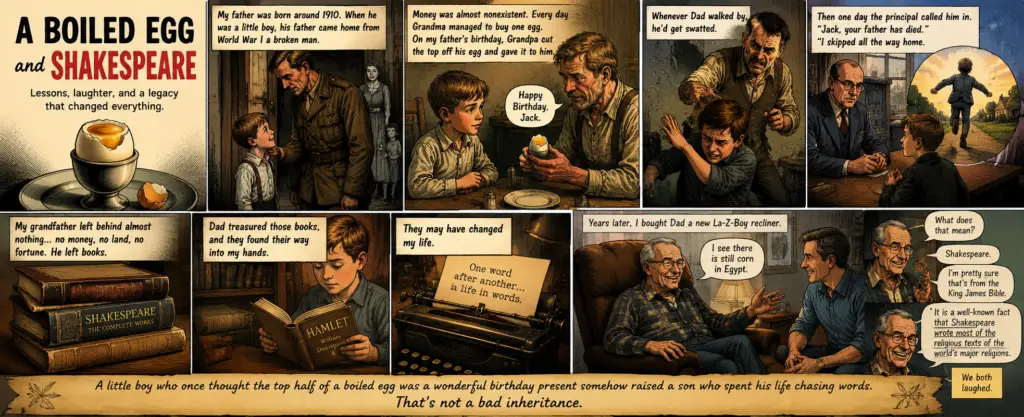
My father was born around 1910. He told me that when he was a little boy, his father came home from the First World War a broken man.
Grandpa carried a piece of shrapnel next to his heart. The doctors said he probably had only a few months to live. I never met him, but from everything I heard, the war had stolen much more than his health.
Money was almost nonexistent.
Every day my grandmother somehow managed to find enough money for one egg. She would boil it and give it to my grandfather.
On my father’s birthday, Grandpa performed a little ceremony.
He cut the top off his boiled egg and handed it to my father.
“Happy Birthday, Jack.”
That was his birthday present.
Dad never forgot it.
Long before Grandpa came home from the war, my father had decided he was the man of the house. He was only a little boy, but with his father overseas, someone had to be in charge. My grandmother and his older sisters let him believe it.
Then one day his father came home.
Dad was thrilled.
It didn’t last.
The man who returned wasn’t the man who had left. He was angry, impatient, and hurting. Dad told me that whenever he walked past his father, there was a good chance he’d get swatted for no particular reason.
Years later, he told me another story that shocked me.
One day the school principal called him into the office.
“Jack, I’m sorry. Your father has died.”
The principal offered to take him home.
Dad said he could make it on his own.
Then he confessed something very few people ever would.
“I skipped all the way home.”
When he first told me that, I didn’t know what to think.
Now I do.
Children don’t celebrate death.
They celebrate the end of fear.
Years passed.
I became a newspaper reporter and eventually made my living by putting one word after another on paper.
I’ve often wondered where that came from.
Then I remembered something.
My grandfather left behind almost nothing.
No money.
No land.
No fortune.
He left books.
Shakespeare.
Dad treasured those old volumes, and eventually they found their way into my hands. I stumbled through Hamlet, Macbeth, and the rest. I didn’t understand half of what I was reading, but I understood enough to know I was listening to one of the greatest writers who ever lived.
Those battered books may have changed my life.
Years later, after I’d been writing professionally for a long time, I bought Dad a brand-new La-Z-Boy recliner.
He looked at it with a smile and said, “I see there is still corn in Egypt.”
“What does that mean?” I asked.
He smiled.
“Shakespeare.”
“I’m pretty sure that’s from the King James Bible.”
He looked at me as though I had a great deal to learn.
“It is a well-known fact,” he said, “that Shakespeare wrote most of the religious texts of the world’s major religions.”
We both burst out laughing.
My father had a wonderful gift.
He could teach me something, make me laugh, and leave me wondering if I’d just been educated or conned.
I’m still not entirely sure.
But I do know this.
A little boy who once thought the top half of a boiled egg was the finest birthday present imaginable somehow grew up to raise a son who spent his life chasing words.
That’s not a bad inheritance.
And every now and then, when I manage to avoid a lexiphanicism, I wonder if somewhere an old soldier who carried a piece of shrapnel beside his heart is smiling.
Or quoting Shakespeare.